August 1, 2026
The Invisible Choke Point: Why Uranium Conversion Is Nuclear Energy's Most Overlooked Vulnerability
Most conversations about nuclear energy security focus on mining output, enrichment capacity, or reactor construction timelines. Far less attention lands on the chemical transformation that sits between these stages — a process so technically demanding and geographically concentrated that a single facility disruption could ripple across the entire U.S. commercial reactor fleet. Uranium conversion is that choke point, and it remains one of the least understood bottlenecks in the civilian nuclear fuel chain.
Understanding why Texas A&M uranium conversion research matters requires first understanding the structural fragility this research is designed to address. Furthermore, the uranium supply challenges that have emerged in recent years make this research all the more critical.
When big ASX news breaks, our subscribers know first
From Yellowcake to Enrichment: The Step Nobody Talks About
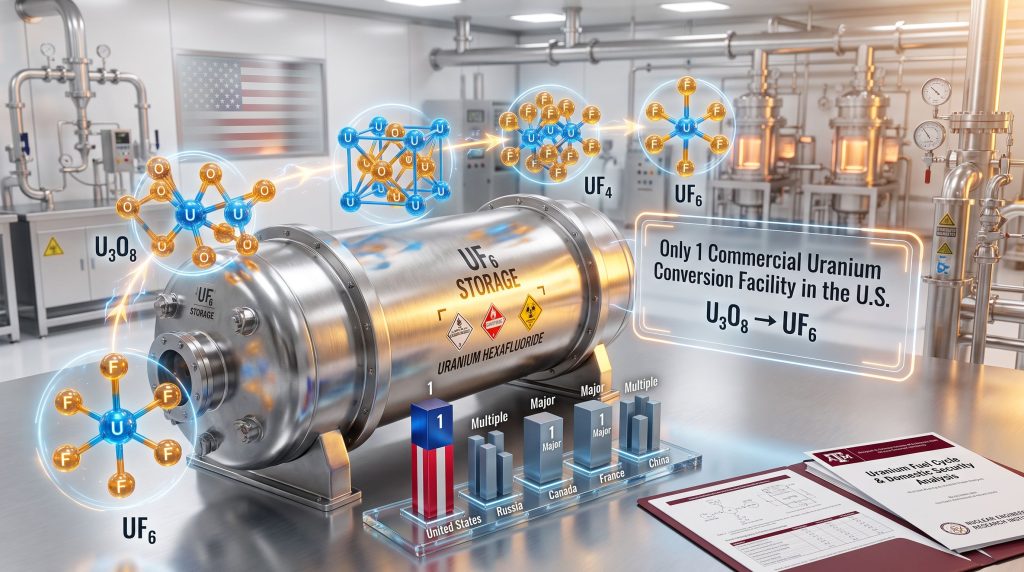
The nuclear fuel cycle is commonly described in terms of its most visible stages: uranium mining, enrichment, and reactor operation. What gets compressed into a single sentence — if mentioned at all — is the conversion step, the chemical process that transforms mined uranium oxide concentrate (U₃O₈, commonly called yellowcake) into uranium hexafluoride (UF6), the gaseous compound that enrichment facilities require as feedstock.
Without UF6, centrifuge enrichment plants cannot operate. Without enrichment, reactor fuel cannot be manufactured. The conversion step is not optional — it is structurally embedded in every pathway from ore to electricity generation.
The chemistry involves four distinct reaction stages:
- Yellowcake preparation — Raw U₃O₈ is dried and refined to remove moisture and trace impurities that would interfere with downstream reactions.
- Reduction to UO₂ — The uranium oxide is chemically reduced using hydrogen gas at elevated temperatures, producing uranium dioxide.
- Hydrofluorination — UO₂ reacts with hydrogen fluoride gas to produce uranium tetrafluoride (UF4), a solid intermediate compound sometimes called green salt.
- Fluorination to UF6 — UF4 reacts with elemental fluorine gas under controlled conditions to yield uranium hexafluoride, which is then condensed into liquid, sampled for purity, and transported to enrichment facilities in pressurised cylinders.
Each stage introduces potential contamination vectors. Trace metals, moisture, and non-uranium fluoride compounds surviving into the final UF6 product can damage enrichment centrifuge bearings, corrode piping, or create complications in laser-based isotope separation systems. Purity is not a preference — it is a technical requirement, and achieving it consistently at commercial scale is the engineering challenge at the core of the Texas A&M uranium conversion research partnership.
One Facility for an Entire Nation: The Scale of U.S. Structural Exposure
The United States currently operates a single commercial uranium conversion facility. Honeywell's Metropolis Works plant in Illinois is responsible for processing yellowcake into UF6 for the full U.S. light water reactor fleet — approximately 94 operating reactors as of recent counts. This creates what engineers and supply chain analysts would recognise as a critical single-point-of-failure risk.
Compare that concentration to the broader global landscape:
| Country / Region | Commercial Conversion Facilities | Primary Operators |
|---|---|---|
| United States | 1 | Honeywell (Metropolis Works, Illinois) |
| Russia | Multiple | TVEL / Rosatom |
| France | 1 major | Orano (Pierrelatte / Tricastin complex) |
| Canada | 1 major | Cameco (Port Hope, Ontario) |
| China | Multiple | CNNC |
Russia's Rosatom has historically provided a substantial share of global enrichment services — and by extension, conversion services — to Western reactor operators. However, the Russian uranium import ban has made that dependency increasingly difficult to ignore as geopolitical conditions shift. France's Orano and Canada's Cameco provide allied-nation alternatives, but Western conversion capacity as a whole remains thin relative to the size of the global reactor fleet it supports.
The consolidation of U.S. conversion capacity reflects decades of post-Cold War market contraction, sustained price pressure from lower-cost international suppliers, and a long decline in domestic uranium mining activity. The result is a supply chain that functions adequately under normal conditions but carries concentrated risk when any single node is disrupted. Consequently, uranium supply-demand volatility continues to be a pressing concern for industry stakeholders.
What the TEES–QLE Research Agreement Actually Involves
The Texas A&M Engineering Experiment Station (TEES) — the applied research division of the Texas A&M University System's engineering programmes — has entered into a research agreement with Quantum Leap Energy (QLE), an Austin, Texas-based subsidiary of ASP Isotopes (ASPI). QLE's focus is narrow and specific: the uranium conversion stage of the nuclear fuel cycle, and specifically the commercial production of high-purity UF6 supply.
It is important to be precise about what this agreement does and does not represent. TEES is not constructing a uranium conversion plant. No commercial production is occurring at the university. The agreement is structured as a scientific and engineering research initiative aimed at generating the physicochemical data and process optimisation insights that would be required to scale UF6 production commercially at a future dedicated facility.
The research scope covers five interconnected areas:
| Research Focus Area | Core Objective |
|---|---|
| Reaction pathway mapping | Characterise the fundamental chemistry of U₃O₈ to UF6 transformation |
| Process efficiency optimisation | Reduce energy and material inputs per unit of high-purity UF6 produced |
| Cost modelling | Identify economic variables relevant to commercial-scale competitiveness |
| Scale-up feasibility assessment | Generate engineering data to bridge lab-scale and industrial-scale operations |
| Output quality refinement | Define and improve the operational parameters that govern UF6 purity consistency |
This research partnership represents a foundational investment in scientific validation before capital is committed to commercial infrastructure — a sequencing discipline that has historically distinguished successful fuel cycle ventures from costly failures.
The HALEU Dimension: Why Conversion Quality Now Determines Advanced Reactor Timelines
The stakes of uranium conversion research extend well beyond the existing light water reactor fleet. The next generation of nuclear reactors — including sodium-cooled fast reactors, high-temperature gas reactors, and certain microreactor designs — requires high-assay low-enriched uranium, or HALEU. HALEU is enriched to uranium-235 concentrations between 10% and 20%, compared to the roughly 3–5% enrichment level used in conventional reactor fuel.
Producing HALEU at commercial volumes requires a reliable upstream conversion chain capable of delivering UF6 at higher purity specifications than standard-grade material. The relationship is direct: conversion quality determines enrichment yield, and enrichment yield determines the commercial viability of HALEU supply agreements. In addition, uranium market pricing trends are increasingly shaped by the availability of advanced fuel cycle services like high-purity conversion.
This is where ASP Isotopes' broader commercial position becomes relevant. In May 2025, ASP Isotopes announced conditional commitments from TerraPower — the Bill Gates-backed advanced reactor company — for a loan to partially finance a uranium enrichment facility in South Africa. Alongside that financing arrangement, the companies reached a HALEU supply agreement structured to support the first fuel core for TerraPower's Natrium fast reactor project in Kemmerer, Wyoming, with supply contemplated over a 10-year period. TerraPower had previously signed a term sheet with ASP Isotopes in October 2024 as the initial step toward this investment relationship.
The Natrium reactor design requires HALEU fuel, and the TerraPower-ASP supply chain pathway runs through the conversion and laser enrichment technology that QLE and ASP Isotopes are developing. High-purity UF6 is not merely a quality preference in this context — it is a technical prerequisite for the laser isotope separation platform that ASP Isotopes is building around.
Laser enrichment technology, unlike centrifuge-based approaches, is particularly sensitive to the chemical composition of its UF6 feedstock. Impurities that might be tolerated in conventional centrifuge cascades can cause disproportionate performance degradation in laser-based systems. Research that improves UF6 purity and consistency therefore expands the viable feedstock options for next-generation enrichment platforms.
Two Very Different Types of Uranium Conversion Research at Texas A&M
Texas A&M has prior history with uranium conversion, but it is a history that differs fundamentally from the current TEES-QLE initiative. The university's research reactor previously underwent a fuel conversion process under programmes administered by the U.S. Department of Energy and the National Nuclear Security Administration. That work involved transitioning the reactor from highly enriched uranium (HEU) fuel to low-enriched uranium (LEU) fuel — a nonproliferation objective designed to reduce the quantity of weapons-usable material in civilian research reactor inventories worldwide.
The current TEES-QLE agreement operates from an entirely different mandate:
| Dimension | Historical HEU to LEU Reactor Conversion | Current TEES-QLE UF6 Research |
|---|---|---|
| Primary goal | Weapons material reduction / nonproliferation | Commercial fuel cycle capacity development |
| Governing authority | DOE / NNSA Reactor Conversion Programme | Private research agreement |
| Research output | Safer reactor operation using LEU fuel | Physicochemical data for UF6 commercial scale-up |
| Fuel cycle position | End-use reactor fuel specification | Pre-enrichment upstream conversion stage |
| Commercial orientation | Indirect | Direct |
Conflating these two research traditions would misrepresent the nature and purpose of the current agreement. The TEES-QLE work is fundamentally oriented toward commercial fuel supply security rather than nonproliferation compliance.
The next major ASX story will hit our subscribers first
The Engineering Challenges That Make This Research Necessary
Scaling UF6 production to commercial volumes is not a straightforward engineering exercise. Several overlapping technical barriers make academic research partnerships like the TEES-QLE agreement a rational precursor to capital investment:
- Corrosion management — Elemental fluorine and hydrogen fluoride are among the most chemically aggressive substances in industrial use. Materials selection for reactor vessels, piping, valves, and instrumentation is a critical engineering challenge.
- Feedstock variability — Yellowcake composition varies meaningfully between different uranium mines and processing facilities. Uranium from in-situ recovery operations differs chemically from conventionally mined and milled uranium, and those differences propagate through the conversion chemistry in ways that must be characterised and managed.
- Energy intensity — High-temperature reduction and fluorination stages consume substantial energy. At commercial volumes, energy cost becomes a meaningful competitive variable, and process optimisation research directly targets this cost driver.
- Regulatory complexity — UF6 production involves radioactive materials, highly toxic fluorine compounds, and pressure vessel systems, placing it under oversight from multiple regulatory bodies.
- Purity control at scale — Maintaining purity specifications across continuous industrial production is fundamentally different from achieving target purity in a laboratory setting.
University Research as a De-Risking Mechanism for Nuclear Fuel Innovation
The TEES-QLE partnership reflects a broader pattern that is becoming more common in advanced nuclear fuel cycle development: private companies using academic research environments to validate the scientific foundations of a commercial process before committing the capital required to build licensed production facilities.
This sequencing makes economic sense. Regulatory agencies require extensive documentation of process chemistry and safety characteristics before approving commercial nuclear fuel cycle facilities. Generating that documentation in a university research setting — where specialised analytical equipment, deep technical expertise, and regulatory frameworks for experimental work are already in place — reduces both the cost and timeline of the pre-licensing phase.
The model also creates durable knowledge assets. Research conducted at TEES generates data, publications, and trained personnel that remain part of the U.S. nuclear engineering knowledge base regardless of the ultimate commercial trajectory of any specific project.
A rebuilt domestic uranium conversion sector would carry consequences well beyond the companies directly involved:
- Reduced exposure to foreign conversion service disruptions for U.S. utility operators
- Lower fuel cycle cost pressure if domestic competition increases conversion market liquidity
- A stronger foundation for HALEU supply chains that advanced reactor programmes depend upon
- Expanded scientific and engineering workforce capacity in a field where expertise has eroded over decades of market contraction
The Road Ahead: From Lab Data to Commercial Production
The pathway from a university research agreement to a functioning commercial UF6 conversion facility spans multiple distinct phases, each with its own capital requirements, regulatory milestones, and technical validation criteria:
- Phase 1 — Physicochemical data collection and reaction pathway characterisation at laboratory scale (current stage under the TEES agreement)
- Phase 2 — Process optimisation modelling informed by Phase 1 data, followed by pilot-scale validation of improved process parameters
- Phase 3 — Engineering design development for a commercial-scale facility, incorporating pilot validation results
- Phase 4 — Regulatory licensing engagement with relevant agencies, facility siting, and construction
- Phase 5 — Commercial UF6 production and integration as a supply source within the domestic nuclear fuel chain
Each phase represents a discrete investment decision point. The Texas A&M uranium conversion research currently underway is designed to de-risk Phase 1 and generate the data required to support credible Phase 2 and 3 planning. That is a less dramatic milestone than breaking ground on a production facility, but it is the milestone that makes all subsequent phases possible.
This article is intended for informational purposes only and does not constitute financial or investment advice. Readers should conduct their own due diligence before making investment decisions. Forward-looking statements regarding timelines, commercial outcomes, and supply agreements are subject to material uncertainties and may not be realised.
For ongoing coverage of uranium conversion research, advanced reactor fuel developments, and nuclear energy policy, the American Nuclear Society's Nuclear Newswire at ans.org/news provides regularly updated reporting from across the nuclear sector.
Want to Capitalise on the Next Major Uranium Discovery Before the Broader Market?
Discovery Alert's proprietary Discovery IQ model delivers real-time alerts on significant ASX mineral discoveries — including uranium — instantly transforming complex data into actionable investment insights for both short-term traders and long-term investors. Explore how historic discoveries have generated substantial returns on Discovery Alert's dedicated discoveries page, and begin your 14-day free trial today to position yourself ahead of the market.