July 31, 2026
Inside the Mechanics of ISR: Why Freeze Walls and Underground Chemistry Are Reshaping Uranium Production
The economics of uranium extraction are undergoing a quiet structural shift. While the world's attention gravitates toward uranium market dynamics and reactor construction pipelines, a less-discussed transformation is happening underground: the gradual displacement of conventional excavation techniques by in-situ recovery (ISR) methodologies that dissolve ore bodies in place, extract mineralised solution at surface, and leave the geology largely intact. For investors and industry observers tracking the nuclear fuel supply chain, understanding this technical shift is as important as tracking spot prices.
The confirmation that Phoenix uranium project construction begins in full-scale mode at Denison Mines' Wheeler River property in northern Saskatchewan represents more than a single project milestone. It signals that ISR technology, long proven in Kazakhstan and the American southwest, is now entering Canada's highest-grade uranium jurisdiction at commercial scale for the first time.
When big ASX news breaks, our subscribers know first
What Makes the Athabasca Basin Geologically Exceptional
Northern Saskatchewan's Athabasca Basin holds a disproportionate share of the world's known high-grade uranium resources. The basin's mineralisation is characterised by unconformity-type deposits, which form at the boundary between ancient Proterozoic sandstone and underlying crystalline basement rocks. This geological setting concentrates uranium into exceptionally narrow but extraordinarily high-grade ore lenses, with grades routinely measured in the tens of thousands of parts per million, compared to global averages often below 1,000 ppm at conventional uranium operations.
The Phoenix deposit, located within the Wheeler River property, sits within this framework. What distinguishes Phoenix from neighbouring Athabasca Basin giants like Cigar Lake and McArthur River is not its grade profile alone, but its geometry: the ore body is positioned at a depth and configuration that makes conventional underground development technically complex and capital intensive. This is precisely why ISR was selected as the extraction method, and why that selection carries significant implications for the project's cost structure and environmental footprint.
How In-Situ Recovery Actually Works at the Deposit Level
ISR at a high-grade unconformity deposit like Phoenix differs materially from the ISR operations more commonly associated with sandstone-hosted uranium deposits in Wyoming or Kazakhstan. In sandstone ISR, a mildly acidic or alkaline solution is circulated through permeable host rock to leach uranium in place. Furthermore, the in-situ leaching benefits at Phoenix extend beyond simple extraction efficiency, given the high-grade nature of the mineralisation and the hydrogeological complexity of the Athabasca Basin, which require an additional engineering control: the perimeter freeze wall.
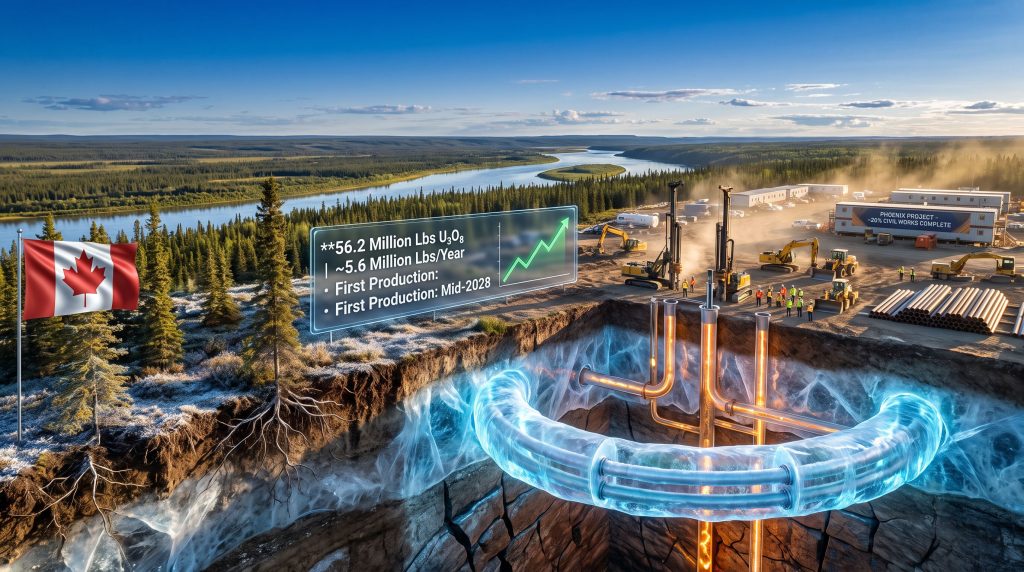
A freeze wall works by circulating refrigerant fluid through a network of drilled pipes positioned around the perimeter of the ore zone. The surrounding groundwater freezes, forming an impermeable subsurface barrier that isolates the leach field from adjacent aquifers. This containment system allows the uranium-bearing leach solution to be circulated within the ore body, collected, pumped to surface, and processed without the risk of mineralised fluid migrating laterally into the broader groundwater system.
Technical Note: The freeze wall approach at Phoenix is a first-of-kind application for high-grade unconformity uranium ISR in Canada. Its success or failure as an engineering solution will have direct implications for how other Athabasca Basin deposits with similar geometries are evaluated for future ISR development.
Phase 1 freeze wall installation commenced in July 2026, coinciding with the transition to full-scale construction. This sequencing is deliberate: the freeze infrastructure must be established and proven before leaching operations can begin, making it one of the most technically critical components of the entire construction programme.
The Phoenix Construction Timeline: Progress and Targets
Denison reports readiness to commence construction of its flagship Phoenix ISR project, having reached its Final Investment Decision in February 2026, with site preparation beginning the following month. By late July 2026, Denison confirmed the transition to full-scale construction, with civil works more than 20% complete and the site camp expanded to accommodate approximately 400 workers.
| Milestone | Date / Period |
|---|---|
| Final Investment Decision | February 2026 |
| Site preparation commences | March 2026 |
| Full-scale construction confirmed | July 28, 2026 |
| Phase 1 freeze wall installation begins | July 2026 |
| Targeted first production | Mid-2028 |
| Initial mine life | 10 years |
The 400-worker camp capacity reflects the labour intensity of this construction phase, which encompasses civil infrastructure, freeze wall drilling, wellfield installation, and surface processing facilities. For a project of this technical novelty, the workforce scale also implies substantial local and regional economic activity in northern Saskatchewan.
Production Profile: Contextualising 56.2 Million Pounds
The Phoenix project carries a projected lifetime output of 56.2 million pounds of triuranium octoxide (U₃O₈) across a 10-year initial mine life, implying an average annual production rate of approximately 5.6 million pounds U₃O₈. To appreciate what this number means within the Canadian uranium sector, it helps to compare Phoenix against the operations that currently define production benchmarks in the country.
| Project / Operation | Operator | Estimated Annual Output | Method |
|---|---|---|---|
| Cigar Lake | Cameco / Orano | ~18 million lbs U₃O₈ | Underground |
| McArthur River | Cameco | ~18 million lbs U₃O₈ | Underground |
| Phoenix (projected) | Denison Mines | ~5.6 million lbs U₃O₈ | ISR |
While Phoenix's annual output is a fraction of Cigar Lake or McArthur River, the structural comparison is misleading if taken at face value. Those underground operations reflect decades of capital investment, deep shaft infrastructure, and the physical movement of high-grade ore to surface milling facilities. Phoenix, by contrast, is designed to produce uranium without excavating rock, with the leaching and ion exchange processing occurring largely above ground. The capital cost model and the operational cost curve for ISR are structurally different from underground mining, which is relevant to how investors should evaluate project economics across a uranium portfolio.
Why the Mid-2028 Production Target Is Strategically Timed
The uranium market entered a new contracting cycle beginning in 2023, driven by utilities that had run down inventory following the post-Fukushima period of suppressed demand and that were now facing reactor fleet expansions requiring long-term fuel supply security. Consequently, uranium supply-demand volatility reflected this shift, with significant price appreciation from the lows of the 2018–2020 period.
A new production source entering the market in mid-2028 positions Phoenix to supply into what many market observers anticipate will be a structurally tighter supply environment. New reactor construction programmes in the United States, the United Kingdom, and across Asia, combined with the accelerating deployment pipeline for small modular reactors (SMRs), are creating forward demand that existing production capacity may struggle to fully meet. SMRs in particular represent a qualitatively different demand driver: they are designed for deployment in jurisdictions and at scales where large conventional reactors have historically been impractical, broadening the potential universe of uranium consumers.
Market Context: Uranium contracting cycles typically move slowly, with utilities signing multi-year agreements years in advance of delivery requirements. A mine targeting mid-2028 first production is entering the market at a point when utilities contracting for 2028–2032 delivery would currently be seeking supply. This timing is commercially relevant, not incidental.
Regulatory Architecture Supporting the Phoenix Build
The Phoenix project holds two distinct regulatory clearances that together underpin the legality of the current construction activity:
-
Saskatchewan provincial environmental assessment approval, which addressed the project's surface and groundwater impacts, waste management, site remediation obligations, and indigenous consultation requirements under provincial law.
-
Canadian Nuclear Safety Commission (CNSC) Licence to Prepare Site and Construct, which is the federal nuclear regulator's authorisation specifically permitting the physical preparation and construction of a nuclear facility. This licence is distinct from a future operating licence, which the CNSC would issue separately prior to commissioning.
The dual-jurisdiction nature of uranium project approvals in Canada reflects the overlap between provincial resource management authority and federal nuclear regulation. For project developers, navigating both successfully before construction commences materially reduces timeline risk, as outstanding regulatory processes are often the single largest source of construction schedule uncertainty for resource projects.
Broader Canadian Mining Sector Developments Shaping the Context
The Phoenix uranium project construction begins against a backdrop of several other significant sector developments that collectively illustrate the diversity and dynamism of Canadian mining in mid-2026.
Quebec's Filon Programme and Permitting as a Competitive Variable
Quebec's newly launched Filon initiative has selected Troilus Mining's copper-gold project as one of its inaugural recipients of specialised programme support. Filon assigns dedicated mining experts to navigate government agency coordination and identify specific permitting bottlenecks that can add months or years to project timelines. Troilus had already submitted an environmental assessment in 2025 and secured a 70-megawatt hydroelectric power allocation from Hydro-Québec, placing it at an advanced stage of pre-development.
The Filon programme reflects a broader recognition within Canadian provincial governments that permitting timelines, rather than resource endowment, are increasingly the binding constraint on new mine development. For investors evaluating Canadian mining equities, permitting velocity is becoming a meaningful differentiator between projects on comparable development trajectories.
The Caribou Mine Acquisition: Distressed Asset Recycling in New Brunswick
Canadian Copper's acquisition of the idled Caribou mine in New Brunswick for $6.2 million illustrates a distinct value pathway that emerges from corporate insolvency in the mining sector. The Caribou site entered government receivership in 2023 following Trevali Mining's New Brunswick division insolvency, leaving behind processing infrastructure that Canadian Copper now intends to repurpose.
The strategic logic is asset-light capital deployment: rather than constructing a new mill for its Murray Brook copper-zinc-silver-lead project, Canadian Copper acquires existing processing capacity at a fraction of replacement cost. Murray Brook development is targeted to begin in 2027, with Caribou mill processing commencing in 2028, subject to environmental approval. This sequencing demonstrates how distressed asset acquisition can compress the capital intensity of bringing a new mining operation online.
Critical Minerals Trade Policy: The Supply Chain Interdependency Problem
British Columbia's mining sector has raised substantive concerns about proposals to restrict American access to Canadian critical minerals as a response to tariff measures. The technical argument centres on integrated cross-border supply chains that do not respect the logic of resource nationalism. Teck Resources' Trail smelter in southern British Columbia, which processes zinc and lead ore originating from the Red Dog mine in Alaska, is a concrete example: restricting ore flows in either direction would harm both Canadian processing capacity and American mining output simultaneously.
This debate highlights a structural feature of North American minerals processing that is not widely appreciated: many of the most economically significant mineral supply chains are deeply integrated across the Canada-U.S. border, and unilateral policy interventions carry the risk of damaging domestic industry more than the intended target.
Rock Tech Lithium's Georgia Lake Offtake: Battery Materials Supply Chain Building
Rock Tech Lithium's seven-year offtake agreement with Transamine for spodumene concentrate from the Georgia Lake project in northern Ontario adds another layer to Canada's battery materials supply chain development. Deliveries are structured to begin at 50,000 dry tonnes in 2028, scaling to 100,000 tonnes annually thereafter.
A notable flexibility provision allows the agreement to be amended so that Transamine receives battery-grade lithium hydroxide monohydrate or lithium carbonate instead of raw concentrate, if Rock Tech directs Georgia Lake output to its planned Red Rock converter facility in Ontario. This optionality reflects the commercial uncertainty around converter capacity timelines and provides both parties with structural flexibility as the lithium processing landscape evolves.
The next major ASX story will hit our subscribers first
Frequently Asked Questions: Phoenix Uranium Project Construction
What extraction method does Phoenix use?
Phoenix uses in-situ recovery (ISR), circulating a leaching solution through the underground ore zone to dissolve uranium, which is then pumped to surface for processing without conventional rock excavation.
What is a perimeter freeze wall and why is it used at Phoenix?
A freeze wall is a subsurface containment barrier created by circulating refrigerant through drilled pipes to freeze surrounding groundwater into an impermeable boundary. At Phoenix, it isolates the uranium leach zone from adjacent aquifers, providing both environmental protection and operational containment for the leach solution.
When will Phoenix first produce uranium?
First production is targeted for mid-2028, following full-scale construction that commenced in July 2026.
How much uranium will Phoenix produce over its mine life?
The project is projected to produce 56.2 million pounds of U₃O₈ across a 10-year initial mine life, at an implied average annual rate of approximately 5.6 million pounds.
What regulatory approvals does the project hold?
Phoenix holds Saskatchewan provincial environmental assessment approval and a Canadian Nuclear Safety Commission Licence to Prepare Site and Construct.
How many workers will be at the Phoenix site during construction?
Site camp capacity has been expanded to accommodate approximately 400 workers during the active construction phase.
Key Takeaways for Investors and Industry Observers
-
Phoenix represents the first large-scale application of ISR technology to a high-grade unconformity uranium deposit in Canada, making it a genuinely novel engineering undertaking with sector-wide implications.
-
The perimeter freeze wall is the single most technically critical and closely watched component of the construction programme; its performance will inform how the broader industry evaluates ISR feasibility across the Athabasca Basin.
-
With more than 20% of civil works complete and camp capacity expanded to 400 workers as of late July 2026, the project is progressing on a schedule consistent with the mid-2028 first production target.
-
Understanding spot versus term pricing is essential context for evaluating Phoenix's commercial timing, as Phoenix's production entry in 2028 aligns with a period when uranium utilities are actively contracting for medium-term supply.
-
The dual provincial-federal regulatory clearance already in hand reduces the construction timeline risk that has historically been the largest source of schedule uncertainty for Canadian uranium projects.
-
For those interpreting drill results and evaluating exploration-stage assets nearby, Phoenix's operational progress provides a practical benchmark for ISR feasibility in high-grade unconformity settings.
-
Broader Canadian sector activity, from Quebec's Filon programme to lithium offtake structuring and base metals asset recycling, reflects a mining landscape where permitting velocity, capital efficiency, and supply chain integration are increasingly the decisive competitive variables.
This article contains forward-looking statements and projections based on publicly available information as of July 2026. Production timelines, output estimates, and market projections are subject to change based on operational, regulatory, and market developments. Nothing in this article constitutes financial or investment advice.
Ready to Identify the Next Major Uranium Discovery Before the Market Does?
Discovery Alert's proprietary Discovery IQ model scans ASX announcements in real time, instantly flagging significant mineral discoveries — including uranium — and turning complex data into actionable insights for both short-term traders and long-term investors. Explore Discovery Alert's dedicated discoveries page to see how historic mineral discoveries have generated substantial returns, and begin your 14-day free trial today to position yourself ahead of the market.