July 30, 2026
The Geology Beneath the Strategy: What Makes Russia's Shirondukuyskoye Uranium Deposit Unusual
Most discussions about uranium supply focus on the front end of the nuclear fuel cycle: enrichment capacity, conversion facilities, and reactor construction pipelines. Far less attention is paid to the mine-level decisions that determine whether those downstream systems ever receive a reliable feedstock. Yet it is precisely at the mine development stage where long-term supply trajectories are locked in, sometimes a decade before a single kilogram of uranium reaches a conversion plant.
The Shirondukuyskoye uranium deposit in eastern Siberia represents one of the more instructive examples of how resource-holding nations are making those upstream decisions today. Its development, driven by Rosatom's mining subsidiary, offers a window into Russia's thinking about uranium self-sufficiency, the technical challenges of underground hard-rock uranium mining, and the strategic logic of expanding production capacity well in advance of anticipated demand increases.
When big ASX news breaks, our subscribers know first
Understanding the Streltsovsky Uranium Ore District
To understand the significance of Shirondukuyskoye uranium deposit development, it helps to first understand the district in which it sits. The Streltsovsky uranium ore district in Zabaykalsky Krai, eastern Siberia, is one of the most important uranium-producing regions in Russia. Centred near the city of Krasnokamensk, the district has been the backbone of Russian domestic uranium mining for decades.
Krasnokamensk, located in the far south-east of the Zabaykalsky region close to the Chinese and Mongolian borders, is often described as Russia's uranium capital. The city and its surrounding mining infrastructure were purpose-built during the Soviet era to support uranium extraction, and they continue to anchor Russia's domestic supply base today.
The Shirondukuyskoye deposit sits approximately 8 kilometres from Krasnokamensk, placing it firmly within the established operational and logistical infrastructure of the Streltsovsky district. This proximity matters more than it might initially appear: access to existing processing facilities, skilled labour, surface infrastructure, and regulatory familiarity significantly reduces the capital intensity and timeline risk of bringing a new deposit into production compared to developing a greenfield site in an isolated location.
What Distinguishes Shirondukuyskoye Geologically
One of the less commonly discussed aspects of the Shirondukuyskoye deposit is its co-deposit character. Unlike a pure uranium deposit, Shirondukuyskoye hosts both uranium and molybdenum mineralisation, classified as a molybdenum-uranium deposit. This distinction carries meaningful implications for both mine economics and processing design.
Co-deposits of this type are geologically linked to hydrothermal or metasomatic processes in which uranium and molybdenum are co-precipitated or sequentially deposited within the same host rock environment. The presence of molybdenum alongside uranium can complicate ore processing if the two minerals require different metallurgical pathways, but it can also provide supplementary revenue streams that improve overall project economics. The geology of uranium deposits more broadly reveals how such co-mineralisation patterns arise across different tectonic settings worldwide.
The confirmed reserve figures reported for Shirondukuyskoye reflect the deposit's scale:
| Resource | Reported Reserve Volume |
|---|---|
| Uranium (C1/C2 Category) | ~8,000 tonnes |
| Molybdenum | ~40 tonnes |
| Target Annual Uranium Output | ~400 tonnes/year |
| Planned Production Start | 2028 |
| Licence Acquired | February 2025 |
At a target extraction rate of approximately 400 tonnes of uranium per year, the deposit's uranium reserves represent roughly a 20-year mine life at steady-state production, though actual mine life depends heavily on resource confidence, recovery rates, and future exploration results.
Russia's C1/C2 Reserve Classification: What It Means in Practice
The C1/C2 classification system used in Russia is a legacy of Soviet-era geological reporting standards and is not directly equivalent to the JORC or NI 43-101 codes used in Australia, Canada, and other Western jurisdictions. Understanding these distinctions is important for any analyst comparing Russian uranium projects with international peers.
Russia's C1 and C2 reserve categories broadly correspond to "Measured and Indicated" or "Reasonably Assured" classifications under international frameworks such as JORC and CRIRSCO, providing a workable basis for cross-jurisdictional comparison, though methodological differences in estimation practice remain.
In practical terms:
- C1 reserves are considered the highest-confidence category, roughly analogous to "Measured" resources under JORC, supported by detailed drilling, sampling, and geophysical data.
- C2 reserves represent a step down in confidence, roughly corresponding to "Indicated" resources, where geological continuity is inferred from wider-spaced data.
- Both categories are considered sufficiently reliable to support feasibility-level mine planning and capital commitment decisions under Russian regulatory frameworks.
The fact that Shirondukuyskoye's 8,000-tonne uranium reserve is reported within the C1/C2 categories signals that the deposit has progressed well beyond early-stage exploration and into a phase where resource confidence supports engineering design and investment decisions. Furthermore, understanding global uranium reserves helps contextualise where Russia's domestic resource base sits relative to other major uranium-holding nations.
The Operators: Rosatom Nedra and PIMCU
The development of Shirondukuyskoye is driven by Priargunsky Industrial Mining and Chemical Union (PIMCU), which operates as the project operator and sits within Rosatom Nedra, the mining arm of Russia's state nuclear corporation Rosatom. PIMCU has deep historical roots in the Streltsovsky district, having operated uranium mines in the Krasnokamensk region for several decades.
This institutional continuity provides the project with significant operational advantages. PIMCU's workforce already has experience with the specific geological and geotechnical conditions of the Streltsovsky district. Its regulatory relationships with Russian mining authorities, including Glavgosexpertiza (Russia's state design review authority) and Rosnedra (the federal subsoil use agency), are long-established, which streamlined the approval pathway for the Shirondukuyskoye licence acquired in February 2025.
Rosatom Nedra's broader mandate is explicitly tied to Russia's nuclear energy security. The organisation's stated priority is expanding Russia's domestic uranium mineral resource base to satisfy the fuel requirements of the Russian nuclear power fleet, which comprises one of the largest operating reactor inventories in the world. In addition, the intersection of uranium and nuclear growth investment themes underscores why state-backed entities are accelerating upstream mine development at this particular juncture.
Underground Progress: The Significance of the 3-Kilometre Milestone
The most recent operational update from the Shirondukuyskoye project confirms that underground crews from PIMCU completed 3 kilometres of mine workings ahead of the originally scheduled target date of 10 August. While this may sound like a purely logistical achievement, it carries deeper technical significance.
The breakthrough in question connected two previously separate sections of the mine at the fourth level, a development that fundamentally altered the operational geometry of underground operations in several ways:
- Ventilation optimisation: Underground mines, particularly those extracting radioactive ores, require continuous and reliable airflow management. At the fourth level, the connection created a through-ventilation circuit, significantly improving air quality and reducing the risk of radon accumulation, which is a primary occupational hazard in uranium mining environments.
- Rock mass logistics: The physical connection between the two fourth-level sections now allows for more efficient movement of broken rock (ore and waste) to surface infrastructure, reducing haulage cycle times and improving overall mining productivity.
- Safety architecture: Single-access mine sections present evacuation risks in emergency scenarios. The completed breakthrough provides a secondary egress pathway for workers at the fourth level, which is a critical mine safety requirement under Russian underground mining regulations.
PIMCU's CEO Ivan Kiselev described the completed underground connection as fundamentally restructuring both the logistics and safety profile of fourth-level operations, characterising it as the foundational infrastructure required for the smooth long-term development of the Shirondukuyskoye field and its role in supporting Russia's energy security objectives. Rosatom's eastern Siberia expansion is consistent with broader targets the organisation has set for domestic uranium output through the end of the decade.
The next major ASX story will hit our subscribers first
The Production Timeline: Phases and Milestones
How Is Development Structured?
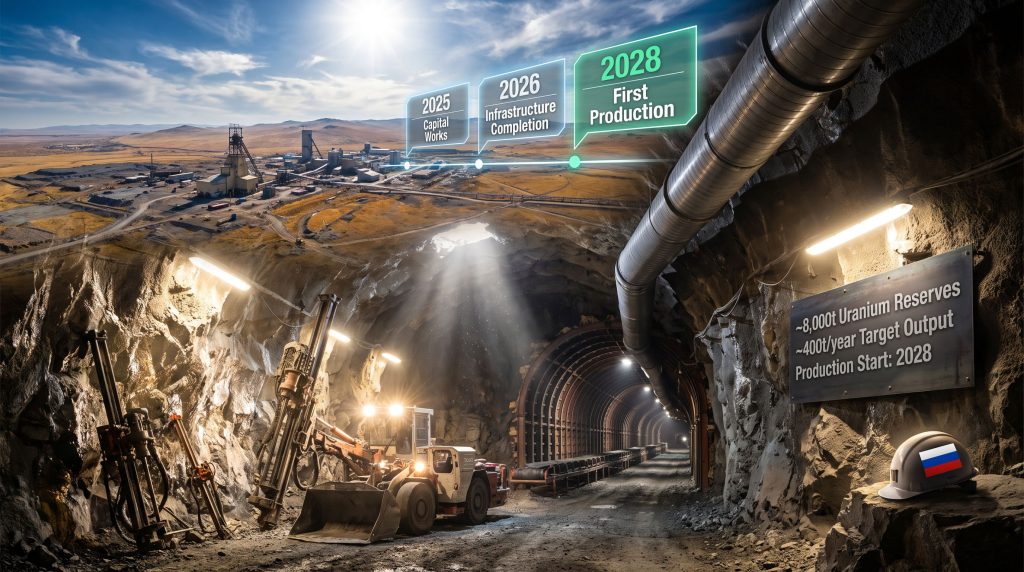
The development schedule for Shirondukuyskoye uranium deposit development is structured across three broad phases:
Phase 1 (2025 to 2026): Surface infrastructure development running in parallel with continued underground capital mining works. This phase includes the construction of ore handling facilities, surface ventilation upgrades, and further underground level development below the fourth level.
Phase 2 (Target completion: 2026): Completion of the bulk of capital mining work. Rosatom Nedra has stated that the primary objective for this period is finalising the underground infrastructure required to support continuous ore extraction, including ore passes, pump chambers, and permanent ventilation installations.
Phase 3 (Target: 2028): First uranium extraction and ramp-up toward the target annual production rate of approximately 400 tonnes of uranium per year.
Some secondary sources have referenced a 2027 production start for Shirondukuyskoye. However, the most detailed technical reporting from Rosatom Nedra consistently points to 2028 as the realistic first-production year, with capital works scheduled for completion through 2026. The 2027 references are likely based on earlier preliminary projections rather than confirmed engineering milestones.
Shirondukuyskoye in Russia's Wider Uranium Development Pipeline
The Shirondukuyskoye project does not operate in isolation. It is part of a broader strategy by Rosatom Nedra to expand Russia's domestic uranium production capacity ahead of rising internal demand from new reactor builds and the extended operation of existing plants.
| Project | Status | Key Reserve Feature | Target Output |
|---|---|---|---|
| Shirondukuyskoye | Capital works underway | 8,000t U + Mo co-deposit | ~400t U/year from 2028 |
| Elkon | Emerging from hibernation | Largest U reserves in Russia | To be determined |
| Dobrovolnoye | First product shipped | Early-stage active production | Active |
The Elkon project, located in the Sakha Republic (Yakutia), is particularly significant. It reportedly holds the largest uranium reserve base of any single project in Russia, but has remained undeveloped for many years due to its remote location and the infrastructure investment required. Rosatom Nedra has indicated plans to revive the Elkon development as part of its longer-term resource expansion strategy.
Meanwhile, the Dobrovolnoye deposit has already shipped its first uranium product, representing the near-term production horizon within Rosatom Nedra's portfolio. Together, these three projects reflect a deliberate sequencing of Russia's uranium supply pipeline: Dobrovolnoye providing near-term output, Shirondukuyskoye targeting medium-term production from 2028, and Elkon representing the long-term reserve base.
Geopolitical and Supply Chain Dimensions
How Does Geography Shape Supply Strategy?
The geographic positioning of Shirondukuyskoye and the broader Krasnokamensk mining district in eastern Siberia is worth noting from a supply chain perspective. The region's proximity to the Chinese and Mongolian borders places it within a geographic corridor that is increasingly relevant to Asian nuclear energy markets.
Russia's nuclear fuel cycle is highly vertically integrated through Rosatom, spanning uranium mining, conversion, enrichment, fuel fabrication, and reactor technology. The expansion of domestic uranium mining at sites like Shirondukuyskoye feeds directly into this integrated model, reducing Russia's dependence on uranium imports and reinforcing the economics of downstream fuel cycle operations.
For Western uranium market observers, Russia's sustained investment in domestic mining capacity during a period when global uranium demand is rising offers a structural lesson. Consequently, understanding uranium supply and demand dynamics helps explain why decisions made today will determine market balances in the mid-2030s and beyond. The lead times involved in bringing new uranium mines into production, typically seven to twelve years from discovery to first output, are a critical variable in that equation.
However, for investors tracking these developments, the divergence between spot and term prices often reflects how the market is pricing in exactly these kinds of long-dated supply additions. Furthermore, the broader uranium market dynamics at play in 2025 suggest that upstream mine development decisions are receiving greater scrutiny from institutional capital than at any point in the previous decade.
Frequently Asked Questions About the Shirondukuyskoye Uranium Deposit
What Type of Uranium Deposit Is Shirondukuyskoye?
It is a molybdenum-uranium co-deposit, meaning it contains economically meaningful concentrations of both uranium and molybdenum within the same mineralised system.
Where Is It Located?
The deposit sits within the Streltsovsky uranium ore district in Zabaykalsky Krai, eastern Siberia, approximately 8 kilometres from the city of Krasnokamensk.
How Large Are the Uranium Reserves?
Rosatom Nedra reports uranium reserves of approximately 8,000 tonnes in the C1/C2 categories, alongside approximately 40 tonnes of molybdenum reserves.
When Will Production Begin?
The target production start is 2028, following completion of bulk capital mining works scheduled through 2026.
Who Holds the Operating Licence?
PIMCU, a subsidiary of Rosatom Nedra, acquired the operating licence in February 2025 and serves as the project operator.
What Is the Annual Uranium Production Target?
Rosatom Nedra has stated a target of approximately 400 tonnes of uranium per year once steady-state production is achieved.
What Is the Streltsovsky Uranium Ore District?
It is one of Russia's primary uranium mining regions, centred near Krasnokamensk in eastern Siberia. The district has been the core of Russian domestic uranium production for several decades and hosts multiple operating and development-stage uranium deposits.
How Does Shirondukuyskoye Support Russia's Energy Security?
By adding new domestic uranium production capacity, the project contributes to reducing reliance on imported uranium feedstock and supports the continuous fuel supply requirements of Russia's nuclear power fleet.
What the Ahead-of-Schedule Progress Reveals
In capital-intensive mining projects, schedule slippage is far more common than early delivery. The completion of 3 kilometres of mine workings ahead of the August 2025 target date is therefore notable not just as a project milestone, but as a signal about execution culture and operational capability within PIMCU and Rosatom Nedra more broadly.
For Russia's nuclear fuel cycle planners, on-schedule or ahead-of-schedule underground development at Shirondukuyskoye uranium deposit development reduces the risk of supply gaps emerging in the late 2020s, when domestic reactor demand is projected to grow alongside Russia's ambitious new nuclear build programme. The Krasnokamensk district's expanding resource base, encompassing both existing operations and the Shirondukuyskoye development, positions the region as the enduring centrepiece of Russia's uranium production geography for the decades ahead.
Disclaimer: This article contains forward-looking statements and projections related to mining timelines, production targets, and resource development plans. These are based on publicly available information from Rosatom Nedra and related sources and are subject to change based on technical, regulatory, and market conditions. This article does not constitute financial or investment advice.
Want to Track the Next Major Mineral Discovery Before the Market Moves?
Discovery Alert's proprietary Discovery IQ model delivers real-time alerts on significant ASX mineral discoveries, instantly converting complex geological data into actionable investment insights for both short-term traders and long-term investors — explore historic discoveries and their returns to understand the scale of opportunity, then begin your 14-day free trial at Discovery Alert to position yourself ahead of the broader market.