July 28, 2026
The Race to Refill the Uranium Supply Gap: Why Canada's Next Mine Matters Now
Nuclear energy has quietly re-emerged as one of the most contested and consequential topics in global energy planning. After decades of stagnation following the Fukushima disaster in 2011, uranium demand is accelerating again as governments across the United States, Europe, Japan, and South Korea revisit nuclear power as a low-carbon baseload solution. Yet the supply side has struggled to keep pace, and uranium supply-demand volatility has intensified as years of underinvestment, mine closures, and project delays have created a structural deficit. Into this environment steps the Denison Phoenix uranium project construction, now actively underway in northern Saskatchewan, representing the most significant new Canadian uranium mine development in well over a generation.
Understanding what makes Phoenix genuinely different requires looking beyond the headlines and into the geology, the technology, and the regulatory milestones that have brought this project to the construction phase.
When big ASX news breaks, our subscribers know first
What Makes the Athabasca Basin the World's Premier Uranium Address
Not all uranium is created equal. The Athabasca Basin in northern Saskatchewan sits at the apex of global uranium geology, hosting ore grades that can be ten to one hundred times higher than the global average for uranium deposits. While the average open-pit uranium mine worldwide might process ore grading around 0.1% U₃O₈, Athabasca Basin deposits routinely exceed grades of 1%, with some zones reaching far higher concentrations.
This extraordinary grade profile is the product of specific geological conditions: unconformity-related uranium deposits formed at the boundary between ancient Proterozoic sandstone and underlying basement rocks. Hydrothermal fluids carried dissolved uranium through permeable sandstone, where chemical reducing conditions caused uranium to precipitate in highly concentrated zones over hundreds of millions of years.
The Phoenix deposit sits within the Wheeler River project, surrounded by an established producing ecosystem. Cigar Lake, jointly operated by Cameco and Orano Canada, reached commercial production in 2015 and remains one of the highest-grade uranium mines on Earth. McArthur River, also in the Basin and restarted in 2022, holds comparable status. Phoenix's location within this proven district provides meaningful geological and infrastructure context, even as its chosen extraction methodology sets it apart fundamentally from its neighbours.
Furthermore, understanding the distribution of global uranium reserves helps contextualise why Athabasca Basin projects command such significant attention from both utilities and investors worldwide.
In-Situ Recovery: A Technically Novel Approach to High-Grade Uranium
How Does ISR Differ From Conventional Mining?
The defining technical characteristic of the Denison Phoenix uranium project construction program is its reliance on in-situ recovery, known in the industry as ISR. This method is radically different from how Cigar Lake or McArthur River extract uranium, and understanding the distinction is essential for evaluating Phoenix's risk and reward profile.
Conventional Athabasca Basin uranium mines use underground mining methods adapted to extreme radiological and geotechnical conditions. Cigar Lake famously employs jet boring, using high-pressure water jets operated remotely to excavate the ore face while ground freezing stabilises the surrounding rock. The mined slurry is then pumped to surface. This approach works but requires substantial underground infrastructure, freeze plant capacity, and radiation management protocols.
ISR takes an entirely different path:
- A network of injection and extraction wells is drilled into the uranium-bearing orebody from surface.
- A chemically adjusted solution, typically acidic or alkaline depending on ore mineralogy, is injected to dissolve uranium directly within the rock.
- The uranium-bearing solution, called pregnant leach solution, is pumped back to surface through recovery wells.
- The solution is processed at a surface plant to extract and refine uranium product.
- The barren solution is re-conditioned and recirculated back into the orebody.
ISR is the dominant mining method in Kazakhstan, which accounts for roughly 45% of global uranium production, and is also widely used in uranium districts of the United States, Uzbekistan, and China. The in-situ leaching benefits include lower capital intensity, reduced surface disturbance, minimal waste rock generation, and lower radiation exposure for workers compared to underground mining.
What Engineering Challenges Does Phoenix Face?
However, applying ISR to Athabasca Basin-style high-grade deposits introduces engineering challenges that have no direct commercial precedent at scale. The primary concerns involve:
- Groundwater containment: High-grade Athabasca deposits often sit near or within permeable sandstone aquifers. Preventing the pregnant leach solution from migrating beyond the target orebody requires highly effective hydraulic control.
- Freeze wall technology: Phoenix's design incorporates a perimeter freeze wall, which uses refrigeration systems to freeze the surrounding ground, creating an ice barrier that confines the leach solution within the orebody zone. This is a sophisticated adaptation of ground freezing techniques borrowed from underground mining engineering.
- Solution chemistry management: The geochemistry of Athabasca Basin ore is more complex than typical ISR deposits in sedimentary basins, requiring careful solution chemistry calibration to achieve efficient uranium dissolution without mobilising unwanted elements.
The freeze wall at Phoenix is not merely a safety measure but a core process engineering component. Its successful installation and long-term performance will be one of the most closely watched technical variables as the project advances toward first production.
Denison Phoenix Uranium Project Construction: Current Status and Milestones
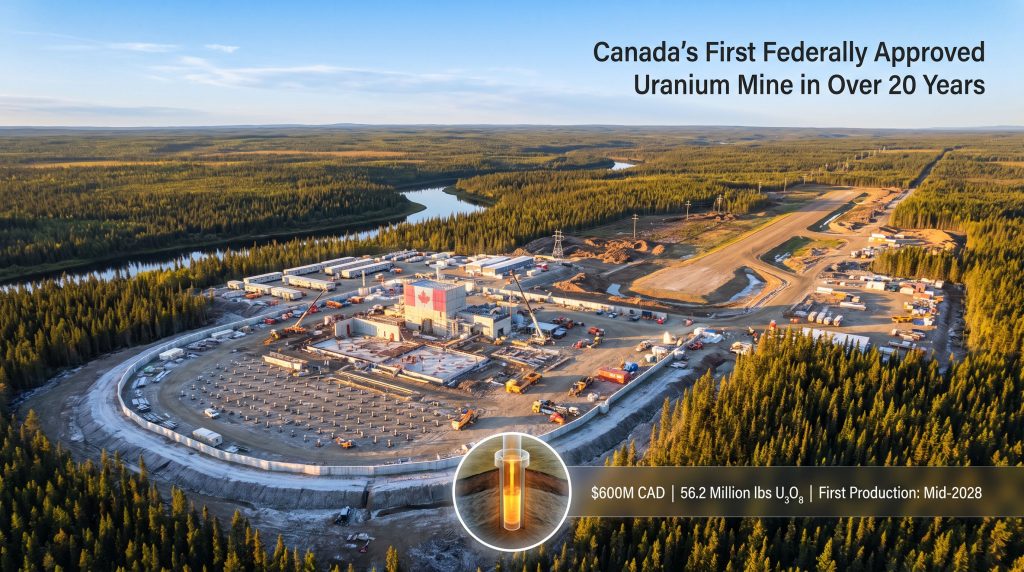
The Denison Phoenix uranium project construction program passed a critical threshold in February 2026 when the Canadian Nuclear Safety Commission issued the construction licence, following provincial environmental approval granted by Saskatchewan in August 2025. These two approvals represent the culmination of a multi-year regulatory process and, collectively, make Phoenix the first uranium mine in Canada to receive federal construction authorisation in more than two decades.
Site preparation commenced in March 2026 and has progressed at a meaningful pace. By late July 2026, the following had been reported:
| Milestone | Status as of Late July 2026 |
|---|---|
| Site clearing | Substantially complete |
| Temporary camp facilities | Installed, commissioned, ~400 person capacity |
| Construction management infrastructure | Operational |
| Overall site civil works | More than 20% complete |
| Second construction shift | Introduced to enable near-24-hour operations |
| Perimeter freeze wall installation | In progress |
| Process plant foundations (concrete pour) | Targeted Q3-Q4 2026 |
| Airstrip earthworks | In progress |
| On-site power distribution system | In progress |
| Targeted first uranium production | Mid-2028 |
The introduction of a second construction shift is particularly notable from a scheduling standpoint. Northern Saskatchewan's summer season offers a relatively short window for frost-sensitive civil works. Consequently, by operating near-continuously during summer months, Denison is preserving schedule flexibility and reducing the risk of winter weather disruptions pushing key milestones into the following construction season.
Capital Expenditure and Production Economics: Understanding the Numbers
The financial scale of the Denison Phoenix uranium project construction program reflects both the technical complexity of ISR adaptation in Athabasca geology and the broader cost environment for greenfield mine development in Canada.
| Financial or Production Metric | Figure |
|---|---|
| Post-FID initial capital cost | ~$600 million CAD |
| Total uranium available for sale | ~56.2 million pounds U₃O₈ |
| Initial mine life | ~10 years |
| Implied average annual production | ~5.6 million pounds U₃O₈/year |
| Targeted production start | Mid-2028 |
At approximately $600 million CAD in initial capital, Phoenix sits in the mid-tier range for greenfield uranium projects globally. For context, conventional underground uranium mines of similar scale in Athabasca geology have historically carried higher capital requirements due to underground infrastructure, shaft sinking, and refrigeration plant costs. ISR's lower surface disturbance and absence of underground development theoretically provides capital efficiency, though the freeze wall system and surface processing plant represent substantial investments in their own right.
The implied annual production rate of roughly 5.6 million pounds U₃O₈ per year, if sustained across the mine life, would make Phoenix a meaningful contributor to Canadian output. Canada currently produces in the range of 15 to 20 million kilograms of uranium per year across its operating mines, meaning Phoenix alone could add materially to national supply once ramped up.
Disclaimer: Production forecasts, capital cost estimates, and financial projections discussed in this article are based on information reported by Denison Mines and carry inherent uncertainty. Actual outcomes may differ materially. This article does not constitute financial or investment advice.
Canada's Regulatory Framework: A Two-Stage Approval Architecture
Canada operates one of the world's most rigorous nuclear regulatory environments, and the approval pathway for Phoenix illustrates exactly why uranium mine development timelines in Canada are measured in years rather than months. In addition, the broader uranium market dynamics at play make regulatory certainty all the more valuable for developers and investors alike.
The framework requires developers to navigate two distinct and sequential approval processes:
Stage 1: Provincial Environmental Assessment
Saskatchewan's provincial government oversees environmental review under its own legislation, examining surface and groundwater impacts, land disturbance, waste management, and effects on surrounding communities and ecosystems. Phoenix's provincial approval came in August 2025, following a multi-year review process.
Stage 2: Federal Nuclear Regulatory Licensing
The Canadian Nuclear Safety Commission holds jurisdiction over all activities involving radioactive materials in Canada. A CNSC construction licence is required before any physical mine development involving radioactive material can proceed. Phoenix received this licence in February 2026, approximately six months after provincial approval. This sequential six-month interval may serve as a practical benchmark for future uranium project developers navigating Canada's dual-track system.
The historical rarity of new uranium mine approvals in Canada adds weight to this milestone. The last comparable approval before Phoenix was Cigar Lake's development pathway, which concluded with commercial production in 2015 after a development history stretching back decades. No new large-scale uranium mine has received federal construction approval in Canada in the intervening period, making Phoenix's regulatory journey genuinely precedent-setting for ISR-based uranium development in the country.
The next major ASX story will hit our subscribers first
Indigenous Engagement: From Legal Challenge to Formal Support
Broad-based Indigenous support has become a prerequisite for major resource project advancement in Canada, and the Phoenix project's consultation history reflects both the complexity and the constructive potential of that process.
Denison secured formal benefit and oversight agreements with the following groups connected to the Wheeler River region:
- English River First Nation
- Kineepik Métis Local #9
- Métis Nation-Saskatchewan
- Three Athabasca Denesułiné First Nations
These agreements collectively address environmental monitoring roles, employment and skills training opportunities, business procurement access, community investment commitments, and financial benefits sharing.
The more complex dimension of Phoenix's consultation history involves Peter Ballantyne Cree Nation (PBCN). In October 2025, PBCN filed a legal challenge asserting that Saskatchewan had failed to conduct meaningful consultation and had not allowed sufficient time for the nation to assess the project's potential effects on its traditional territory. This type of challenge, rooted in the constitutional duty to consult and accommodate Indigenous peoples, carries real legal weight in Canada and has previously delayed or stalled resource projects at advanced stages.
The challenge was resolved and formally withdrawn in July 2026 following a confidential agreement between PBCN and Denison. PBCN now formally supports the Phoenix project. The outcome illustrates a pattern increasingly visible across Canadian resource development: contested consultation processes can reach constructive resolution when developers engage substantively with community concerns and negotiate meaningful benefit structures.
Phoenix in the Broader Canadian Uranium Landscape
| Project | Developer | Method | Status | First Production |
|---|---|---|---|---|
| Phoenix | Denison Mines | In-Situ Recovery | Under construction | Mid-2028 (target) |
| Cigar Lake | Cameco / Orano Canada | Underground (jet boring) | Operating | 2015 |
| McArthur River | Cameco / Orano Canada | Underground | Restarted 2022 | In production |
| Patterson Lake South | Fission Uranium / NexGen | Underground (planned) | Feasibility stage | TBD |
Phoenix occupies a unique position in this landscape as the only ISR uranium project currently under construction within the Athabasca Basin. Its mid-2028 production target places it ahead of other advanced-stage Canadian uranium projects still in feasibility or permitting phases, making it a near-term supply addition of genuine relevance to utilities seeking to diversify sourcing away from Russian and Kazakh supply chains.
The global context amplifies this significance. Kazakhstan's state uranium company Kazatomprom accounts for an outsized share of world uranium supply, and geopolitical considerations have prompted nuclear utilities, particularly in the United States, European Union, and Japan, to actively pursue supply diversification. Furthermore, the uranium market deficit facing these utilities makes Canadian tier-one supply increasingly attractive. Phoenix's ~5.6 million pounds per year of projected output is therefore commercially relevant well before first production.
Frequently Asked Questions: Denison Phoenix Uranium Project Construction
When did construction begin at the Phoenix uranium project?
Site preparation and early works commenced in March 2026, following the final investment decision in February 2026. Full-scale construction activities, including civil works and freeze wall installation, accelerated through mid-2026.
What is the expected production start date for Phoenix?
Denison is targeting first uranium production in mid-2028, approximately two years after construction commenced.
How much will it cost to build the Phoenix uranium project?
Post-FID initial capital expenditure is estimated at approximately $600 million CAD.
What mining method does Phoenix use?
Phoenix will use in-situ recovery, a technique that chemically dissolves uranium within the orebody and pumps the solution to surface for processing without conventional excavation.
How much uranium will Phoenix produce?
The project is expected to yield approximately 56.2 million pounds of uranium over an initial 10-year mine life, implying average annual production of roughly 5.6 million pounds of U₃O₈.
What approvals did Phoenix require?
Phoenix required both a Saskatchewan provincial environmental approval, granted in August 2025, and a Canadian Nuclear Safety Commission construction licence, granted in February 2026.
Has Indigenous consultation been completed for Phoenix?
Denison has signed formal benefit and oversight agreements with multiple First Nations and Métis organisations. A legal challenge by Peter Ballantyne Cree Nation was resolved and withdrawn in July 2026, with PBCN now supporting the project.
Key Takeaways for Investors and Industry Observers
The Denison Phoenix uranium project construction program carries significance that extends well beyond a single company's development schedule. Its technical, regulatory, and social dimensions collectively make it one of the most closely watched uranium projects globally entering the second half of the 2020s.
- Phoenix is Canada's first federally licensed uranium mine construction in more than 20 years, setting a modern regulatory template for ISR-based uranium development in the country.
- The freeze wall containment system and ISR application in high-grade Athabasca geology represent a genuinely novel technical undertaking with no direct commercial precedent at this scale. Execution outcomes will be studied industry-wide.
- With more than 20% of site civil works complete by late July 2026 and a second construction shift underway, the project appears on schedule relative to the mid-2028 production target, though construction programmes of this complexity carry inherent timeline and cost risk.
- The PBCN resolution demonstrates that Canada's constitutional duty-to-consult framework, while capable of generating legal friction, can also produce durable community partnerships when developers negotiate in good faith.
- Uranium supply from tier-one jurisdictions like Canada is increasingly valued by utilities managing geopolitical supply chain risk, positioning Phoenix's ~5.6 million pounds per year of projected output as commercially relevant well before first production.
Further reading on the Phoenix uranium project's development history and ISR methodology is available through CIM Magazine at magazine.cim.org, including coverage of Denison's environmental approval milestones and broader analysis of in-situ recovery uranium mining in Canada.
Want to Stay Ahead of the Next Major Mineral Discovery?
Discovery Alert's proprietary Discovery IQ model delivers real-time alerts on significant ASX mineral discoveries, transforming complex data into actionable investment insights — explore historic discoveries and their exceptional market returns, then begin your 14-day free trial at Discovery Alert to position yourself ahead of the broader market.