July 27, 2026
The Legal Architecture That Governs All U.S. Nuclear Exports
Most discussions about the U.S.-Saudi nuclear deal uranium enrichment controversy begin with geopolitics. A more instructive starting point, however, is the legal mechanism that makes the entire arrangement possible, and the reason its precise wording carries consequences measured in decades, not years.
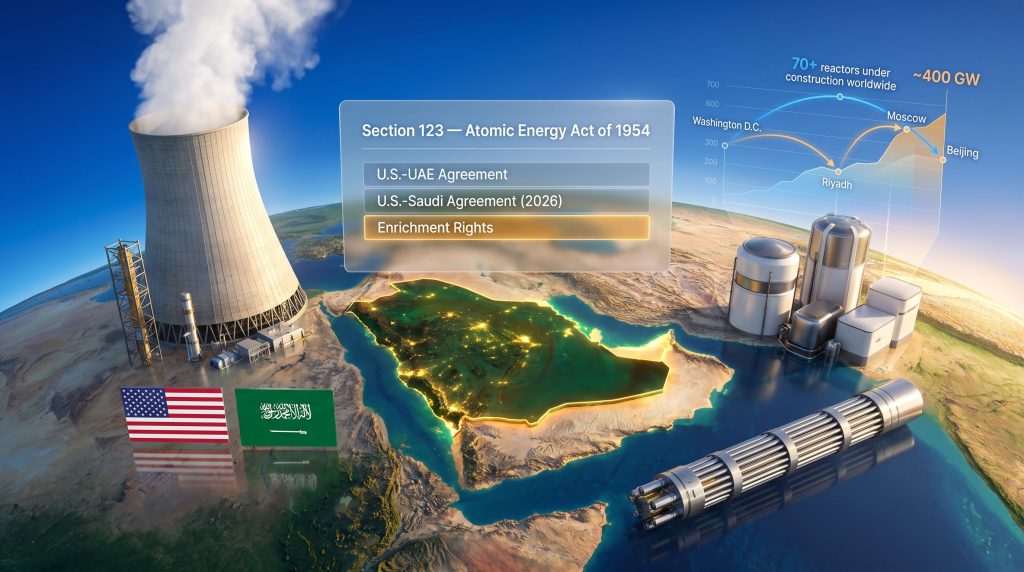
Section 123 of the U.S. Atomic Energy Act of 1954 established the foundational requirement that any nation wishing to receive American nuclear technology, materials, or expertise must first enter into a formal bilateral agreement with the United States. These frameworks, universally referred to as 123 Agreements, are not memoranda of understanding or policy statements. They are legally binding instruments that define the full scope of permissible cooperation for roughly 30 years, covering technology transfer protocols, safety obligations, physical security requirements, and critically, non-proliferation commitments.
No U.S. company, whether a reactor manufacturer, fuel supplier, or engineering services provider, can legally export nuclear-related goods or expertise to a foreign partner without a ratified 123 Agreement in place. This makes these frameworks the gateway to one of the world's most commercially significant emerging markets. The Department of Energy signed such an agreement with Saudi Arabia on July 22, 2026, with U.S. Energy Secretary Chris Wright and Saudi Energy Minister Prince Abdulaziz bin Salman formalising the arrangement. Before it can take legal effect, however, the deal must clear a mandatory Congressional review period, during which lawmakers retain the authority to block or modify its terms through joint resolution.
A 123 Agreement is not merely a trade document. It is a legally binding non-proliferation instrument that defines what a partner nation can and cannot do with U.S.-supplied nuclear materials and technology for an entire generation.
When big ASX news breaks, our subscribers know first
How the Saudi Deal Compares to the UAE Gold Standard
Defining the Benchmark: The 2009 U.S.-UAE Framework
When non-proliferation analysts refer to the gold standard in civil nuclear cooperation, they mean the 2009 agreement between the United States and the United Arab Emirates. That framework set a benchmark that no subsequent U.S. agreement has fully replicated: the UAE permanently and unconditionally waived its right to enrich uranium domestically and agreed never to reprocess spent nuclear fuel. It also incorporated the IAEA Additional Protocol, which grants international inspectors enhanced access rights and transparency mechanisms beyond standard safeguards.
The UAE's willingness to accept these conditions was remarkable given that enrichment technology represents both economic value and strategic leverage. Its decision to forfeit that capability entirely made the 2009 agreement the reference point by which all future U.S. nuclear cooperation deals are evaluated.
Where the Saudi Agreement Diverges
The U.S.-Saudi agreement does not appear to replicate the UAE model in full. The precise terms remain subject to Congressional scrutiny, but the divergences that have emerged in public reporting are structurally significant. For a detailed breakdown of what the US-Saudi deal involves, independent analysis helps frame the stakes clearly.
| Feature | U.S.-UAE Agreement (2009) | U.S.-Saudi Agreement (2026) |
|---|---|---|
| Enrichment Rights | Permanently waived | Contested / conditionally studied |
| IAEA Additional Protocol | Included | Reportedly absent or unconfirmed |
| Reprocessing Rights | Waived | Not publicly confirmed as waived |
| Congressional Approval | Completed | Pending |
| Duration | ~30 years | ~30 years |
| Proliferation Benchmark | Gold Standard | Under active policy debate |
Chris Wright has stated publicly that the agreement focuses exclusively on peaceful electricity generation and does not include enrichment provisions. Competing reporting, however, indicates the existence of a joint U.S.-Saudi feasibility study that could open a conditional pathway to enrichment at a U.S.-built facility within the Kingdom. Whether that study constitutes an enrichment commitment or merely a deferred exploration is precisely the question that has alarmed non-proliferation experts.
The ambiguity itself is a policy problem. Unresolved enrichment language does not merely create legal uncertainty — it sends a signal to other regional actors who are watching the Saudi precedent very closely.
Why Uranium Enrichment Is the Central Proliferation Risk
The Physics of the Dual-Use Dilemma
Understanding why the enrichment question carries such weight requires a brief explanation of the underlying technology. Natural uranium ore contains approximately 0.7% uranium-235, the isotope capable of sustaining the fission chain reactions that power both reactors and weapons. Civilian reactor fuel requires enrichment to roughly 3 to 5% U-235. Weapons-grade material requires enrichment to 90% or above.
The critical insight is that the same centrifuge cascade infrastructure used to produce low-enriched reactor fuel can be reconfigured — without any fundamental change in hardware — to pursue weapons-grade levels. This is the dual-use dilemma at the heart of all enrichment debates. The equipment does not distinguish between peaceful and weapons programmes. Only the operational choices made by the facility's operators determine which direction the technology is pointed.
Controlling access to enrichment capability, not just enriched material, is therefore the primary objective of global non-proliferation architecture.
The NPT Framework and Its Structural Limitations
Saudi Arabia is a signatory to the Nuclear Non-Proliferation Treaty, which legally permits civilian nuclear energy programmes. Standard IAEA safeguards apply to NPT signatories, but these baseline inspection rights have long been recognised as insufficient for comprehensive verification. The Additional Protocol, which the UAE accepted and Saudi Arabia has reportedly not committed to, provides inspectors with far broader access to facilities, records, and activities.
Non-proliferation analysts have flagged that even a conditional or deferred enrichment pathway — one that requires a future feasibility study before activation — represents a structural departure from the UAE model and could establish a precedent with consequences extending well beyond Saudi Arabia's borders.
The regional cascade risk is not hypothetical. Turkey, Egypt, and other Middle Eastern states have watched nuclear cooperation negotiations in the Gulf with considerable interest. Furthermore, if Saudi Arabia secures enrichment access under a U.S. framework, the political pressure on Washington to offer equivalent terms to other regional partners will intensify significantly.
Saudi Arabia's Strategic Rationale for Building Nuclear Capacity
The Vision 2030 Energy Calculus
Saudi Arabia's interest in nuclear power is grounded in straightforward economics. The Kingdom currently relies almost entirely on oil and natural gas for domestic electricity generation. Every barrel of petroleum burned domestically to power air conditioning, desalination plants, and industrial facilities is a barrel unavailable for export, where it generates far greater revenue.
Nuclear energy's role within the Vision 2030 economic diversification programme encompasses several interconnected objectives:
- Reducing domestic hydrocarbon consumption to maximise export revenues
- Supporting large-scale seawater desalination at competitive energy costs
- Enabling industrial expansion without proportional increases in hydrocarbon burn
- Positioning Saudi Arabia within international emissions reduction frameworks
- Creating a domestic nuclear technology and workforce sector
Saudi Arabia has already signed nuclear cooperation agreements with France, South Korea, China, and Russia over the past decade. The U.S. agreement is strategically distinct, however, because of the technology access, geopolitical alignment, and long-term oversight relationship it would establish.
The Competitive Supplier Dynamic
This last point cannot be overstated in terms of its policy implications. If the United States declines to supply reactors and expertise, or if Congressional conditions cause the deal to collapse, Russia's ROSATOM and Chinese state-owned nuclear enterprises are positioned to fill the gap. Both competitors impose considerably fewer non-proliferation conditions on their partners.
A Saudi nuclear buildout financed and built by ROSATOM or a Chinese state enterprise would proceed with far less transparency and under far weaker international verification frameworks than a U.S.-led programme. Saudi Arabia has stated ambitions to construct up to 16 nuclear reactors over the coming decades. Given that nuclear infrastructure development operates on 15 to 20 year planning and construction horizons, the agreements signed today are commercially decisive for generations of vendor relationships.
The Global Nuclear Renaissance and Its Market Implications
Structural Demand Drivers Reshaping the Baseload Power Landscape
The U.S.-Saudi nuclear deal uranium enrichment debate is being negotiated against a backdrop of genuinely accelerating global nuclear demand. The current worldwide fleet exceeds 440 operational reactors, generating approximately 400 gigawatts of electricity. Moreover, more than 70 additional reactors are currently under construction globally, with many more in advanced planning stages.
The IEA projects global electricity demand will grow at approximately 3.6% annually through 2030, driven by the convergence of several structural forces:
- Rapid expansion of AI infrastructure and data centres
- Electric vehicle adoption across major economies
- Industrial electrification in manufacturing and chemical sectors
- Population growth and urbanisation in emerging markets
- Large-scale desalination needs in water-stressed regions
Nuclear power currently accounts for approximately 9% of global electricity generation and nearly 25% of all low-carbon electricity produced worldwide. The IEA projects that renewables and nuclear together will supply roughly half of global electricity by 2030, a milestone that firmly repositions nuclear as an essential component of the clean energy transition. Understanding broader uranium market volatility is therefore essential context for assessing how deals like this one reshape long-term supply planning.
The IEA projects that renewables and nuclear together will account for approximately half of global electricity generation by 2030, reframing nuclear not as a relic of 20th century energy policy but as an indispensable pillar of the decarbonisation pathway.
Small Modular Reactors and the Emerging Market Opportunity
The economics of nuclear deployment are also shifting. Small modular reactors, which are factory-manufactured units producing typically less than 300 megawatts of electricity, reduce the upfront capital commitment and construction timeline associated with conventional large-scale reactors. For emerging markets like Saudi Arabia, where grid integration planning and financing structures differ from established nuclear nations, SMR technology lowers the entry barrier considerably.
U.S. advanced nuclear vendors are among the global leaders in SMR design and licensing. In addition, a Saudi deployment of American SMR technology would represent a flagship commercial reference project with implications for vendor positioning across the broader Middle East and North Africa region.
How the Deal Reshapes Uranium Market Dynamics
Demand Implications of the Saudi Buildout
The addition of Saudi Arabia to the global reactor fleet represents meaningful incremental uranium demand over the agreement's 30-year horizon. Analysts tracking the uranium market dynamics of this period have noted that supply-demand conditions are already tightening as new reactors come online across China, India, and Eastern Europe, while legacy uranium mines face resource depletion and permitting delays for new projects.
| Market Variable | Short-Term Impact | Long-Term Impact |
|---|---|---|
| Saudi reactor construction announcement | Moderate sentiment uplift | Sustained demand addition |
| Enrichment pathway confirmed | Elevated geopolitical risk premium | Potential supply chain restructuring |
| No enrichment / U.S. fuel supply model | Neutral to positive for U.S. uranium producers | Increased U.S. enrichment capacity demand |
| Deal blocked by Congress | Near-term market uncertainty | Competitor nations fill supply gap |
A particularly underappreciated dimension of the deal's commercial structure involves the downstream fuel services economy. If Saudi Arabia builds reactors under a U.S. technology framework without domestic enrichment rights, it becomes a long-term customer for U.S. enrichment services, fuel fabrication, and conversion capacity. This would consequently strengthen the commercial case for expanding domestic U.S. enrichment infrastructure, which the Department of Energy has already identified as a strategic priority.
The Commercial Ecosystem Beyond Reactor Construction
Engineering, procurement, and construction contracts represent the most visible commercial opportunity, but they are far from the only one. Over a 30-year agreement horizon, U.S. companies could access:
- Long-term uranium fuel supply agreements
- Operational maintenance and lifecycle support contracts
- Workforce training and nuclear safety programme development
- Technology licensing for reactor designs and safety systems
- Advanced nuclear fuel cycle consulting services
The Department of Energy has framed the agreement as the foundation for a decades-long, multi-billion-dollar partnership, reflecting the compound commercial value that accrues when a supplier nation locks in technology standards during the infrastructure development phase.
The next major ASX story will hit our subscribers first
Congressional Review and the Non-Proliferation Fault Lines
The Legislative Hurdles Ahead
Under U.S. law, the President must formally submit a 123 Agreement to Congress before it can take effect. Congress then enters a mandatory review period during which lawmakers may pass a joint resolution of disapproval to block or modify the deal. Historical precedent shows that Congress has used this leverage to attach conditions to previous agreements, and the Saudi deal is likely to attract more scrutiny than most.
The central fault lines in the Congressional debate break along predictable but genuinely consequential lines:
Critics of the deal argue:
- Departing from the UAE gold standard weakens U.S. credibility as the world's leading non-proliferation advocate
- A conditional enrichment pathway sets a permissive precedent for the broader Middle East
- The absence of the IAEA Additional Protocol creates a verification gap that undermines international safeguards
Supporters of the deal argue:
- U.S. engagement ensures Saudi nuclear infrastructure develops under American oversight rather than Russian or Chinese influence
- Conditional frameworks with strong safeguards are preferable to no agreement at all
- Commercial exclusion from the Saudi market would simply transfer influence to less restrictive suppliers
If Congress attaches IAEA Additional Protocol acceptance as a non-negotiable condition and Saudi Arabia declines, the deal could collapse entirely, opening the market to suppliers who impose far fewer transparency requirements on their partners.
These legislative tensions also intersect with broader concerns about uranium supply challenges that continue to shape how policymakers weigh commercial and security interests simultaneously. Furthermore, the ongoing Russian uranium import ban has already altered U.S. fuel supply calculations, adding further urgency to the question of which partners America cultivates for its nuclear future.
Three Scenarios for How the Deal Resolves
Scenario 1: Full Gold Standard Adoption. Congress conditions approval on Saudi Arabia permanently waiving enrichment rights and accepting the IAEA Additional Protocol. Saudi Arabia agrees. The deal advances as a strengthened non-proliferation model and potentially rehabilitates the gold standard as a genuine global benchmark.
Scenario 2: Conditional Enrichment Pathway. The agreement advances with a deferred enrichment feasibility mechanism. A new, weaker regional precedent is established. Other Middle Eastern states begin pressing for equivalent treatment, consequently fragmenting the non-proliferation architecture across the region.
Scenario 3: Congressional Blockage. The deal fails legislative review. ROSATOM and Chinese state nuclear enterprises accelerate engagement with Saudi Arabia under substantially fewer constraints. U.S. commercial and strategic influence over the Kingdom's nuclear trajectory diminishes significantly for the duration of the agreement horizon.
The outcome of this Congressional review will not only determine the commercial fate of American nuclear vendors in Saudi Arabia. It will establish the effective non-proliferation standard for all future U.S. civil nuclear agreements in the Middle East and, by extension, define the diplomatic credibility of U.S. nuclear export policy globally. Observers tracking uranium market trends will find these legislative developments increasingly relevant to long-term investment and supply chain planning.
Frequently Asked Questions: U.S.-Saudi Nuclear Deal and Uranium Enrichment
What is the U.S.-Saudi 123 Agreement?
A bilateral civil nuclear cooperation framework authorised under Section 123 of the U.S. Atomic Energy Act of 1954, establishing the legal conditions under which U.S. nuclear technology, expertise, and materials can be transferred to Saudi Arabia for peaceful energy purposes.
Does the deal allow Saudi Arabia to enrich uranium?
This remains the central point of public controversy. U.S. Energy Secretary Chris Wright has stated publicly that the agreement does not include enrichment provisions. However, separate reporting suggests a joint feasibility study could create a conditional pathway to enrichment at a U.S.-built facility within Saudi Arabia. The final terms remain subject to Congressional review. NPR's coverage of the US-Saudi nuclear agreement provides additional context on how this debate is unfolding politically.
What is the gold standard in nuclear agreements and does Saudi Arabia meet it?
The gold standard refers to the 2009 U.S.-UAE agreement, under which the UAE permanently waived its right to enrich uranium or reprocess spent fuel. The Saudi agreement, as currently reported, does not appear to meet this benchmark — a distinction that has drawn significant criticism from non-proliferation experts.
Why does uranium enrichment create a weapons proliferation risk?
Enrichment technology is inherently dual-use. Centrifuge systems designed to produce low-enriched uranium (3 to 5% U-235) for reactor fuel can be reconfigured to produce highly enriched uranium (90%+ U-235) suitable for nuclear weapons. Controlling access to enrichment infrastructure is therefore a primary objective of global non-proliferation policy.
What commercial opportunities does the deal create for U.S. companies?
Beyond reactor construction contracts, U.S. firms stand to benefit from long-term fuel supply agreements, engineering services, operational maintenance, workforce training, and technology licensing — potentially representing multi-billion-dollar revenue streams over the 30-year agreement horizon.
How does this deal affect global uranium demand?
Saudi Arabia's planned nuclear buildout, potentially encompassing up to 16 reactors, would add meaningful long-term demand to the global uranium market, compounding existing supply-demand tightness driven by reactor expansions in China, India, and other major economies. The U.S.-Saudi nuclear deal uranium enrichment question will consequently remain central to how analysts model future fuel cycle requirements and procurement strategy.
This article contains forward-looking analysis regarding policy outcomes, market dynamics, and geopolitical scenarios. Such projections are inherently speculative and subject to change based on Congressional decisions, diplomatic developments, and regulatory outcomes. Nothing in this article constitutes financial or investment advice. Readers should conduct independent research before making any investment or policy-related decisions.
Want to Stay Ahead of the Next Major Uranium Discovery on the ASX?
As the global nuclear renaissance accelerates and deals like the U.S.-Saudi agreement reshape long-term uranium demand, Discovery Alert's proprietary Discovery IQ model delivers real-time alerts on significant ASX mineral discoveries — instantly turning complex data across more than 30 commodities into actionable investment insights. Explore historic discovery returns on Discovery Alert's dedicated discoveries page and begin your 14-day free trial today to position yourself ahead of the market.