July 23, 2026

What the Uranium Supply Deficit Term Premium Actually Measures
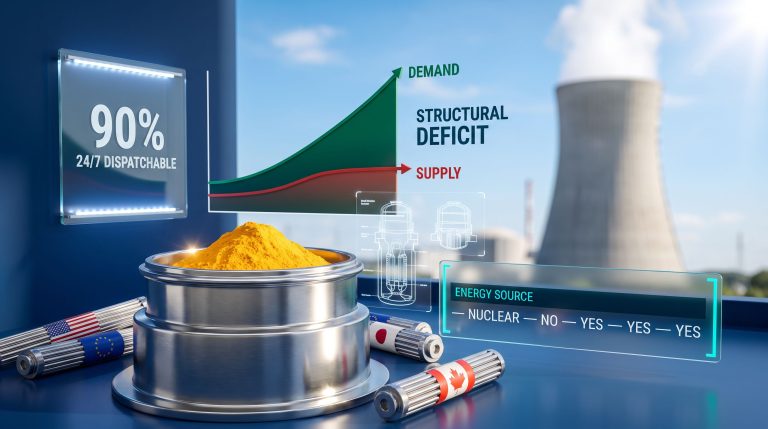
Most commodity markets give investors a relatively straightforward signal: when demand is rising faster than supply can respond, prices move up. Uranium operates differently. Its most revealing price signal is not the spot price shown on financial terminals, but rather the gap between what nuclear utilities pay for long-term contracted supply and what the same material trades for in near-term spot transactions. That gap, currently exceeding $11 per pound, is the uranium supply deficit term premium, and understanding its mechanics is increasingly important for anyone analysing the nuclear fuel market in 2026.
The uranium supply deficit term premium is not an abstract financial construct. It is a measurable reflection of how confident the buyers responsible for fuelling the world's nuclear reactors are about their ability to source material in future years. When that confidence is low, utilities move aggressively into multi-year contracts, pushing term prices higher relative to spot. When secondary inventories are abundant and production is running smoothly, the gap compresses. Today, the spread is widening, and the reasons behind that widening are structural rather than speculative.
The Mechanics Behind the Term-Spot Gap
Understanding how this premium forms requires separating two distinct uranium pricing benchmarks:
-
Spot price: Reflects near-term physical delivery, transacted in relatively thin volumes between traders, producers, and opportunistic buyers. As of late July 2026, spot closed at approximately $85.70 per pound and had remained largely unchanged for more than a month, according to Trading Economics.
-
Long-term indicator price: Reflects multi-year forward contracts negotiated directly between uranium producers and nuclear utilities, typically covering delivery three to ten years ahead. TradeTech's long-term uranium price indicator reached $97 per pound in mid-July 2026, up from $90 per pound on January 31, 2026.
-
Term premium: The dollar-per-pound differential between these two benchmarks, currently sitting above $11.30 per pound.
| Benchmark | Price (July 2026) | Timeframe |
|---|---|---|
| Spot Uranium Price | ~$85.70/lb | Near-term delivery |
| Long-Term Indicator Price | ~$97.00/lb | 3-10 year forward contracts |
| Term Premium | ~$11.30/lb | Structural gap |
| January 2026 Term Price | $90.00/lb | Prior reference point |
In most commodity markets, spot and term prices track each other closely because arbitrage opportunities quickly erase persistent differentials. Uranium is different. The fuel cycle is long, reactors cannot switch fuels, and the logistics of securing enriched uranium feedstock require planning years in advance. Furthermore, when spot-term price divergence occurs materially, it signals that procurement decisions being made now by reactor operators reflect an expectation of future tightness that the near-term spot market has not yet priced in.
TradeTech has described spot market activity as quiet even as term contracting volumes accelerate, which reinforces the interpretation that the premium reflects structural procurement pressure rather than trading momentum.
When big ASX news breaks, our subscribers know first
The Structural Supply-Demand Imbalance Powering the Premium
A Deficit That Compounds Over Time
The uranium supply deficit term premium does not emerge in a vacuum. It is anchored in a measurable and well-documented gap between what the world's mines produce and what its reactors consume. The uranium market deficit is clearly illustrated by the following figures:
- Annual global uranium production: approximately 150 million pounds
- Annual nuclear utility consumption: approximately 200 million pounds
- Current annual deficit: roughly 50 million pounds, bridged by secondary inventory drawdowns
- Projected demand by 2040: approximately 400 million pounds
- Projected primary mine supply by 2040 (on current trajectory): as low as 50 million pounds
Phil Hoskins, Chief Executive Officer of Atomic Eagle, which is advancing the Muntanga uranium project in Zambia, has described the arithmetic of this challenge in stark terms. He notes that on current production trajectories, a supply figure of roughly 150 million pounds annually is set to fall toward 50 million pounds by 2040 as existing mines deplete, while demand doubles toward 400 million pounds driven by nuclear energy expansion globally.
That trajectory raises fundamental questions about where replacement supply will come from, particularly given how long new uranium mines take to move from discovery through permitting to production.
Scale check: The Muntanga project currently hosts a 58.8 million pound uranium oxide resource, a figure that increased by 24% from its maiden drill programme. A single project of that scale would meet less than two months of projected 2040 global demand at current consumption rates, illustrating just how large the future supply gap could become.
Why a Decade of Under-Contracting Has Created a Procurement Crisis
Nuclear utilities have historically managed uranium procurement in long cycles. Following the Fukushima disaster in 2011, reactor shutdowns in Japan and a broader reassessment of nuclear energy globally caused utility demand to contract, and many operators allowed their contracted inventory positions to run down rather than renewing agreements at what they perceived as elevated prices.
That posture persisted through much of the 2010s and into the early 2020s. Producers, facing a low-price environment, curtailed output. Secondary inventories, including material held by traders, utilities, and government stockpiles, served as the effective market buffer. However, the problem with this arrangement is its inherent finitude: secondary inventories are drawn down over time and cannot be replenished without new primary production.
As existing producer supply has progressively been committed under legacy term contracts, the pool of uncommitted uranium available for new agreements has shrunk. Utilities that deferred contracting for years are now discovering that the queue for long-term supply is lengthening precisely when their reactor requirements demand certainty. This dynamic is the primary engine behind the widening uranium supply deficit term premium observed in mid-2026.
How Concentrated Mine Supply Amplifies Market Disruptions
The Geographic Reality of Uranium Production
Uranium is not mined everywhere. A handful of operations in a small number of jurisdictions account for the majority of global output, which means individual site disruptions can have market-wide consequences with no equivalent in more geographically distributed commodity sectors. According to the World Nuclear Association, this concentration of production is one of the defining structural features of the global uranium supply chain.
| Producer / Region | Estimated Share of Global Supply | Key Vulnerability |
|---|---|---|
| Kazakhstan (Kazatomprom) | ~20% of global output | Output cuts, extraction tax increases |
| Canada (Cameco operations) | Significant primary supply | Mechanical failures, flooding events |
| Niger (Somaïr mine) | Modest but stranded | Nationalisation, arbitration delays |
2026 Supply Events: Each Disruption Amplifying a Pre-Existing Imbalance
Three separate supply-side events in 2026 have already demonstrated how this concentration translates into market tightness.
Event 1: Cigar Lake Suspension
Cameco suspended mining at Cigar Lake on July 1, 2026, after a mechanical failure at Orano's McClean Lake sulfuric acid plant forced the mill to halt operations. The connection is critical: McClean Lake processes Cigar Lake ore, so a processing facility failure directly halted mine production. Operations resumed by mid-July, and Cameco maintained its full-year 2026 production guidance of 17.5 to 18.0 million pounds of uranium oxide.
However, the incident followed flooding at the McArthur River and Key Lake operations in May 2026, highlighting the sector's essentially zero spare capacity buffer. When the margin for operational error is this thin, single events become market events.
Event 2: Kazatomprom Production Reduction
Kazakhstan's state uranium producer confirmed a 10% reduction in 2026 output, attributing the cut to market conditions and elevated extraction taxes rather than any resource depletion. This is a nuanced but important distinction: the resource is available, but economics and fiscal policy have made producing it at full capacity less attractive. With Kazatomprom supplying approximately one-fifth of global uranium, a 10% reduction removes a material volume from an already undersupplied market. These developments reflect broader uranium supply-demand volatility that continues to reshape global procurement strategies.
Event 3: Niger's Stranded Inventory
Approximately 1,800 tonnes of uranium concentrate remain physically present at the Somaïr mine but commercially inaccessible, locked behind an unresolved arbitration dispute between Niger's government and Orano following the mine's nationalisation. The material exists, but the legal pathway to bring it to market remains unresolved, effectively removing it from available supply.
Critical insight: Unlike oil markets, where OPEC+ maintains strategic surplus production capacity that can be activated to offset supply disruptions, the uranium sector has no equivalent buffer. Every mine that goes offline creates a direct reduction in available supply with no mechanism for rapid compensation from other producers.
The Strait of Hormuz: Uranium's Hidden Supply Chain Vulnerability
How a Regional Chokepoint Connects to Nuclear Fuel Production
The link between the Strait of Hormuz and uranium production is rarely examined in market commentary but represents one of the most important and underappreciated risk vectors in the sector. International Energy Agency Executive Director Fatih Birol has described disruptions to shipping through the Strait as the largest in the history of the global oil market. The uranium connection operates through a less visible supply chain.
The sulfuric acid dependency chain:
- Approximately one-fifth of global sulfur shipments transit the Strait of Hormuz
- Sulfur is the primary feedstock for industrial sulfuric acid production
- Sulfuric acid is a critical input for two distinct uranium production processes:
- Kazakh in-situ recovery (ISR) mining, where acidic solution is injected into the ore body to dissolve uranium, then pumped to surface for processing
- Canadian ore milling, including the McClean Lake facility whose acid plant failure triggered the Cigar Lake suspension in July 2026
This chain means a sustained disruption to Strait of Hormuz shipping would simultaneously pressure the two largest primary uranium supply sources in the world. When combined with Kazatomprom's already confirmed 10% output reduction, a prolonged Hormuz disruption scenario could push the uranium supply deficit term premium materially above its current level as utilities compete for whatever contracted supply remains uncommitted.
What makes this risk particularly significant is that it is largely invisible to conventional uranium market analysis. Most commentary focuses on mine-level disruptions, utility contracting cycles, and enrichment capacity. The sulfuric acid supply chain that physically enables ISR and milling operations receives far less attention, yet it represents a direct transmission mechanism from regional geopolitics to uranium production costs and volumes.
US Policy Architecture and the Expanding Nuclear Fuel Demand Picture
The US-Saudi Civil Nuclear Cooperation Agreement
The United States has approved a 30-year civil nuclear cooperation agreement with Saudi Arabia, positioning American companies as central participants in Saudi Arabia's emerging nuclear energy programme. The agreement remains subject to Congressional review and is expected to generate tens of billions of dollars in nuclear infrastructure investment over its duration.
From a uranium market perspective, the significance extends beyond the direct investment numbers. Every new enrichment facility or reactor programme that emerges from this framework requires uranium feedstock secured through long-term contracts, expanding addressable demand in the term market before a single new reactor generates electricity. This is additive to existing reactor demand, not a substitution.
Section 232 and Domestic Uranium Price Architecture
A Section 232 proclamation has directed US trade negotiations toward reducing dependence on imported processed critical minerals, and the administration is actively evaluating the addition of uranium to the tariff annex alongside copper, silver, and potash. If implemented, tariff protection would establish a domestic uranium price floor above global spot levels.
Energy Fuels operates the only currently licensed and operating conventional uranium mill in the United States, making it a direct beneficiary of any policy shift that prioritises domestic fuel-cycle self-sufficiency. This policy trajectory represents a source of domestic uranium price support that operates independently of global spot market dynamics, adding a layer of demand for US-origin material that would not be captured in headline spot price data.
Disclaimer: Policy outcomes involving tariffs and trade agreements are subject to Congressional review, regulatory processes, and geopolitical developments. The above reflects proposed measures under evaluation as of mid-2026, not confirmed policy outcomes.
Institutional Capital Positioning: Reading the Smart Money Signal
Physical Uranium Accumulation as a Forward Indicator
One of the most analytically significant developments in the uranium market during 2026 has been the timing of institutional capital flows into physical uranium. The Sprott Physical Uranium Trust recorded $562 million in net unit sales during Q1 2026, expanding the trust's market capitalisation to approximately $7.4 billion. Because the trust purchases and holds physical uranium oxide with incoming capital, these inflows directly remove material from an already constrained market.
The critical detail is not the magnitude of these inflows but their timing: capital deployed in a period when spot prices remained largely unchanged represents forward-positioning based on fundamental conviction rather than momentum-chasing. When sophisticated institutional buyers accumulate physical commodity exposure in a flat or declining spot price environment, they are typically signalling that they expect the spot market to lag an underlying fundamental shift.
This pattern — capital accumulation preceding spot price movement — is consistent with behaviour observed during the early stages of previous uranium price cycles, where physical accumulation by well-capitalised buyers preceded broader market repricing by quarters or years.
Where Analyst Price Forecasts Converge and Diverge
| Institution | 2026 Uranium Price Target | Implied Move vs. ~$86 Spot |
|---|---|---|
| Scotiabank | ~$80/lb | Modest downside |
| Goldman Sachs | ~$91/lb | ~6% upside |
| Bank of America | ~$135/lb | ~57% upside |
The wide range reflects genuine uncertainty about when the structural deficit crystallises into a spot market repricing, not disagreement about the direction of the imbalance. All three institutions position uranium at or above current spot levels over a medium-term horizon, which is notable given how conservative commodity price forecasting tends to be in institutional research. These diverging views are consistent with broader uranium market dynamics that make precise timing difficult even for well-resourced analysts.
The next major ASX story will hit our subscribers first
New Supply Pathways: How Capital Is Flowing Across the Development Spectrum
Pre-Resource Financing as a Structural Market Signal
One of the less-discussed developments in the current uranium cycle is the willingness of capital markets to finance exploration projects before formal resource definitions exist. ATHA Energy raised C$63 million in Q1 2026 to advance its Angilak project in Nunavut despite the project not yet carrying a defined mineral resource at the time of financing.
Troy Boisjoli, CEO of ATHA Energy, has noted that the company's conviction strengthens with each successive investment round, reflecting a strategic objective of building significant tier-one scale resources ahead of what management views as a multi-year supply cycle. The financing provides a minimum of two years of simultaneous exploration across two separate mineralised corridors, an approach made possible by the scale of the capital raise.
Financing pre-resource projects at this scale is unusual and reflects investor conviction that the uranium market will require major new sources of primary supply over the coming decade. Consequently, capital is moving upstream in the development cycle, accepting earlier-stage risk in exchange for greater exposure to the anticipated repricing.
Brownfield ISR Expansion: The Fastest Incremental Supply Route
For investors evaluating supply-response timelines, the development pathway with the shortest lead time to production is brownfield expansion of in-situ recovery operations adjacent to existing licensed processing infrastructure.
| Development Type | Capex Intensity | Time to Production | Permitting Risk |
|---|---|---|---|
| Greenfield conventional mine | Very high | 10-15+ years | Very high |
| Greenfield ISR project | Moderate | 5-8 years | Moderate-high |
| Brownfield ISR expansion | Low (<15% of conventional) | 2-4 years | Low (existing licence) |
| Secondary inventory drawdown | Near-zero | Immediate | None |
The Alta Mesa uranium project in Texas illustrates this approach clearly. enCore Energy is drilling its Alta Mesa East property adjacent to the licensed Alta Mesa central processing plant, which has been operational since Q2 2024 with a design capacity of 2 million pounds of uranium oxide annually. By expanding around existing licensed infrastructure rather than pursuing greenfield development, the company can bring incremental production online on a materially compressed timeline. Industry data indicates ISR projects require capital expenditure of less than 15% of equivalent conventional mines, making this the most capital-efficient supply-response mechanism available to the market.
The Supply Deficit Thesis Does Not Need AI to Be Valid
Separating the Structural Case from the Demand Narrative
Philip Williams, Chief Executive Officer of IsoEnergy, has articulated a perspective on the uranium deficit thesis that distinguishes it from narratives tied to AI-driven electricity demand growth. His position, expressed publicly, is that the fundamental case for a supply deficit is independently supported by existing reactor demand and a decade of structural under-investment in mine supply, regardless of how much incremental power generation AI data centres ultimately require.
This distinction matters analytically. A deficit thesis anchored in AI demand growth is contingent on assumptions about data centre build rates, power consumption benchmarks, and the speed at which nuclear-powered electricity supply can respond to that demand. In contrast, a deficit thesis anchored in existing reactor requirements, utility under-contracting, concentrated mine supply, and decades-long development timelines is not contingent on any single demand narrative.
Analytical distinction: The uranium supply deficit term premium that exists today was not created by AI. It was created by a decade of utilities deferring long-term contracts while producers curtailed mine supply, resulting in a structural mismatch that will require years of new mine development to correct. AI and data centre demand represent potential additional upside, not the foundation of the thesis.
Key Indicators to Monitor for the Uranium Supply Deficit Term Premium
Investors tracking the uranium supply deficit term premium should focus on the following variables, each of which has a direct and measurable connection to whether the premium expands, holds, or compresses. According to Money Management, the uranium supply chain is approaching a critical inflection point that makes these indicators especially timely to monitor.
- Term-spot price spread: A gap widening beyond $12-13/lb signals accelerating utility procurement urgency; compression back toward $5-8/lb suggests disruption resolution or utility demand moderation
- Kazatomprom quarterly production data: Any further reduction in Kazakh output deepens the supply deficit; full restoration of production would partially ease near-term tightness
- Strait of Hormuz sulfur shipping volumes: A measurable proxy for sulfuric acid supply chain pressure in Kazakhstan and Canada
- Utility contracting volumes reported by TradeTech: Accelerating term contract signings confirm that utilities are responding to perceived future scarcity
- Sprott Physical Uranium Trust inflows: Capital accumulation into physical uranium ahead of spot price movement has historically been a leading indicator of broader market repricing
- Section 232 tariff announcements: Inclusion of uranium in the tariff annex would establish a domestic price floor independent of global spot dynamics
- Niger arbitration developments: Resolution or escalation of the Orano dispute would either release approximately 1,800 tonnes of stranded concentrate to the market or confirm its prolonged absence
Frequently Asked Questions: Uranium Supply Deficit Term Premium
What does the uranium supply deficit term premium mean in practical terms?
When nuclear utilities secure uranium through long-term contracts at prices above what spot market transactions reflect, the difference is the term premium. A rising premium signals that buyers responsible for fuelling real reactors expect future uranium availability to be more constrained than current spot trading volumes suggest. It is a forward-looking pricing signal embedded in procurement decisions with multi-year consequences.
Why do term and spot prices diverge in uranium when they typically converge in other commodities?
Uranium's market structure is unusual. Spot volumes are thin, and nuclear utilities cannot substitute alternative fuels. Long-term contracts are negotiated years in advance and reflect multi-year supply planning. When utilities are simultaneously competing for a limited pool of uncommitted producer supply while secondary inventories are depleting, term prices can rise independently of spot, creating a persistent premium that arbitrage cannot easily close.
Is the deficit structural or cyclical?
The balance of evidence points toward structural origins. The current deficit reflects over a decade of utility under-contracting, a decade of producer output discipline, long mine development timelines that prevent rapid supply response, and geographic concentration in production that amplifies individual disruptions. Specific events such as the Cigar Lake suspension and Kazatomprom's output reduction are temporary, but they are amplifying a pre-existing structural imbalance rather than creating one.
How does the Strait of Hormuz disruption transmit into uranium markets?
The transmission mechanism operates through industrial sulfuric acid supply chains. Approximately one-fifth of global sulfur shipments transit the Strait. Sulfur is the feedstock for sulfuric acid, which is essential for Kazakh ISR uranium mining and Canadian ore milling operations. A prolonged disruption to Strait shipping raises production costs and increases the probability of output interruptions at the world's two largest uranium supply sources.
What would cause the term premium to narrow?
The premium would compress if Kazatomprom restored full 2026 production, Strait of Hormuz shipping normalised and eased sulfuric acid supply risks, Niger's stranded uranium inventory was released through arbitration resolution, or utility contracting appetite moderated. As of mid-2026, none of these conditions had materialised.
Disclaimer: This article contains forward-looking statements, price forecasts from third-party institutions, and scenario analysis. None of this constitutes financial advice. Uranium market conditions can change rapidly, and past price behaviour is not indicative of future outcomes. Readers should conduct their own research and consult qualified financial advisers before making investment decisions.
Want to Stay Ahead of the Next Major Mineral Discovery Before the Broader Market Catches On?
Discovery Alert's proprietary Discovery IQ model scans ASX announcements in real time, delivering actionable alerts on significant mineral discoveries — including uranium — so investors can position themselves ahead of broader market repricing. Explore how historic discoveries have generated substantial returns on Discovery Alert's dedicated discoveries page, and begin a 14-day free trial to secure a market-leading edge.