July 30, 2026
The Hidden Architecture of a Price That Won't Come Down
Most commodity price spikes are cyclical. Supply contracts, demand surges, prices climb, and eventually the market rebalances. Aluminum in the United States is currently defying that logic. The all-in landed cost of US aluminum tops $6,000 tonne tariff cost floor, and the structural forces holding it there are not the kind that resolve when a ceasefire is signed or a shipping lane reopens.
Understanding why requires looking beyond the headline number and examining the layered cost architecture beneath it, because each layer responds to a different set of variables, and not all of those variables are moving in the same direction.
When big ASX news breaks, our subscribers know first
The Anatomy of a $6,000/Tonne Price: How the US Aluminum Cost Stack Was Built
Breaking Down the Three-Layer Cost Architecture
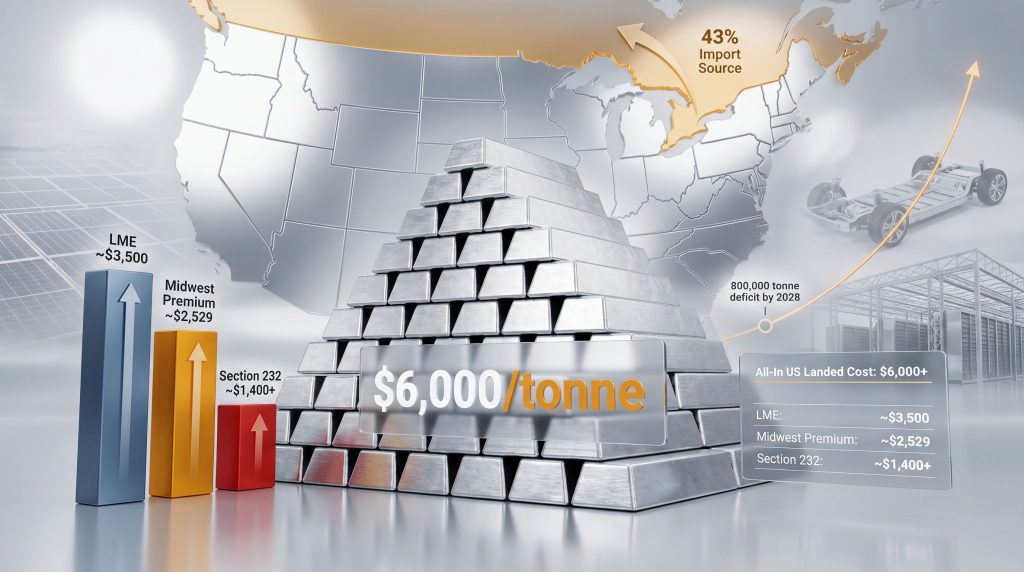
The figure most widely cited, $6,000/tonne, is not a government-set price or a contract benchmark. It is the sum of three compounding cost components that have converged simultaneously in the US market. Each layer operates independently, and critically, each responds to a different policy or market trigger.
| Cost Component | Estimated Contribution (USD/tonne) | Notes |
|---|---|---|
| LME Benchmark Price | ~$3,500 | Four-year high as of early May 2026 |
| US Midwest Premium | ~$2,529 | Exceeds 40% of all-in transaction cost |
| Section 232 Tariff Component | ~$1,400+ (on Canadian imports) | Tripled from ~$560 earlier in the year |
| All-In US Landed Cost | $6,000+ | Market-derived floor, not a government price |
The LME benchmark represents global aluminum pricing consensus. The Midwest Premium captures the localised cost of delivering metal into US consumption channels. The Section 232 tariff layer reflects a deliberate policy decision about how import duties are calculated. These three forces are now compounding in a way that has no simple single-lever solution.
Why the Midwest Premium Now Carries More Weight Than the LME Price
For most of the past decade, aluminum buyers treated the Midwest Premium as a secondary consideration. The LME price was the number that moved markets and drove procurement decisions. That hierarchy has now structurally inverted.
As of early May 2026, the Midwest Premium reached $2,529/tonne, a figure that accounts for more than 40% of the total all-in transaction cost, according to CME Group data. The US aluminium tariff impact on the premium has been significant, with several compounding factors explaining its elevation:
- Freight and logistics costs for aluminum entering US distribution channels have remained persistently high
- Domestic supply scarcity, driven by reduced Canadian import volumes and limited US primary production capacity, has tightened spot availability
- The effective tariff burden embedded in import costs has compounded premium pricing for material sourced from tariff-affected origins
- The premium is not geopolitically reversible in the short term; even if Middle Eastern shipping routes normalise, the domestic supply imbalance and tariff structure remain
What makes this particularly significant for procurement teams and investors is that the Midwest Premium does not move in lockstep with the LME. A decline in global aluminum prices would reduce one component of the cost stack while leaving the premium, and the tariff layer, largely intact.
From Metal Content to Full Invoice Value: What Presidential Proclamation 11021 Changed
The most technically consequential shift in the US aluminum cost environment occurred on April 2, 2026, when Presidential Proclamation 11021 came into effect. Before this date, Section 232 tariffs on aluminum were calculated against the metal content embedded within imported finished goods and derivatives. A product that contained 30% aluminum by value would attract tariffs only on that fraction.
Proclamation 11021 fundamentally changed this methodology. The tariff base shifted to the full invoice value of the imported aluminum article or derivative, regardless of the actual aluminum content within it. The practical consequences were immediate and material:
- The effective tariff burden per unit for every US importer of aluminum-containing finished goods increased significantly overnight
- For Canadian-sourced aluminum, the tariff component rose from approximately $560/tonne to over $1,400/tonne under the new calculation methodology
- Manufacturers importing finished aluminum components, not just raw primary metal, suddenly faced a tariff on the entire product value
- Industries sourcing aluminum-intensive finished goods from Canada encountered cost structures that bore little resemblance to what their contracts had been structured around
This recalculation is not a temporary administrative measure. It represents a structural reset in how Section 232 functions for aluminum, and it applies independently of whatever is happening at the LME or in Middle Eastern shipping lanes. Furthermore, US tariffs on aluminum and steel have created a layered policy environment that compounds cost pressures across multiple supply chains simultaneously.
What Geopolitical Disruption Added to a Supply Deficit That Was Already Forming
The Pre-War Supply Imbalance: Structural Demand Drivers Before February 2026
The Iran conflict that began in late February 2026 is widely cited as the trigger for the current aluminum price environment. However, the supply deficit it accelerated was already taking shape before the first shot was fired. Wood Mackenzie had already projected that the 2026 global aluminum shortfall would materially exceed the sub-50,000-tonne gap anticipated in late 2025.
Three demand sectors were identified as the primary drivers of the widening structural deficit:
- Electric vehicle manufacturing: Modern EV platforms are significantly more aluminum-intensive than their internal combustion counterparts, with aluminum used extensively in body structures, battery enclosures, and thermal management systems
- Solar panel production: Utility-scale solar installations require aluminum frames and mounting systems in substantial volume, and deployment targets across major economies show no sign of slowing
- AI data center construction: The physical infrastructure supporting large-scale AI computation requires aluminum for thermal management, structural components, and cooling systems at a scale that was not fully anticipated in earlier demand models
The deficit trajectory under continued disruption scenarios pointed toward 800,000 tonnes by 2028, a figure that represents a structural supply-demand imbalance rather than a temporary cyclical gap.
How the Strait of Hormuz Closure Accelerated an Existing Imbalance
The closure of the Strait of Hormuz following the Iran conflict removed a transit route that, under normal operating conditions, handles approximately 9% of global aluminum supply, according to CME Group. The market response was rapid and significant:
- LME aluminum moved from $3,200/tonne to $3,500/tonne within two weeks of the conflict's start, reaching a four-year high
- Aluminium Bahrain, one of the region's largest producers, announced a 19% production cut in response to the maritime disruption
- Physical availability in international spot markets tightened as buyers scrambled to reroute procurement toward non-Hormuz supply channels
The compounding effect of a pre-existing structural deficit meeting a sudden supply shock accelerated a price move that was already directionally overdue. The Strait closure did not create the aluminum supply problem; it accelerated a trajectory that demand fundamentals had already set in motion. Consequently, global commodity tariff impacts have amplified these supply-side pressures well beyond what geopolitical disruption alone would have produced.
Supply Disruption Timeline: A Structured Overview
| Date | Event | Market Impact |
|---|---|---|
| Late February 2026 | Iran conflict begins; Strait of Hormuz closes | LME aluminum begins rapid ascent |
| Within 2 weeks | LME reaches $3,500/tonne | Four-year high confirmed |
| April 2, 2026 | Presidential Proclamation 11021 enacted | Tariff base shifts to full invoice value |
| Early May 2026 | Midwest Premium reaches $2,529/tonne | All-in US price crosses $6,000/tonne |
| July 2026 | USMCA review proceedings scheduled | Potential, but uncertain, structural relief mechanism |
Why a Strait Reopening Does Not Solve the US Pricing Problem
The Structural Permanence of the Tariff Floor
A geopolitical resolution in the Middle East would reduce the LME component of the cost stack. It would not reduce the Midwest Premium to pre-crisis levels overnight, and it would have zero direct effect on the 50% full-value tariff applied to Canadian aluminum imports.
This distinction matters enormously for anyone attempting to model when or whether the US aluminum cost environment normalises. Canada supplied 43% of all US aluminum imports in 2025, representing approximately $7.5 billion in trade value. Canada has operated without a Section 232 exemption since March 2025, and under Proclamation 11021, the 50% tariff now applies to the entire invoice value of Canadian-origin aluminum articles.
Even if the Strait of Hormuz reopened tomorrow and LME prices retraced toward $3,200/tonne, the Canadian supply channel would remain burdened by a cost floor that is entirely policy-driven and entirely independent of geopolitical conditions in the Middle East.
The USMCA Review: The Only Near-Term Relief Mechanism, And Why It's Uncertain
The July 2026 USTR review of USMCA trade terms represents the primary institutional forum where a Section 232 aluminum exemption for Canada could formally enter the discussion. It is important to be precise about what this review is and is not:
- It is a scheduled procedural process, not a committed policy outcome
- It does not guarantee any tariff relief for Canadian aluminum
- It is the only near-term institutional mechanism through which the tariff-driven component of the US cost floor could be structurally reduced
- The signal to monitor is whether the USTR proceedings formally open an aluminum-specific exemption discussion, not whether they produce an immediate result
For manufacturers and investors tracking the US aluminum cost environment, the July 2026 USMCA review carries more structural significance than LME movements or Strait of Hormuz status updates. Tariff policy, not commodity markets, is the controlling variable in this environment.
Scenario Modelling: Cost Floor Outcomes Under Different Conditions
| Scenario | LME Impact | Midwest Premium Impact | Canadian Tariff Impact | Net US Cost Floor |
|---|---|---|---|---|
| Strait Reopens, No USMCA Relief | Moderate decline | Partial reduction | Unchanged (50%) | Remains above $5,500/tonne |
| Strait Remains Closed, USMCA Relief Granted | Elevated | Elevated | Reduced | Mixed, depends on exemption scope |
| Strait Reopens + USMCA Relief | Declines toward $3,200 | Normalises gradually | Reduced | Potential floor decline toward $4,500-$5,000 |
| Status Quo Maintained | $3,500 | $2,529+ | 50% full value | $6,000+ sustained |
Who Bears the Cost: Operational Exposure Across US Manufacturing Sectors
Industries With Direct $6,000/Tonne Exposure
The full weight of the current cost environment falls most heavily on manufacturers that rely on Canadian primary aluminum without meaningful domestic scrap substitution capacity:
- Automotive and EV manufacturers sourcing primary aluminum for body structures and battery enclosures face the complete all-in cost, with the Midwest Premium representing more than 40% of their total transaction price
- Aerospace sector companies relying on Canadian supply chains for airframe and structural components now carry a 50% full-value tariff on the entire invoice, not just the embedded metal fraction
- Consumer electronics and appliance manufacturers importing aluminum-intensive finished components from Canada face a tariff burden calculated against the complete product value, a cost structure that was entirely different before April 2, 2026
The Domestic Scrap Advantage: Who Can Partially Insulate Themselves?
Not all US aluminum consumers face identical exposure. The operational divide between manufacturers with domestic scrap access and those dependent on primary imports has become a material cost competitiveness variable.
US secondary aluminum capacity is projected to reach 4 million tonnes in 2026, up from 3 million tonnes in 2025, following approximately $10 billion in recent domestic investment in secondary aluminum processing infrastructure. Manufacturers with established scrap access can substitute Canadian primary imports on a partial basis, avoiding the 50% full-value tariff on that fraction of their input mix.
The cost differential between scrap-accessible and scrap-dependent manufacturers compounds as long as the Midwest Premium remains elevated, transforming what was once a marginal efficiency consideration into a structural competitive advantage.
Comparative Exposure Framework
| Manufacturer Type | Primary Input Source | Tariff Exposure | Relative Cost Position |
|---|---|---|---|
| Scrap-integrated domestic producer | US secondary aluminum | Minimal | Structurally advantaged |
| Canadian-import dependent manufacturer | Canadian primary aluminum | 50% full-value tariff | Highest cost exposure |
| Diversified importer (non-Canadian sources) | Mixed global supply | Variable by origin | Moderate exposure |
| Vertically integrated US primary producer | Domestic primary | No import tariff | Competitive advantage |
What the Aluminum Deficit Outlook Through 2028 Means for Cost Expectations
Quantifying the Forward Supply Gap
The structural demand drivers underpinning the aluminum deficit are not geopolitically contingent. EV production growth, solar manufacturing scale-up, and AI infrastructure construction are all expected to sustain demand growth independent of whether the Strait of Hormuz remains closed. The pre-war Wood Mackenzie forecast already projected a 2026 deficit materially exceeding the 50,000-tonne estimate from late 2025, and the cumulative shortfall under continued disruption scenarios is projected to reach 800,000 tonnes by 2028.
Aluminium Bahrain's 19% output cut represents a supply-side contraction that may not be immediately reversible even if maritime routes normalise. Production capacity that is idled or curtailed during a period of maritime disruption does not return to full output overnight. In addition, aluminum and alumina markets are experiencing simultaneous pressure across multiple input categories, further complicating the supply recovery picture.
Why Higher-for-Longer Is the Rational Base Case
Several compounding dynamics support the view that the US aluminum cost environment remains elevated through the medium term. According to reporting from Reuters on aluminium producers, domestic producers continue to benefit structurally while downstream manufacturers absorb the burden of elevated input costs:
- The 800,000-tonne deficit projection by 2028 reflects structural demand growth, not just geopolitical disruption
- The tariff floor created by Proclamation 11021 operates entirely independently of commodity market dynamics
- The Midwest Premium's elevation above 40% of total transaction cost represents a structural shift in US aluminum pricing composition that does not unwind quickly
- US primary aluminum production capacity is structurally limited, and expanding domestic smelting requires capital investment and energy infrastructure that takes years to build
- Secondary aluminum capacity expansion, while significant at $10 billion in recent investment, addresses only a fraction of the primary import substitution gap
The combination of tariff-elevated domestic premiums and a widening global supply deficit creates a compounding cost environment for US aluminum consumers that extends well beyond the current geopolitical episode. Furthermore, the top aluminium producers globally are repositioning supply strategies in response to these sustained price dynamics.
The next major ASX story will hit our subscribers first
Frequently Asked Questions: US Aluminum Tariffs and the $6,000/Tonne Cost Floor
What does the $6,000/tonne aluminum cost floor actually mean?
The $6,000/tonne figure is the all-in landed cost of aluminum in the US market as of early May 2026. It combines the LME benchmark price of approximately $3,500/tonne, the Midwest Premium of approximately $2,529/tonne, and the effective tariff burden on imported material. It is a market-derived cost floor, not a government-set price, and it reflects the simultaneous convergence of a global supply shock and a domestic tariff policy recalibration.
Why did the Midwest Premium rise above 40% of total cost?
The Midwest Premium captures the aggregate cost of delivering aluminum into US consumption channels, including freight, import duties, and domestic supply scarcity. The shift of the Section 232 tariff base to full invoice value under Proclamation 11021, combined with the physical supply disruption from the Strait of Hormuz closure, drove the premium to historically elevated levels relative to the LME benchmark.
Would a ceasefire or Strait reopening bring US aluminum prices back below $6,000/tonne?
A Strait reopening would reduce the LME component of the cost stack. However, the 50% full-value tariff on Canadian aluminum, the dominant US import source at 43% of total imports, would remain unchanged unless the July 2026 USMCA review produces a formal exemption. The cost floor would likely remain above $5,500/tonne even under full geopolitical resolution without accompanying tariff relief.
What changed under Presidential Proclamation 11021?
Before April 2, 2026, Section 232 aluminum tariffs were applied to the aluminum metal content within imported goods. Proclamation 11021 expanded the tariff base to cover the full invoice value of aluminum articles and derivatives, materially increasing the effective tariff burden per unit for all US importers. For Canadian-sourced material, this shifted the tariff component from approximately $560/tonne to over $1,400/tonne.
What is the key signal to watch for potential cost floor relief?
The July 2026 USTR proceedings under the USMCA review framework. If those proceedings formally open a Section 232 aluminum exemption discussion for Canada, that would represent the first credible structural mechanism for reducing the tariff-driven component of the US cost floor. Strait of Hormuz status and LME movements are secondary variables in this context.
The Structural Verdict: A Policy Outcome, Not a Market Anomaly
Key Takeaways for Manufacturers, Investors, and Policy Watchers
The environment in which US aluminum tops $6,000 tonne tariff cost floor did not emerge from a single event, and it will not resolve when that event ends. Two largely independent forces have converged: a geopolitical supply shock that tightened physical availability globally, and a deliberate tariff policy recalibration that permanently altered the cost calculation for the largest single source of US aluminum imports.
- Resolving the geopolitical force does not neutralise the policy force
- The Midwest Premium's elevation above 40% of total transaction cost signals a structural shift in how US aluminum pricing is composed, premium-driven rather than benchmark-driven
- The 800,000-tonne deficit projection through 2028 suggests that demand-side pressure on US aluminum pricing remains intact independent of geopolitical resolution
- The July 2026 USMCA review is the most consequential near-term policy event for US aluminum cost dynamics, not LME price movements and not Strait of Hormuz status
- The operational divide between scrap-accessible and scrap-dependent manufacturers has become a material strategic variable, not a marginal efficiency consideration
Until the tariff base methodology is revised or a Canadian exemption is formally granted, the structural cost floor for US aluminum remains anchored well above historical norms, regardless of what happens in the Middle East.
For procurement teams modelling input costs, the actionable constraint is the same as it is for investors assessing manufacturing sector exposure: the USMCA review outcome is unknowable in advance, and the cost environment should be planned around the assumption that it persists until there is a specific policy signal to the contrary. As analysis from The Guardian on Trump tariffs notes, the broader tariff architecture reshaping US metals markets represents a deliberate policy posture rather than a temporary trade measure.
Readers seeking additional market context on US aluminum pricing dynamics and Section 232 trade policy can explore related analysis published by Crux Investor at cruxinvestor.com, which covers commodity market developments across the metals and mining sector.
Want to Track the ASX Mining Stocks Positioned to Benefit from Structural Commodity Shifts Like This?
Discovery Alert's proprietary Discovery IQ model delivers real-time alerts the moment significant mineral discoveries hit the ASX, transforming complex market data into clear, actionable insights — so subscribers can identify opportunities ahead of the broader market. Explore historic discoveries and the returns they generated, then start your 14-day free trial at Discovery Alert to gain a structural edge in today's rapidly shifting commodities landscape.