August 5, 2026
Understanding America's Strategic Mineral Independence Framework
The transformation of global supply chains has fundamentally altered how nations approach critical material security. While international markets once provided reliable access to specialised minerals, geopolitical tensions and export restrictions have exposed vulnerabilities in defence manufacturing capabilities. The strategic importance of antimony exemplifies this challenge, as its unique chemical properties make it irreplaceable in multiple defence applications, driving the need for US Antimony domestic production expansion.
Modern military systems depend on antimony compounds for flame retardation in equipment, semiconductor functionality in advanced electronics, and specialised applications in munitions manufacturing. This dependency, combined with concentrated global production in potentially hostile nations, has created an urgent need for domestic production capabilities that can operate independently of international supply disruptions.
When big ASX news breaks, our subscribers know first
What Makes Antimony Essential for US National Security?
Strategic Applications Across Defence Industries
Antimony's unique metallurgical properties position it as a cornerstone material in defence manufacturing. The element's low melting point and chemical reactivity enable integration into polymer matrices, creating flame-retardant materials essential for military equipment safety. Additionally, its semiconductor properties support advanced electronics used in night vision systems and thermal imaging technology.
Key Applications by Compound Type:
| Compound Type | Primary Uses | Strategic Importance |
|---|---|---|
| Antimony Trioxide | Flame retardants, polymer additives | Fire safety in military equipment |
| Antimony Trisulfide | Munitions, solar panel components | Defence manufacturing, energy transition |
| Antimony Metal | Semiconductors, night vision systems | Advanced military technology |
The Department of Defence relies heavily on antimony derivatives for multiple mission-critical applications. Antimony trioxide serves as a flame retardant in military uniforms and vehicle components, while antimony metal enables the semiconductor doping processes essential for infrared detection systems.
Supply Chain Vulnerabilities and Market Dynamics
Current global antimony production demonstrates extreme geographic concentration, creating strategic vulnerabilities for U.S. defence capabilities. China's recent export restrictions on critical minerals directly impact antimony availability, forcing American manufacturers to confront supply chain dependencies that threaten national security interests.
The United States Antimony Corporation operates as the only fully integrated domestic antimony producer outside of China and Russia, highlighting the limited alternatives available to American defence contractors. This concentration risk extends beyond immediate supply concerns to encompass technological dependencies and quality control challenges inherent in international sourcing.
Furthermore, the mining industry innovation has evolved to address these security concerns through advanced processing techniques. However, the concentration of antimony production in geopolitically sensitive regions creates unacceptable risks for defence manufacturing capabilities, necessitating immediate investment in domestic production infrastructure.
How Are US Companies Scaling Domestic Antimony Extraction?
Integrated Production Facility Development
The expansion of domestic antimony production requires sophisticated coordination between extraction and processing operations. Modern antimony refining demands precise temperature control systems, specialised furnace technologies, and environmental compliance frameworks that exceed standard mining operations.
Montana Smelter Modernisation Projects:
- Furnace installation capable of processing raw antimony ores into refined compounds
- Temperature control systems optimised for antimony trioxide production (500-700°C operational ranges)
- Pollution control equipment including scrubber systems for sulphur dioxide capture
- Quality assurance protocols ensuring military-specification compliance
Alaska Mining Operations Development:
- Geological survey implementation to assess resource reserves and ore quality
- Environmental permitting compliance under federal and state regulatory frameworks
- Extraction methodology selection based on deposit characteristics and environmental constraints
- Transportation infrastructure development for feedstock delivery to processing facilities
Processing Technology Advancements
The technical requirements for military-grade antimony production exceed commercial standards, demanding specialised equipment and quality control protocols. Processing operations must achieve purity specifications exceeding 99.5% for semiconductor applications while maintaining impurity limits for elements such as arsenic, bismuth, and lead.
Production Capacity Development Timeline:
- Phase 1: Equipment installation and commissioning (6-12 months)
- Phase 2: Process optimisation and quality certification (3-6 months)
- Phase 3: Full-scale production implementation (ongoing)
- Phase 4: Capacity expansion based on demand requirements
The integration of Alaska extraction operations with Montana processing facilities creates a vertically integrated supply chain capable of maintaining quality control throughout the production process. This approach reduces dependencies on international suppliers while ensuring compliance with military specifications, aligning with broader critical minerals strategy initiatives.
What Federal Support Mechanisms Drive Domestic Production?
Defense Production Act Implementation
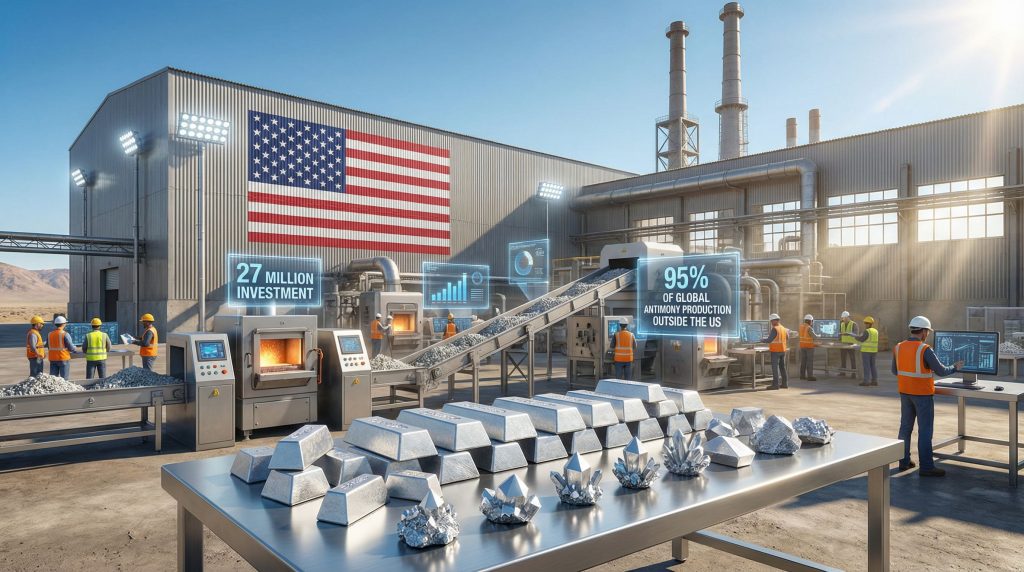
The Title III funding mechanism operates as a strategic investment framework designed to incentivise private sector capacity expansion in critical defence materials. The $27 million federal investment represents approximately 85.6% of total project costs, with United States Antimony Corporation contributing $3.9 million in private sector cost-sharing.
Investment Allocation Structure:
| Funding Source | Amount | Percentage | Purpose |
|---|---|---|---|
| Federal (Title III) | $27.0 million | 85.6% | Equipment, infrastructure, operations |
| Private (USAC) | $3.9 million | 14.4% | Cost-sharing requirement |
| Total Project | $30.9 million | 100% | Complete capacity expansion |
The Defence Production Act authorisation enables federal agencies to provide direct financial support to private producers when market mechanisms alone cannot justify domestic production investments. This approach acknowledges that international competitors, particularly state-subsidised operations in China and Russia, create cost structures that render domestic production economically unviable without government support.
Regulatory Framework for Critical Materials
Executive Order 14241, issued in March 2025, established comprehensive policy frameworks for critical minerals directive initiatives. This directive provides legal authority for federal agencies to prioritise domestic production capabilities over cost considerations when national security interests require supply chain resilience.
The $245 million sole-source contract awarded by the U.S. Defence Logistics Agency Strategic Materials division demonstrates federal commitment to long-term antimony procurement from domestic sources. Sole-source contracting authority eliminates competitive bidding requirements when only one qualified supplier exists, accelerating procurement processes for critical defence materials.
Federal Investment Context:
- $58.5 million total Defence Production Act Purchases Office investments in fiscal year 2026
- Multiple critical mineral projects receiving coordinated federal support
- Long-term procurement contracts guaranteeing market demand for domestic producers
Which Technical Challenges Must US Producers Overcome?
Operational Scaling Requirements
The transition from limited domestic production to industrial-scale operations presents multiple technical and logistical challenges. Current antimony processing capabilities must expand significantly to meet defence procurement requirements while maintaining quality specifications that exceed international standards.
Key Scaling Challenges:
- Processing equipment specifications accommodating feedstock quality variations from Alaska operations
- Workforce development programmes for specialised furnace operations and quality control
- Environmental compliance frameworks meeting federal and state regulatory requirements
- Transportation logistics for raw materials between Alaska extraction and Montana processing facilities
Quality assurance protocols for military-grade antimony compounds require sophisticated testing methodologies and documentation systems. Semiconductor applications demand purity levels exceeding 99.9%, while flame-retardant applications require specific particle size distributions and chemical stability characteristics.
Infrastructure Development Needs
The development of integrated domestic antimony production requires substantial infrastructure investments beyond basic mining and processing equipment. Transportation networks, environmental monitoring systems, and specialised storage facilities must support continuous operations while meeting military security requirements.
Capital Investment Requirements:
| Infrastructure Category | Investment Level | Timeline |
|---|---|---|
| Processing Equipment | High | 12-18 months |
| Transportation Systems | Medium | 6-12 months |
| Environmental Controls | High | Ongoing |
| Quality Assurance Labs | Medium | 3-6 months |
Moreover, workforce development represents a critical component of infrastructure expansion, as antimony processing requires specialised technical expertise not readily available in domestic labour markets. Training programmes must address furnace operations, chemical process control, and military specification compliance requirements.
How Does Domestic Production Compare to International Standards?
Global Competitive Analysis
The economic realities of domestic antimony production reflect structural disadvantages relative to international competitors, particularly Chinese operations that benefit from lower labour costs, reduced environmental compliance requirements, and potential state subsidisation. These factors necessitate federal intervention to achieve cost competitiveness.
Production Cost Structure Factors:
- Labour costs: U.S. unionised mining and processing labour significantly exceed international competitors
- Energy costs: Electricity and natural gas expenses impact processing economics
- Regulatory compliance: Environmental and occupational safety standards increase operational expenses
- Capital equipment: Advanced processing technology requires substantial upfront investments
The federal investment decision acknowledges that market mechanisms alone cannot overcome these cost disadvantages. United States Antimony Corporation's position as the only domestic processor outside China and Russia demonstrates both the capital-intensive nature of antimony refining and the market dominance established by lower-cost international producers.
Quality and Specification Benchmarking
Military applications require antimony compounds meeting specifications that often exceed commercial international standards. Defence procurement protocols demand comprehensive documentation, traceability systems, and quality verification processes that add costs while ensuring performance reliability.
Military Specification Requirements:
- Chemical purity standards exceeding 99.5% for semiconductor applications
- Impurity limits for specific elements (arsenic, bismuth, lead content restrictions)
- Particle size distribution requirements for flame-retardant applications
- Thermal stability characteristics for high-temperature defence applications
The premium associated with domestically-produced, security-vetted antimony reflects both higher production costs and the strategic value of supply chain independence. Defence contractors increasingly recognise that cost savings from international sourcing may be offset by supply disruption risks and security vulnerabilities.
The next major ASX story will hit our subscribers first
What Are the Long-term Implications for US Manufacturing?
Supply Chain Resilience Benefits
The development of domestic antimony production capabilities extends beyond immediate defence needs to encompass broader manufacturing resilience. Industries ranging from electronics to automotive manufacturing depend on antimony compounds for flame retardation and specialised applications.
Economic Impact Projections:
- Job creation in mining and processing sectors across Alaska and Montana
- Regional economic development opportunities in rural communities
- Reduced vulnerability to international supply disruptions
- Technology development spillovers to other critical mineral processing capabilities
The strategic significance of establishing domestic antimony production serves as a model for addressing similar vulnerabilities in other critical minerals. Rare earth elements, lithium compounds, and specialised alloys present comparable challenges requiring coordinated federal and private sector responses.
Strategic Industry Development
Investment in domestic antimony capacity supports broader objectives of critical mineral independence while fostering innovation in processing technologies. Advanced automation systems, environmental control technologies, and quality assurance methodologies developed for antimony production may apply to other strategic materials.
Additionally, the strategic antimony financing model demonstrates how public-private partnerships can accelerate US Antimony domestic production expansion initiatives across multiple projects.
Technology Development Opportunities:
- Next-generation processing techniques reducing environmental impact
- Automation systems improving operational efficiency and safety
- Quality control innovations ensuring military specification compliance
- Resource recovery technologies maximising extraction efficiency
The establishment of domestic antimony production capabilities demonstrates that strategic materials independence requires acceptance of higher costs in exchange for supply chain security and national defence readiness.
Future Outlook: Scaling Critical Mineral Independence
Investment Trends and Market Projections
The federal commitment to domestic antimony production reflects broader recognition that critical mineral independence requires sustained investment over multiple years. Current funding represents initial capacity development, with additional investments likely as defence requirements expand and technology advances.
Projected Development Milestones:
| Timeline | Milestone | Expected Outcome |
|---|---|---|
| 2026-2027 | Equipment Installation | Processing capacity expansion |
| 2027-2028 | Full Production | Military specification compliance |
| 2028-2030 | Capacity Optimisation | Cost reduction and efficiency gains |
| Beyond 2030 | Technology Innovation | Next-generation processing methods |
The success of antimony production scaling will likely influence federal policy toward other critical minerals, establishing precedents for public-private partnerships in strategic material development. Private sector confidence in government procurement commitments will determine investment levels in similar projects.
Technology Development Roadmap
Continued advancement in antimony processing technology offers opportunities for improved efficiency, reduced environmental impact, and enhanced product quality. Digital monitoring systems, automated process control, and advanced metallurgy may reduce operational costs while maintaining military specification compliance.
Furthermore, the implementation of the US production executive order provides regulatory support for these technological advancements, ensuring that domestic production initiatives receive priority in federal procurement processes.
Key Performance Indicators for Success:
- Production volume targets meeting defence procurement requirements
- Cost reduction trajectories approaching international competitiveness
- Quality metrics exceeding military specification standards
- Environmental compliance performance meeting regulatory requirements
- Workforce development outcomes supporting sustained operations
The long-term viability of domestic antimony production depends on sustained federal procurement commitments, continued technology development, and efficient operational scaling. Success in achieving supply chain independence for antimony will demonstrate the feasibility of similar approaches for other critical minerals essential to national security.
Consequently, the US Antimony domestic production expansion represents a critical milestone in establishing strategic mineral independence while maintaining technological competitiveness in global markets.
This analysis is based on publicly available information and should not be considered investment advice. Projections regarding future production capacity, costs, and market conditions involve significant uncertainties and may not reflect actual outcomes.
Ready to Invest in America's Critical Mineral Independence?
Discovery Alert's proprietary Discovery IQ model delivers real-time alerts on significant ASX mineral discoveries, instantly empowering subscribers to identify actionable opportunities ahead of the broader market in the strategic minerals sector. Begin your 14-day free trial today and secure your market-leading advantage in critical mineral investments.