May 9, 2026
Strategic partnerships in critical mineral supply chains represent one of the most consequential shifts in global economic policy since the end of the Cold War. As traditional commodity flows face unprecedented disruption from geopolitical tensions, resource-rich nations increasingly leverage their mineral wealth to secure favourable terms in bilateral agreements. The emerging US Brazil critical minerals deal exemplifies this fundamental restructuring of supply chain relationships, creating both opportunities and risks for established trading partners seeking to reduce dependency on dominant suppliers.
What Makes the US-Brazil Critical Minerals Partnership a Game-Changer for Global Supply Chains?
The emergence of strategic mineral cooperation frameworks between Western hemisphere nations signals a fundamental shift away from China-dominated supply chains. These partnerships transcend traditional commodity trading relationships by incorporating technology transfer requirements, domestic processing mandates, and long-term supply security provisions that reshape how nations approach mineral resource development.
Defining Strategic Mineral Cooperation in the Post-China Era
Modern critical mineral partnerships differ markedly from conventional trade agreements through their emphasis on supply chain resilience rather than cost optimisation. The US-Brazil critical minerals deal under negotiation encompasses over 50 mining projects spanning multiple mineral categories, representing a comprehensive approach to supply chain diversification. This partnership structure reflects growing recognition that strategic minerals require specialised frameworks addressing both economic and national security considerations.
The concept of friend-shoring has evolved beyond simple geographic proximity to encompass shared values regarding environmental standards, labour practices, and governance structures. Furthermore, Brazil's positioning as a key partner stems from its democratic institutions, established mining regulatory framework, and substantial untapped mineral reserves that complement existing Western hemisphere production capacity.
Brazil's Unique Position as a Western Hemisphere Mining Powerhouse
Brazil's mineral endowment positions the nation as a critical component in any comprehensive critical minerals strategy. The country's 21 million tonnes of rare earth reserves represent significant untapped potential for reducing global dependence on Chinese rare earth processing. However, Brazil's strategic value extends beyond reserve quantities to encompass established mining infrastructure, skilled workforce, and proximity to North American markets.
Geographic advantages compound Brazil's appeal as a strategic partner. Transportation costs from Brazilian mines to North American processing facilities remain substantially lower than equivalent routes from alternative suppliers in Africa or Asia. Consequently, this logistical efficiency becomes increasingly important as supply chain resilience considerations weigh more heavily in sourcing decisions.
When big ASX news breaks, our subscribers know first
How Does Brazil's Mineral Wealth Stack Up Against Global Competition?
Brazil's mineral inventory spans virtually every category of strategic importance to modern industrial economies. The nation's reserves provide potential alternatives to current supply concentrations in politically sensitive regions, though development timelines and infrastructure requirements vary significantly across different mineral categories.
Quantifying Brazil's Critical Mineral Reserves by Strategic Value
| Mineral | Global Rank | Estimated Reserves | Strategic Importance |
|---|---|---|---|
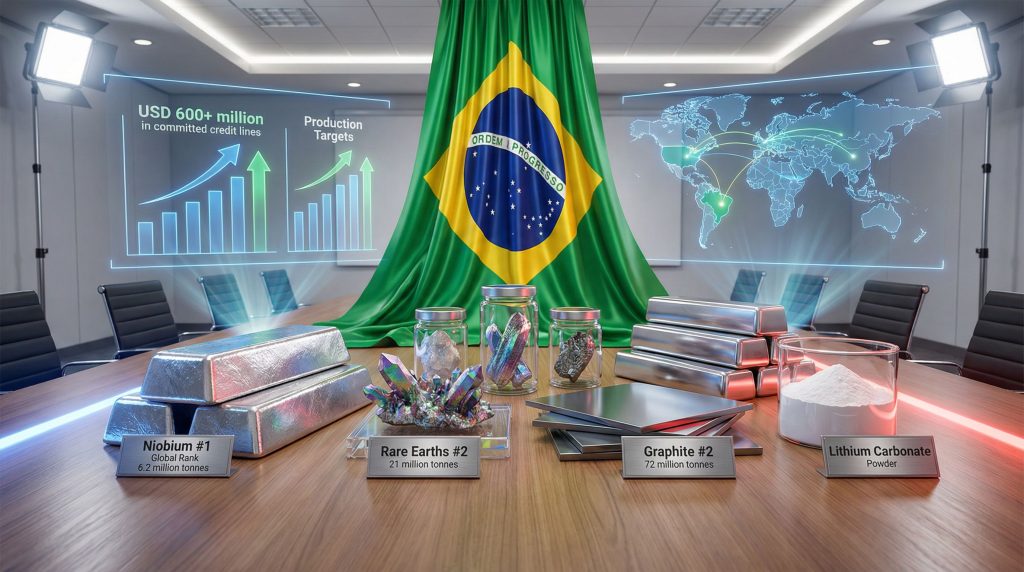
| Niobium | #1 | 6.2 million tonnes | Superalloy production |
| Rare Earths | #2 | 21 million tonnes | Technology manufacturing |
| Graphite | #2 | 72 million tonnes | Battery anodes |
| Nickel | #3 | 16 million tonnes | EV batteries |
| Lithium | #6 | 2.9 million tonnes | Energy storage |
Note: Reserve figures require verification against current geological survey data and may fluctuate based on exploration activities and resource classification standards.
Brazil's dominance in niobium production provides significant leverage in negotiations, as the metal remains essential for high-strength steel production in aerospace and energy applications. This monopoly-like position offers Brazil a template for developing similar strategic advantages across other mineral categories through targeted investment and development programs.
The rare earth reserves merit particular attention given their concentration in regions suitable for large-scale extraction operations. Unlike deposits in some competing nations, Brazilian rare earth resources often occur in geological formations that facilitate more environmental innovation in mining, addressing sustainability concerns that increasingly influence supply chain decisions.
Geographic Distribution and Mining Infrastructure Assessment
Brazil's mineral wealth demonstrates favourable geographic distribution across multiple states, reducing single-point-of-failure risks that characterise some competing supply sources. This distribution pattern enables development of redundant production capacity whilst minimising transportation bottlenecks that could disrupt supply continuity.
Existing mining infrastructure provides foundation for accelerated development timelines compared to greenfield operations in less developed regions. In addition, Brazil's established mining equipment suppliers, skilled workforce availability, and existing transportation networks create conditions conducive to rapid capacity expansion when market conditions justify investment.
What Financial Mechanisms Are Driving US Investment in Brazilian Mining?
The financial architecture supporting US-Brazil mineral cooperation reflects sophisticated development finance approaches designed to manage both commercial and strategic objectives. This framework combines traditional project finance structures with government-backed risk mitigation instruments specifically tailored to critical mineral development requirements.
DFC and EXIM Bank Funding Architecture Analysis
Combined credit facilities exceeding USD 600 million from the US International Development Finance Corporation (DFC) and Export-Import Bank represent substantial commitment to Brazilian mineral development projects. These funding mechanisms address market failures that typically prevent private sector investment in strategic mineral projects due to long development timelines, regulatory uncertainties, and volatile commodity pricing.
The financial structure incorporates several innovative elements:
• Risk-sharing arrangements between government agencies and private investors
• Performance-based disbursement schedules tied to production milestones
• Currency hedging mechanisms to manage exchange rate volatility
• Environmental compliance monitoring integrated with financing terms
DFC participation signals willingness to accept higher risk profiles than traditional commercial lenders, particularly regarding regulatory approval timelines and initial production ramp-up periods. This US EXIM loan case study demonstrates how patient capital approaches address fundamental mismatches between strategic mineral development requirements and conventional project finance expectations.
Case Study Breakdown: Serra Verde and Aclara Projects
Serra Verde operations achieved commercial production in 2024, establishing a precedent for successful rare earth development under the partnership framework. The project's target production of 6,500 metric tonnes of rare earth oxides annually by 2027 provides concrete benchmarks for evaluating subsequent development proposals.
Investment Timeline and Production Targets
Serra Verde achieved commercial production in 2024, targeting 6,500 metric tonnes of rare earth oxides annually by 2027. Aclara's operations commence in H2 2028 with full ramp-up throughout 2029.
Aclara's development timeline, with operations commencing in H2 2028 and full ramp-up throughout 2029, reflects more typical development schedules for complex mineral processing operations. The extended timeline accounts for environmental permitting requirements, infrastructure development, and workforce training programs necessary for sustainable operations.
These case studies demonstrate varying approaches to project development based on specific geological conditions, existing infrastructure availability, and local community engagement requirements. For instance, success factors identified across both projects include early stakeholder consultation, robust environmental management systems, and flexible financing structures accommodating development uncertainties.
Why Is Brazil Demanding Processing Capacity Over Raw Material Exports?
Brazil's negotiating position reflects sophisticated understanding of value chain economics and strategic leverage dynamics. The nation's insistence on domestic processing requirements represents departure from traditional commodity export models toward value-added manufacturing strategies that capture higher margins whilst developing domestic industrial capabilities.
Value-Added Manufacturing Strategy vs. Traditional Commodity Approach
Brazil's three key partnership conditions focus on domestic mineral processing requirements, ensuring local access to processed materials before exports, and developing downstream manufacturing capabilities rather than serving as raw materials supplier. This approach reflects lessons learned from historical commodity dependence cycles that concentrated value creation in importing nations while leaving resource-rich countries vulnerable to price volatility.
The processing requirement creates strategic advantages for Brazil:
• Higher employment levels in skilled manufacturing positions
• Technology transfer opportunities through joint ventures
• Reduced transportation costs for domestic industrial users
• Enhanced supply chain security for critical domestic applications
Manufacturing capacity development in batteries and semiconductors represents logical extension of mineral processing requirements. However, Brazil seeks to capture value-added manufacturing opportunities that leverage its mineral advantages whilst developing industrial capabilities applicable across multiple sectors.
Domestic Industrial Requirements and Export Surplus Calculations
Brazil's domestic industrial base requires substantial quantities of processed minerals for steel production, automotive manufacturing, and emerging renewable energy applications. Ensuring adequate domestic supply before committing to export arrangements reflects pragmatic approach to resource management that prioritises national industrial development.
Export surplus calculations must account for growing domestic demand driven by energy transition and minerals investments, infrastructure development programs, and industrial modernisation initiatives. This dynamic domestic demand environment complicates long-term export commitment planning but provides Brazil with additional negotiating leverage.
How Does China's Market Dominance Shape US-Brazil Negotiations?
China's overwhelming market position in critical mineral processing creates both urgency and complexity in US-Brazil partnership discussions. Understanding the scale and nature of Chinese dominance provides essential context for evaluating alternative supply chain development strategies and US critical minerals policy.
Chinese Critical Mineral Market Share Analysis
China controls approximately 67% of global rare earth production and 90% of rare earth refining capacity, creating unprecedented concentration in strategically important supply chains. This dominance extends beyond production volumes to encompass specialised processing technologies, equipment manufacturing, and downstream application development.
Chinese market control mechanisms include:
• Vertical integration across entire value chains
• Export quota systems managing global supply availability
• Technology licensing restrictions limiting alternative processing development
• Strategic stockpiling programs providing market manipulation capabilities
The concentration of refining capacity represents particularly significant challenge for supply chain diversification efforts. Even with alternative mining operations, processing bottlenecks could maintain Chinese leverage over global supply chains unless substantial refining capacity develops in alternative locations.
Friend-Shoring vs. Near-Shoring: Strategic Positioning Models
Friend-shoring strategies prioritise partnerships with nations sharing similar governance standards and strategic interests, while near-shoring emphasises geographic proximity for supply chain efficiency. The US-Brazil partnership combines both approaches through shared democratic values and Western hemisphere location advantages.
Strategic positioning considerations extend beyond immediate supply security to encompass long-term competitive dynamics. Furthermore, successful friend-shoring requires sustained commitment to partnership development even during periods of favourable market conditions or reduced geopolitical tensions.
What Role Does the March 2026 São Paulo Critical Minerals Forum Play?
The São Paulo Critical Minerals Forum represents concentrated effort to accelerate partnership development through direct industry engagement and deal-making opportunities. This forum format addresses networking gaps that often slow complex international partnership development.
Industry Participation and Deal-Making Opportunities
With over 100 companies participating, the forum represents the largest US-led mining event in Latin America, creating unprecedented opportunity for direct engagement between potential partners. The concentrated format enables rapid relationship development and preliminary agreement negotiation in ways that traditional trade missions or bilateral meetings cannot achieve.
Participation spans multiple industry categories:
• Mining companies seeking development partnerships
• Processing technology providers offering specialised expertise
• Equipment manufacturers targeting emerging market opportunities
• Financial institutions evaluating investment prospects
• Logistics providers developing transportation solutions
The forum structure facilitates both formal presentations and informal networking essential for complex partnership development. Success depends on translating initial contacts into concrete follow-up commitments and development agreements.
Anticipated Outcomes and Follow-Up Mechanisms
Forum organisers anticipate multiple partnership announcements and memoranda of understanding spanning different development stages and partnership structures. The concentrated engagement format enables rapid iteration on partnership terms and identification of potential deal-breakers before substantial negotiation resources are committed.
Follow-up mechanisms must address the transition from forum-generated interest to concrete development commitments. This includes establishing working groups for specific projects, defining due diligence processes, and creating accountability structures for partnership development progress.
The next major ASX story will hit our subscribers first
How Is Brazil Balancing Multiple International Partnerships?
Brazil's multi-partner approach reflects sophisticated strategy for maximising negotiating leverage whilst avoiding excessive dependence on any single relationship. This diversification strategy requires careful management to avoid conflicts between competing partnership requirements.
Diversification Strategy Analysis
Brazil's February 2026 agreements with India and South Korea demonstrate commitment to partnership diversification across different geographic regions and industrial capabilities. The Ministry of Mines and Energy has explicitly stated openness to working with multiple countries without exclusivity arrangements.
The diversification approach provides several strategic advantages:
• Reduced dependency risk on single partnership relationships
• Enhanced negotiating leverage through competitive alternatives
• Technology diversification across different industrial approaches
• Market diversification reducing exposure to single-economy downturns
However, managing multiple partnerships requires substantial administrative capacity and careful coordination to avoid conflicting commitments or partnership terms that create operational difficulties.
Competitive Positioning Against Other US Regional Partners
| Country | Agreement Status | Key Minerals | Strategic Focus |
|---|---|---|---|
| Brazil | Under Negotiation | Rare earths, lithium, nickel | Processing capacity |
| Argentina | Signed | Lithium | Extraction partnerships |
| Ecuador | Signed | Copper, gold | Mining development |
| Paraguay | Signed | Iron ore | Infrastructure |
| Peru | Signed | Copper, zinc | Production expansion |
Note: Agreement details require verification from official sources and may not reflect current status or complete terms.
Brazil's negotiating position benefits from its substantially larger mineral inventory and processing capacity potential compared to other regional partners. However, some partners offer advantages in specific mineral categories or development timeline flexibility that could influence partnership prioritisation decisions.
What Are the Environmental and Regulatory Hurdles?
Environmental and regulatory requirements represent significant complexity factors in US-Brazil partnership development. Balancing accelerated development timelines with environmental protection standards requires innovative approaches to regulatory coordination and compliance verification.
Sustainability Standards Integration Requirements
Partnership discussions emphasise streamlining environmental approvals whilst maintaining sustainability standards, with financing contingent on meeting international environmental benchmarks. This dual requirement creates tension between development urgency and environmental protection that requires careful management.
Regulatory Timeline Challenges
Current discussions focus on streamlining environmental approvals while maintaining sustainability standards, with financing contingent on meeting international environmental benchmarks.
International financing institutions typically require compliance with performance standards that may exceed local regulatory requirements. Consequently, this creates additional complexity layer requiring coordination between multiple regulatory frameworks and approval processes.
Accelerated Approval Processes vs. Environmental Protection
Accelerated approval mechanisms must address legitimate environmental concerns whilst reducing regulatory delays that discourage investment in strategic mineral development. This balance requires innovative regulatory approaches that maintain environmental protection standards whilst providing development timeline certainty.
Potential solutions include:
• Parallel review processes for related permits
• Fast-track procedures for projects meeting predetermined criteria
• Regulatory sandboxes for testing innovative approaches
• Integrated environmental management systems spanning multiple agencies
Success depends on maintaining stakeholder confidence in environmental protection whilst demonstrating tangible improvements in regulatory efficiency and predictability.
How Will Market Volatility Affect Long-Term Deal Viability?
Critical mineral markets demonstrate extreme volatility driven by supply disruptions, demand fluctuations, and speculative trading activities. Partnership structures must incorporate mechanisms for managing price volatility whilst maintaining long-term investment incentives.
Pricing Mechanism Design for Strategic Minerals
Partnership negotiations include pricing mechanisms to manage market volatility whilst ensuring project viability across different market conditions. These mechanisms must balance price stability requirements with market responsiveness to maintain competitiveness against alternative suppliers.
Potential pricing approaches include:
• Long-term contract pricing with adjustment mechanisms
• Price floors and ceilings protecting both buyers and sellers
• Volume-based pricing reflecting economies of scale
• Market index-linked pricing maintaining competitiveness
The optimal pricing structure depends on specific mineral characteristics, market dynamics, and partnership objectives. Flexibility mechanisms enable adjustment as market conditions evolve and partnership experience develops.
Risk Management Frameworks for Commodity Price Fluctuations
Effective risk management requires sophisticated financial instruments and operational flexibility to maintain project viability across different price environments. This includes both upside and downside price movements that could destabilise project economics or partnership relationships.
Risk management tools include hedging strategies, production flexibility mechanisms, and financial reserves for managing temporary market disruptions. Success depends on matching risk management approaches to specific project characteristics and market conditions.
What Does Success Look Like for Both Nations by 2030?
Partnership success requires measurable outcomes benefiting both nations whilst advancing broader supply chain diversification objectives. Success metrics must encompass economic, strategic, and environmental dimensions to provide comprehensive evaluation framework.
Production Target Scenarios and Supply Chain Integration
Successful partnership implementation could reduce US critical mineral import dependence on China by 15-20% whilst establishing Brazil as a major Western hemisphere processing hub. These targets require substantial investment coordination and development timeline execution across multiple projects and partnership arrangements.
Production scaling scenarios depend on successful integration of multiple development projects with varying timelines, technical requirements, and market positioning. Coordination challenges increase substantially as project numbers expand and interdependencies develop between different partnership components.
Technology Transfer and Industrial Development Outcomes
Technology transfer requirements create opportunities for both nations to develop advanced capabilities in mineral processing, equipment manufacturing, and downstream applications. Success depends on matching technology transfer arrangements with recipient capacity and development priorities.
Industrial development outcomes extend beyond immediate partnership projects to encompass broader industrial ecosystem development supporting long-term competitive advantages. This includes workforce development, supplier network expansion, and research and development capability enhancement.
Furthermore, the US Brazil critical minerals deal represents a significant step toward reducing Western dependence on Chinese supply chains whilst developing sustainable mineral processing capabilities in democratic nations. The partnership's success will largely depend on effective coordination between multiple stakeholders, innovative financing mechanisms, and balanced environmental protection measures.
Frequently Asked Questions
How long will negotiations take to finalise?
Negotiation timelines depend on resolution of processing capacity requirements, environmental approval streamlining, and pricing mechanism agreements. Complex partnership structures typically require 12-18 months for completion, though political priorities could accelerate or delay progress.
What happens if Brazil prioritises other international partnerships?
Brazil's diversification strategy includes multiple partnerships without exclusivity commitments. US partnership success depends on offering competitive terms and maintaining engagement intensity despite Brazilian flexibility in partner selection.
How will this affect global critical mineral prices?
Substantial new supply capacity could moderate price volatility and reduce Chinese pricing leverage, though market impacts depend on development timeline success and production scaling achievement. Price effects will likely emerge gradually as production capacity increases. Additionally, US investment in Latin American mining could further influence regional pricing dynamics.
What are the main risks to deal completion?
Primary risks include environmental approval delays, financing coordination difficulties, and political changes affecting partnership priorities. Technical development challenges and market volatility could also influence partnership viability and timeline achievement.
Disclaimer: This analysis contains forward-looking statements and projections based on current information. Actual outcomes may differ significantly from projections due to market conditions, regulatory changes, technical challenges, and other factors beyond the control of partnership participants. Investment decisions should not be based solely on this analysis.
Looking to Capitalise on Critical Minerals Investment Opportunities?
Discovery Alert's proprietary Discovery IQ model identifies significant ASX mineral discoveries in real-time, delivering actionable insights for traders and investors seeking to position themselves ahead of market movements in critical minerals and emerging commodity sectors. Explore how major mineral discoveries have generated substantial returns throughout history and begin your 14-day free trial today to gain immediate access to Discovery Alert's cutting-edge market intelligence.