August 10, 2026
The Hidden Architecture of Modern Defense: Why Minerals Now Drive Military Readiness
For most of the twentieth century, military supremacy was measured in tonnage, airframes, and warheads. Raw material supply chains were logistical footnotes, not strategic vulnerabilities. That calculus has shifted dramatically. The components powering today's precision-guided munitions, autonomous drone swarms, and electronic warfare systems depend on US critical minerals investments for defense supply chains — a set of materials whose refining and processing infrastructure sits overwhelmingly outside US borders. The result is a supply chain architecture that, in a conflict scenario, could become a decisive liability before a single shot is fired.
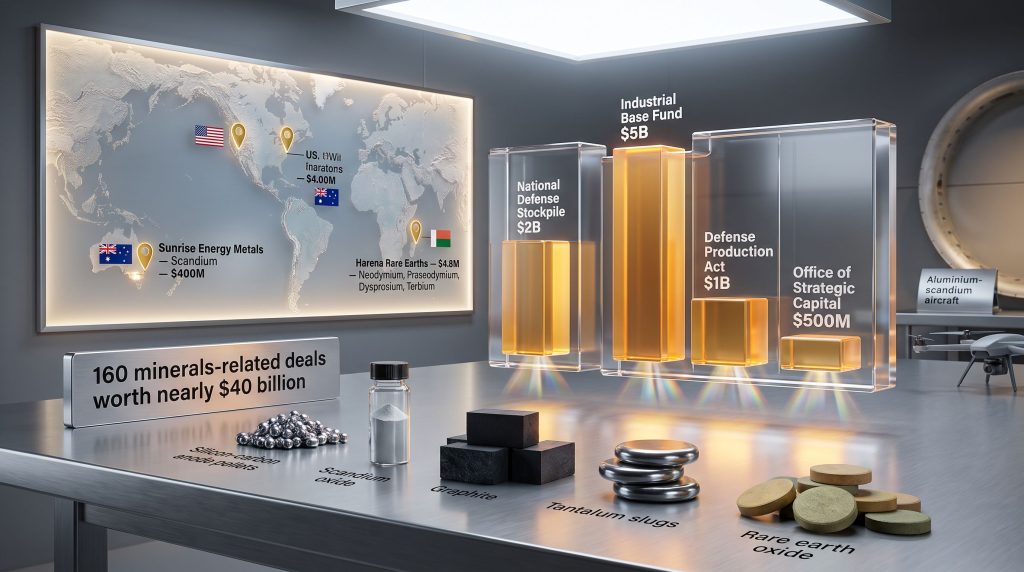
This structural exposure has triggered what now amounts to the largest coordinated investment programme in history. Since January 2025, the administration has approved or signed approximately 160 minerals-related deals worth nearly $40 billion, with the most recent tranche exceeding $2 billion committed during a mining industry roundtable hosted by President Trump on August 7, 2026. Understanding why this capital is flowing, where it is going, and what gaps remain requires looking beyond the headlines and into the technical and geopolitical mechanics driving the decisions.
When big ASX news breaks, our subscribers know first
Why Supply Chain Risk Lives in Refining, Not the Ground
A common misconception frames the critical minerals problem as a shortage of ore in the earth's crust. In reality, many of the materials the Pentagon most urgently needs exist in commercially viable concentrations across multiple continents. The actual chokepoint is what happens after extraction: chemical separation, refining to defence-grade purity, and conversion into finished components.
China has spent three decades building dominance not just in mining but across the entire value chain. It controls the majority of global rare earth separation capacity, produces the overwhelming share of the world's permanent magnets, and commands near-total market positions in refined gallium, germanium, and graphite. For the US defence industrial base, this creates single-point-of-failure risks that span some of its most sophisticated weapons systems:
- Missile guidance systems rely on rare earth permanent magnets for actuators and control surfaces
- Aircraft avionics and radar depend on gallium arsenide and other compound semiconductors
- Armoured vehicle drive systems and autonomous platforms increasingly incorporate rare-earth-dependent electric motors
- Drone propulsion and power storage require battery-grade graphite and high-energy-density cell chemistries
Defence supply chain vulnerability is rarely a mining problem. It is a refining and component manufacturing problem, and US policy is now beginning to address the full chain rather than just the extraction layer.
Furthermore, this insight is central to how the current investment framework has been designed. Rather than funding prospecting and drilling exclusively, the majority of capital is flowing into midstream processing, domestic manufacturing, and battery materials production. The critical minerals demand surge seen across defence and clean energy sectors has made this strategic pivot not only logical but urgent.
The Four-Track Financing Architecture Behind the Capital Surge
The US critical minerals investments for defense supply chains are being deployed through four distinct but complementary mechanisms, each targeting a different part of the problem:
- Department of Defense Office of Strategic Capital (OSC) conditional loans — direct financing for projects with clear defence applications and domestic or allied-nation production
- Export-Import Bank lending — structured financing for smaller projects and allied-nation resource development
- National Defense Stockpile capitalisation — physical reserve accumulation managed through the Defense Logistics Agency
- Public-private partnerships — blended finance structures combining government loan guarantees with private equity co-investment
The legislative foundation enabling this deployment was restructured through the One Big Beautiful Bill Act, which established the following allocations:
| Legislative Allocation | Funding Amount | Primary Purpose |
|---|---|---|
| National Defense Stockpile | $2 billion | Strategic reserve buildup |
| Industrial Base Fund | $5 billion | Domestic manufacturing capacity |
| Defense Production Act Financing | $1 billion | Priority materials production |
| Office of Strategic Capital | $500 million | Conditional loan authority |
Separately, the US government established Project Vault in February 2026, a public-private partnership designed to create a strategic minerals reserve backed by a loan facility of up to $10 billion from the Export-Import Bank alongside $2 billion in private industry co-investment. The critical distinction between a stockpile and a domestic supply chain is that stockpiles are consumable buffers, while processing and manufacturing capacity represents permanent, self-renewing resilience.
A Complete Map of the August 2026 Investment Round
The latest tranche of US critical minerals investments for defense supply chains spans eight recipients across a range of strategically important materials and technologies:
| Recipient | Funding Committed | Mineral Focus | Defence and Industrial Applications |
|---|---|---|---|
| Sila Nanotechnologies | $1.4 billion (DoD OSC conditional loan) | Silicon-carbon battery anodes | Drones, autonomous systems, military communications, energy storage |
| Sunrise Energy Metals | $400 million (DoD OSC conditional loan) | Scandium | Aerospace aluminium alloys, military aircraft, spacecraft, missiles |
| Niron Magnetics | $150 million (DoD OSC conditional loan) | Iron nitride permanent magnets | EV motors, robotics, drone systems, data centre cooling |
| Standard Bauxite | $85 million+ | Refractory-grade bauxite | Heat shields, turbine engines, guided missiles, military aircraft |
| Westwater Resources | $25 million (EXIM Bank) | Graphite | Lithium-ion batteries, EV and grid storage |
| Global Advanced Materials | $25 million (EXIM Bank) | Tantalum, niobium | Electronics, semiconductors, superalloys |
| 5E Advanced Materials | $8 million (EXIM Bank) | Boron | Magnets, semiconductors, specialty glass, clean energy |
| Harena Rare Earths | $4.8 million (DFC matched investment) | Neodymium, praseodymium, dysprosium, terbium | Permanent magnets for EV motors, wind turbines, data storage |
This round follows the June 2026 commitment of $2.9 billion in direct federal funding toward rare earth metals and permanent magnet supply chains outside China, reinforcing a consistent strategic direction rather than representing a one-off announcement.
Scandium: The $400 Million Supply Chain Being Built From Near-Zero
Of all the materials receiving investment attention, scandium may represent the starkest illustration of strategic supply chain fragility. Despite its remarkable performance characteristics, the global commercial scandium market outside China remains thin to the point of dysfunction.
Scandium alloyed with aluminium at concentrations as low as 0.1 to 0.5 percent by weight produces materials with significantly enhanced strength, weldability, and corrosion resistance compared to standard aerospace aluminium grades. These properties are directly relevant to next-generation military aircraft frames, missile structural components, and spacecraft. The strength-to-weight improvement is not incremental; in some applications it enables structural designs that are simply not achievable with conventional alloys.
The supply landscape outside China is stark. Rio Tinto produces high-purity scandium oxide as a by-product of titanium dioxide processing at its Quebec facility, but this output is insufficient to support defence-scale demand. NioCorp's Elk Creek Project in Nebraska is targeting 100 tonnes of annual scandium production beginning in 2028, a development significant enough that Lockheed Martin signed a non-binding memorandum of understanding on August 4, 2026 for potential supply of up to 15 tonnes per year of scandium oxide or aluminium-scandium alloy products over a ten-year period.
Sunrise Energy Metals, the recipient of the $400 million DoD OSC conditional loan, is developing a scandium project located approximately 460 kilometres west of Sydney, Australia, with production targeted for the second half of 2028. The inclusion of an Australian project within a US defence financing framework reflects the broader allied-nation sourcing model now embedded in US critical minerals policy. In this context, Australia's defence critical materials strategy has become an increasingly integral part of the allied supply chain architecture.
What is scandium used for in defence? Scandium is combined with aluminium to produce lightweight, high-strength structural materials used in military aircraft frames, spacecraft, and missile components. Its extremely limited commercial supply outside China makes allied-nation and domestic supply development a high-priority national security objective.
Silicon Anodes and the $1.4 Billion Battery Materials Bet
The single largest commitment in the August 2026 round went to California-based Sila Nanotechnologies: a $1.4 billion conditional loan from the DoD OSC to expand domestic silicon-carbon anode production capacity.
The strategic logic behind this investment is grounded in the physics of battery chemistry. Conventional lithium-ion batteries use graphite anodes, which store lithium ions through an intercalation mechanism with relatively low volumetric capacity. Silicon anodes, by contrast, can theoretically store approximately ten times more lithium ions per unit volume than graphite, enabling substantially higher energy density in the same cell form factor.
For defence applications, this translates directly into:
- Extended operational duration for reconnaissance and combat drones without increasing airframe weight
- Longer mission endurance for autonomous ground systems
- Reduced battery weight for soldier-portable power systems and communications equipment
- Higher energy-to-weight ratios for autonomous naval platforms
The challenge with silicon anodes has historically been volumetric expansion during charge-discharge cycling, which degrades cell longevity. Silicon-carbon composite architectures, the specific technology Sila Nanotechnologies has commercialised, address this through engineered particle structures that accommodate expansion while maintaining electrical connectivity. Consequently, funding domestic production of this technology reduces dependence on Asian battery material supply chains that currently supply the majority of global anode material.
The next major ASX story will hit our subscribers first
Rare-Earth-Free Magnets: The Iron Nitride Breakthrough and What It Means Strategically
The $150 million commitment to Niron Magnetics addresses what analysts consider one of the most structurally important vulnerabilities in the defence supply chain: the dependence of high-performance permanent magnets on rare earth supply chains whose processing is concentrated in China.
Neodymium-iron-boron (NdFeB) magnets power everything from guided missile actuators to the electric drive motors in next-generation military vehicles. The rare earth inputs, particularly dysprosium and terbium which are added to maintain magnetic performance at elevated temperatures, are refined almost exclusively in China. Even if mining were diversified, the absence of non-Chinese separation and magnet manufacturing capacity creates a persistent vulnerability.
Iron nitride as a magnetic material offers a theoretically attractive alternative. Its maximum energy product potential in ideal crystalline form competes with rare earth magnets, and it contains no critical materials subject to export control or supply concentration risk. The manufacturing scalability and consistency of iron nitride magnets at commercial grade remains a development challenge, which is precisely what the Niron Magnetics investment is designed to resolve. Success in this area would represent a structural shift in the defence magnet supply chain rather than a marginal improvement.
The Supporting Cast: Boron, Graphite, Tantalum, Niobium, and Refractory Bauxite
While the largest dollar figures attract the most attention, the smaller investments in this round address supply chain vulnerabilities that are equally real if less publicised.
Boron was added to the US critical minerals list in November 2025 as part of the third revision since Executive Order 13817 established the programme in 2017. Its relevance spans magnet manufacturing, semiconductor dopants, and specialty glass applications. The $8 million EXIM Bank commitment to 5E Advanced Materials supports production from the Fort Cady boron and lithium project in Southern California.
Graphite serves dual strategic purposes: as the anode material in virtually all lithium-ion batteries currently in production, and as a moderator material in nuclear reactors. The $25 million EXIM Bank commitment to Westwater Resources supports graphite production from the Coosa graphite deposit in Alabama.
Tantalum and niobium are irreplaceable in capacitors used across defence electronics, in superalloys for high-temperature aerospace components, and in specialised semiconductor applications. The importance of these materials is further underscored when considering critical minerals for semiconductors and their role in advanced defence electronics. The $25 million commitment to Global Advanced Materials supports development of tantalum and niobium resources in Pennsylvania.
Refractory-grade bauxite is an often-overlooked but critical material. High-purity bauxite underpins heat-resistant ceramics used in missile heat shields, thermal barrier coatings on turbine blades, and refractory linings in industrial furnaces. The $85 million-plus commitment to Standard Bauxite addresses a domestic supply baseline that currently falls well short of defence-grade requirements.
Magnet rare earths from Madagascar: The $4.8 million DFC matched investment in Harena Rare Earths' Ampasindava Ionic Clay project targets neodymium, praseodymium, dysprosium, and terbium. Ionic clay deposits carry a processing advantage over hard rock rare earth ores: the rare earth ions are adsorbed onto clay mineral surfaces rather than locked in crystalline mineral structures, which means they can often be extracted through simpler hydrometallurgical techniques at lower processing temperatures and energy inputs. This makes ionic clay deposits strategically attractive for projects seeking faster pathways to commercial production.
Furthermore, the role of antimony in defence applications deserves mention alongside these investments, as the Defense Logistics Agency has also been actively procuring antimony for the national stockpile, recognising its critical role in ammunition, flame retardants, and night-vision systems.
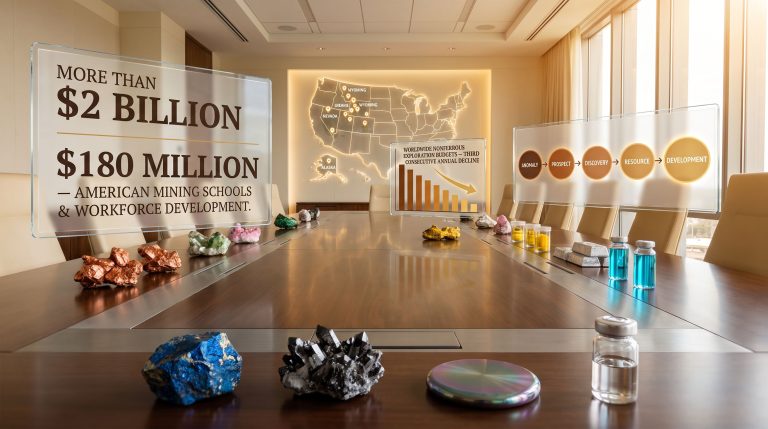
Building the Human Capital Layer: The $180 Million Workforce Investment
Capital investment in projects is a necessary but insufficient condition for supply chain resilience. The structural shortage of qualified mining engineers, metallurgists, and geologists in the US domestic workforce represents a binding constraint on how quickly funded projects can actually reach production.
The administration's $180 million workforce package addresses this through two parallel tracks:
| Programme | Funding | Focus Area |
|---|---|---|
| Department of Energy grants to 14 US mining schools | $100 million | Increasing graduates in mining, minerals, and supply-chain disciplines |
| Workforce development programmes and technology innovation hubs | $80 million | Training geologists, metallurgists, and mining engineers |
The lag between education investment and operational impact is substantial. A mining engineer who begins university study in 2026 will not reach professional competence until 2030 at the earliest. This timeline dynamic means that today's workforce funding shapes the supply chain capabilities of the mid-2030s, not the near term. The strategic stockpile and allied-nation sourcing agreements are intended to bridge the gap.
Tightening the Procurement Rules: The July 2026 Executive Order
Alongside capital deployment, the administration has moved to close the waiver loopholes that previously allowed defence contractors to continue sourcing from restricted foreign suppliers when domestic alternatives were unavailable or more expensive.
The late July 2026 executive order makes it materially harder to obtain these waivers, and introduces a supply chain mapping requirement that traces material origins back to raw extraction rather than stopping at tier-one component suppliers. This change has significant implications for existing defence procurement pipelines, where the full material provenance of complex systems has often not been systematically documented.
The broader policy mandate requires that defence-critical materials originate from the US or allied nations. Australia and Canada feature prominently in this framework, as does Madagascar through the DFC investment in Harena Rare Earths. According to the US-Australia framework for securing supply, this allied-nation integration model represents a meaningful evolution from the purely domestic sourcing ambitions of earlier critical minerals policy.
Benchmarking US Investment Against Global Peers
| Country/Bloc | Primary Mechanism | Estimated Committed Capital | Key Mineral Focus |
|---|---|---|---|
| United States | DoD OSC loans, EXIM Bank, DLA stockpiling, DPA Title III | $40 billion+ cumulative since January 2025 | Rare earths, scandium, graphite, battery materials, magnets |
| European Union | Critical Raw Materials Act, EIB financing | Multi-billion euro framework | Lithium, rare earths, cobalt, nickel |
| Australia | Critical Minerals Facility, NAIF | AUD billions | Lithium, rare earths, cobalt, nickel, scandium |
| China | State-directed enterprise investment, export controls | Dominant across full supply chain | All critical minerals categories |
| Canada | Critical Minerals Strategy, federal loans | CAD billions | Lithium, cobalt, nickel, graphite, rare earths |
What differentiates the US approach is its explicit defence-application framing and its use of conditional loans rather than outright grants, which introduces a degree of project discipline absent from some allied programmes. The integration of overseas projects within the US defence financing architecture, as demonstrated by the Sunrise Energy Metals commitment in Australia, blurs the traditional distinction between domestic and foreign investment in ways that are likely to become more common. As Deloitte's analysis of defence supply chain resilience highlights, enhancing critical minerals supply chain resilience for aerospace and defence now requires a truly global strategic approach.
Where the Strategy Remains Vulnerable: Four Structural Risks
The scale of US critical minerals investments for defense supply chains is historically unprecedented. However, capital commitment and operational supply chain resilience are not the same thing. Four structural risks deserve scrutiny:
Risk 1: Processing bottlenecks persist despite mining investment. The most significant single indicator that US policy is beginning to address this is the DoD OSC's earlier $150 million loan to MP Materials for heavy rare earth separation at Mountain Pass, California. However, the broader separation, alloy production, and battery-grade processing infrastructure remains underdeveloped relative to the ambition of the investment programme.
Risk 2: Project timelines exceed strategic planning horizons. Most funded projects, including both the Sunrise Energy Metals scandium project and NioCorp's Elk Creek, target production in 2028. The gap between today's procurement needs and the date when new domestic supply reaches operational scale is real and significant.
Risk 3: Geopolitical escalation could compress available timelines. Allied-nation supply agreements with Australia, Canada, and Madagascar provide near-term risk mitigation, but are themselves subject to shipping route vulnerability and bilateral political dynamics.
Risk 4: Permitting and workforce constraints compound each other. Even well-funded projects face multi-year permitting timelines under current US regulatory frameworks. When combined with the skills shortage documented by the $180 million workforce investment, the compounding effect on delivery timelines is significant.
The US critical minerals defence investment programme is the most ambitious by dollar volume in the nation's history. However, capital commitment alone does not resolve the structural challenges of processing capacity, workforce depth, and permitting timelines. The gap between announced investment and operational supply chain resilience remains the central execution risk.
Frequently Asked Questions: US Critical Minerals Investments for Defence Supply Chains
What is the total value of US critical minerals defence investments since January 2025?
The administration has signed or approved approximately 160 minerals-related deals worth nearly $40 billion since January 2025, spanning mining, processing, battery materials, magnet production, and allied-nation supply chain development.
Which agencies are leading US defence minerals financing?
The Department of Defense Office of Strategic Capital (OSC) is the primary vehicle for large conditional loans. The US Export-Import Bank and the US International Development Finance Corporation (DFC) are also active participants in the broader investment framework, targeting smaller projects and allied-nation developments.
Why is scandium strategically important for US defence?
Scandium alloyed with aluminium produces materials with exceptional strength-to-weight ratios used in military aircraft frames, spacecraft structures, and missile components. Commercial supply outside China is extremely limited, making allied-nation and domestic production a high-priority national security objective.
What is the Defense Logistics Agency's role in critical minerals security?
The Defense Logistics Agency (DLA) manages procurement for the US national stockpile, issuing purchase requests for materials including antimony, bismuth, cobalt, indium, and fluorspar. It functions as the operational arm for translating policy mandates into physical stockpile accumulation.
When was boron added to the US critical minerals list?
Boron was added to the US critical minerals list in November 2025, as part of the third revision since the programme was established under Executive Order 13817 in 2017.
How does the US strategy address refining capacity, not just mining?
The strategy increasingly targets midstream capacity, including DoD OSC loans for heavy rare earth separation at Mountain Pass and investment in Niron Magnetics for rare-earth-free permanent magnet manufacturing. The explicit policy goal is to build a complete domestic supply chain from raw extraction through to finished defence components.
Readers seeking detailed pricing data, supply chain developments, and market analysis across aerospace, defence, and battery materials sectors can explore the broader coverage available through Fastmarkets, which tracks commodity price movements and industry analysis relevant to critical minerals markets.
Want to Identify the Next Major Mineral Discovery Before the Market Does?
Discovery Alert's proprietary Discovery IQ model delivers real-time ASX alerts the moment significant mineral discoveries are announced — turning complex data across critical commodities like rare earths, graphite, and battery materials into clear, actionable insights for investors at every level. Explore historic discoveries and their exceptional market returns to understand the opportunity, then begin your 14-day free trial and position yourself ahead of the broader market.