July 21, 2026
The Mechanics of a Rolling Waiver: How the US Manages Russian Oil in Transit
Global commodity sanctions rarely operate with the surgical precision their architects intend. When crude oil is already aboard a tanker in international waters, the legal and logistical reality of enforcement becomes far more complex than any policy blueprint anticipates. The architecture surrounding in-transit cargo represents one of the least understood dimensions of modern sanctions law, and the ongoing US extends sanctions waiver for Russian oil at sea approach offers a revealing case study in how regulators navigate that complexity in real time.
The question is not simply whether Washington is enforcing its sanctions on Russian energy. The more nuanced and consequential question is how it is doing so, through what legal instruments, and what the repeated use of those instruments reveals about the broader strategic calculus at play.
When big ASX news breaks, our subscribers know first
Understanding General Licenses Under OFAC's Regulatory Framework
The US Treasury's Office of Foreign Assets Control, universally known as OFAC, is the federal body responsible for administering and enforcing economic sanctions. It operates through two primary licensing mechanisms: specific licences and general licences.
A specific licence is issued to a named party for a defined purpose, effectively an individual permission slip. A general licence, by contrast, is a regulatory instrument that authorises a category of transactions for any eligible party without requiring individual application. General licences are used when OFAC determines that a blanket carve-out, however narrow, serves a legitimate policy purpose — typically market stability, humanitarian need, or allied-nation coordination.
Critically, general licences are almost always time-limited. This is not an oversight. It reflects OFAC's need to retain enforcement flexibility while managing the real-world consequences of abrupt policy application. The time-bound structure allows Treasury to reassess conditions, observe market responses, and adjust course without abandoning the formal sanctions architecture. Furthermore, the sanctions on Russian oil trade have created layered compliance obligations that extend well beyond simple cargo restrictions.
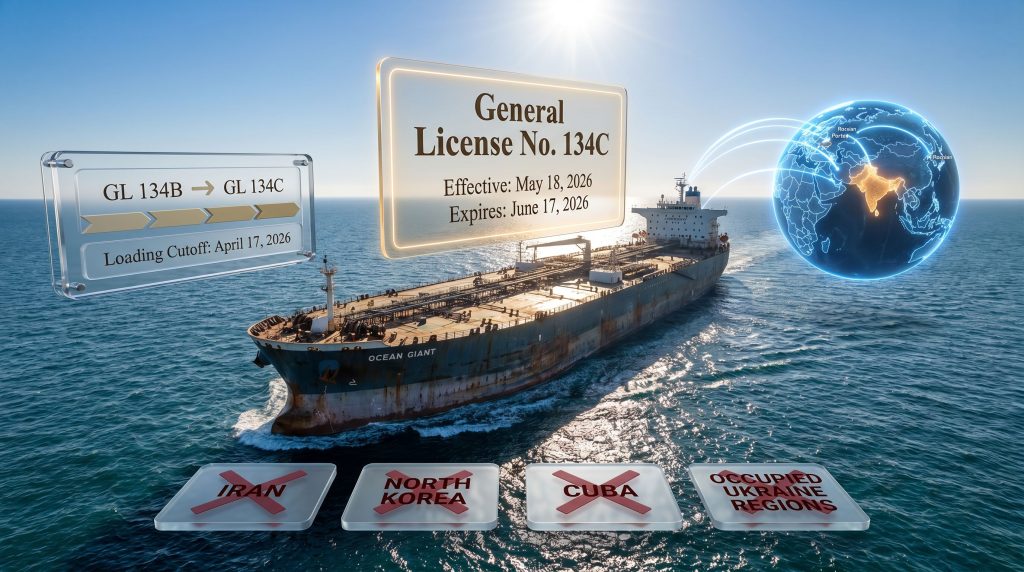
In the context of Russian oil, General Licence No. 134C represents the current iteration of a waiver chain that has evolved across multiple extensions since early 2026. It was issued on 18 May 2026, replacing and superseding General Licence No. 134B in its entirety. Its coverage window runs through 17 June 2026, maintaining the approximately 30-day renewal cadence that has characterised every prior extension.
The eligibility anchor throughout this entire waiver chain has remained fixed: only crude oil and petroleum products physically loaded onto vessels on or before 17 April 2026 qualify for protection. No cargo loaded after that date benefits from this licence, regardless of how many subsequent extensions are issued.
A Chronological Map of the Russian Oil Waiver Chain
The progression from country-specific exemptions to a broad General Licence reveals an increasingly systemic policy approach. The table below maps the key milestones in this evolving framework.
| Licence Stage | Approximate Issue Date | Expiry Date | Key Characteristics |
|---|---|---|---|
| India-Specific Exemption | ~5 March 2026 | ~11 April 2026 | First narrow carve-out for Indian buyers |
| Multi-Country Extension | ~10 March 2026 | 11 April 2026 | Expanded to additional importing nations |
| General Licence 134B | 17 April 2026 | 16 May 2026 | Superseded prior waivers; broadened scope |
| General Licence 134C | 18 May 2026 | 17 June 2026 | Current active licence; replaces 134B entirely |
The shift from country-designated exemptions to a General Licence is more significant than it may appear. Country-specific waivers require explicit identification of beneficiary nations and create diplomatic asymmetries. A General Licence removes that bilateral dimension, applying more uniformly across eligible transaction types while maintaining the same underlying policy logic. Consequently, the oil price geopolitical factors at play have made these incremental policy distinctions increasingly consequential for global markets.
Why In-Transit Cargo Creates a Distinct Legal Problem
The legal complexity of in-transit oil is rooted in a fundamental characteristic of maritime trade: once crude is loaded and a vessel departs, multiple legal jurisdictions, contractual obligations, and financial instruments are simultaneously activated. A shipping company, a cargo insurer, a commodity trader, and an end-user refinery may each be operating under different national legal frameworks, none of which cleanly align with each other.
If OFAC were to apply sanctions to cargo already mid-voyage without a transitional waiver, several cascading consequences would follow:
- Shipping operators would face immediate exposure to penalties for completing a voyage that was legally authorised when it began
- Cargo insurers would confront ambiguous liability positions on policies already underwritten
- Refineries with scheduled intake would face sudden supply gaps, driving spot market volatility
- Tanker owners could be forced to divert or anchor vessels indefinitely, with no clear legal resolution pathway
This scenario, sometimes described in trade circles as cargo stranding, is precisely what the in-transit waiver architecture is designed to prevent. The alternative approach, applied in post-2018 Iran sanctions, involved no systematic in-transit waivers and resulted in documented tanker disputes and forced cargo diversions that disrupted markets well beyond the intended scope of enforcement.
How Does This Compare to Other Sanctions Regimes?
Comparison of how different sanctions regimes have managed in-transit cargo illustrates the range of policy outcomes. Iran's approach produced significant market disruption. The Venezuela oil market impact demonstrated how a limited case-by-case model created partial instability and shadow fleet expansion. Russia's rolling General Licence model has maintained broader market continuity, though not without ongoing compliance debate.
Who Is Covered, and Where the Hard Limits Fall
General Licence No. 134C authorises transactions related to qualifying Russian crude and petroleum products — including delivery, payment processing, insurance, and shipping services — provided the parties involved are not connected to four explicitly excluded jurisdictions:
- Iran — any person, entity, or joint venture located in Iran is ineligible
- North Korea — transactions involving North Korea-linked parties are prohibited
- Cuba — Cuba-connected entities remain outside the licence's scope
- Certain occupied regions of Ukraine — specific territorial carve-outs apply
These exclusions are not simply diplomatic gestures. They carry serious compliance implications for every party in the transaction chain. A commodity trading intermediary whose counterparty has even indirect financial exposure to an excluded jurisdiction could find its licence protection voided entirely.
Compliance consideration: Enhanced due diligence on counterparty nexus is not optional under GL 134C. The four excluded jurisdictions create meaningful screening obligations that extend beyond direct counterparties to include beneficial ownership structures, vessel registration chains, and financial intermediaries.
The Geopolitical Logic Behind Each 30-Day Extension
Each renewal cycle in this waiver chain carries a dual function that goes beyond mere market management. Diplomatically, the 30-day window serves as a calibration mechanism, allowing Washington to signal enforcement intent to allied partners while avoiding the economic blowback that abrupt cargo-level sanctions would generate in markets that depend on Russian crude.
India was among the first beneficiaries of this waiver architecture, receiving a country-specific exemption beginning 5 March 2026. Indian refiners had become among the largest buyers of discounted Russian seaborne crude following the 2022 price cap framework. Any sudden enforcement without transition provisions would have created significant supply disruption in one of the world's largest oil-consuming economies. However, the broader global trade war fallout has added additional complexity to these already delicate energy diplomacy calculations.
The tension in this policy approach is real and openly debated among sanctions analysts. There is a credible argument that each successive renewal — particularly when preceded by signals from senior Treasury officials suggesting the waiver would not be extended — erodes the deterrent credibility of the broader sanctions regime.
What Are the Key Criticisms of the Rolling Waiver Model?
Critics of the rolling waiver model raise several pointed concerns:
- Moscow may interpret repeated extensions as evidence that enforcement has a practical ceiling
- The predictable 30-day renewal pattern creates a de facto planning window for future cargo loading decisions by sanctioned entities
- Verification of the April 17 loading cutoff date is inherently difficult given the documentation practices observed within the so-called shadow fleet of tankers operating outside Western maritime tracking systems
- Legislative voices in Washington have questioned whether the waiver chain has functionally hollowed out the price cap's enforcement mechanism
Supporters of the continued extensions counter that the alternative carries its own risks — including driving qualifying cargo toward jurisdictions entirely outside Western financial oversight, damaging allied economic relationships, and undermining US credibility as a predictable regulatory actor in global commodity markets. In addition, the trade war market impacts have further complicated the strategic environment in which these decisions are being made.
The next major ASX story will hit our subscribers first
What the Shadow Fleet Dynamic Adds to the Compliance Picture
One element that complicates the entire waiver architecture is the role of vessels operating outside conventional maritime insurance and classification systems. According to reporting by DW, a substantial portion of Russian seaborne oil exports since 2022 has moved aboard tankers that do not use Western P&I clubs for insurance and are not classified by major international maritime bodies. These vessels have limited visibility in standard cargo tracking systems.
This creates a verification problem that is difficult to overstate. The 17 April loading cutoff date is the single eligibility anchor across all iterations of this waiver chain, but establishing precisely when a given cargo was loaded aboard a vessel that operates outside normal documentation frameworks is not straightforward. It creates an asymmetry between the policy's stated precision and the practical limits of enforcement verification.
For legitimate commodity traders and shipping operators seeking to use GL 134C's protections, this ambiguity reinforces the importance of robust documentation practices, vessel history verification, and independent loading confirmation before relying on the licence as a compliance shield.
Key Structural Takeaways for Market Participants
For energy traders, refinery operators, shipping companies, and compliance professionals tracking the US extends sanctions waiver for Russian oil at sea development, several structural observations are worth carrying forward. France 24 has reported extensively on these developments, highlighting the broader market implications as each new waiver extension is announced.
Furthermore, the following points represent the most critical considerations for affected parties:
- The April 17 loading cutoff is immovable. Every extension to date has preserved this date as the eligibility boundary. New cargo loaded after that date has no path to coverage under any version of this licence.
- GL 134C expires 17 June 2026. Market participants should be monitoring OFAC closely in the days preceding that date for any indication of a further extension or, alternatively, a formal wind-down announcement.
- The four excluded jurisdictions create active compliance exposure. Sanctions violations stemming from counterparty nexus to Iran, North Korea, Cuba, or specified Ukrainian territories are not mitigated by the General Licence, regardless of the cargo's loading date.
- The waiver architecture does not signal a relaxation of the broader regime. All Russian energy sanctions outside this narrow cargo-in-transit carve-out remain fully operative.
- Asian refinery exposure remains central to the policy calculus. The consistent inclusion of India and other major Russian crude importers as intended beneficiaries reflects the US interest in managing energy economics for allied and partner economies simultaneously with sanctions enforcement.
The broader lesson from the GL 134A through GL 134C progression is that modern commodity sanctions increasingly require parallel legal mechanisms to manage the real-world gap between policy intent and physical supply chain realities. The in-transit waiver is not a concession. It is a technical instrument designed to make enforcement sustainable without triggering unintended systemic damage to global energy markets.
The question that will define the next chapter of this policy story is whether a GL 134D follows on or before 17 June 2026, or whether OFAC determines that the in-transit inventory has been sufficiently cleared to allow the waiver chain to lapse. Both outcomes are plausible, and both carry distinct implications for oil markets, shipping operators, and the long-term credibility of the Western sanctions framework against Russian energy exports. The US extends sanctions waiver for Russian oil at sea approach will, in either case, stand as an instructive model for how major economies manage the inherent tensions between sanctions policy ambition and the physical realities of global energy supply chains.
Want to Stay Ahead of Commodity Market Shifts Driven by Geopolitical Events?
Discovery Alert's proprietary Discovery IQ model delivers real-time alerts on significant ASX mineral discoveries, instantly transforming complex market data into actionable investment insights — explore the historic returns major discoveries have generated and begin a 14-day free trial to position yourself ahead of the next major market-moving event.