May 19, 2026
When the Anchor Offers No Protection: The New Reality of Gulf Maritime Risk
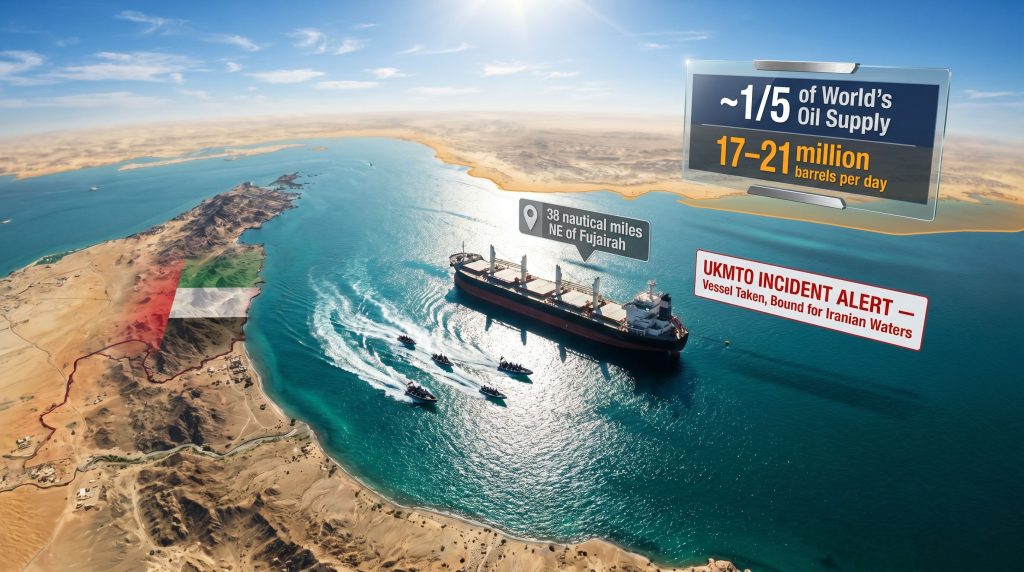
For decades, the conventional wisdom in commercial shipping held that a vessel at anchor was a vessel at rest, legally and operationally sheltered from the volatility of active transit routes. That assumption has been fundamentally challenged by the latest incident in the Gulf of Oman, where a vessel taken off UAE coast bound for Iran waters was seized after sitting anchored 38 nautical miles northeast of Fujairah. The incident, confirmed by the United Kingdom Maritime Trade Operations centre (UKMTO) on May 14, 2026, represents more than a single security event. It signals a structural shift in the risk architecture of the world's most consequential maritime corridor.
Understanding what this means for global energy markets, shipping operators, and the broader geopolitical balance requires stepping back from the immediate headlines and examining the system of pressures that made this incident not only possible, but arguably predictable.
When big ASX news breaks, our subscribers know first
The Strait of Hormuz: A Single Point of Failure for Global Energy
No other waterway on Earth carries the combined strategic and economic weight of the Strait of Hormuz. Sitting between the Persian Gulf and the Gulf of Oman, this narrow passage handles approximately one-fifth of the world's total oil supply, alongside a substantial share of global LNG supply exports. For context, Qatar, the world's largest LNG exporter, depends on this corridor for virtually all of its seaborne energy trade.
What makes the strait uniquely vulnerable is its geography. At its narrowest point, the navigable shipping lanes span roughly 3.2 kilometres in each direction, meaning that a relatively small number of actors can exert disproportionate influence over traffic flow. This physical constraint transforms geopolitical disputes into immediate supply-chain events, with consequences that ripple instantly through oil futures markets, insurance pricing, and energy security planning in Asia and Europe.
The economic sensitivity of this corridor cannot be overstated. Under normal transit conditions, the strait carries an estimated 17 to 21 million barrels of oil per day. Even partial disruption triggers war-risk insurance surcharges across the entire transiting fleet, effectively taxing every barrel that passes through regardless of whether that specific vessel encounters any threat.
Dual Blockades and the Architecture of Compounding Risk
The current maritime environment in the Gulf is operating under conditions with few modern precedents. Since the outbreak of conflict involving the United States and Israel on February 28, Iran has largely restricted commercial shipping through the Strait of Hormuz. A ceasefire established on April 8 has not produced a corresponding normalisation of maritime conditions. Instead, both the US naval blockade on Iranian port access and Iranian-aligned interference with Hormuz transit have continued in parallel, creating what analysts are calling a dual blockade dynamic.
This dual blockade is legally ambiguous in ways that complicate every dimension of response and attribution. Neither set of restrictions sits comfortably within conventional international maritime law frameworks, and the resulting governance vacuum creates space for non-state actors and proxy forces to operate with reduced accountability. Furthermore, the convergence of these pressures has significantly reshaped the geopolitical risk landscape for energy markets globally.
"The convergence of state-level blockade enforcement with non-state boarding operations in the same waterway is a combination that commercial shipping insurance frameworks were not designed to price efficiently."
The ceasefire, rather than reducing risk, has in some respects increased it by creating uncertainty about what rules of engagement actually apply. Hostilities are nominally paused, but maritime pressure tactics have not followed suit, leaving commercial operators navigating a legal and operational grey zone.
What Happened Off Fujairah: An Operational and Geospatial Assessment
The Seizure in Detail
The vessel taken off the UAE coast and now bound for Iranian waters was reportedly at anchor when the boarding occurred. According to the UKMTO, which confirmed the seizure and the vessel's subsequent trajectory toward Iranian territorial waters, the identity of the ship, its cargo, and the group responsible had not been publicly disclosed at the time of initial reporting.
The location itself carries significant strategic weight. Fujairah occupies a unique position in Gulf maritime infrastructure, sitting on the Gulf of Oman coastline outside the Persian Gulf proper. This positioning makes it:
- One of the world's largest ship bunkering hubs, servicing vessels that prefer to refuel before or after strait transit rather than inside the Gulf
- A critical anchorage zone where vessels wait for transit clearance, weather windows, or scheduling coordination
- A location that sits technically outside the Persian Gulf but is functionally inseparable from Hormuz transit logistics
The assumption embedded in these functions has always been that Fujairah's position outside the Persian Gulf offered a degree of separation from the most acute risk zones. The seizure of a vessel taken off the UAE coast while bound for Iranian waters challenges that assumption directly.
| Incident Detail | Confirmed Information |
|---|---|
| Vessel status at time of boarding | At anchor |
| Distance from Fujairah | 38 nautical miles (70 km) northeast |
| Nature of incident | Taken by unauthorized personnel |
| Post-seizure trajectory | Bound for Iranian territorial waters |
| Vessel identity and cargo | Not disclosed at time of reporting |
| Responsible party | No claim of responsibility made |
A Pattern, Not an Anomaly: Recent Escalation in Gulf Waters
Viewing the Fujairah seizure in isolation misses a documented pattern of escalating maritime incidents across the broader Hormuz region in the weeks prior. The tactical progression is notable:
| Date | Incident | Attribution Status |
|---|---|---|
| February 28 | US-Israel-Iran conflict outbreak; maritime posture shifts | Confirmed |
| April 8 | Ceasefire established; blockade conditions persist | Confirmed |
| Sunday (prior to May 14) | South Korean cargo vessel struck by unidentified aircraft in Hormuz | South Korean officials indicated Iranian origin as most probable |
| Same Sunday | Freighter arriving in Qatari waters from Abu Dhabi struck by drone | Drone origin unconfirmed |
| May 14 | Vessel taken 38 nm northeast of Fujairah, bound for Iranian waters | No claim of responsibility |
South Korean officials publicly stated it was unlikely anyone other than Iran was responsible for the aircraft strike on the cargo vessel in Hormuz, according to reporting by Yonhap. This represents a diplomatically significant statement from Seoul, a non-belligerent trading nation with deep economic interests in Gulf energy security, and one that historically avoids direct attribution in sensitive geopolitical situations.
The progression from aerial and drone strikes to a physical vessel boarding is tactically meaningful. Remote-weapon attacks require targeting capability and munitions. Physical vessel seizure requires deployed personnel, fast-craft coordination, and boarding teams operating under conditions where they accept personal exposure. Consequently, the operational complexity and commitment involved in a physical boarding is substantially higher, and that escalation in method suggests deliberate intent rather than opportunistic action.
Energy Market Consequences: What the Numbers Actually Mean
The market sensitivity to Hormuz disruption extends well beyond the obvious oil price rally channel. Several interconnected effects compound simultaneously when seizure incidents occur:
War-risk insurance recalculation is typically the fastest market response. Lloyd's and the international P&I club network reassess risk classifications within hours of confirmed incidents, and premium surcharges are applied fleet-wide across all vessels transiting or anchoring in affected zones. This cost is passed directly to cargo owners and, ultimately, to energy consumers globally.
Re-routing decisions create secondary supply chain disruption. Vessels diverting around the Cape of Good Hope to avoid the Gulf add thousands of nautical miles to transit times, increasing fuel consumption, voyage duration, and charter costs simultaneously. For time-sensitive LNG cargoes, this creates scheduling compression at destination ports.
Port congestion effects downstream are frequently underestimated in market analysis. When multiple vessels delay or reroute simultaneously, receiving ports face compressed arrival schedules that generate demurrage charges and storage pressure. This is particularly acute for Asian LNG importers with limited onshore storage capacity.
LNG-specific vulnerability deserves separate attention. Qatar's position as the world's largest LNG exporter means that any sustained access restriction on Hormuz transit directly threatens European and Asian energy security at a structural level, not merely as a short-term pricing event. Nations that have replaced Russian pipeline gas with Qatari LNG under long-term contracts have limited short-term substitution options.
The next major ASX story will hit our subscribers first
International Law, Jurisdiction, and the Attribution Problem
Under the United Nations Convention on the Law of the Sea (UNCLOS), vessels anchored in international waters or within another state's exclusive economic zone are protected from unauthorised boarding. Seizure by parties lacking legal authority constitutes either piracy or an act of war, depending on whether those responsible are non-state actors or state-affiliated forces operating under direction.
The distinction matters enormously for what response mechanisms become available. Piracy invokes universal jurisdiction principles that allow any state's naval forces to respond. An act of war invokes an entirely different set of legal and escalation considerations, including the obligations and authorities of flag states, alliance partners, and multinational naval frameworks like the Combined Maritime Forces (CMF), which coordinates multi-nation maritime security responses from its Bahrain headquarters.
The current grey zone between active conflict and ceasefire complicates attribution and response authorisation at every level. The ceasefire established on April 8 has not been accompanied by any formal maritime provisions, meaning that the legal status of ongoing blockade enforcement and vessel interference remains deeply contested.
What Operators and Cargo Owners Need to Understand Right Now
Guidance for Shipping Operators
For commercial shipping operators, the Fujairah incident rewrites the risk calculus in several specific ways:
- Anchor position is no longer a risk-reducing factor in this region. Vessels at anchor near Fujairah must now be treated as exposed to the same boarding threat as vessels in active transit through the strait.
- UKMTO voluntary registration and regular position reporting are more important than ever. The system's ability to trigger rapid response coordination depends on operators participating consistently rather than only during active transit legs.
- Anti-boarding drill frequency should be reviewed against current crew training schedules. The nature of this incident, a coordinated boarding by multiple personnel, requires crew to have rehearsed responses rather than encountering scenarios for the first time operationally.
- Voyage planning windows around Fujairah anchorages should factor in extended exposure time as an active risk variable, not a neutral holding pattern.
Guidance for Cargo Owners
For cargo owners and P&I club members, the implications extend into contract and insurance structures:
- War-risk exclusion clause reviews should be accelerated given the expanded risk perimeter now evidenced by this incident
- Force majeure clause applicability in supply contracts should be assessed against scenarios where vessels are detained in Iranian waters for extended periods
- Historically, vessels taken into Iranian territorial waters have been held for weeks to months, with resolution requiring government-level diplomatic engagement
"Cargo owners operating under just-in-time delivery models face disproportionate exposure when detention timelines are measured in months rather than days."
Regional State Dynamics and the Diplomatic Dimension
The UAE faces a particularly complex position as the coastal state nearest to the incident. Demonstrating maritime sovereignty over waters adjacent to Fujairah is a sovereign interest, but direct confrontation with Iranian naval or proxy forces carries escalation risks that constrain the available response options.
Qatar, having experienced a drone strike on a vessel arriving in its waters from Abu Dhabi in the days before the Fujairah seizure, is dealing with a direct threat to its energy export supply chain integrity. As the world's largest LNG exporter, Qatar's exposure to Hormuz instability is not abstract. It is existential to its export revenue model. Moreover, these events are increasingly influencing the global commodity markets in ways that extend well beyond the immediate region.
At the diplomatic level, US Vice President JD Vance publicly indicated that progress was being made in ongoing Iran negotiations, suggesting that back-channel engagement continues even as maritime incidents escalate. This gap between diplomatic signalling and operational reality on the water is one of the defining features of the current environment, and it creates genuine uncertainty about whether any near-term diplomatic outcome will include binding maritime provisions.
Three Scenarios for the Gulf Maritime Environment
Scenario 1: Diplomatic De-escalation
US-Iran negotiations produce a formal agreement that includes maritime provisions. UKMTO risk classifications are downgraded, blockade conditions are formally lifted on both sides, and commercial traffic normalises. This scenario requires a level of comprehensive agreement that has not been achieved in prior rounds of US-Iran diplomacy.
Scenario 2: Sustained Grey-Zone Pressure
Incidents continue at irregular intervals, war-risk premiums remain structurally elevated, and shipping companies adopt permanent contingency rerouting strategies. The cost of Gulf energy exports rises durably, and the strait becomes a chronic rather than acute risk environment. This scenario is consistent with the current trajectory of events.
Scenario 3: Full Escalation
A seizure or strike involving a vessel from a major trading nation triggers a multinational naval response, effectively closing the strait to commercial traffic. The resulting energy supply shock would have global macroeconomic consequences comparable to the 1973 oil embargo in terms of speed of impact, though the structural global energy mix has diversified considerably since that period.
"The shift from drone and aircraft strikes to physical vessel boarding, as documented in the May 14 incident, represents movement along the escalation curve rather than a stable deterrent equilibrium. The current pattern is more consistent with sustained grey-zone pressure than with an imminent return to normalised transit conditions."
Frequently Asked Questions
What does it mean when a vessel is described as taken by unauthorised personnel?
This UKMTO terminology indicates that individuals without the legal authority of the vessel's master, owner, or flag state have assumed physical control of the ship. It can apply to piracy by non-state actors or to state-directed seizure operations, and the distinction carries significant legal and diplomatic consequences for how the international community can respond.
Why is Fujairah strategically significant?
Fujairah sits on the Gulf of Oman coastline outside the Persian Gulf, positioning it as the primary bunkering and anchorage hub for vessels approaching or departing the Strait of Hormuz. It hosts one of the world's largest ship-to-ship transfer and bunkering operations, making it a critical node in the global energy logistics chain.
How much oil transits the Strait of Hormuz?
Approximately one-fifth of the world's total oil supply passes through the strait under normal conditions, alongside a major share of global LNG shipments. This equates to roughly 17 to 21 million barrels of oil per day, making it the single most consequential maritime chokepoint for global energy security.
Has any party claimed responsibility for the vessel seizure?
No group or government had publicly claimed responsibility at the time of initial reporting. The UKMTO confirmed the seizure and the vessel's trajectory toward Iranian waters, but attribution remained under investigation. Reporting from The Defense Post provides further detail on the confirmed facts of the incident as they emerged.
What typically happens when a vessel is taken into Iranian waters?
Based on historical precedent, vessels taken into Iranian territorial waters have been held for extended periods. Crew members may be detained and cargo confiscated. Resolution has historically required government-level diplomatic engagement and has taken anywhere from several weeks to several months.
Readers seeking ongoing coverage of Gulf maritime security developments, ceasefire updates, and US-Iran diplomatic progress can follow reporting at Arab News.
Want to Stay Ahead of the Resource Opportunities Emerging From Global Maritime Disruption?
When geopolitical flashpoints reshape commodity markets at speed, Discovery Alert's proprietary Discovery IQ model scans ASX announcements in real time, delivering instant notifications on significant mineral discoveries so investors can act before the broader market catches on — explore historic discoveries and their returns, then begin a 14-day free trial to ensure the next major opportunity doesn't pass unnoticed.