July 20, 2026
When a Strait Closes, the World Reprices: India's Crude Crisis in Context
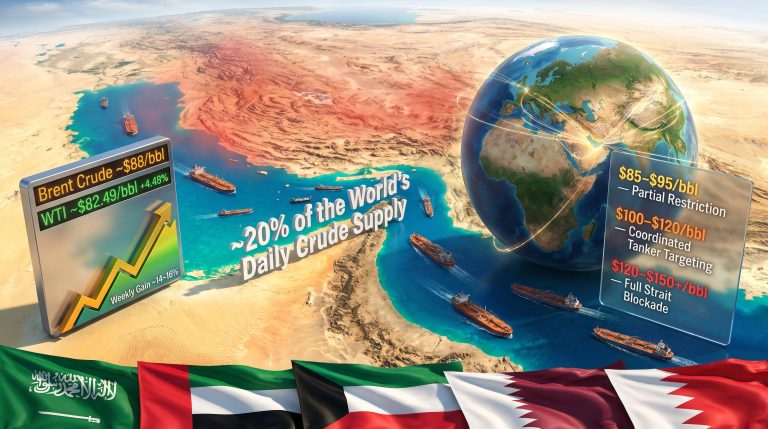
The Strait of Hormuz has long occupied a unique position in the architecture of global energy security. Roughly 20 to 21 percent of all seaborne oil trade passes through this narrow corridor between Oman and Iran, making it the single most consequential maritime chokepoint in the world. When that passage closes, even partially, the consequences do not distribute evenly across consuming nations. They concentrate precisely where inventory buffers are thinnest, refinery configurations are most specialised, and geopolitical relationships are most complex. In 2026, that intersection points almost entirely to India, where the US waiver extension for India's Russian crude imports has become a critical lifeline.
When big ASX news breaks, our subscribers know first
The Mechanics of the US Waiver Extension for India's Russian Crude Imports
Understanding why the US waiver extension for India's Russian crude imports matters requires grasping what the instrument actually does. It is not a formal diplomatic agreement or a permanent trade arrangement. It is a temporary regulatory carve-out issued by the US Treasury that permits designated buyers, primarily Indian refiners, to continue receiving Russian crude oil cargoes loaded onto vessels before a specified cut-off date without triggering secondary sanctions penalties.
The timeline of the waiver tells its own story:
- March 12, 2026 – Initial waiver issued as an emergency supply measure following the Strait of Hormuz closure, which resulted from the Iran conflict that began in February 2026.
- Mid-April 2026 – First 30-day extension granted as supply disruptions persisted without resolution.
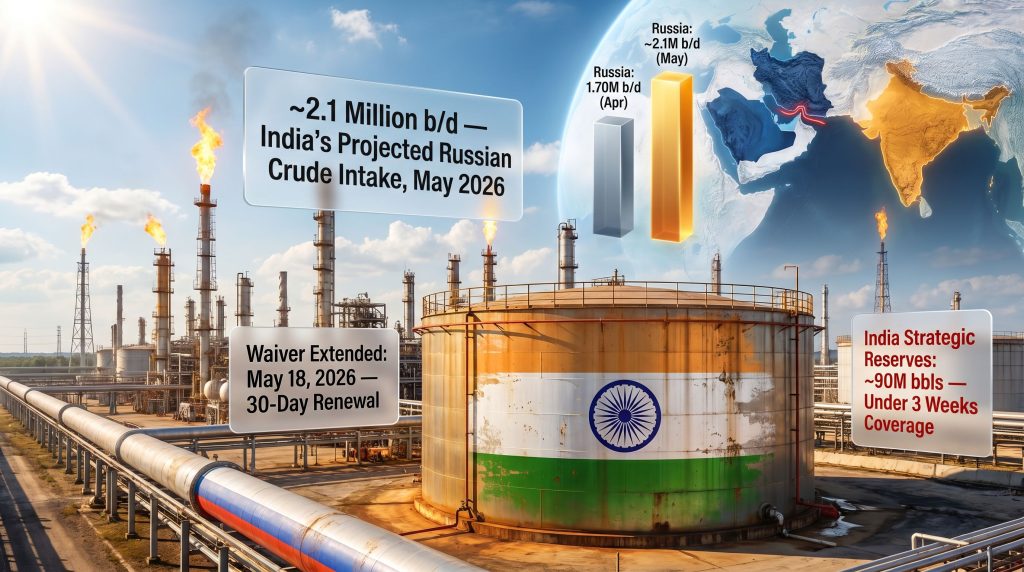
- May 18, 2026 – Second 30-day extension confirmed, maintaining access to Russian seaborne volumes at a moment when Indian intake was approaching record levels. According to S&P Global, India's Russian crude imports were set to rise further following this extension.
The deliberate use of rolling 30-day renewals rather than a longer-term exemption is not administrative convenience. It is a calibrated policy instrument. Washington retains maximum flexibility and implicit leverage over Indian energy procurement decisions by ensuring that compliance-sensitive Indian refiners remain dependent on continued US goodwill rather than operating under a permanent licence. Furthermore, this approach directly reflects the broader global trade policy impact of the current US administration's approach to sanctions and energy diplomacy.
Why Did the Hormuz Closure Create a Supply Gap No Other Source Could Fill?
The February 2026 conflict that closed the Strait of Hormuz did not merely disrupt oil flows; it eliminated the specific grade of crude that Indian refineries are most engineered to process. The technical term here is medium-sour crude, typically defined as oil with an API gravity of roughly 25 to 35 degrees and a sulphur content of 1 to 2 percent. This specification is disproportionately produced by Gulf states, particularly Saudi Arabia and Iraq.
When the Strait closed, Saudi Arabia and the UAE were forced to reroute export volumes through bypass pipelines, dramatically compressing the quantities available to Asian buyers. Saudi exports to India dropped from 1.03 million barrels per day (b/d) in February 2026 to 670,000 b/d in April, a decline of approximately 35 percent. The UAE managed to sustain exports at 550,000 to 600,000 b/d through its Fujairah pipeline route, but pipeline capacity limits prevented any meaningful increase from that level.
In April 2026, UAE Murban exports to India reached 600,000 b/d, double the prior year level and the highest monthly volume ever recorded, yet still insufficient to offset broader Gulf losses. The grade problem matters enormously and is often underappreciated in mainstream energy commentary. Russian Urals blend closely matches the medium-sour specification, making it a near-perfect functional substitute for the Gulf crudes India was losing. This is not merely a volume substitution story; it is a chemistry story.
Consequently, refineries configured for medium-sour processing cannot simply pivot to light sweet crudes from West Africa or the United States without significant operational adjustments and yield penalties. These dynamics are central to understanding the crude oil trade geopolitics driving India's current import decisions.
India's Import Profile: The Numbers Behind the Dependency
The scale of India's Russian crude intake in 2026 reflects both necessity and opportunity. The country imports approximately 4.5 million b/d of total crude, making it the world's third-largest importer. The table below illustrates how its supply sources shifted as the Gulf crisis deepened:
| Supply Source | February 2026 (b/d) | April 2026 (b/d) | Change |
|---|---|---|---|
| Russia (seaborne) | ~1.8M | 1.70M | Maintenance-related dip |
| Saudi Arabia | 1.03M | 670,000 | Down ~35% |
| UAE | ~550,000 | 550,000–600,000 | Stable at pipeline ceiling |
| Venezuela | Negligible | 285,000 | New sourcing relationship |
| Brazil | ~137,500 | 275,000 | Doubled month-on-month |
| Nigeria | Moderate | Increased | Grade mismatch limiting utility |
By May 2026, India's projected Russian crude intake was set to reach approximately 2.1 million b/d, the highest monthly volume on record. Russian barrels had grown to represent roughly 40 to 47 percent of India's total crude import requirements.
The diversification toward Latin America reveals the desperation underlying the search. Venezuela's Merey blend and certain Brazilian grades carry medium-sour characteristics that partially match Indian refinery requirements, but they also require significantly longer shipping distances, elevating freight costs. Nigeria's Bonny Light and similar West African grades, despite increased export volumes to India, are generally too light for the medium-sour optimised refineries that dominate India's processing capacity.
The Strategic Reserve Problem Washington Understands Well
One of the least discussed dimensions of the US waiver extension for India's Russian crude imports is the asymmetry in inventory resilience between Asia's two largest crude buyers. This asymmetry fundamentally shapes the geopolitical calculus.
China held crude inventories estimated at approximately 1.23 billion barrels as of April 2026, sufficient to sustain domestic consumption of 14 to 15 million b/d for several months without new seaborne imports. India's strategic and commercial crude reserves stood at only 106 million barrels before the conflict began in February, declining to approximately 90 million barrels by April 2026. At consumption rates of 5.5 to 6 million b/d, this represents less than three weeks of consumption coverage.
China also benefits from overland pipeline access to Russian crude, meaning a portion of its Russian supply is entirely insulated from maritime sanctions enforcement. Indian state-owned refiners, by contrast, maintain deep integration with US dollar-denominated financing and Western banking relationships. This compliance sensitivity is not theoretical. When Washington threatened 25 percent tariffs on countries purchasing Russian crude, a cohort of Indian refiners suspended purchases immediately, demonstrating that US policy tools do influence Indian procurement behaviour. This episode is well documented in analyses of oil market disruption stemming from tariff escalation.
Which Refiners Are Actually Exposed: India's Compliance Spectrum
The Indian refining sector does not present a uniform risk profile when it comes to Russian crude. A meaningful distinction exists between entities with high sanctions exposure and those operating with greater insulation.
High Sanctions Exposure (Compliance-Sensitive Buyers):
- Indian Oil Corporation (IOC) became India's single largest buyer of Russian crude in April 2026 at 750,000 b/d. As a state-owned entity with extensive US dollar financing exposure, IOC faces the most direct regulatory risk from any waiver non-renewal.
- BPCL purchased 190,000 b/d of Russian crude in April 2026 and sits in a similarly exposed position given its international financing relationships.
- HMEL, MRPL, and HPCL collectively purchased approximately 350,000 b/d in April 2026. Crucially, all three had suspended Russian crude purchases for several months prior to the waiver, specifically in response to US tariff threats.
Lower Sanctions Exposure:
- Vadinar Refinery (Nayara Energy), co-owned by Rosneft, already operates under existing sanctions frameworks. Following scheduled maintenance that took the facility offline from April 10 to May 15, the refinery's Russian crude intake collapsed to just 25,000 b/d during the maintenance period. Post-restart resumption of approximately 400,000 b/d represents an incremental demand upside of 350,000 to 375,000 b/d.
Compliance Swing Buyer:
- Reliance Industries (Jamnagar) suspended Russian crude purchases in January 2026 specifically due to sanctions concerns, only to return under the waiver. Russian crude accounted for approximately 18 percent of Jamnagar's 1.2 million b/d total intake in April 2026.
The Consumer Cost: Fuel Prices and Macro Consequences
The energy supply disruption has now fully penetrated India's consumer economy. In May 2026, the Indian government raised regulated diesel and gasoline prices by 3 rupees per litre (approximately $0.03/litre), the first retail fuel price increase in four years. New prices stand at approximately $0.94 per litre for diesel and $1.02 per litre for gasoline.
The broader economic damage extends well beyond the pump. India's wholesale price index reached a 3.5-year high as fuel cost increases cascaded through industrial supply chains. Year-on-year demand data from April 2026 reveals that despite higher prices, consumption growth remains positive: diesel consumption rose 1 percent YoY to 2.07 million b/d, and gasoline consumption grew 7 percent YoY to 1.06 million b/d.
India's fiscal position is under compounding pressure. Historically, New Delhi has absorbed fuel price volatility through state subsidies. The decision to pass through cost increases to retail buyers signals that the subsidy buffer has reached its operational limit. A widening trade deficit, driven by surging energy import costs, is simultaneously pressuring the rupee and the current account balance. As The Diplomat notes, uncertainty continues to loom over India's energy planning horizon.
Scenario Analysis: What Happens if the Waiver Is Not Renewed?
The rolling 30-day structure of the waiver creates a recurring decision point for both Washington and New Delhi. The table below frames the three most plausible near-term policy trajectories:
| Scenario | Probability | India Impact | Global Oil Market Impact |
|---|---|---|---|
| Waiver renewed again (30-day rolling) | High near-term | Supply continuity maintained | Minimal additional upward price pressure |
| Waiver expires without renewal | Moderate medium-term | Compliance-sensitive refiners (~1.1M b/d exposure) halt Russian purchases | Significant upward pressure on medium-sour differentials; potential Brent spike |
| Permanent structured exemption negotiated | Low near-term | India secures long-term supply certainty | Reduces sanctions signal strength; potential precedent for other buyers |
The substitution problem would become acute in a non-renewal scenario. Compliance-sensitive Indian buyers account for roughly 1.1 million b/d of Russian crude intake. Redirecting that volume would simultaneously drive up freight costs, strain available tanker capacity, and tighten the already-constrained medium-sour differential in Asian markets. This scenario would inevitably trigger an oil price shock with consequences extending well beyond South Asia.
The next major ASX story will hit our subscribers first
The Geopolitical Leverage Equation
The waiver's architecture reflects a sophisticated understanding of asymmetric dependency. India needs the US waiver extension for India's Russian crude imports far more acutely than Washington needs to provide it. This asymmetry gives the US measurable leverage over India's energy procurement decisions without requiring explicit coercion.
Several competing policy interests converge in Washington's calculation:
- Preserving the US-India strategic partnership requires avoiding a scenario where energy necessity permanently deepens Indian alignment with Moscow.
- Maintaining Russia sanctions integrity argues against permanent or open-ended waivers that could hollow out the broader sanctions architecture.
- Global oil market stability considerations push against forcing a large-volume buyer off a key supply source during an active supply crisis.
- India's strategic autonomy doctrine means New Delhi will resist any arrangement perceived as subordinating sovereign economic decisions to Western geopolitical preferences.
The rolling 30-day structure threads this needle by providing operational relief without sacrificing policy leverage. However, whether Washington will continue threading it depends heavily on the trajectory of the Iran conflict and the geopolitical trade tensions reshaping the broader global energy order.
The Structural Vulnerability the Waiver Cannot Resolve
Operational continuity and structural resilience are fundamentally different things, and the waiver addresses only the former. India's underlying vulnerability in the medium-sour crude market will not disappear when the Hormuz situation eventually normalises. Several structural gaps have been exposed by this crisis:
- India's strategic petroleum reserve capacity of approximately 90 million barrels as of April 2026 represents less than three weeks of consumption, far below the International Energy Agency benchmark of 90 days of net import coverage.
- The refinery configuration problem is a legacy of decades of investment decisions optimised for Gulf supply availability. Shifting toward greater grade flexibility requires capital investment cycles measured in years.
- Forced diversification toward Latin America and West Africa has permanently elevated India's awareness of these supply corridors, but freight cost and grade mismatch penalties make them supplements rather than substitutes.
- India's emergence as what commodity analysts describe as the premium crude market in Asia during this crisis creates a pricing signal that attracts barrels from greater distances, but it also structurally expands the import bill even after Hormuz reopens.
Russian crude has completed a transition in India's supply calculus. What began in 2022 as an opportunistic discount trade has evolved into a structural supply necessity. The waiver extension preserves the status quo for another 30 days. But the deeper question of India's energy security architecture — its reserve depth, refinery grade flexibility, and geopolitical supply diversity — remains an unresolved challenge that extends well beyond the current Gulf crisis.
Disclaimer: This article is for informational purposes only and does not constitute financial or investment advice. Projections, scenario analyses, and supply forecasts involve inherent uncertainty and should not be relied upon as predictions of future market conditions. Readers should conduct their own research before making investment or commercial decisions.
Want to Stay Ahead of the Resource Opportunities Emerging From Global Energy Disruptions?
Discovery Alert's proprietary Discovery IQ model scans ASX announcements in real time, instantly identifying significant mineral discoveries tied to the commodities reshaping global supply chains — from energy inputs to critical minerals — so subscribers can act on actionable opportunities before the broader market reacts. Explore how historic discoveries have delivered exceptional returns and begin your 14-day free trial to position yourself ahead of the next major market move.