May 19, 2026
The Hidden Architecture of Sanctions Relief: Why Short-Term Oil Waivers Are More Powerful Than They Appear
When policymakers design sanctions regimes targeting major energy exporters, they rarely build them as static, all-or-nothing instruments. The more sophisticated approach, developed over decades of experience from Iran to Venezuela, treats sanctions as a dynamic policy dial rather than an on-off switch. The U.S. waiver for Russian oil cargo transactions represents exactly this kind of calibrated flexibility in action, and understanding its mechanics reveals far more about American foreign energy policy than any single news cycle can capture.
When big ASX news breaks, our subscribers know first
What OFAC General Licenses Actually Do in a Sanctions Framework
The Office of Foreign Assets Control operates as the primary enforcement body for U.S. economic sanctions, and its general license mechanism functions as a legally precise pressure-release valve. Rather than requiring individual companies or governments to apply for case-by-case exemptions, a general license creates a category of permitted activity that anyone meeting the defined criteria can rely upon without seeking separate authorisation.
This distinction matters enormously in practice. When a tanker operator, a P&I insurance club, or a port authority needs to decide within hours whether accepting a vessel constitutes a sanctions violation, the presence or absence of a general license determines commercial viability in real time. Without such instruments, the chilling effect of sanctions on Russian oil trading extends far beyond their intended targets, freezing legitimate transactions and punishing neutral parties caught in the compliance crossfire.
It is also critical to understand the difference between a sanctions suspension and a sanctions waiver of limited scope. General License 134C does not suspend, reduce, or reverse any aspect of the broader Russia sanctions architecture. It creates a narrow, time-bounded corridor through which specific pre-existing cargo transactions can be legally completed. The underlying sanctions framework, including vessel designations, entity restrictions, and the G7 price cap mechanism, remains fully intact.
Breaking Down General License 134C: Scope, Limits, and Timeline
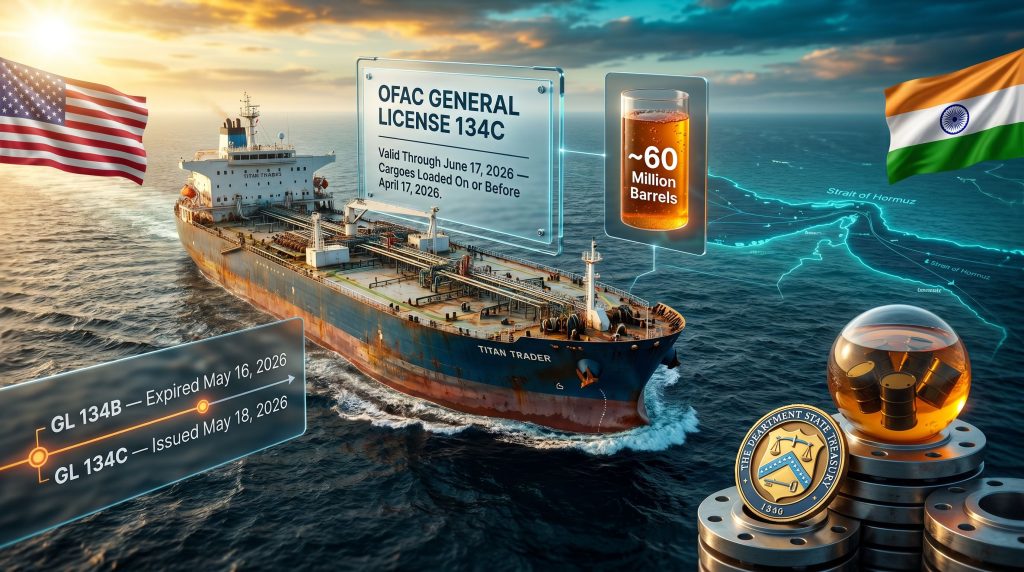
Issued by OFAC on 18 May 2026, General License 134C replaced the expiring General License 134B and extended operational authorisation through 17 June 2026. The eligibility anchor point is cargo loading date: only vessels that had loaded Russian crude oil or petroleum products on or before 17 April 2026 fall within scope.
The range of permitted activities under the license is deliberately comprehensive, designed to ensure that a qualifying cargo can complete its entire voyage without triggering secondary compliance exposure at any stage of the supply chain.
| Permitted Activity | Coverage Detail |
|---|---|
| Cargo delivery and offloading | Vessels loaded on or before 17 April 2026 |
| Vessel operational services | Docking, anchoring, bunkering |
| Cargo handling support | Port services and logistics coordination |
| Marine insurance | Coverage for in-transit Russian oil cargoes |
| Emergency vessel services | Salvage operations and emergency repairs |
| Classification services | Vessel certification and compliance checks |
Equally important is what the license explicitly does not cover. The following categories remain fully prohibited regardless of the waiver:
- Transactions involving Iran, Cuba, or North Korea
- Activity connected to certain Russian-occupied Ukrainian territories
- Dealings with entities owned or controlled by sanctioned parties in restricted jurisdictions
- Any new Russian oil procurement, contracting, or cargo loading after the April 17 cutoff date
The license architecture follows a rolling 30-day structure. The sequence runs as follows:
- General License 134B expired on 16 May 2026
- General License 134C was issued on 18 May 2026, creating a brief two-day gap that required retroactive compliance management
- The authorisation window runs through 17 June 2026
- The cargo eligibility cutoff remains fixed at 17 April 2026
"The 30-day rolling structure is not accidental. It preserves maximum policy flexibility for the U.S. Treasury while providing just enough short-term legal certainty for shipping operators and trading counterparties to make operational decisions. It is precision-engineered ambiguity."
The Scale of the Problem: Approximately 60 Million Barrels at Sea
To appreciate why this waiver was considered necessary, the volume of affected cargo must be placed in context. Based on vessel tracking data available at the time of issuance, an estimated 60 million barrels of Russian crude were in transit at sea, spanning both sanctioned and non-sanctioned tanker fleets.
This is not a trivial figure. At prevailing crude prices, 60 million barrels represents a cargo value in the range of several billion dollars, involving dozens of vessels, hundreds of counterparties, and supply chain dependencies across multiple importing nations. The practical reality of in-transit crude is that it cannot simply be reversed once a voyage has commenced.
Denying legal completion of these voyages would not reduce Russian oil revenues retroactively, since loading and payment terms are typically agreed in advance. Instead, denial of completion would primarily harm downstream importers and the logistics operators who committed to these transactions in good faith. Consequently, as Reuters reported, the U.S. Treasury issued the updated general licence to address exactly these concerns.
The Sanctioned Tanker Complication
A particularly complex dimension of this situation involves vessels that have been formally designated under Russia-related sanctions programmes, sometimes referred to as the shadow fleet. These tankers occupy a unique legal grey zone: they are blocked entities, yet they are simultaneously transporting cargo that downstream importers have already contracted and paid for.
General License 134C explicitly extends its coverage to blocked vessels, provided the transactions remain limited to completing the current in-progress voyage. This is an unusual but precedented approach. By extending coverage to designated vessels, OFAC allows the physical commodity to reach its destination without requiring counterparties to interact with sanctioned entities in any ongoing commercial sense beyond the immediate voyage completion.
Why the Strait of Hormuz Crisis Changed the Calculus
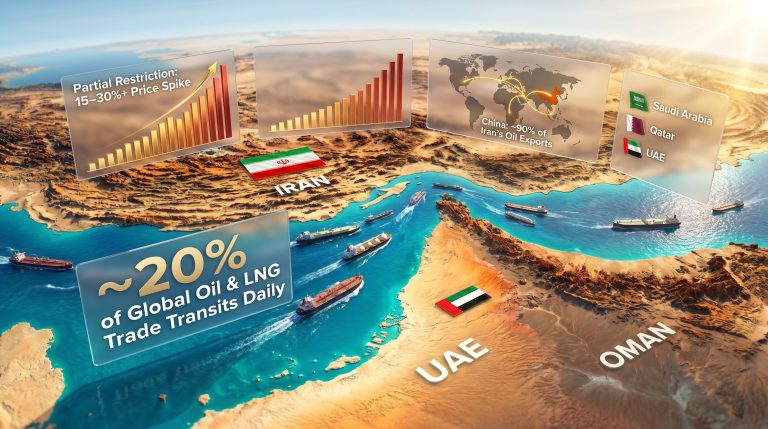
The waiver does not exist in isolation. It was issued against a backdrop of simultaneous supply disruptions that had materially compressed global crude availability. Heightened tensions involving the Strait of Hormuz, through which approximately 20% of global seaborne oil trade passes, created conditions in which removing an additional 60 million barrels from accessible supply channels would have amplified already elevated price pressures.
Middle East conflict escalation compounded this dynamic. When multiple geopolitical flashpoints activate concurrently, the aggregate supply uncertainty exceeds what energy markets can absorb through normal inventory drawdowns or alternative routing. Furthermore, the global oil price shock of recent years has demonstrated precisely how quickly market disruptions can cascade across economies. In this environment, U.S. Treasury Secretary Scott Bessent described the extension as a measure intended to help the most economically vulnerable importing nations retain access to cargoes already stranded at sea, per reporting by World Oil on 18 May 2026.
The convergence of the Hormuz situation and in-transit Russian crude essentially forced a prioritisation decision: which sanctions objective mattered more in this specific moment, maintaining the appearance of comprehensive Russia pressure, or preventing a supply shock from cascading into a global economic destabilisation event? The 30-day waiver reflects the answer.
Who Is Most Exposed: Mapping the Affected Stakeholders
Understanding the waiver's practical significance requires mapping the full chain of affected parties.
Primary importing nations face the highest exposure. India has been widely identified as a major destination market for in-transit Russian crude, having significantly expanded its purchases of discounted Russian oil following the 2022 sanctions escalation. SP Global's analysis of oil trade and geopolitics confirms that Indian refiners were among the most directly affected by the waiver's scope. Other emerging market economies with limited alternative crude sourcing infrastructure face disproportionate supply risk if waiver continuity breaks down.
Shipping operators and tanker owners required explicit legal clarity on whether bunkering, port entry, and insurance renewals could proceed. Without the waiver, each of these services would constitute potential sanctions exposure for the service provider, regardless of whether the underlying cargo transaction predated any new restrictions.
Marine insurers and P&I clubs occupy a particularly sensitive position. Protection and indemnity clubs require affirmative OFAC authorisation to service vessels operating under restricted conditions. The waiver restores their ability to cover legitimate in-transit liabilities without assuming regulatory risk.
Classification societies face parallel exposure. Certifying a vessel's seaworthiness when that vessel is under sanctions designation requires explicit legal cover, which the license provides on a time-limited basis.
The next major ASX story will hit our subscribers first
The Three-Way Policy Balancing Act
The decision to issue and repeatedly extend these licenses reflects a deliberate effort by the U.S. Treasury to manage three competing priorities simultaneously:
- Preserving the integrity of the broader Russia sanctions architecture by ensuring no permanent carve-outs are created
- Managing global price stability by preventing an abrupt supply shock during an already volatile market period
- Protecting vulnerable importers from becoming collateral damage in a geopolitical standoff they have limited capacity to influence
This three-way tension is not new. OFAC deployed similar short-duration license structures during the escalation of Iran sanctions, where allied nation dependencies on Iranian crude required carefully timed phase-out windows rather than immediate cutoffs. The Russian energy context presents a more complex version of the same problem, given the larger volumes involved and the broader geographic distribution of dependency. Moreover, the broader trade war economic impact of recent years has further complicated the environment in which these decisions are being made.
What Happens at the June 17 Deadline
The expiry of General License 134C on 17 June 2026 creates a decision point with several plausible outcomes.
| Scenario | Trigger Conditions | Market Implication |
|---|---|---|
| Further extension issued | Hormuz crisis unresolved; vulnerable importer pressure continues | Continued supply stability; sanctions pressure maintained nominally |
| License allowed to expire | Diplomatic progress on Ukraine; oil markets stabilise | Potential short-term tightening; signals harder sanctions posture |
| Escalation to broader waiver | Major price spike; allied nation supply emergency | Significant policy signal; potential market relief response |
| Targeted country carve-outs | Bilateral negotiations with key importers | Fragmented compliance landscape; legal complexity increases |
Oil price benchmarks will play a meaningful role in this calculus. If Brent crude is trading significantly above the level at which vulnerable importers face fiscal stress, the humanitarian and economic stability argument for extension becomes stronger. Conversely, if diplomatic progress on the Russia-Ukraine conflict accelerates, maintaining even a narrow waiver corridor becomes politically harder to justify domestically.
The Broader Sanctions Architecture: A Cumulative Timeline
General License 134C does not exist in a vacuum. It is the latest instrument in a multi-year escalating framework:
- February 2022: Initial sanctions wave following Russia's invasion of Ukraine
- December 2022: G7 price cap on Russian seaborne crude implemented at $60 per barrel
- 2023 to 2024: Successive rounds of vessel and entity designations by OFAC, the EU, and the UK
- January 2025: Expanded OFAC designations targeting the Russian crude tanker fleet specifically
- March 2026: First temporary waiver issued for cargoes loaded before 12 March 2026, linked to Iran-related market disruption
- May 2026: General License 134C extends coverage to cargoes loaded before 17 April 2026
The progression from the price cap mechanism to the shadow fleet designations to these rolling waivers illustrates an important structural tension in sanctions enforcement. The price cap was designed to allow Russian oil to keep flowing while limiting revenue. The vessel designations were designed to tighten that flow. The waivers are now managing the operational fallout of the designations interacting with a simultaneously disrupted Middle East supply environment. Each layer of policy creates downstream compliance consequences that subsequent instruments must address.
In addition, the geopolitical trade tensions reshaping global commerce in 2025 and beyond have made these policy instruments even more consequential for international market participants.
"The shadow fleet problem highlights a fundamental limitation of sanctions enforcement: when enough vessels operate outside the Western maritime services ecosystem, the leverage those services provide as an enforcement mechanism diminishes. Waivers become one of the few tools available to manage this reality without abandoning the policy framework entirely."
Frequently Asked Questions: U.S. Waiver for Russian Oil Cargo Transactions
What is OFAC General License 134C?
General License 134C is a temporary authorisation issued by the U.S. Treasury's Office of Foreign Assets Control on 18 May 2026. It permits transactions necessary to complete the delivery, sale, and offloading of Russian crude oil and petroleum products loaded onto vessels on or before 17 April 2026, with validity through 17 June 2026.
Does the waiver allow new purchases of Russian oil?
No. The U.S. waiver for Russian oil cargo transactions applies exclusively to cargoes already loaded before the 17 April 2026 cutoff. It does not authorise new procurement, contracting, or loading of Russian oil after that date.
Which jurisdictions are excluded from the waiver?
Transactions involving Iran, Cuba, North Korea, certain Russian-occupied Ukrainian territories, and entities controlled by sanctioned parties in those jurisdictions remain prohibited regardless of the waiver's existence.
Does the waiver apply to sanctioned tankers?
Yes. The license explicitly extends to vessels blocked under existing Russia-related sanctions programmes, provided the transactions are limited to completing the current voyage and do not involve new commercial engagements.
What services are covered?
Covered services include cargo delivery, offloading, vessel docking, anchoring, bunkering, marine insurance, vessel classification, salvage, and emergency repairs, all in connection with qualifying cargoes already at sea at the time of issuance.
Key Takeaways
- The U.S. waiver for Russian oil cargo transactions represents a tactical, time-limited adjustment within a sustained sanctions framework, not a strategic retreat from pressure on Russian energy exports
- An estimated 60 million barrels of Russian crude at sea at the time of issuance illustrates the practical scale of the supply management challenge facing regulators
- India and other emerging market importers carry the highest exposure if waiver renewal does not occur, given their structural dependence on discounted Russian crude volumes
- The Strait of Hormuz crisis created an unusual convergence scenario in which two simultaneous geopolitical disruptions forced sanctions administrators to prioritise market stability alongside enforcement objectives
- The 30-day rolling license structure preserves maximum policy flexibility while providing just enough short-term operational certainty for shipping, insurance, and trading counterparties
- The interaction between sanctioned vessel operations, marine insurance requirements, and port access rules creates a layered compliance environment requiring continuous monitoring as each deadline approaches
This article contains forward-looking analysis and scenario projections related to sanctions policy and energy market dynamics. Such projections are inherently uncertain and should not be construed as legal, financial, or compliance advice. Readers with exposure to Russian oil cargo transactions should seek qualified legal counsel familiar with current OFAC regulations.
Want to Stay Ahead of the Next Major Resource Discovery?
While sanctions regimes and energy market disruptions reshape global commodity flows, Discovery Alert's proprietary Discovery IQ model delivers real-time alerts on significant ASX mineral discoveries, transforming complex resource data into actionable investment insights for both short-term traders and long-term investors — explore Discovery Alert's dedicated discoveries page to understand how historic finds have generated substantial returns, and begin your 14-day free trial to position yourself ahead of the market.