May 19, 2026
The Hidden Transmission Mechanism Destroying Met Coal Margins
Most commodity downturns follow a familiar script: demand falls, prices drop, producers cut output, balance returns. The current crisis gripping metallurgical coal miners is running a more complicated playbook. The damage is not arriving in a straight line from end-user to raw material supplier. Instead, it is travelling through one of the most distorted industrial systems in modern economic history: China's state-influenced steel complex, which has quietly become the single most powerful price-setting force in global met coal markets, even for producers who have never sold a tonne directly to a Chinese mill.
Understanding why China steel dumping and met coal miners are so inextricably linked requires unpacking a transmission mechanism that operates several steps removed from the obvious trade headlines.
When big ASX news breaks, our subscribers know first
China's Steel Machine and the Overcapacity Arithmetic
China produces more steel than the rest of the world combined. As of the mid-2020s, the country accounts for roughly 54% of global crude steel output, a concentration of industrial capacity without historical precedent in any major commodity. This dominance was built over decades through a combination of state-directed capital allocation, subsidised electricity and raw materials, and a domestic construction boom that has now substantially decelerated.
The structural problem is straightforward: Chinese steel capacity was built to serve an infrastructure and real estate expansion cycle that has materially slowed. Rather than closing uneconomic capacity, Chinese producers have increasingly redirected output toward export markets, often at prices that competitors in South Korea, Japan, Europe, Australia, and North America cannot match. The China steel market continues to reshape global supply dynamics in ways that extend well beyond simple price competition.
The OECD has been tracking this phenomenon across multiple steel cycles. China's foreign affairs ministry has consistently characterised overcapacity criticisms as reflecting a misunderstanding of how supply and demand function within economic globalisation, a position that has frustrated multilateral coordination efforts considerably. Historically, attempts to build binding international frameworks around steel overcapacity have produced limited enforceable outcomes, a pattern that shows little sign of changing in the current cycle.
How the Price Signal Travels to Met Coal Markets
The connection between Chinese steel exports and met coal benchmark prices is indirect but highly reliable as a transmission mechanism. Here is how the chain operates:
-
Chinese steelmakers export finished steel at below-cost prices into global markets.
-
Competing steelmakers in India, Japan, South Korea, Europe, and elsewhere face margin compression as domestic and export prices are dragged lower.
-
Squeezed steelmakers respond by reducing blast-furnace utilisation rates and pressuring raw material suppliers for price concessions.
-
Met coal benchmark prices fall as buyers reduce spot purchasing and negotiate harder on contract terms.
-
Seaborne hard coking coal prices decline across all major export origins, regardless of whether that coal was ever destined for China.
The key insight that many investors miss is this: met coal miners are not directly exposed to Chinese steel tariffs. Their exposure is to the demand destruction and margin compression caused by global steel oversupply moving through international steelmaking supply chains.
Ramaco Resources, the Lexington, Kentucky-based metallurgical coal producer, reported a quarterly loss and a revenue miss in early 2026 that its leadership attributed directly to sustained Chinese steel market pressure. With approximately two-thirds of its metallurgical coal sold into international markets, Ramaco's financial results function as a real-time gauge of seaborne met coal market conditions. The company's chief executive noted publicly that the met coal business had faced approximately 18 months of sustained pressure rooted in China's industrial dynamics. (Source: Bloomberg, May 2026)
What Steel Dumping Actually Means in Trade Law Terms
The word "dumping" carries specific legal meaning in international trade. Under OECD and World Trade Organisation frameworks, dumping occurs when goods are exported at prices below their domestic production cost or below fair market value in the exporting country. The challenge with Chinese steel is that state subsidies, discounted energy inputs, and directed lending complicate the calculation of what the "true" cost of production actually is.
This definitional complexity matters because anti-dumping cases require petitioners to demonstrate a calculable price differential. When input costs are obscured by subsidy structures, the evidentiary burden becomes substantially harder to meet, which helps explain why anti-dumping proceedings against Chinese steel have been ongoing across multiple jurisdictions for over a decade without resolving the underlying supply dynamics. Furthermore, the trade tariffs impact on raw material markets often lags the policy implementation by several quarters, adding further complexity for producers trying to plan ahead.
The Tariff Arithmetic: Why U.S. Met Coal Cannot Access China
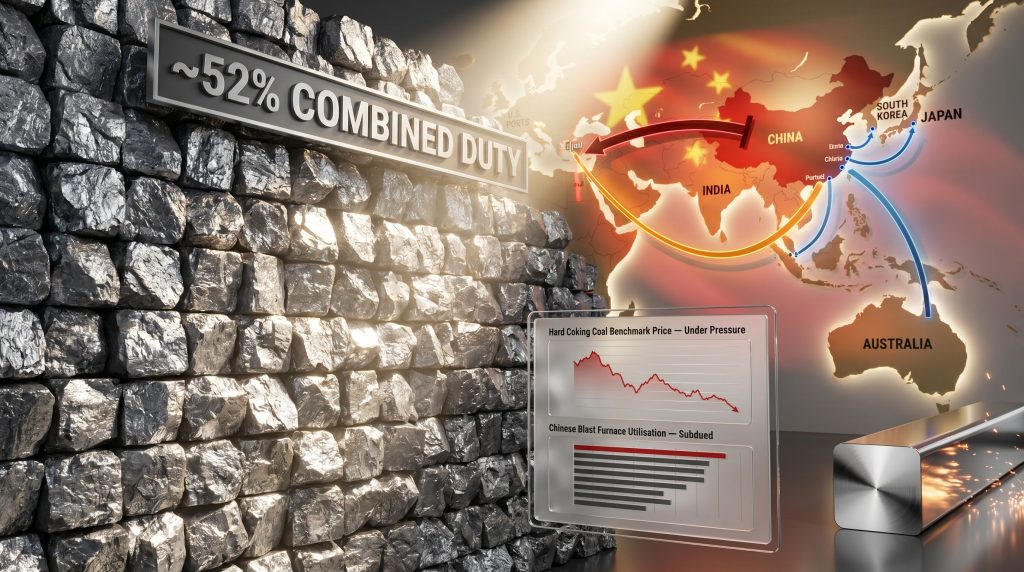
A separate but compounding factor for U.S. producers is the effective closure of the Chinese market to American metallurgical coal. Combined tariff duties of approximately 52% now apply to U.S. met coal shipped to China. This is not a new development created by the most recent round of trade tensions. Earlier tariff escalations had already made U.S. coal largely uncompetitive in China before the latest measures were added.
S&P Global's analysis of the tariff situation concluded that Chinese traders viewed the incremental new duties as having minimal practical effect on import mix, precisely because American coal was already priced out of the Chinese market on a landed-cost basis before the additional tariffs were applied. The real commercial damage from these duties had already been absorbed in prior years. In addition, the broader U.S. tariff impact on iron ore and related commodity flows has further complicated procurement decisions for steelmakers across multiple continents.
Export Route Fragmentation: The New Trade Map
| Export Route | Pre-Tariff Status | Post-Tariff Reality |
|---|---|---|
| U.S. to China | Competitive | ~52% combined duty; largely unviable |
| Australia to China | Dominant | Recovering post-ban; exposed to demand softness |
| U.S. to India | Growing | Primary alternative for displaced U.S. volumes |
| U.S. to Japan and South Korea | Established | Stable but facing seaborne price weakness |
| U.S. to Southeast Asia | Emerging | Rising strategic importance for U.S. exporters |
The Blast Furnace Dependency: Why Met Coal Has No Easy Substitute
A point frequently underappreciated by generalist investors is the chemical specificity of metallurgical coal's role in steelmaking. Unlike thermal coal, which is simply combusted for heat and power generation, met coal performs a dual function inside a blast furnace: it provides the carbon needed to reduce iron ore to metallic iron, and its transformation into coke creates the physical structure that supports the iron ore burden inside the furnace while allowing gas to flow upward.
This means that coking coal quality characteristics matter enormously. Key quality parameters include:
-
Coking strength after reaction (CSR): Measures coke's ability to maintain structural integrity under blast-furnace conditions. Higher CSR coals command significant price premiums.
-
Coke reactivity index (CRI): Measures how reactive the coke is with carbon dioxide inside the furnace. Lower CRI combined with higher CSR is the preferred combination.
-
Volatile matter content: Influences coking behaviour and blend composition requirements.
-
Ash and sulphur levels: Both affect steel quality and are subject to strict contractual limits.
Hard coking coal from the Appalachian coalfields and Queensland, Australia, typically sits at the premium end of the quality spectrum, commanding higher benchmark prices than lower-rank semi-soft coking coals. This quality differentiation means that not all met coal is interchangeable, and benchmark price movements for premium hard coking coal carry disproportionate financial implications for producers of high-quality product.
The nuance here for investors is that a generalised price decline in the seaborne coking coal market affects premium hard coking coal producers more severely in absolute dollar terms, even though their product commands a margin over lower-quality alternatives. When benchmark prices fall sharply, the absolute revenue per tonne lost is largest for the highest-quality producers.
The International Policy Response: A Patchwork of Defences
The breadth of anti-dumping activity now underway globally is a useful proxy for the severity of the steel dumping problem.
-
Australia imposed tariffs on Chinese steel coil following dumping findings, a notable development given Australia's position as a major raw material supplier to China.
-
South Korea launched antidumping investigations into hot-rolled steel plates from both Japan and China in the first quarter of 2025.
-
European anti-dumping probes targeting Chinese steel imports have been reshaping procurement patterns across the continent.
What is striking about this list is its geographic diversity. The dumping problem has reached the point where even resource-exporting nations that depend on Chinese commodity demand are deploying trade defences against Chinese manufactured goods. This represents a meaningful shift in the diplomatic calculus for countries like Australia.
The Policy Paradox Facing U.S. Trade Strategy
U.S. trade policy contains a structural tension that is rarely acknowledged in mainstream coverage. The policy simultaneously aims to protect domestic steel manufacturing capacity through tariffs and to support coal-mining communities through favourable treatment of the coal sector. These two objectives can operate at cross-purposes in met coal markets.
When the U.S. imposes tariffs that protect domestic steelmakers, it creates conditions where U.S. steel production is more viable, which theoretically supports domestic met coal demand. However, the majority of U.S. metallurgical coal production is exported, with China, India, and Japan historically among the largest buyers. Policies that restrict Chinese steel imports into the U.S. do nothing to reopen the Chinese market to U.S. met coal, and may actually intensify China's incentive to source raw materials from non-U.S. origins.
Key Market Indicators and What They Signal
| Indicator | Significance | Direction as of Mid-2026 |
|---|---|---|
| Hard Coking Coal Benchmark Price | Primary revenue driver | Under sustained pressure |
| Chinese Blast Furnace Utilisation | Proxy for met coal demand | Subdued |
| U.S. Met Coal Exports to Asia | Market diversification gauge | Redirecting toward India and Southeast Asia |
| Global Steel Capacity Utilisation | Macro demand signal | Below long-run average |
| Anti-Dumping Case Activity | Trade policy risk indicator | Accelerating globally |
The next major ASX story will hit our subscribers first
Strategic Repositioning: How Producers Are Adapting
The most significant strategic response emerging among U.S. producers is business unit segregation. Ramaco Resources announced a restructuring into separate divisions covering metallurgical coal operations and rare earth production. The rationale is to isolate commodity-cycle exposure within the met coal segment while allowing the rare earth business to be valued independently and pursue growth opportunities tied to critical mineral supply chains.
This bifurcation strategy reflects a broader recognition that the equity market cannot accurately value two very different business profiles within a single reporting structure. Met coal is a cyclical commodity business with benchmark price exposure; rare earth production is a strategic minerals business with different demand drivers, pricing dynamics, and investor audiences. Consequently, the global crude steel outlook for 2025 and beyond plays a significant role in determining which of these business models attracts greater institutional interest.
The rare earth dimension introduced a significant volatility event into Ramaco's share price in 2025. The company's stock reached the high $50 range in mid-2025 when the U.S. government made its initial investment into private rare earth operations, including a transaction with MP Materials Corp., which created positive sentiment across rare earth-linked equities. The share price subsequently reversed sharply, declining approximately 19% year-to-date through mid-May 2026, after diplomatic signals from a U.S.-China summit in late 2025 created a market perception that rare earth supply security concerns had been partially addressed. (Source: Bloomberg, May 2026)
This price behaviour illustrates a critical dynamic for investors in diversified commodity companies: a single geopolitical narrative shift can override months of fundamental operational performance in determining share price direction.
Supply Contraction as the Path to Recovery
The met coal market has historically rebalanced through supply discipline rather than demand recovery. The current down-cycle appears to be following the same template, with the key question being timing rather than direction.
Early indicators of supply-side contraction include mine closures and production curtailments among higher-cost operators, particularly in regions where production costs are elevated and balance sheets are stretched. The lag between curtailment announcements and the actual removal of supply from seaborne markets typically runs several months, which means reductions announced in early-to-mid 2026 may begin showing up in trade flow data in the second half of the year.
Anglo American's planned divestiture of its Australian metallurgical coal mines, valued at up to $3.9 billion, reflects the broader strategic repositioning underway among major diversified miners, who are reassessing met coal's role within their portfolios as the current cycle extends. (Source: Mining.com, May 2026) Furthermore, emerging discussions around green steel pricing are beginning to influence how producers and investors think about longer-term demand trajectories for metallurgical coal.
Recovery Scenario Framework
| Scenario | Probability Assessment | Met Coal Market Impact |
|---|---|---|
| U.S.-China tariff de-escalation | Moderate | Positive; partially reopens Chinese market |
| Sustained OECD anti-dumping coordination | Low to moderate | Reduces steel glut; supports met coal pricing |
| Continued trade fragmentation | High near-term | Prolonged price weakness; route diversification accelerates |
| Chinese domestic demand stimulus | Moderate | Significant positive for seaborne met coal prices |
| Accelerated green steel transition | Low near-term | Long-run structural demand headwind |
Frequently Asked Questions: China Steel Dumping and Met Coal
What makes metallurgical coal chemically different from thermal coal?
Metallurgical coal contains the specific caking properties needed to form coke when heated in the absence of oxygen. This coke formation is chemically essential to blast-furnace steelmaking and cannot be replicated by thermal coal varieties, which lack sufficient fluidity and coking strength. The functional distinction means met coal markets are structurally separate from thermal coal markets, with different demand drivers and pricing benchmarks.
Why do Australian producers face a different risk profile than U.S. producers?
Australian exporters are not subject to the same tariff barriers into China that disadvantage U.S. coal, meaning they retain theoretical market access to Chinese buyers. However, the benefit of that access is limited when Chinese blast-furnace utilisation is subdued and Chinese steelmakers are under margin pressure. Both producer groups suffer from the same seaborne benchmark price weakness, but U.S. producers carry the additional burden of market access restrictions on top of the price headwind.
How long do met coal down-cycles typically last?
Historical cycles suggest that supply-driven rebalancing in the seaborne met coal market typically takes 18 to 36 months from the onset of price weakness to the point where sufficient capacity exits the market to restore pricing equilibrium. The current cycle, which began exerting serious pressure around late 2024 to early 2025, is therefore approaching the window where supply contraction effects could begin meaningfully improving market balance.
The Structural Complexity of This Cycle
What distinguishes the current met coal downturn from previous cycles is the layering of trade policy fragmentation on top of the underlying supply-demand imbalance. Prior downturns, including the sharp corrections seen in 2015–2016 and the post-pandemic adjustment of 2022–2023, were primarily driven by demand shifts. The current environment combines weak Chinese blast-furnace utilisation, active steel dumping into third-country markets, tariff-driven export route disruption for U.S. producers, and accelerating anti-dumping enforcement across multiple jurisdictions simultaneously.
For met coal miners, the path forward depends on three converging factors: the pace at which supply contraction removes high-cost tonnes from seaborne markets, the trajectory of Chinese steel demand in response to any domestic stimulus, and the degree to which diplomatic progress on U.S.-China trade tensions restores commercial optionality for American exporters. The relationship between China steel dumping and met coal miners will, in all likelihood, remain the defining dynamic of this cycle for the foreseeable future. Producers with diversified customer bases, low-cost operations, and strong balance sheets are best positioned to absorb the duration risk that this cycle's complexity introduces.
Disclaimer: This article is intended for informational purposes only and does not constitute financial or investment advice. Commodity markets involve significant risk, and past pricing cycles are not necessarily indicative of future outcomes. Readers should conduct independent research and consult qualified financial advisers before making investment decisions.
Want to Stay Ahead of the Next Major Mineral Discovery on the ASX?
While met coal markets navigate China's steel overcapacity and shifting trade routes, Discovery Alert's proprietary Discovery IQ model delivers real-time alerts on significant ASX mineral discoveries — instantly translating complex data across 30-plus commodities into clear, actionable insights for both traders and long-term investors. Explore how historic discoveries have generated substantial returns on Discovery Alert's dedicated discoveries page, and start your 14-day free trial today to position yourself ahead of the broader market.