
August 4, 2026
The Structural Shift Redefining How Steel Gets Made
Ferrous scrap has quietly become one of the most strategically significant commodities in the modern steel supply chain. For decades, it was treated as an industrial byproduct, a raw material that sat at the margins of steelmaking economics. Today, it sits at the centre. The accelerating build-out of electric arc furnace (EAF) capacity across North America has fundamentally altered the demand architecture for recycled steel, turning what was once a cyclical, regionally fragmented market into a globally interconnected pricing system sensitive to mill utilisation rates, export flows, and seasonal collection patterns all at once.
Understanding the US ferrous scrap market outlook for 2026 requires moving beyond simple price direction and into the layered dynamics that govern supply availability, grade-level demand, and participant psychology. The August 2026 survey data reveals a market caught between short-term softness and a durable long-term demand thesis, and the gap between those two realities is where the most important strategic decisions are being made.
When big ASX news breaks, our subscribers know first
Decoding the August 2026 Trend Indicator Reading
The Trend Indicator is a composite sentiment and predictive metric drawn from survey responses across three distinct market participant groups: buyers (steel mills), brokers, and sellers (scrap dealers and processors). Calibrated on a scale where 50 represents neutrality, readings above 50 suggest upward price momentum, while readings below 50 point toward softening conditions.
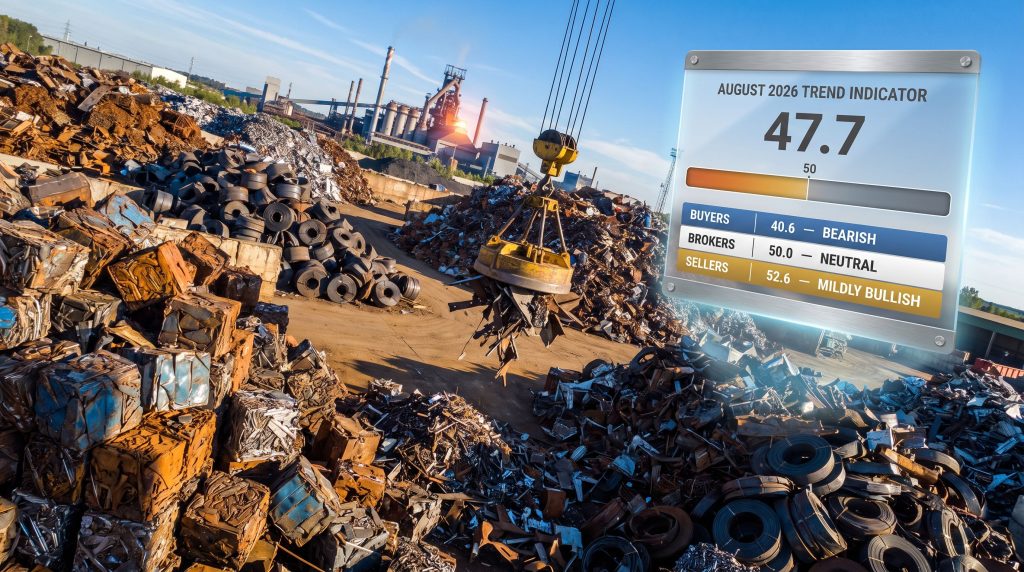
The August 2026 Trend Indicator came in at 47.7, placing it marginally below the neutral threshold. While the distance from 50 might appear modest, the directional signal carries weight when paired with the predictive model's output, which estimates an average month-on-month price decline of approximately 0.9%. This follows a 0.7% decline recorded in the prior month, suggesting a mild but sustained softening trajectory rather than an isolated dip.
The back-to-back monthly declines, while individually small, reflect a market that has lost its upward momentum without yet finding a catalyst to reverse direction. In scrap markets, these transitional phases often persist longer than participants expect, particularly when inventory levels remain close to average and no supply shock is visible on the horizon.
Comparing the August reading against the 24-month consensus average adds further context. The consensus score, which measures agreement across participant groups, sits at 65%, above the 24-month average of 61%. Higher consensus typically signals reduced internal market conflict, which in pricing terms often translates to range-bound conditions rather than sharp directional moves. For additional ferrous scrap pricing data, real-time benchmarks can offer useful context for interpreting these survey-based signals.
Where Buyers, Brokers, and Sellers Disagree
The August survey reveals a clear divergence in how each participant group is reading current conditions, even if the overall consensus is relatively tight.
| Participant Group | Trend Indicator Reading | Market Bias |
|---|---|---|
| Buyers (Mills) | 40.6 | Bearish, expecting price softening |
| Brokers | 50.0 | Neutral, balanced supply and demand view |
| Sellers (Scrap Dealers) | 52.6 | Mildly bullish, floor support anticipated |
Mill buyers are the most bearish cohort, with a reading of 40.6, a figure that reflects their direct exposure to weaker operating schedules and reduced intake requirements. Summer maintenance outages are compressing mill run rates, and when furnaces are offline, the appetite for scrap purchases falls sharply. This creates a buyers' market in the short term, with mills under little pressure to bid aggressively.
Brokers, occupying the middle ground at exactly 50.0, reflect a balanced view of supply and demand. Their neutrality is informative: brokers with active positions across both sides of the market tend to converge toward neutrality only when they genuinely cannot identify a clear directional edge, suggesting that any near-term price move is likely to be modest.
Sellers at 52.6 represent a mild but meaningful counterpoint. Scrap dealers and processors tend to hold back inventory when they believe prices are below fair value, and a reading above 50 indicates that the seller community sees some floor support in current conditions. This restrained supply behaviour is itself a stabilising force, preventing the kind of sudden price drops that can occur when sellers flood the market simultaneously.
Supply, Inventory, and the Seasonal Demand Compression
The inventory indicator reading of 49.7 confirms that scrap stocks at US mills are sitting close to historical averages. This near-neutral inventory position is significant for several reasons:
- It removes the urgency-driven buying that can propel prices higher during periods of genuine tightness.
- It also removes the liquidation pressure that tends to accelerate declines when mills are overstocked.
- The balanced position is consistent with survey participants identifying All Unchanged as the most common market driver for August, reinforcing the expectation of a quiet trading month.
Summer seasonality is a well-established pattern in US ferrous scrap markets. Higher ambient temperatures reduce the efficiency of outdoor scrap processing operations, slowing collection volumes from demolition sites, industrial generators, and auto shredding facilities. At the same time, several steel mills schedule planned maintenance outages during July and August, deliberately drawing down inventories before restarts.
The combination of softer supply generation and compressed mill demand typically creates a period of price suppression that lasts until September or October. Furthermore, the broader steel and iron ore market dynamics playing out globally are adding another layer of complexity to domestic pricing decisions.
Export market weakness is compounding this dynamic. Offshore buyers, particularly from Turkey and Asian markets, are the primary absorbers of excess US scrap that cannot be placed domestically. When global steel capacity utilisation softens or freight economics become unfavourable, these export channels narrow, removing a key price-support mechanism. Survey participants specifically cited weak exports as a contributing factor to the subdued August outlook.
Grade-Level Performance: Not All Scrap Is Moving the Same Way
One of the most important but underappreciated aspects of the US ferrous scrap market is that different grades can diverge significantly in price direction, even within the same monthly period. Headline price averages can obscure grade-level dynamics that matter considerably to specific buyer and seller categories.
| Scrap Grade | 2026 Price Trend | Key Driver | Risk Factor |
|---|---|---|---|
| Busheling (Prime) | Relatively firm | EAF mill preference, low substitution | Automotive sector slowdown |
| Shredded (Obsolete) | Mildly declining | Adequate flows, weak exports | Consumer durable end-of-life timing |
| HMS 1&2 | Soft to sideways | Export demand dependency | Freight cost volatility |
| Plate and Structural | Stable to soft | Infrastructure project pipeline | Mill maintenance schedules |
Prime scrap grades, particularly No. 1 Busheling and Bundles generated from automotive stamping and sheet metal operations, are holding up better than obsolete grades. EAF mills prioritise prime scrap for its low residual content and consistent chemistry, and the limited volume of prime generation relative to demand keeps pricing relatively supported even in softer markets.
Shredded scrap, derived from shredded automobiles and consumer durables, faces the most immediate downward pressure. Survey participants flagged shredded as the grade most likely to see a price decline following several months of relative stability, as summer flows remain adequate and export demand has softened.
Heavy Melting Steel (HMS 1 and 2) continues on a soft-to-sideways trajectory, with price direction heavily influenced by Turkish and Asian export demand. HMS is the most globally traded ferrous scrap grade, making it particularly sensitive to freight rate movements and the purchasing behaviour of overseas EAF mills.
The Structural Demand Case Remains Intact
Short-term softness should not obscure the multi-year demand thesis that continues to build beneath the surface. Several structural forces are converging to increase scrap consumption on a secular basis:
- EAF capacity expansion is ongoing across multiple US steelmakers. Electric arc furnaces consume between 60% and 100% scrap in their metallic charge mix, meaning every new EAF tonne of steelmaking capacity adds directly to long-run scrap demand.
- Decarbonisation economics increasingly favour scrap-based production. Considering the role of hydrogen iron reduction technologies emerging alongside EAF growth, the pressure on carbon-intensive steelmaking routes is intensifying from multiple directions simultaneously.
- Infrastructure and construction demand flowing through multi-year domestic spending programmes is supporting long-run finished steel consumption, which in turn sustains the economic rationale for scrap collection and processing investment.
- Consumer durable and automotive recycling flows generate the long-cycle supply pipeline that feeds obsolete scrap grades. As vehicles scrapped today were manufactured 12 to 15 years ago, the composition and volume of future scrap flows are, to a significant degree, already determined by past production cycles.
It is worth noting that EAF steelmaking's scrap intensity also makes it structurally exposed to scrap price volatility in a way that blast furnace operators, who can substitute between iron ore and hot metal, are not. This means that as EAF capacity grows, the scrap market becomes simultaneously more strategically important and more sensitive to supply disruptions.
The next major ASX story will hit our subscribers first
Near-Term Headwinds Limiting Price Recovery
Several factors are working against a price rebound in the immediate term:
- Mill outage schedules are reducing scrap intake at a time when summer collection rates are also softer, creating a demand vacuum that sellers cannot easily bridge.
- Pig iron substitution economics periodically make alternative metallics competitive with scrap, particularly when prime scrap premiums widen. When pig iron, direct reduced iron (DRI), or hot briquetted iron (HBI) become cost-competitive, some mills reduce scrap purchases at the margin, softening demand further.
- Freight and fuel costs represent a meaningful input cost for scrap processors and dealers, and sustained fuel surcharges compress dealer margins, occasionally forcing reluctant selling that adds supply pressure.
- Reduced export activity is removing the offshore demand release valve that typically absorbs excess domestic supply.
However, the US ferrous scrap outlook over a longer horizon remains underpinned by structural EAF demand growth, which means near-term softness is unlikely to persist into a prolonged bear market without a significant demand-side shock.
Market participants should recognise that the convergence of summer mill outages, muted export demand, and near-average inventory creates conditions where upside price catalysts are structurally limited in the short term. A meaningful rally from current levels would most likely require either an unexpected acceleration in mill restart schedules or a significant reduction in available prime scrap supply.
Scenario Framework: Q3 to Q4 2026
| Scenario | Price Direction | Key Trigger | Assessment |
|---|---|---|---|
| Base Case | Flat to -1% MoM in Q3, mild recovery Q4 | Balanced supply and demand, seasonal normalisation | Most probable outcome |
| Bull Case | +3 to 5% from current levels | Export demand surge, prime scrap tightening | Lower probability |
| Bear Case | -3 to 5% sustained decline | Extended mill downtime, weak finished steel demand | Moderate tail risk |
The base case anticipates range-bound pricing through the core summer period, with a gradual seasonal recovery beginning in September as mills restart and scrap collection rates normalise. This pattern has characterised numerous prior summer cycles and aligns with the balanced inventory and muted consensus readings from the August survey.
The bull case depends on factors not currently visible in the data: a revival of Turkish or Asian export demand, an unexpected tightening of prime scrap availability, or a faster-than-expected ramp-up in EAF operating rates. None of these are implausible, but they require confluent positive surprises to materialise simultaneously.
The bear case would require a more persistent weakening of finished steel demand, potentially triggered by a deterioration in construction activity or automotive production schedules. Extended mill outages beyond seasonal norms would amplify this scenario. In addition, ongoing steel tariffs impact from US trade policy continues to shape how domestic mills and international buyers are positioning themselves heading into Q4.
Positioning Strategies for Each Participant Type
For steel mills and buyers: The current environment favours measured procurement rather than aggressive forward buying. With inventory near average levels and supply flow adequate, there is limited strategic cost in allowing spot markets to find their own level before committing to fixed-price arrangements. The risk to this posture is a sharper-than-expected autumn demand surge catching buyers under-covered.
For scrap dealers and processors: Timing inventory release around mill restart schedules in September and October historically captures the best pricing in the post-summer recovery window. Holding back high-value prime grades during August, when mill appetite is suppressed, may improve realised pricing without meaningfully increasing carrying cost risk.
For brokers and traders: The elevated consensus score of 65% signals that directional conviction across the market is relatively high, which compresses the arbitrage opportunities that typically arise from participant disagreement. Margin management and position sizing matter more than directional bets in this environment. Furthermore, monitoring green steel pricing trends is increasingly relevant, as the premium attached to low-carbon scrap-based steel is beginning to influence buyer procurement strategies at the mill level.
Frequently Asked Questions: US Ferrous Scrap Market Outlook
What is the current price trend for US ferrous scrap in 2026?
The market is in a mild softening phase, with the August 2026 Trend Indicator at 47.7 pointing to an estimated 0.9% month-on-month price decline. Conditions are broadly stable rather than sharply directional.
Why are mill buyers more bearish than scrap sellers on price direction?
Mills are operating at reduced rates due to summer maintenance outages, lowering their immediate scrap intake requirements. Sellers, by contrast, retain the option to withhold inventory if prices fall below their cost-based floor, giving them a degree of price support leverage that buyers lack in the short term.
How does EAF steelmaking growth affect long-term scrap demand?
Each increment of EAF steelmaking capacity adds directly to structural scrap consumption. With US and global EAF capacity continuing to expand, the long-run demand trajectory for ferrous scrap is upward, even if cyclical softness persists in the near term. The scrap recycling industry is projected to grow substantially over the coming decade, underpinned by precisely this structural shift toward electric steelmaking.
What grades of ferrous scrap are most affected by export market weakness?
HMS 1 and 2 grades are the most export-sensitive, given their widespread use in Turkish and Asian EAF mills. Shredded scrap also faces export-related pricing pressure, while prime grades like Busheling are more domestically anchored and relatively insulated.
What would need to happen for US scrap prices to rally significantly?
A meaningful price recovery would require some combination of mill run rate acceleration, a revival in offshore export demand, or an unexpected tightening of prime scrap availability. The current balanced inventory position means no single factor is likely sufficient on its own.
Key Signals Worth Watching Through Year-End
Three metrics deserve particular attention as the market moves through the remainder of 2026:
- The Trend Indicator trajectory: Any sustained move back above 50 would confirm that the seasonal softness is resolving and that buying conviction is returning to the market.
- Inventory level shifts: A move below 45 on the inventory indicator would signal genuine tightness emerging at the mill level, which has historically preceded sharper price recoveries.
- Consensus score direction: If the consensus score falls back toward or below the 61% 24-month average, it would signal re-emerging disagreement between participant groups, potentially flagging a market at an inflection point.
The US ferrous scrap market outlook in mid-2026 presents a picture of controlled stability: neither breaking down sharply nor recovering with conviction. For those with a longer investment or operational horizon, the structural demand thesis built around EAF expansion and decarbonisation remains the more important story. Near-term price softness is a feature of the summer cycle, not a signal that the underlying trajectory has changed.
Disclaimer: This article contains forward-looking analysis, scenario projections, and market forecasts that involve inherent uncertainty. Past price trends and survey data are not reliable indicators of future market outcomes. Readers should conduct their own due diligence before making commercial or investment decisions based on commodity market analysis.
Want to Capitalise on the Next Major Commodity Discovery Before the Market Moves?
Discovery Alert's proprietary Discovery IQ model delivers real-time alerts on significant ASX mineral discoveries — instantly cutting through complex data to surface actionable opportunities across iron ore, steel-related commodities, and more than 30 other sectors. Explore why major mineral discoveries have historically generated extraordinary returns, and begin your 14-day free trial today to position yourself ahead of the broader market.