July 8, 2026
The Geopolitics of Ground-Level Resources: Why Capital Follows Geology
There is a well-established pattern in the history of industrial economies: when a civilisation identifies a material it cannot function without, it stops waiting for markets to deliver it and begins engineering the conditions for supply. That logic, once applied to oil fields in the Middle East and coal seams in Appalachia, is now being applied to copper and lithium deposits in the Andes.
The acceleration of US investment in Chilean mining projects is not simply a corporate trend driven by commodity prices. It is the financial expression of a strategic reorientation, one in which Washington and Wall Street have concluded that waiting passively for critical minerals demand to self-organise is no longer an acceptable posture.
Understanding the scale, structure, and motivations behind this capital deployment requires looking beyond individual project announcements. The full picture involves sovereign financing frameworks, bilateral diplomacy, technological innovation, and a quiet but intense competition with Chinese state capital for influence over the world's most consequential mineral geography.
When big ASX news breaks, our subscribers know first
The Scale of US Investment in Chilean Mining Projects
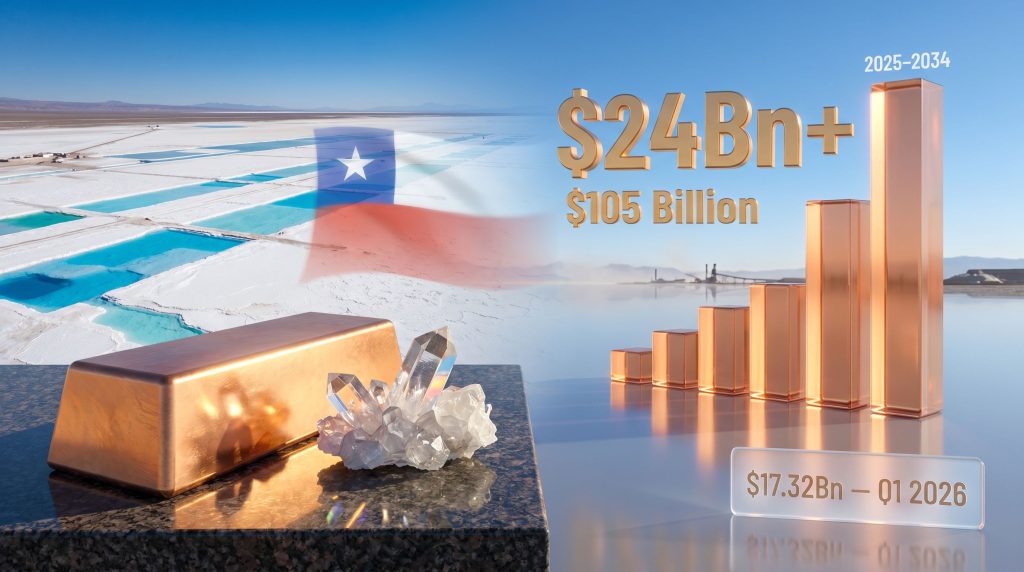
The aggregate figure now attached to US-linked mining ventures in Chile has surpassed $24 billion, spanning projects at various stages from operational expansion to early-stage exploration. This is not a single transaction or a consolidated fund. It represents a multi-horizon capital deployment strategy involving large-cap operators, mid-tier developers, junior explorers, and American technology and equipment suppliers.
To contextualise this figure, Chile's total projected mining investment between 2025 and 2034 is estimated at approximately $105 billion across all project categories and nationalities. US-linked capital therefore accounts for a meaningful share of that pipeline. In Q1 2026 alone, projects worth $17.32 billion entered Chile's formal environmental review process, signalling that the pipeline is accelerating rather than contracting.
| Investment Metric | Value | Timeframe |
|---|---|---|
| Total US-linked mining projects in Chile | $24Bn+ | Active and pipeline |
| Chile's total projected mining investment | ~$105Bn | 2025–2034 |
| Projects entering environmental review | $17.32Bn | Q1 2026 |
| US share of Chile's mining equipment supply | ~20% | Current |
What distinguishes this investment wave from prior cycles is its deliberate architecture. Earlier waves of foreign mining capital flowed into Chile primarily in pursuit of commercial returns. The current wave is structured partly around supply chain security, with financing instruments and bilateral agreements designed to keep production flowing toward US-aligned end markets.
Major US Companies Anchoring the Chilean Mining Landscape
Freeport-McMoRan and the Escondida Complex
Freeport-McMoRan holds a stake in the Escondida copper mine in Chile's Atacama Desert, the single largest copper-producing operation on Earth. The mine accounts for a significant share of global copper supply and sits at the centre of US strategic exposure to Chilean resources. The Nueva Concentradora Escondida expansion, valued at approximately $5.1 billion, has been advancing toward production and represents one of the most capital-intensive single mining investments currently underway in South America.
Escondida's ore grades have been declining gradually over decades, which is a common feature of mature porphyry copper systems. This is precisely why the concentrator expansion matters: it allows lower-grade ore to be processed economically at scale, extending the mine's productive life and maintaining throughput volumes that global copper markets depend upon. Furthermore, the Chile copper market outlook suggests sustained demand pressure will underpin long-term investment returns in the region.
Albemarle and Direct Lithium Extraction in the Atacama
Albemarle Corporation, one of the world's largest lithium producers, is advancing a $3.1 billion direct lithium extraction operation within Chile's Atacama Salt Flat. The Atacama is the world's most productive lithium brine basin, containing brines with lithium concentrations that can reach several thousand milligrams per litre, substantially higher than most competing deposits globally.
Traditional lithium recovery from brines relies on evaporation ponds that take 12 to 24 months to concentrate the brine before processing, consume enormous land areas, and recover only around 50% of available lithium. DLE technology bypasses this process entirely, using selective adsorption or membrane-based systems to extract lithium directly from brine in days to weeks, with recovery rates that can exceed 90% and substantially reduced water consumption.
| Method | Water Usage | Processing Time | Recovery Rate | Capital Intensity |
|---|---|---|---|---|
| Evaporation Ponds | High | 12–24 months | ~50% | Lower upfront |
| Direct Lithium Extraction (DLE) | Significantly lower | Days to weeks | Up to 90%+ | Higher upfront |
The shift toward DLE is not merely a technological preference. It is increasingly a regulatory and social necessity in the Atacama, where water scarcity and Indigenous community concerns about brine drawdown have intensified scrutiny of conventional evaporation methods.
Minera El Abra and the Copper Development Pipeline
The El Abra copper project, in which US interests hold a significant stake, represents a potential $7.5 billion development with strategic importance to domestic US copper supply planning. The project's timeline and economics remain subject to regulatory approvals and commodity price conditions, but its scale positions it as one of the more consequential copper development options currently available to US-aligned mining capital in the region.
The Financial Architecture Supporting US Investment
The FORGE Framework
The Financing for Overseas Resources, Growth, and Enterprise (FORGE) framework, administered through the US Export-Import Bank, provides up to $30 billion in financing capacity directed toward resource projects in allied and partner nations. The mechanism offers loan guarantees, price floor structures, and preferential financing terms that materially reduce the risk profile of projects that would otherwise struggle to attract commercial capital at acceptable rates.
FORGE represents a structural shift in how the US government approaches mineral supply chain risk. Rather than reacting to shortfalls after they emerge, it pre-positions financing tools that make allied-nation resource development commercially viable before demand crises materialise.
The Inflation Reduction Act as an Upstream Catalyst
The Inflation Reduction Act (IRA) creates powerful downstream demand signals that translate directly into upstream investment incentives. By subsidising electric vehicle manufacturing and battery storage deployment in the United States, the IRA generates durable demand for battery-grade lithium and copper cathode. Projects in Chile that can demonstrate supply chain linkage to US manufacturing qualify for preferential treatment under IRA provisions, making their offtake agreements more bankable and their financing terms more favourable.
| Financing Mechanism | Institution | Function |
|---|---|---|
| FORGE Framework | US Export-Import Bank | $30Bn backing for allied nation projects |
| IRA Subsidies | US Federal Government | Downstream demand incentive for critical minerals |
| DFC Investment | US Development Finance Corp. | Direct equity and debt in strategic resource projects |
| IDB Loan (regional) | Inter-American Development Bank | $100M loan for lithium projects in the region |
Bilateral Agreements Formalising the Partnership
The United States and Chile have signed formal agreements covering critical minerals cooperation and mining-related security frameworks. A joint statement on critical minerals has outlined cooperation priorities across supply chain integration, environmental standards, and technology sharing. A formal bilateral dialogue mechanism has also been established, with scheduled meetings intended to institutionalise the partnership rather than leaving it dependent on project-by-project negotiation.
Why Copper and Lithium Define the Strategic Logic
Chile holds an estimated 23% of global copper reserves, the largest national share on Earth, according to US Geological Survey data. Copper is not substitutable in electrical infrastructure at scale. Every electric vehicle requires roughly 2.5 to 4 times more copper than a conventional internal combustion vehicle. Grid-scale battery storage, offshore wind turbines, and defence electronics all carry similar copper intensity premiums.
Lithium demand is projected by the International Energy Agency to increase by a factor of six or more by 2040 under accelerated decarbonisation scenarios. Chile is the world's second-largest lithium producer and home to the highest-grade lithium brine deposits known to exist. The Atacama's brines also contain elevated concentrations of potassium and boron, which can be co-extracted to improve project economics, a feature less commonly discussed in mainstream analysis of the basin's value.
The product form question also matters strategically. US battery manufacturers primarily require lithium hydroxide rather than lithium carbonate, because hydroxide is better suited to the nickel-manganese-cobalt (NMC) cathode chemistries used in high-energy-density EV applications. Chilean producers have been expanding hydroxide conversion capacity, however, the transition from a historically carbonate-focused industry adds capital and processing complexity.
Chile as the Cornerstone of a Regional Strategy
US investment in Chilean mining projects does not exist in isolation. The US Development Finance Corporation has proposed a $465 million investment in Argentine lithium operations, and rare earth projects in Brazil are attracting increasing US development finance interest. However, Chile functions as the anchor of this regional strategy because of its combination of reserve scale, established infrastructure, institutional stability, and existing trade relationships with the United States.
Chile's lithium strategy and its broader policy frameworks are central to understanding how the country has positioned itself as an indispensable partner for US-aligned supply chains. Furthermore, Codelco's copper strategy plays a pivotal role in shaping how state and private capital interact across Chilean mining operations.
If political conditions were to shift dramatically and restrict US access to Chilean mineral resources, the downstream consequences for American battery manufacturing timelines and clean energy deployment schedules would be severe. This vulnerability is precisely why the diplomatic and financial architecture being built around the relationship is so deliberate.
The next major ASX story will hit our subscribers first
Risks That Could Derail the Investment Thesis
Regulatory and Environmental Approval Timelines
Chile's environmental impact assessment process, known as the Sistema de Evaluación de Impacto Ambiental (SEIA), is thorough and legally enforceable. Large projects routinely take three to six years from submission to final approval. Indigenous consultation requirements under ILO Convention 169, to which Chile is a signatory, add further procedural complexity in regions such as the Atacama, where Atacameño communities hold ancestral water rights that intersect with mining operations.
Political and Policy Risk
Chile's lithium sector has undergone meaningful policy evolution in recent years, with the government of President Gabriel Boric introducing a national lithium strategy that envisions greater state participation through CODELCO and SQM partnership structures. While outright nationalisation has not occurred, the direction of policy has introduced uncertainty for private investors accustomed to more predictable regulatory environments. This uncertainty is a genuine factor in how US-aligned capital prices risk on long-duration Chilean lithium projects.
Commodity Price Cycles
Lithium carbonate prices collapsed from highs above $80,000 per tonne in late 2022 to below $15,000 per tonne by mid-2024, according to S&P Global Commodity Insights data. Copper has been more resilient but remains vulnerable to demand shocks tied to Chinese construction and industrial activity. The FORGE framework's price floor provisions are specifically designed to buffer projects against these cycles, but they do not eliminate the underlying exposure entirely.
China's Entrenched Position
Chinese state-owned enterprises are not newcomers to Chilean mining. Antofagasta's Zaldivar and Los Pelambres operations involve Chinese institutional shareholders, and BHP's Escondida partnership includes non-US parties. The competitive dynamic is not simply US capital displacing Chinese capital. It is a more nuanced contest over offtake destinations, processing relationships, and technology supply, fought at the level of contractual structures rather than headline ownership. In addition, Chile's critical minerals rivalry between US and Chinese interests continues to reshape the broader investment risk landscape.
The Full Spectrum: From Corporate Giants to Technology Providers
One of the less-examined dimensions of US investment in Chilean mining projects is the role played by American technology and equipment companies. US suppliers currently account for approximately 20% of Chile's mining equipment market, covering everything from haul truck fleets and ventilation systems to drill rigs and process control software. As DLE technology scales, US firms developing proprietary adsorption media and membrane systems stand to capture a growing share of the capital expenditure embedded in new lithium projects.
Junior and mid-tier US exploration companies are also active across Chile's northern regions, pursuing copper porphyry and lithium brine targets at earlier stages of development. These ventures carry higher geological risk but offer substantial leverage to discovery outcomes. Furthermore, they are increasingly structured to qualify for DFC or FORGE-linked support once they reach feasibility stage. According to InvestChile, the country's institutional framework continues to welcome and actively support foreign capital across the mining sector.
Frequently Asked Questions
How much has the US invested in Chilean mining?
US-linked mining projects in Chile collectively represent more than $24 billion in committed and pipeline capital, spanning copper, lithium, and associated processing infrastructure.
What is the FORGE framework?
FORGE is a $30 billion financing mechanism administered through the US Export-Import Bank, providing loan guarantees, price floor structures, and preferential terms for resource projects in partner nations.
Why is Chile critical to US mineral security?
Chile holds the world's largest copper reserves and is the second-largest lithium producer globally. Its Atacama Salt Flat contains the highest-grade lithium brine deposits known to exist, making it central to US battery, defence, and clean energy supply chains.
What is DLE and why does it matter?
Direct lithium extraction is a processing technology that recovers lithium from brine in days rather than months, with recovery rates above 90% and lower water consumption than conventional evaporation methods.
Disclaimer: This article contains forward-looking statements, projections, and analysis based on publicly available data. Figures relating to investment pipelines, commodity price forecasts, and project timelines are subject to change. Nothing in this article constitutes financial or investment advice. Readers should conduct independent due diligence before making any investment decisions.
Want to Stay Ahead of the Next Major Mineral Discovery?
Discovery Alert's proprietary Discovery IQ model delivers real-time alerts on significant ASX mineral discoveries — turning complex mineral data into actionable insights for both short-term traders and long-term investors. Explore Discovery Alert's dedicated discoveries page to see how historic mineral discoveries have generated substantial returns, and begin your 14-day free trial to position yourself ahead of the market.