
July 8, 2026
The Economics of Proximity: Why Mining's Next Billion-Dollar Opportunity Is Already in the Ground
The global mining industry has spent decades optimising individual assets, refining single-mine economics, and deploying capital one project at a time. Yet as ore grades decline, permitting timelines stretch, and the cost of new greenfield development continues to climb, a fundamental question is emerging: what if the industry has been measuring value at the wrong scale all along?
The answer, according to a detailed analytical framework developed by GEM Mining Consulting, lies not in finding new deposits but in rethinking how existing and adjacent ones are evaluated, developed, and operated together. The concept driving this shift is the mining district, and the evidence suggests that mining districts could unlock billions in value that traditional single-asset analysis has consistently left on the table.
When big ASX news breaks, our subscribers know first
Why Standalone Mine Economics Are Increasingly Under Pressure
The structural case for single-asset mine development has been quietly eroding for years. Average ore grades across major copper, gold, and lithium jurisdictions have fallen meaningfully over the past two decades. The consequence is straightforward: more rock must be moved and processed to produce the same quantity of metal, which drives up unit costs across energy, water, labour, and capital.
This grade decline problem compounds when combined with rising input costs and increasingly complex permitting environments. A mine that looked economically robust at the feasibility stage five years ago may struggle to justify its capital requirements today, particularly when permitting challenges add years to development timelines and water scarcity constraints force expensive engineering workarounds.
Social licence pressures add another layer of friction. Communities and indigenous groups adjacent to proposed mining operations have become increasingly sophisticated in their engagement with regulatory processes, and projects that fail to establish genuine social consent face delays that can rival those caused by technical or financial obstacles.
The result is a growing class of individually viable deposits that collectively fail to attract the capital needed for development. The economics simply do not close when assessed in isolation.
Redefining the Unit of Analysis: From Mine to District
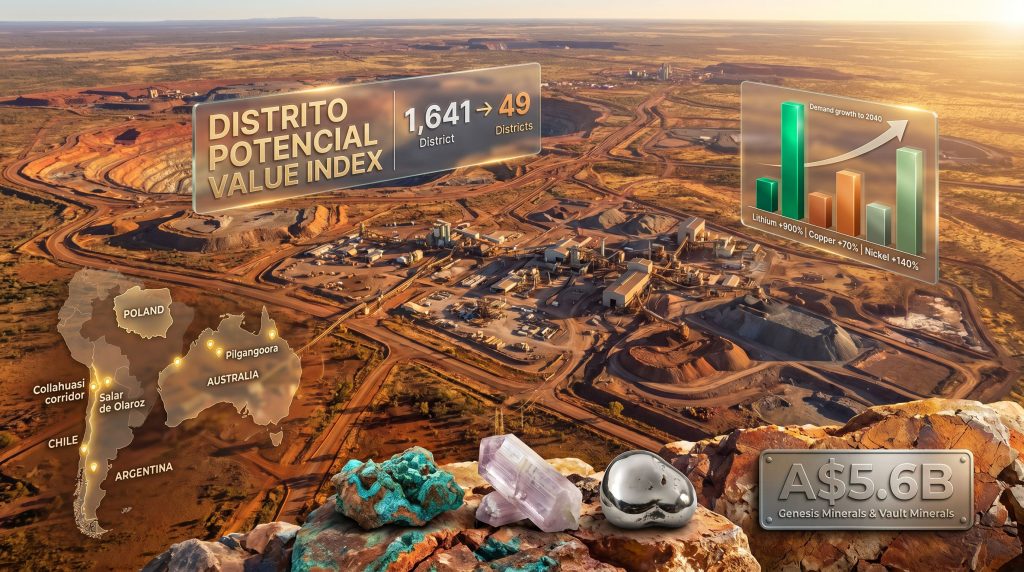
GEM Mining Consulting's District Potential Value Index (DPVI) represents a systematic attempt to quantify what district-level thinking can deliver. The methodology began with a screening universe of 1,641 mines and projects across global jurisdictions, applying a multi-stage evaluation process that ultimately identified 49 districts warranting full assessment.
The DPVI evaluates each district across three primary dimensions:
- Economic scale: The aggregate resource base and revenue potential of the cluster as a collective unit
- Shared infrastructure capacity: Existing or feasibly shareable logistics, processing, power, and water systems across the district
- Operational coordination potential: The degree to which neighbouring assets can be developed in a complementary rather than competing sequence
Critically, environmental and social governance performance functions as a structural constraint within the framework rather than a supplementary consideration. Districts that score strongly on resource metrics but carry significant environmental or social risks are not treated as high-value opportunities; they are effectively disqualified from the upper ranking tiers.
The DPVI also separates districts into three categories based on their current development readiness:
| District Classification | Core Characteristics | Strategic Implication |
|---|---|---|
| Mature Clusters | Established infrastructure, high operational continuity | Positioned for near-term integration and value capture |
| Emerging Districts | Significant resource base, investment still required | Medium-term development pipeline |
| Fragmented Clusters | Insufficient coordination potential at present | Not yet viable for district-level strategy |
Which Districts Score Highest on the DPVI and Why
The top-ranked districts in GEM's analysis span three continents and cover both copper and lithium, the two minerals most central to the critical minerals energy transition:
- Altura-Pilgangoora Lithium District, Western Australia: Ranked first globally, benefiting from a combination of large hard-rock lithium resource scale, high-density existing infrastructure, and relatively manageable environmental constraints compared to brine-based competitors
- Collahuasi-Quebrada Blanca Copper District, Northern Chile: Decades of operational continuity and deeply embedded logistics infrastructure create a competitive position that newer entrants would struggle to replicate even with equivalent resource quality
- Andina-Los Bronces Copper District, Central Chile: A case study in how mature processing and transport infrastructure can offset the operational challenges of high-altitude, water-constrained environments
- Lubin-Polkowice-Sieroszowice-Rudna Copper District, Poland: Europe's standout performer, operated predominantly by KGHM, demonstrating what multi-decade coordinated development under a unified strategic framework can deliver in terms of cost efficiency and mine life extension
- Salar de Olaroz-Cauchari-Olaroz Lithium District, Argentina: The leading emerging lithium district in the Puna plateau, where brine chemistry compatibility and the potential for shared evaporation and processing infrastructure create district-level efficiencies unavailable to standalone brine operations
The study found that Oceania leads globally when districts are assessed on a combined basis of resource endowment, social performance, and environmental constraint manageability. Australia's regulatory maturity, existing infrastructure density, and established water management frameworks provide structural advantages that arid-zone competitors in Chile and Argentina must work significantly harder to replicate.
Chile's northern copper districts retain strong positions despite water scarcity challenges, primarily because the legacy capital investment already embedded in those districts — spanning transport corridors, power infrastructure, and processing facilities — represents a competitive moat that newer districts cannot easily overcome. Furthermore, a major copper system in Argentina is illustrating how emerging jurisdictions are beginning to challenge established district hierarchies.
The Billion-Dollar Synergy Equation in Practice
The proposed A$5.6 billion merger between Genesis Minerals and Vault Minerals provides a real-world illustration of how district economics translate into corporate strategy. The merger rationale rests substantially on the geographic proximity of the Leonora and Bardoc-Mt Monger operations in Western Australia, with Genesis arguing that routing ore from both operations through existing processing infrastructure rather than constructing new facilities could generate more than A$1.5 billion in unique synergies.
This example reveals something important about where district value actually originates. According to research into creating mining districts, the findings consistently point to a core insight:
The most significant value unlocked through district integration is not revenue growth. It is capital avoidance. Eliminating the need for duplicate processing infrastructure, shared haul roads, and consolidated water systems can generate returns that no single-asset expansion programme could replicate.
BHP's approach to its Pampa Norte division in Chile reinforces this logic. Rather than pursuing greenfield development to expand its Chilean copper footprint, BHP submitted a plan to extend the life of Cerro Colorado alongside its Escondida and Spence operations. The risk-adjusted returns from extending an existing district asset, even one with ageing infrastructure, have proven more attractive than bearing the full capital and permitting burden of new project development.
Global Demand Pressures Making District Thinking Urgent
The timeline pressure for adopting district-level strategy is not theoretical. The scale of projected critical mineral demand growth over the coming fifteen years is unlike anything the industry has navigated before:
| Mineral | Projected Demand Increase to 2040 | Primary End-Use Driver |
|---|---|---|
| Copper | ~70% increase | Grid infrastructure, EVs, renewable energy systems |
| Lithium | ~900% increase | EV battery manufacturing and stationary storage |
| Nickel | ~140% increase | Battery cathode chemistry |
| Rare Earths | 3x to 7x depending on element | Permanent magnets, defence electronics, wind turbines |
Without a significant acceleration in district-level development, a global mining investment shortfall exceeding $500 billion is expected to materialise before 2040. This gap cannot be closed through greenfield discovery and development alone, particularly given the timelines involved. A major copper mine discovered today faces a development pathway of ten to fifteen years before meaningful production commences.
District-level coordination compresses this timeline by leveraging infrastructure that already exists, processing capacity that can be expanded rather than built from scratch, and regulatory relationships with communities that have already been established through existing operations.
Government Instruments Reshaping District Economics
Policy frameworks in several jurisdictions are beginning to function as structural amplifiers of district economics, though it is important to note these are broad policy environments rather than project-specific endorsements:
- The U.S. Inflation Reduction Act has redirected more than $1 trillion in federal incentives toward domestic critical mineral supply chains, fundamentally altering the economics of processing-integrated district development within American borders
- A single nickel project in Minnesota has been assessed as potentially generating more than $26 billion in IRA-linked tax credits spanning refining, battery manufacturing, and EV purchase subsidies when the full downstream value chain is considered
- The U.S. Department of Energy allocated $2.26 billion in loan support for the Thacker Pass lithium project in Nevada as part of an $11.7 billion critical minerals financing programme, reflecting the scale of institutional capital now moving into district-adjacent investment
- British Columbia's critical mineral districts are projected to reach annual production values of $16 billion by 2040, supported by record exploration spending of $751 million
The Alaska Ambler Road corridor represents another dimension of this dynamic. Reversing access restrictions reopened more than 1,700 mining claims, some held for over a century, for potential critical mineral development. A federal equity stake of 10% alongside a 17.5% Department of War stake in the project illustrates how government participation is being structured to align public and private incentives within a district development framework.
The next major ASX story will hit our subscribers first
The Four Barriers Preventing Districts From Reaching Their Potential
Despite the compelling economics, most districts worldwide are not capturing anywhere near their theoretical value. Four structural constraints consistently emerge as the primary inhibitors:
1. Water Scarcity
Lithium brine extraction across the western United States and South American salars faces intensifying competition for water resources. Stress indicators are rising across Nevada, Chile's Atacama, and Argentina's Puna plateau simultaneously — creating a resource conflict that can override even strong economic fundamentals. In addition, Argentina lithium brines face particular scrutiny given the environmental sensitivities of the high-altitude salar environments.
2. Permitting Uncertainty
Slow, fragmented, and sometimes contradictory approval processes across multiple jurisdictions create coordination failures that systematically erode the time-value of district integration. The longer permitting takes, the more the economics of shared infrastructure deteriorate as individual operators make unilateral decisions that foreclose district-level options.
3. Social Licence Deficits
Districts with world-class mineral endowments have repeatedly failed to convert resource potential into economic value when community relationships have not been proactively cultivated. Development timelines and capital efficiency consistently underperform in districts where social consent is contested rather than earned.
4. Governance Fragmentation
Multi-ownership structures across a single district create classic free-rider dynamics. If one operator can benefit from another's infrastructure investment without contributing proportionally, the incentive to invest in shared assets collapses. Most mining districts currently lack the institutional governance structures needed to prevent this from occurring.
Resource quality is a necessary but not sufficient condition for district-level value creation. Districts with world-class mineral endowments have repeatedly failed when water access, community consent, or coordinated governance frameworks are absent.
Three Models of District Integration Already Operating at Scale
Leading mining companies are not waiting for a universal district governance framework to emerge. Three operational models are already demonstrating how district thinking translates into practice.
Model 1: Ore Routing and Processing Consolidation
Directing ore from multiple nearby deposits through a single processing facility eliminates redundant capital expenditure and improves processing utilisation rates. This is the primary mechanism underpinning the Genesis Minerals-Vault Minerals merger rationale, where the geographic logic of the Leonora district makes consolidated processing economically transformative rather than merely convenient.
Model 2: Infrastructure Sharing Across Competing Operators
Joint haul roads, shared power supply arrangements, and coordinated water management across adjacent licence holders represent a more complex form of district integration that does not require ownership consolidation. This model is most developed in Chile's northern copper districts, where decades of operational co-existence have produced informal but durable infrastructure sharing arrangements between companies that compete in the same commodity markets.
Model 3: Territorial Development Planning
Long-term regional planning frameworks sequence development across an entire district to optimise capital deployment timing and minimise cumulative environmental footprint. Poland's Lubin-Polkowice-Sieroszowice-Rudna district, operated predominantly by KGHM across multiple decades, demonstrates what this model can achieve when a single operator maintains strategic continuity over a generational timeframe.
From Extraction to Supply Chain Sovereignty: The Downstream Dimension
One dimension of district thinking that is frequently underappreciated is the opportunity it creates for capturing downstream value within a single geographic footprint. Raw mineral extraction captures only a fraction of the total economic value generated by a mineral supply chain. The real value accumulates through beneficiation, processing, and early-stage manufacturing.
District-level coordination enables the co-location of these activities in ways that isolated mine development cannot. When processing infrastructure is shared across multiple extraction operations, the scale economics of that processing facility improve, making investment in higher-value processing steps more commercially viable than they would be for any single upstream operation.
Furthermore, research from the World Bank's metals and minerals programme consistently highlights that downstream value capture remains one of the most underdeveloped opportunities in emerging market mining economies. Ethiopia's $4.2 billion in new international investment agreements for iron ore, potash, and gold illustrates how emerging market governments are beginning to apply district-scale thinking to attract integrated supply chain investment rather than raw extraction capital alone.
The Strategic Scenarios Ahead
The trajectory of district-level thinking across the global mining industry will most likely follow one of three paths over the next decade:
- Accelerated Consolidation: M&A activity intensifies as major producers acquire neighbouring assets specifically to capture district synergies, compressing the integration timeline in mature clusters where the value case is already clear
- Institutional Framework Development: Industry bodies and governments establish formal district governance structures that enable infrastructure sharing between competing operators without requiring ownership consolidation, broadening access to district economics beyond M&A-capable majors
- Fragmented Stagnation: Permitting delays, unresolved social conflicts, and ownership fragmentation prevent coordinated development in enough districts that billions in potential value remains unrealised despite strong underlying resource endowments
The indicators worth monitoring as this dynamic unfolds include:
| Indicator | What It Signals |
|---|---|
| Cross-operator infrastructure sharing agreements | Early coordination adoption without requiring M&A |
| District-level permitting frameworks | Government commitment to enabling coordinated development |
| Processing co-investment between neighbouring operators | Movement toward integrated district value chains |
| DPVI score trajectory for emerging districts | Pipeline strength for future high-value integration |
Frequently Asked Questions: Mining Districts and Value Creation
What exactly is a mining district in economic terms?
A mining district is a geographically proximate cluster of mines, deposits, and development projects evaluated as a collective economic unit rather than a series of independent assets. The key distinction is that district economics are governed by shared infrastructure, coordinated development sequencing, and cumulative environmental and social management, rather than the individual performance of any single operation within the cluster.
Why are ore grade declines accelerating the case for district-level strategy?
As average ore grades fall across major jurisdictions, the cost per unit of metal recovered rises proportionally. District integration allows operators to offset this through processing efficiency improvements at shared facilities, overhead cost reduction through consolidated services, and mine life extension achieved by processing lower-grade material from multiple deposits through optimised shared infrastructure. None of these outcomes are accessible to isolated single-asset operations.
Which minerals benefit most from district-level development?
Copper and lithium present the strongest near-term cases given the scale of infrastructure investment required relative to the value of individual deposits. Nickel districts are increasingly relevant given battery cathode demand trajectories. Rare earth districts present significant coordination opportunities particularly where multiple deposit types — including carbonatite, ionic clay, and placer occurrences — exist within a single geological province and can share processing infrastructure despite different mineralogical characteristics. Consequently, mining districts could unlock billions in latent value across all of these commodity categories when the right governance conditions are in place.
Disclaimer: This article contains references to demand projections, investment figures, and scenario forecasts drawn from industry research and publicly available sources. These represent analytical perspectives rather than guaranteed outcomes. Readers should conduct independent research before making investment decisions. All financial figures are subject to change based on market conditions, regulatory developments, and corporate strategy.
Want to Catch the Next Major ASX Mineral Discovery Before the Market Does?
Discovery Alert's proprietary Discovery IQ model scans ASX announcements in real time, instantly identifying significant mineral discoveries across copper, lithium, and beyond — transforming complex data into actionable insights for investors at every level. Explore historic examples of extraordinary discovery returns and begin a 14-day free trial today to position yourself ahead of the market.