July 8, 2026
When Pension Funds Become Kingmakers: The Mechanics Behind Vale's Board Upheaval
In the world of large-cap mining, the assumption has long been that operational scale insulates companies from the kind of board-level turbulence that affects smaller, less capitalised peers. The reality in 2026 looks quite different. Across global resource majors, institutional shareholders — particularly pension funds with long-duration mandates and beneficiary obligations — are demonstrating a willingness to use formal governance mechanisms to reshape leadership at the very top. The Vale chairman Daniel Stieler resignation, effective July 6, 2026, is one of the most striking recent examples of this shift.
Understanding why this matters requires looking beyond the headline and into the structural mechanics of Brazilian corporate governance, the strategic weight of institutional activism, and what the transition signals for one of the world's most consequential iron ore producers.
When big ASX news breaks, our subscribers know first
The Governance Architecture That Made This Possible
How a 7% Stake Can Move a Chairman
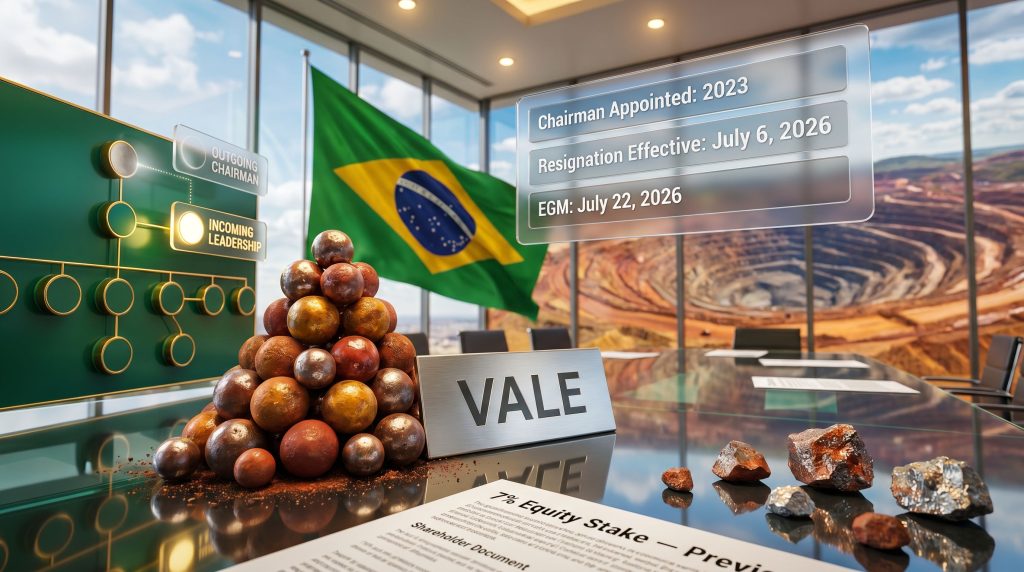
Brazilian corporate law grants shareholders holding relatively modest equity positions meaningful procedural rights, including the ability to formally requisition extraordinary shareholder meetings when they identify governance concerns. Previ, the pension fund that administers retirement benefits for employees of state-owned Banco do Brasil, holds approximately 7% of Vale's equity. That figure might appear modest relative to Vale's total market capitalisation, but its practical leverage under Brazilian securities regulations is disproportionate to its ownership percentage.
By formally demanding that Vale convene an Extraordinary General Meeting (EGM) to deliberate on the chairman's removal, Previ transformed what might otherwise have remained an internal disagreement into a public, legally binding governance process. The meeting was scheduled for July 22, 2026, with Stieler's removal as a central agenda item. Furthermore, understanding mining governance risks of this magnitude helps contextualise why such formal proceedings carry such significant weight.
Rather than proceed to a formal removal vote, Stieler resigned with immediate effect. Vale subsequently filed with securities regulators to withdraw the removal item from the EGM agenda, though the meeting itself was not cancelled. According to Bloomberg's reporting on the resignation, Stieler's departure came just weeks before the scheduled vote, underscoring how quickly institutional pressure can translate into board-level action.
Institutional shareholders in resource companies do not need majority ownership to drive board-level outcomes. The combination of formal procedural rights, public disclosure obligations, and reputational sensitivity means even a single determined minority holder can force a chairman's hand before a vote is ever cast.
What Is an EGM and Why Does It Matter?
An Extraordinary General Meeting differs from a company's regular Annual General Meeting in that it is convened specifically to address urgent, discrete governance matters that cannot wait for the scheduled annual cycle. These might include:
- Removal or appointment of board directors
- Major corporate transactions requiring shareholder approval
- Amendments to a company's articles of incorporation or bylaws
- Responses to governance crises that have reached a threshold of urgency
The scheduling of an EGM carries its own weight as a signal. It forces public disclosure, triggers scrutiny from other institutional investors, attracts media attention, and creates a visible governance event that credit rating agencies and index providers monitor. For Stieler, the EGM date of July 22 effectively functioned as a deadline that made resignation the path of least resistance.
A Closer Look at Daniel Stieler's Tenure
Leadership Timeline at Vale
| Milestone | Date |
|---|---|
| Joined Vale's Board of Directors | 2021 |
| Appointed as Chairman | 2023 |
| Resignation Effective | July 6, 2026 |
| Original Mandate Expiry | April 2027 |
Stieler served approximately five years across his combined board and chairman roles, with his resignation coming nearly one year before his mandate was scheduled to expire. Vale's board acknowledged his contributions to governance frameworks and strategic oversight during his time in leadership. His departure represents an early exit driven by external shareholder pressure rather than planned succession, a distinction that carries its own implications for the perception of Vale's governance culture.
It is worth noting that the circumstances of departure matter in corporate governance analysis. A chairman who exits following a publicly announced removal vote — even if they resign before the vote occurs — leaves a different footprint than one who concludes a term through orderly succession planning. Market participants and governance analysts will interpret the Vale chairman Daniel Stieler resignation as a precedent-setting event for Vale's future board dynamics.
Pension Funds, State Linkages, and the Blurred Lines of Influence
The Structural Position of Previ Within Vale's Shareholder Register
Previ occupies a structurally distinctive role among Vale's institutional investors. As a pension fund managing long-term retirement obligations for Banco do Brasil employees, its investment mandate is inherently conservative: it requires stable capital preservation, reliable dividend flows, and governance that protects against tail risks. This profile makes pension funds natural agents for board accountability.
However, Previ's status as the pension fund of a state-owned bank introduces a layer of analytical complexity. The line between institutional shareholder activism rooted in fiduciary duty and state-influenced corporate intervention is not always clear in Brazil's mixed-ownership corporate ecosystem. Consequently, major Brazilian companies including Vale operate with nominally private governance structures but carry significant state-linked shareholders on their registers.
Whether Previ's intervention reflects genuine fiduciary concern about board effectiveness, political preference for a more aligned chairmanship, or some combination of both is a question that Brazilian markets and international investors will continue to debate. The documented mechanism, however, was formal shareholder governance, not regulatory directive.
This distinction carries real importance for investors assessing Vale's independence from government influence versus its responsiveness to legitimate institutional oversight. Respecting shareholder rights within these governance structures is, in fact, what gives such proceedings their legal legitimacy. The two are not the same, and conflating them risks misreading the company's governance trajectory.
How Institutional Activism Is Reshaping Mining Boardrooms Globally
Previ's move at Vale does not exist in isolation. Across global mining majors, pension funds, sovereign wealth funds, and activist institutional investors are increasingly asserting influence over board composition and strategic direction. The tools they use are consistent:
- Formal requisition of shareholder meetings
- Public endorsement of preferred board candidates
- Coordinated voting with other institutional shareholders
- Media disclosure of governance grievances
- Engagement with proxy advisory firms to shape shareholder vote recommendations
This pattern has played out at companies ranging from BHP, where climate strategy votes forced board-level accountability on emissions planning, to Rio Tinto, where cultural heritage governance failures reshaped board composition following the Juukan Gorge controversy. Vale's situation adds another case study to this growing body of evidence that resource sector boards are no longer insulated from institutional shareholder pressure by virtue of their scale alone. In addition, keeping close watch on management red flags within these organisations has never been more critical for sophisticated investors.
What the July 22 EGM Will Determine
The Election of a New Chairman
With the removal vote withdrawn from the agenda, the EGM's primary remaining business is the election of a new chairman. Previ has publicly backed current board member Manuel Oliveira for the role, positioning him as the frontrunner heading into the July 22 meeting. As reported by Brazil Stock Guide's coverage of the succession, Previ's endorsement of Oliveira represents a deliberate and coordinated governance strategy rather than an improvised response.
Oliveira's election, if confirmed, would represent a consolidation of Previ's influence over Vale's governance structure. Investors and analysts will be assessing several dimensions of the post-EGM landscape:
- Strategic continuity: Whether a new chairman accelerates or modifies Vale's existing capital allocation frameworks, particularly around production expansion, debt management, and ESG-linked investment
- Board dynamics: Whether Oliveira's appointment reflects broader board consensus or creates a governance structure perceived as disproportionately aligned with a single shareholder bloc
- Communication quality: The speed and clarity with which Vale communicates its governance transition plan will be closely observed by institutional investors and credit rating agencies as a proxy for board cohesion
Effective mining risk management communication during a leadership transition is, however, one of the clearest markers of a board that has its governance structures firmly in order.
Vale's Global Role and Why This Matters Beyond Brazilian Markets
Iron Ore Market Leadership and the Weight of Board Decisions
Vale is consistently ranked as the world's largest iron ore producer, with production decisions and capital expenditure planning that reverberate through global steel supply chains, particularly across East and Southeast Asia. Board-level instability, even when resolved within a compressed timeframe, creates a window of uncertainty around major project approvals, dividend policy, and long-term production targets.
For global commodity traders, steel producers, and infrastructure-focused funds with Vale exposure, the governance question is ultimately subordinate to a more fundamental concern: will the new chairman maintain or strengthen the operational and financial frameworks that underpin Vale's position as a reliable large-scale iron ore supplier?
Comparative Governance Across Global Mining Majors
| Company | Domicile | Key Institutional Shareholder Type | Recent Governance Event |
|---|---|---|---|
| Vale | Brazil | State-linked pension fund (Previ) | Chairman resignation, July 2026 |
| BHP | Australia / UK | Diversified institutional investors | Climate strategy shareholder votes |
| Rio Tinto | Australia / UK | Sovereign wealth and pension funds | Cultural heritage governance reform |
The pattern across this peer group reinforces a broader structural shift. In capital-intensive, long-cycle industries like mining, where investment decisions made at board level have consequences measured across decades, institutional shareholders are demanding commensurate accountability. Furthermore, the associated mining taxes and royalties frameworks that govern these companies add yet another layer of complexity to the governance landscape that incoming board chairs must navigate. The era of passive institutional ownership in major mining companies is, consequently, receding.
The next major ASX story will hit our subscribers first
FAQ: Vale Chairman Daniel Stieler Resignation
Why did Daniel Stieler resign as Vale's chairman?
Stieler stepped down on July 6, 2026, following sustained formal pressure from Previ, which had requisitioned an EGM scheduled for July 22 with his removal as a specific agenda item. His resignation rendered that vote unnecessary, and Vale withdrew it from the meeting agenda.
Who is likely to replace Stieler as Vale's chairman?
The EGM on July 22, 2026 will elect a new chairman. Previ has formally endorsed current board member Manuel Oliveira for the position, making him the most publicly supported candidate ahead of the meeting.
How long did Daniel Stieler serve as Vale's chairman?
Stieler was appointed chairman in 2023 and had been a board member since 2021. His resignation in July 2026 came approximately one year before his mandate was due to expire in April 2027.
What is Previ and why does it carry influence over Vale's governance?
Previ manages retirement savings for employees of Banco do Brasil, a state-owned Brazilian bank. It holds roughly 7% of Vale's equity, giving it both voting rights and the procedural ability under Brazilian corporate law to call shareholder meetings and formally nominate or challenge board members.
Does this board change affect Vale's mining operations?
Board-level leadership transitions do not directly affect day-to-day extraction and logistics operations. However, they can shape long-term capital allocation, project prioritisation, and the strategic risk appetite of the company — all of which carry material implications for investors over a multi-year horizon.
Key Takeaways for Investors and Governance Observers
- A 7% equity stake, deployed through coordinated governance mechanisms, proved sufficient to force the Vale chairman Daniel Stieler resignation at one of the world's largest mining companies before a formal vote was ever held
- Previ's intervention reflects the growing capacity of institutional shareholders, particularly those with long-duration mandates, to reshape board leadership at global resource majors
- The July 22, 2026 EGM remains a pivotal event for Vale's governance trajectory, with the chairmanship election set to define the company's strategic posture in the near term
- Investors assessing Vale should distinguish carefully between formal institutional shareholder activism and state-directed corporate interference, as the governance and investment implications of each differ substantially
- Leadership transitions driven by shareholder conflict rather than planned succession carry reputational and operational risk signals that merit close monitoring by credit analysts and long-term equity holders alike
Disclaimer: This article is intended for informational purposes only and does not constitute financial or investment advice. Readers should conduct their own due diligence before making any investment decisions. References to future events, including the July 22, 2026 EGM outcome, represent expectations based on publicly available information and are subject to change.
Want To Catch the Next Major Mineral Discovery Before the Market Does?
While governance shifts at global mining giants like Vale capture headlines, the real wealth-creation opportunities in resources often emerge from significant new mineral discoveries on the ASX — and Discovery Alert's proprietary Discovery IQ model delivers real-time alerts the moment these discoveries are announced, turning complex geological data into actionable investment insights. Explore historic examples of exceptional discovery returns and begin your 14-day free trial at Discovery Alert to position yourself ahead of the broader market.