July 10, 2026
The Hidden Fragility Inside the World's Most Consequential Energy Forecast
Energy markets have always been vulnerable to the tyranny of geography. Roughly one-fifth of all globally traded oil passes through a navigable strip of water barely 33 kilometres wide at its narrowest point. For decades, analysts modelled the closure of the Strait of Hormuz as a theoretical tail risk. That theoretical scenario is now historical fact, and its aftermath is reshaping every major oil market projection through 2027 and beyond.
The US-Iran escalation oil market surplus IEA forecast is, on its surface, a story of recovery and normalisation. Beneath that surface, it is something far more conditional: a precisely calibrated projection that collapses entirely if a single geopolitical variable moves in the wrong direction. Understanding what that variable is, and how fragile its current state truly is, represents one of the most important analytical tasks facing energy market participants today.
This article presents scenario analysis and forward-looking projections based on publicly available IEA forecasts and market data. It does not constitute financial or investment advice. Readers should conduct their own due diligence before making any investment decisions.
When big ASX news breaks, our subscribers know first
Decoding the IEA's 2027 Oil Market Surplus: What the Numbers Actually Say
The Arithmetic of an Unprecedented Market Flip
The scale of the projected market reversal between 2026 and 2027 is, by any historical measure, extraordinary. The IEA's baseline anticipates global supply expanding by approximately 7.5 million barrels per day in 2027, following a contraction of roughly 3.7 million bpd in 2026. On the demand side, consumption is expected to fall by around 1 million bpd this year before recovering by approximately 2 million bpd in 2027.
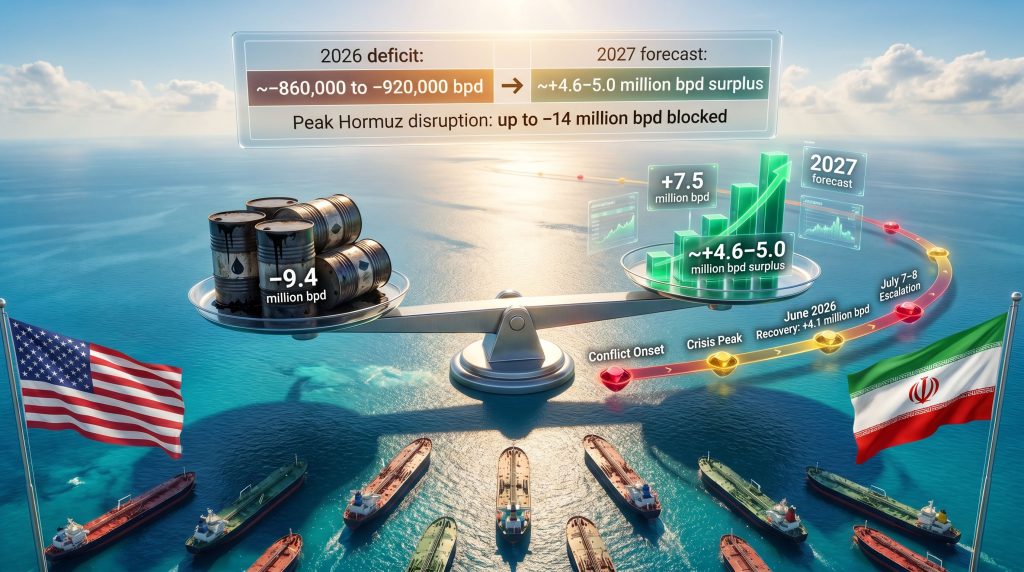
The combined effect of these dynamics is a projected market balance that swings from a deficit of approximately 860,000 bpd in 2026 to a surplus in the range of 4.6 to 5.0 million bpd in 2027. To put that surplus figure in context, it would represent more than double the size of the 1973 Arab oil embargo supply disruption, which removed roughly 5 million bpd and is widely considered the defining energy crisis of the twentieth century.
| Metric | 2026 Estimate | 2027 Forecast |
|---|---|---|
| Global supply change (year-on-year) | -3.7 million bpd | +7.5 million bpd |
| Global demand change (year-on-year) | -1.0 million bpd | +2.0 million bpd |
| Market balance | ~860,000 bpd deficit | ~4.6-5.0 million bpd surplus |
| Inventory drawdown rate (crisis period) | ~3.8 million bpd | Recovery phase begins |
| June 2026 supply recovery | +4.1 million bpd month-on-month | — |
| Remaining supply gap vs pre-war (June 2026) | -9.4 million bpd | — |
| Peak Hormuz disruption | Up to -14 million bpd | — |
Key Insight: The projected 2027 surplus is not generated by organic demand weakness or a structural shift in non-OPEC supply growth. It is mathematically contingent on the near-complete restoration of Middle Eastern production capacity that was effectively removed from global markets during the peak of the conflict.
Why the Strait of Hormuz Is the Entire Forecast
What makes the IEA's outlook genuinely unusual in the annals of energy forecasting is the degree to which it hinges on a single maritime chokepoint. The geopolitical oil market dynamics at play here are unlike anything previously modelled. Several critical dynamics define the Hormuz dependency:
- At the height of the US-Iran conflict, the effective closure of the Strait removed up to 14 million barrels per day of crude flows from global markets — the single largest supply disruption ever recorded
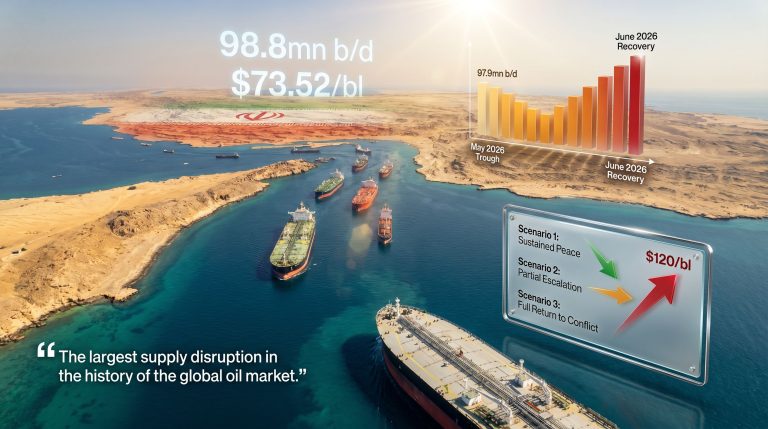
- The partial reopening following a peace agreement allowed June 2026 global supply to recover by 4.1 million bpd month-on-month, a historically unprecedented monthly gain, yet global output still sat 9.4 million bpd below pre-war levels
- The IEA has explicitly framed a lasting peace agreement not as a supportive condition but as an outright prerequisite for market normalisation
- Full supply recovery requires not just unimpeded Hormuz transits but the successful, sequential restart of upstream oil fields — a technically complex process that cannot be accelerated beyond certain operational limits
Furthermore, even in the best-case scenario, the market would need the surplus to be sustained across multiple quarters before inventory levels approach pre-crisis norms. During the conflict period, global inventories were drawing down at a rate of approximately 3.8 million bpd. Reversing that depletion is not a matter of months; it is a multi-year structural challenge.
The Supply Shock in Historical Perspective
How Does the 2026 Crisis Compare to Every Major Oil Disruption in History?
One of the least appreciated dimensions of the current situation is just how far the 2026 Hormuz closure exceeds every previous supply shock in volumetric terms. The comparison is striking:
| Supply Shock Event | Volume Removed | Duration | Primary Market Impact |
|---|---|---|---|
| 1973 Arab Oil Embargo | ~5 million bpd | ~6 months | Price quadrupled |
| 1979 Iranian Revolution | ~5.6 million bpd | ~12 months | Price approximately doubled |
| 1990 Gulf War (Iraq/Kuwait) | ~4.3 million bpd | ~7 months | Sharp spike, rapid reversal |
| 2011 Libya Civil War | ~1.4 million bpd | ~18 months | Moderate price pressure |
| 2026 US-Iran / Hormuz Closure | Up to 14 million bpd | Ongoing | Largest shock in recorded history |
The 2026 disruption removed more than double the combined volume of the 1973 embargo and the 1979 Iranian Revolution. Those two events are typically cited as the defining supply crises of the modern petroleum era. The current crisis, however, is operating in an entirely different order of magnitude. According to the IEA's oil market report, the scale of supply adjustment required to stabilise markets remains historically unprecedented.
A critical but underappreciated technical factor involves the nature of oil field shut-ins. Prolonged production suspension can cause reservoir pressure to decline unevenly, create near-wellbore damage, and in some cases permanently impair ultimate recovery volumes. The speed at which Middle Eastern production capacity can be fully restored is therefore constrained by subsurface engineering realities that unfold on their own timeline.
Three Scenarios for the 2027 Oil Market Balance
Scenario 1: Durable Peace and Full Normalisation
Core assumptions:
- The US-Iran peace agreement holds through 2026 and into 2027
- Hormuz transits recover progressively toward pre-war volumes over a 12 to 18-month period
- Upstream field restarts proceed without material technical complications or security interruptions
- Global demand recovers by approximately 2 million bpd as economic confidence returns and energy prices decline
Projected market outcome:
Under this scenario, the IEA's baseline holds. Supply expands by approximately 7.5 million bpd in 2027, the market moves into surplus territory in the range of 4.6 to 5.0 million bpd, and crude prices face sustained downward pressure as commercial inventories begin replenishing from historically depleted levels. The oil price volatility trends that characterised the crisis period would gradually subside under this outcome.
The less obvious implication is its potential to trigger an upstream investment pullback. If oil prices decline sharply under the weight of the surplus, exploration and development budgets could face pressure, potentially sowing the seeds of the next supply tightness cycle well before the 2027 surplus has fully normalised inventories.
Scenario 2: Intermittent Tensions and Partial Recovery
Core assumptions:
- The July 7-8 escalation reflects a persistent cycle of intermittent hostilities rather than an isolated event
- Hormuz transits remain suppressed, with periodic disruptions limiting throughput to 60 to 70 percent of pre-war volumes
- Field restarts proceed at a significantly reduced pace due to ongoing security uncertainty
- Demand recovery is more subdued, rising by only 1.0 to 1.5 million bpd in 2027
Projected market outcome:
The 2027 surplus narrows materially, potentially to a range of 1.5 to 2.5 million bpd. Oil prices stabilise at levels meaningfully above the baseline scenario. Inventory replenishment is delayed, and emergency reserve levels across industrialised nations remain at historically depressed readings well into 2027.
This scenario is arguably the most underappreciated risk. Markets tend to price binary outcomes: either full normalisation or acute crisis. The more probable middle path, characterised by chronic low-level instability and intermittent flare-ups, creates a persistent uncertainty premium that makes long-term energy planning extraordinarily difficult.
Scenario 3: Renewed Full Escalation and Hormuz Re-Closure
Core assumptions:
- The July 7-8 hostilities escalate into sustained military confrontation
- The Strait of Hormuz is effectively re-closed, erasing the June supply recovery gains
- Global supply falls back toward crisis-period lows, with the 9.4 million bpd gap from pre-war levels widening further
- Demand destruction accelerates as energy prices return to multi-year highs
Projected market outcome:
Under this scenario, the US-Iran escalation oil market surplus IEA projection is entirely invalidated. The market remains in deep structural deficit, and the prospect of a multi-year supply crisis becomes the dominant market narrative. As Reuters reports, oil prices have already been responding to uncertainty around the Hormuz reopening trajectory, underscoring how sensitive markets remain to even incremental developments.
Bear Case Warning: A return to full Hormuz closure would represent not merely a repeat of the initial shock but a compounding event that occurs against a backdrop of already-depleted strategic reserves, weakened producer fiscal positions, and potentially damaged upstream infrastructure. The second wave of disruption could prove more economically damaging than the first.
The Demand Side: Destruction, Seasonality, and the 2027 Rebound Thesis
Why the Demand Recovery Story Is Also Conditional
The IEA's demand projections deserve scrutiny independent of the supply-side analysis. Several dynamics are worth disaggregating:
1. The depth and reversibility of 2026 demand destruction
A 1 million bpd demand contraction in a single year is substantial. However, the critical question is whether that contraction reflects purely price-driven demand destruction, which reverses as prices fall, or whether it reflects more structural economic damage. If the latter, the 2 million bpd demand rebound projected for 2027 could prove optimistic.
2. The seasonal demand signal
Even within the crisis period, the IEA identified a significant seasonal demand uplift, with peak summer fuel consumption estimated at approximately 8 million bpd above May's crisis-period low. This suggests that underlying demand elasticity remains intact, and that consumers and industrial users have not permanently reduced their oil consumption in response to the shock.
3. The strategic petroleum reserve rebuilding impulse
A factor that is rarely modelled explicitly in public demand forecasts is the SPR rebuilding demand that would accompany a surplus scenario. Industrialised nations whose reserves have been severely depleted have both a strategic imperative and a financial incentive to accelerate restocking. This additional demand layer could meaningfully compress the effective surplus available to rebalance commercial inventories.
Geopolitical Risk Architecture: What the July Escalation Reveals
The Structural Instability of Post-Conflict Normalisation
The fact that fresh US-Iran hostilities erupted on July 7-8, shortly after the peace agreement that enabled June's supply recovery, reveals something important about the architecture of geopolitical risk. In addition, the oil market trade war impact from broader US foreign policy decisions continues to amplify these underlying pressures. Several analytical observations are particularly relevant:
- Ceasefire fragility is non-linear. The interval between peace agreement and renewed escalation appears to have been extremely short, suggesting that underlying structural tensions were not resolved by the diplomatic arrangement — merely paused. This is a fundamentally different risk profile from a conflict resolution that addresses root causes.
- Hormuz is not a binary variable. The strait's operational status exists on a spectrum between fully open and effectively closed. Intermittent harassment of tanker traffic, insurance market reactions, and rerouting decisions by shipping companies can suppress effective throughput significantly even without a formal closure.
- Upstream field restart timelines are longer than assumed. Industry experience from prior shut-in events suggests that full capacity restoration typically takes considerably longer than pre-conflict capacity levels would imply, particularly when infrastructure has sustained physical damage.
The next major ASX story will hit our subscribers first
Implications for GCC Economies and Global Monetary Policy
Who Bears the Cost of Each Scenario?
For Gulf Cooperation Council producer states:
- A 2027 surplus of the projected magnitude would place significant downward pressure on Brent crude prices, potentially pushing benchmark levels below the fiscal breakeven thresholds of several GCC economies
- Kuwait's fiscal position has already been materially weakened by lower oil revenues during the crisis period
- Saudi Arabia and the UAE face the challenge of calibrating Vision 2030-era diversification spending against a price environment that could deteriorate rapidly under the surplus scenario
- For producers operating below fiscal breakeven, the pressure to increase production volumes to compensate for lower per-barrel revenues could paradoxically amplify the very surplus compressing prices, creating a self-reinforcing negative feedback loop
For energy-importing economies and monetary policy:
- A sustained oil price decline would provide meaningful inflation relief to import-dependent economies across Asia, South Asia, and parts of Africa that have absorbed severe inflationary pressure during the supply shock
- Central banks maintaining restrictive monetary stances partly in response to energy-driven inflation would gain additional room to ease policy under the surplus scenario
- The current crude oil overview across import-dependent markets already reflects considerable uncertainty about how quickly the price relief thesis will materialise
Furthermore, OPEC's market influence will remain a critical secondary variable throughout this period. If surplus conditions materialise, the cohesion of the OPEC+ alliance — already under strain from differing fiscal needs among member states — could fracture, adding another layer of unpredictability to the supply-side equation.
Frequently Asked Questions: US-Iran Escalation and the IEA 2027 Oil Market Surplus
What Is the IEA's Oil Market Forecast for 2027?
The IEA projects that the global oil market will shift from a deficit of approximately 860,000 barrels per day in 2026 to a surplus of approximately 4.6 to 5.0 million barrels per day in 2027. This projection is explicitly contingent on the normalisation of Strait of Hormuz shipping lanes and the successful restart of Middle Eastern upstream production capacity.
How Much Oil Was Disrupted by the US-Iran Conflict and Hormuz Closure?
At the peak of the conflict, the effective closure of the Strait of Hormuz removed up to 14 million barrels per day of crude flows from global markets, representing the largest supply disruption in the recorded history of the global oil industry, exceeding the combined volumetric impact of the 1973 Arab oil embargo and the 1979 Iranian Revolution.
Why Did Global Oil Supply Rise Significantly in June 2026?
A peace agreement between the US and Iran facilitated the reopening of the Strait of Hormuz to tanker traffic. This enabled a month-on-month global supply recovery of 4.1 million bpd in June 2026 — the largest single-month supply gain on record. However, global output remained 9.4 million bpd below pre-war levels at that point, and the subsequent July escalation has introduced renewed uncertainty about whether this recovery trajectory can be sustained.
What Is the Biggest Risk to the IEA's 2027 Surplus Forecast?
The IEA itself has identified the durability of the US-Iran peace agreement as the single most critical variable underpinning the US-Iran escalation oil market surplus IEA outlook. Fresh hostilities on July 7-8 have demonstrated that the ceasefire remains fragile. Additional risks include the technical complexity of upstream field restarts, the pace of refinery normalisation, and the potential for OPEC+ cohesion to fracture under a surplus price environment.
Want to Identify the Next Major Commodity Opportunity Before the Market Moves?
The energy market disruptions analysed above illustrate precisely why real-time intelligence matters — Discovery Alert's proprietary Discovery IQ model scans ASX announcements the moment they drop, turning complex commodity and resource data into actionable insights for both short-term traders and long-term investors. Explore historic discoveries and their remarkable market returns, then begin your 14-day free trial at Discovery Alert to position yourself ahead of the next major market shift.