
August 23, 2026
The Geometry of Global Energy Risk: When a Single Waterway Holds the World to Ransom
Commodity markets have always been vulnerable to geography. But few geographic realities concentrate systemic risk as completely as a narrow strip of water roughly 33 kilometres wide at its most constrained point. The Strait of Hormuz has functioned for decades as the arterial passage through which a substantial portion of the world's seaborne crude oil must flow, and its potential closure or reopening carries consequences that cascade far beyond the energy sector into inflation rates, central bank policy, currency valuations, and the broader architecture of global trade.
Understanding the current U.S.-Iran peace deal and oil prices dynamic requires stepping back from the daily headline cycle and examining the structural mechanics that make this particular diplomatic episode so consequential for markets worldwide.
When big ASX news breaks, our subscribers know first
The Waterway That Prices the World's Energy
The Strait of Hormuz sits between the southern coast of Iran and the northern tip of Oman, forming the only maritime exit point for crude oil produced across the Persian Gulf basin. Saudi Arabia, the United Arab Emirates, Kuwait, Iraq, and Iran itself all depend on this passage for the bulk of their export volumes. According to the U.S. Energy Information Administration, roughly 20 to 21 million barrels of oil per day transited the strait in recent years, representing approximately one-fifth of global daily consumption and a far larger share of internationally traded crude.
When disruption risk enters this chokepoint, its effect on prices is not proportional to the volume actually affected. It is amplified by uncertainty, by insurance market repricing, by freight cost escalation, and by the speculative positioning of traders who must price future delivery at a premium whenever supply continuity is in question. This amplification mechanism is what turns a geopolitical standoff into a structural floor beneath crude benchmarks.
The ongoing conflict that began in early 2026 introduced precisely this kind of structural premium into oil markets. As military operations intensified and access to the strait became uncertain, benchmark prices climbed to levels that reflected not just current supply conditions but the possibility of prolonged disruption. That premium has now become the central variable in a rapidly evolving diplomatic equation, and the crude oil price trends that preceded this conflict help explain why markets were already sensitive to any further supply shock.
Why the U.S.-Iran Peace Deal and Oil Prices Are Moving Together
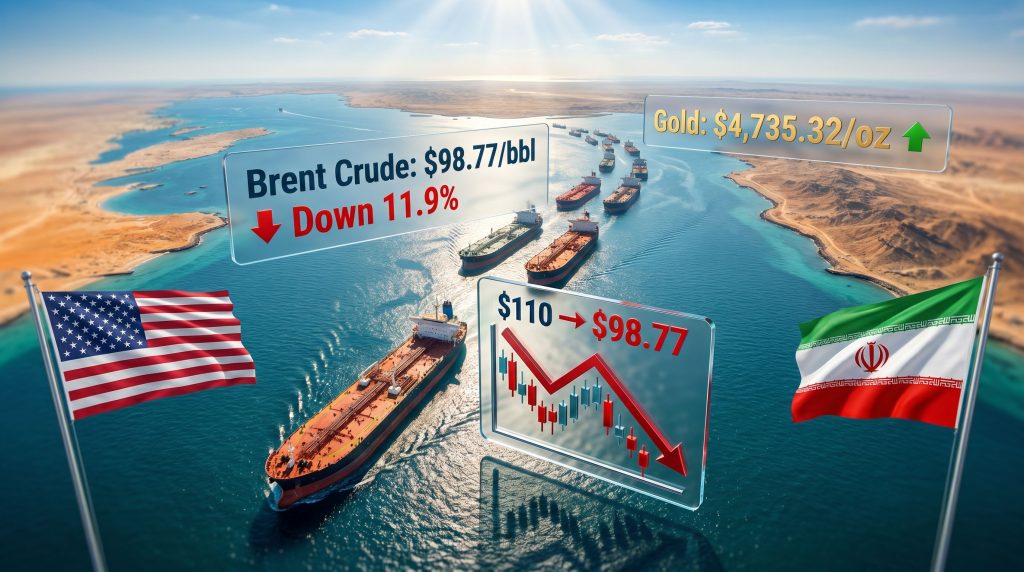
Oil fell below $100 per barrel for the first time since the conflict began during the week of May 5, 2026, with Brent crude futures dropping to $98.77 per barrel by mid-morning on May 7, representing a decline of 2.5% in a single session. West Texas Intermediate tracked the move lower, falling to $92.61 per barrel, down 2.6% on the day. These moves extended an even sharper selloff from the prior session, during which both benchmarks shed more than 7% as initial peace optimism reached markets.
The session itself illustrated just how unstable sentiment had become. Brent traded in an intraday range spanning from gains of 1% to losses of 3.8% relative to the prior close, a span that would be unremarkable in equity markets but represents extreme volatility for a commodity typically anchored by physical supply and demand fundamentals.
"The underlying driver of this price action is not a change in barrels supplied or barrels consumed. It is the market attempting to price the probability-weighted value of the geopolitical risk premium that has been embedded in crude since the conflict began. As that probability shifts, the premium evaporates, and prices fall rapidly."
What the Proposed Peace Framework Actually Covers
Iran confirmed on Wednesday, May 7, that it was reviewing a U.S. peace proposal. Reporting from multiple outlets described a framework that would formally end the conflict while leaving two central issues unresolved: the suspension of Iran's nuclear programme, and the reopening of the Strait of Hormuz to international shipping.
Two additional reports, neither independently verified at the time of publication, added further detail to the diplomatic picture:
- Saudi Arabia's Al Arabiya news channel reported that preliminary understandings had been reached around easing the U.S. naval blockade in exchange for a phased reopening of the strait
- Israel's Channel 12 reported that Iran may have agreed in principle to transfer its stockpile of 60% enriched uranium to a neutral third country, though Reuters stated it could not immediately verify this claim
The uranium stockpile issue sits at the technical heart of the negotiation's most contentious dimension. Uranium enriched to 60% purity places Iran within a relatively short technical distance of weapons-grade material, which requires enrichment above 90%. Any framework that leaves this stockpile in Iranian hands while suspending further enrichment creates a verification challenge that arms control experts have long identified as a structural weakness in comparable agreements.
The Internal Divide Complicating Iran's Position
One of the less widely reported dimensions of the negotiation is the divergence between Iran's diplomatic establishment and its parallel centres of military power. Credible reporting from European security sources has identified a meaningful gap between the Foreign Ministry's apparent willingness to engage with certain terms and the significantly harder line maintained by the Islamic Revolutionary Guards Corps (IRGC).
This matters because the IRGC does not merely advise on the Strait of Hormuz situation. It retains direct operational influence over military assets and irregular forces in the region. A Foreign Ministry signature on a peace memorandum carries limited weight if the IRGC remains operationally opposed. Markets pricing in a peace deal are effectively pricing a political outcome within Iran's internal power structure, not just an external diplomatic agreement.
Breaking Down the Obstacles: A Structural View
The negotiation faces at least four distinct fault lines, each carrying its own probability of becoming the point at which talks break down:
| Obstacle | Complexity Level | Market Impact if Unresolved |
|---|---|---|
| Nuclear programme suspension | Extremely High | Blocks any formal agreement |
| Strait of Hormuz reopening timeline | High | Delays premium reduction |
| U.S. naval blockade withdrawal | Moderate | Prevents Iranian concessions |
| IRGC compliance with terms | Extremely High | Renders any agreement unenforceable |
The nuclear enrichment suspension remains the single most intractable issue. Iran has consistently framed its enrichment programme as a sovereign right and a technical capability it will not surrender as a precondition for any negotiation. The U.S. position, by contrast, has treated suspension as a non-negotiable condition of any formal deal. This standoff has persisted across multiple diplomatic attempts over many years and shows no structural signs of resolution despite the current optimism.
The Geopolitical Risk Premium: What It Is and How It Works
Professional oil traders and energy economists use the concept of a geopolitical risk premium to describe the portion of a crude price that exceeds what supply-demand fundamentals alone would justify. In stable market conditions, Brent crude prices reflect global inventory levels, OPEC's market influence over production decisions, refinery capacity utilisation, and seasonal demand patterns. When a geopolitical shock introduces supply uncertainty, buyers bid above that fundamental level to secure supply certainty, and speculative traders position for further disruption.
In the current conflict cycle, this premium has been the dominant pricing variable, keeping benchmarks structurally elevated above the levels that underlying demand fundamentals would otherwise support. Scenario analysis from Macquarie Group has modelled the extreme case, projecting that a prolonged and complete closure of the Strait could push Brent crude toward $200 per barrel, a level at which demand destruction becomes inevitable and the macroeconomic impact on oil-importing economies accelerates sharply.
Three Price Scenarios for What Comes Next
| Scenario | Brent Crude Trajectory | Broader Economic Implication |
|---|---|---|
| Full peace deal with Hormuz reopening | Rapid decline toward $70-$80/bbl range | Significant inflation relief globally |
| Partial deal with phased reopening | Stabilisation near $90-$95/bbl | Moderate reduction in energy-driven inflation |
| Negotiations collapse, hostilities resume | Spike toward $150-$200/bbl | Demand destruction, recession risk in import-dependent economies |
The asymmetry between these scenarios is what makes the current market positioning particularly dangerous for directional traders. The upside from a deal is already partially reflected in the recent selloff, meaning additional price decline on confirmation of peace would be meaningful but limited. The downside from a breakdown, however, carries the full weight of the unpriced $150 to $200 scenario, representing a far larger absolute move in the opposite direction.
Suspicious Trading Patterns and the Question of Information Asymmetry
One of the most analytically striking dimensions of the current diplomatic episode involves the timing of large crude oil derivative positions relative to major peace-related announcements. Market intelligence analysts tracking derivatives activity identified a sequence on May 7, 2026, that raised immediate questions about information symmetry in commodity futures markets.
At approximately 3:40 AM Eastern Time, a position involving roughly 10,000 crude oil short contracts with a notional value of approximately $920 million was established. No publicly available news catalyst existed at that point. Approximately 70 minutes later, at 4:50 AM, a major news outlet published its reporting on progress in U.S.-Iran peace negotiations. By 7:00 AM, crude prices had declined roughly 12%, generating an estimated $125 million in profit on those short positions.
This incident did not occur in isolation. Analysts tracking the same derivatives market identified comparable patterns across two earlier episodes during the conflict period:
| Date | Notional Position Size | Timing Relative to Major Announcement |
|---|---|---|
| April 7, 2026 | Approximately $950 million | Minutes before a major crude-moving headline |
| Mid-April 2026 | Approximately $760 million | Just ahead of a market-moving diplomatic development |
| May 7, 2026 | Approximately $920 million | 70 minutes before peace deal reporting published |
"No formal regulatory investigation has been publicly announced in connection with these trading episodes. However, the consistency of the pattern across multiple incidents, each involving positions of comparable size established shortly before market-moving geopolitical disclosures, has drawn significant attention from market analysts and financial media covering commodity derivatives."
The total notional value across these three identified incidents approaches $2.6 billion, a figure that underscores the scale of potential information advantage involved if the timing was not coincidental. Furthermore, the broader global market impact of such information asymmetry extends well beyond individual trades, affecting institutional confidence in commodity market integrity.
The next major ASX story will hit our subscribers first
How Other Asset Classes Are Reading the Oil Price Signal
Falling crude benchmarks do not simply affect energy companies and fuel costs. They trigger a transmission mechanism that runs through inflation expectations, monetary policy projections, currency markets, and ultimately equity valuations. The current episode has produced a textbook example of this cross-asset cascade.
Gold climbed to a two-week high of $4,735.32 per ounce as oil fell. Gold's safe-haven role in this environment operates through an indirect but well-established mechanism: lower energy prices reduce headline inflation expectations, which compresses the forward premium investors require on inflation-protected assets and simultaneously reduces the probability of further interest rate increases. Lower expected rates compress real yields, which weakens the U.S. dollar, and dollar weakness has historically been one of the most reliable catalysts for gold appreciation.
Equity markets responded with equal clarity. U.S. index futures pointed more than 400 Dow Jones Industrial Average points higher, with Nasdaq futures advancing approximately 1%. The prospect of reduced energy-driven inflation feeds directly into corporate earnings projections by lowering input costs and improving consumer spending capacity.
Currency markets reflected the same theme. The U.S. dollar hovered near its lowest level in more than two months, consistent with reduced inflation expectations and a diminished near-term case for restrictive monetary policy.
The transmission chain operates in sequence:
- Lower oil prices reduce energy component of headline inflation indices
- Reduced inflation expectations compress forward rate projections
- Lower expected rates reduce Treasury yields and the yield differential supporting dollar demand
- A weaker dollar makes dollar-denominated assets like gold more attractive to international buyers
- Improved inflation outlook boosts equity valuations by lowering discount rates applied to future earnings
This broader pattern of repricing across multiple asset classes is consistent with what analysts have described as a market volatility reset, in which a single dominant geopolitical variable shifts rapidly enough to force simultaneous repositioning across fixed income, equities, commodities, and currencies.
China and Saudi Arabia: The Third-Party Variables Markets Are Watching
The negotiation is not a purely bilateral U.S.-Iran dynamic. Two external actors hold significant leverage over its trajectory.
U.S. Treasury Secretary Scott Bessent publicly urged Beijing to intensify its diplomatic pressure on Tehran to reopen the Strait of Hormuz to international shipping earlier in the week. He confirmed that President Trump and Chinese President Xi Jinping were scheduled to discuss the matter at an upcoming bilateral summit, a meeting that financial markets have identified as the next major catalyst for either resolution or escalation. China's economic interest in Persian Gulf oil access is substantial, giving Beijing both incentive and leverage to apply pressure on Tehran that Washington cannot.
Saudi Arabia's position is more nuanced. Al Arabiya's reporting on preliminary understandings regarding the blockade-for-Hormuz exchange reflects Riyadh's own calculations. As the world's largest crude exporter, Saudi Arabia benefits from elevated prices in the short term but faces structural risks if sustained high prices accelerate the energy transition or cause lasting demand destruction in key import markets. Saudi diplomatic engagement in the framework may reflect an attempt to manage the pace of any resolution rather than simply support it unconditionally.
Analyst Perspectives on the Deal-or-No-Deal Outcome
Priyanka Sachdeva, senior market analyst at Phillip Nova, described oil markets as having been caught between competing forces for more than two months, with daily headline flows keeping investor positioning in constant flux. Her assessment conveyed that a formalised agreement could trigger a rapid evaporation of the geopolitical premium, potentially causing a sharp and sustained downward repricing of crude.
At the same time, she cautioned that any fresh signs of attacks on oil infrastructure or renewed escalation could generate an equally sharp upward spike, illustrating the two-sided nature of the current risk environment. (Reuters/ETEnergyWorld, May 7, 2026)
Hiroyuki Kikukawa, chief strategist at Nissan Securities Investment, characterised the near-term diplomatic trajectory as likely to remain constructive at least through the scheduled U.S.-China summit, while emphasising that the outlook beyond that event carries substantial uncertainty. His framing was a useful corrective to market participants who had begun treating diplomatic engagement as equivalent to diplomatic resolution. (Reuters/ETEnergyWorld, May 7, 2026)
Risk Framework: What Could Rapidly Reverse the Current Trend
The current price decline rests on a fragile foundation of diplomatic optimism. Consequently, several conditions carry meaningful probability of rapidly reversing the downward crude price trend:
- IRGC rejection of the memorandum of understanding if Iran's Foreign Ministry reaches terms that the Revolutionary Guards refuse to honour operationally
- Nuclear programme deadlock if Iran maintains its refusal to suspend enrichment as a precondition, which sources close to the talks identify as the most probable deal-breaker
- Infrastructure attacks on oil production facilities, shipping lanes, or processing infrastructure that would immediately re-inject the geopolitical premium at full force
- Resumption of military operations at elevated intensity, consistent with prior U.S. statements regarding what would follow a failure to meet negotiated deadlines
Disclaimer: This article presents market analysis and does not constitute financial advice. Oil price projections, scenario modelling, and analyst forecasts involve significant uncertainty and may not accurately reflect future market conditions. Readers should conduct independent research and consult qualified financial advisors before making investment decisions based on geopolitical or commodity market analysis.
Frequently Asked Questions
Why did oil prices fall below $100 per barrel in May 2026?
Brent crude fell to $98.77 per barrel on May 7, 2026, as investors began unwinding the geopolitical risk premium that had kept benchmarks elevated since the conflict began. Reports of progress toward a U.S.-Iran peace deal and oil prices moving together, including unverified claims about a phased Strait of Hormuz reopening arrangement and a possible uranium stockpile transfer, drove two consecutive sessions of significant selling pressure.
What is the geopolitical risk premium in oil prices?
The geopolitical risk premium is the component of a crude oil price that exceeds what supply-demand fundamentals alone would justify. It reflects buyer willingness to pay above fundamental value to secure supply certainty when disruption risk is elevated. It evaporates rapidly when diplomatic signals suggest disruption risk is declining.
What is the key obstacle preventing a finalised U.S.-Iran peace deal?
Iran's nuclear enrichment programme, and specifically the U.S. demand that Iran suspend enrichment as a precondition of any agreement, represents the primary unresolved sticking point. Iran's 60% enriched uranium stockpile sits close enough to weapons-grade material that its disposition is a central concern for U.S. negotiators and international non-proliferation frameworks alike.
What could push crude prices toward $200 per barrel?
Scenario analysis from Macquarie Group has modelled a prolonged Strait of Hormuz closure as potentially driving Brent crude toward $200 per barrel. A collapse in current negotiations, renewed military operations, or IRGC rejection of any agreed framework would be among the most likely triggers for such a scenario.
Why are gold and equity markets rising as oil falls?
Lower oil prices reduce inflation expectations, which compresses projected interest rate paths, weakens the U.S. dollar, lowers Treasury yields, and supports risk asset valuations. Gold benefits from dollar weakness and lower real yields, while equity markets benefit from reduced input costs and improved consumer spending capacity.
Want to Stay Ahead of Market-Moving Commodity Discoveries on the ASX?
While geopolitical risk premiums reshape global energy markets, Discovery Alert's proprietary Discovery IQ model delivers real-time alerts on significant ASX mineral discoveries — instantly translating complex commodity data into actionable investment insights for both short-term traders and long-term investors. Explore how historic discoveries have generated substantial returns on Discovery Alert's dedicated discoveries page, and begin your 14-day free trial today to secure a market-leading edge before the broader market catches on.