June 22, 2026
The Hidden Architecture of Oil Price Volatility: How Diplomacy Became a Trading Variable
Crude oil markets have always been hostage to geography. The physical reality of energy infrastructure, chokepoints, and export corridors means that political decisions made in negotiating rooms thousands of kilometres from the nearest oil terminal can move benchmark prices by several percentage points within a single trading session. Understanding why this happens, and how sophisticated traders position around it, reveals a pricing architecture far more complex than simple supply-and-demand models suggest.
The relationship between US-Iran talks and oil prices is one of the most consequential diplomatic-market linkages in global energy today. When those conversations progress, crude falls. When they fracture, crude surges. This asymmetric sensitivity tells us something fundamental about how risk is priced into energy markets, and why geopolitical calendars have become as important to energy analysts as weekly inventory reports.
When big ASX news breaks, our subscribers know first
Why Diplomacy Functions as a Supply Variable in Crude Markets
Most commodity markets price physical supply. Oil markets price expected supply, adjusted for probability-weighted disruption scenarios. This distinction matters enormously when evaluating how US-Iran negotiations translate into barrel-level price movements.
When diplomatic signals emerge suggesting that Iranian crude exports could be restored or expanded through sanctions relief, traders do not wait for barrels to physically arrive at terminals. They immediately reprice forward curves to reflect the probability of additional supply entering the market. The adjustment happens in real time, driven by algorithmic systems that parse diplomatic language, news feeds, and official statements with millisecond precision.
This creates a structural dynamic where price moves often precede confirmed outcomes by days or weeks. Furthermore, consider what occurred in the lead-up to and during the Switzerland talks:
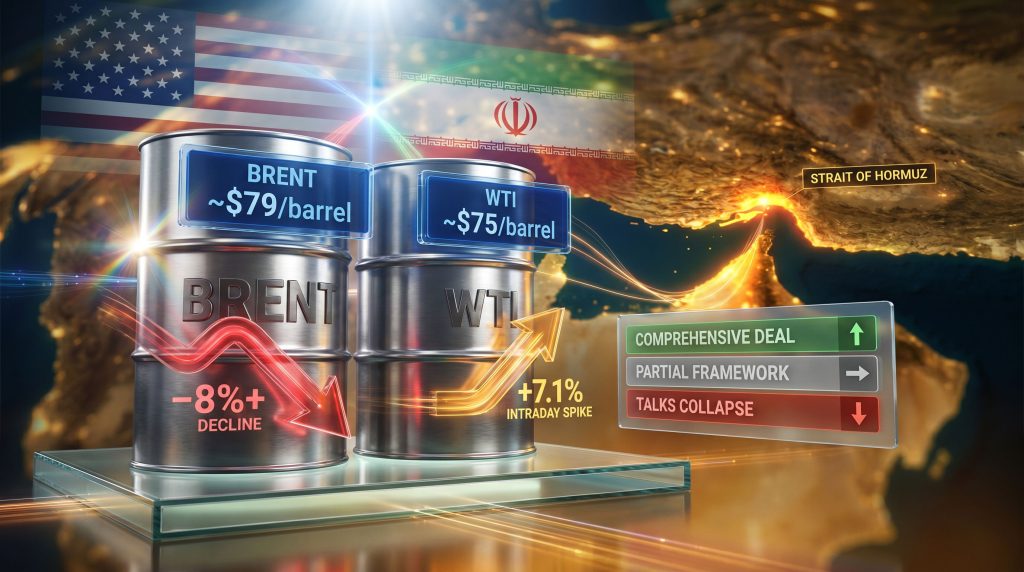
- In the week before formal discussions began, Brent crude declined more than 8% as markets priced in the probability of a constructive outcome.
- Once talks concluded, Brent briefly touched above $82 per barrel at the open of trading, before reversing sharply downward.
- By the close of the same session, Brent had fallen to approximately $79 per barrel, representing a decline of more than 2% from the intraday high.
- WTI crude settled near $75 per barrel, a decline of approximately 3% from its earlier trading range.
The table below summarises how benchmark prices responded across different phases of the diplomatic cycle:
| Market Event | Brent Crude Response | WTI Crude Response |
|---|---|---|
| Reports of talk collapse or stall | +4.5% to approximately $94.98 | +5.5% to approximately $92.16 |
| Intraday spike before official comments | Up as much as +7.1% | Up as much as +8.3% |
| Post-talk optimism and deal expectations | Down approximately 6.1% | Down more than 6% |
| Post-Switzerland session close | Approximately $79/barrel | Approximately $75/barrel |
| Prior week decline on pre-talk expectations | More than 8% overall | More than 8% overall |
What this data reveals is the asymmetry embedded in geopolitical oil pricing. Escalation spikes tend to be sharper and faster than deal-driven declines, because fear moves markets more urgently than relief. A credible disruption threat can add several dollars per barrel within hours, while the process of removing that premium through diplomatic progress unfolds over days or weeks as confidence is gradually rebuilt.
The Strait of Hormuz: Understanding the World's Most Consequential Chokepoint
No discussion of US-Iran talks and oil prices is complete without examining the Strait of Hormuz. This narrow waterway, separating Iran from the Arabian Peninsula, serves as the transit corridor for a substantial share of globally traded crude oil. Estimates from the US Energy Information Administration consistently place the volume of petroleum liquids moving through the strait at roughly 21 million barrels per day, representing approximately 20% of global oil trade.
The strategic importance of this passage creates a permanent geopolitical risk premium embedded in benchmark crude prices. Even during periods of relative calm, traders assign a non-zero probability to disruption scenarios, and that probability rises sharply whenever US-Iran diplomatic relations deteriorate. Indeed, the broader dynamics of oil trade and geopolitics play a central role in how these risk premiums are calculated and sustained over time.
"The Strait of Hormuz is not merely a shipping lane. It is a daily referendum on the stability of the global energy system. Every cargo that transits it without incident represents a tacit validation of the current geopolitical equilibrium."
Several factors make Hormuz uniquely sensitive as a pricing variable:
- Physical narrowness makes the passage difficult to reroute. Unlike other maritime corridors, there is no readily available bypass route capable of absorbing comparable volumes at short notice.
- Insurance cost transmission means that even non-physical threats, such as military posturing or sanctions enforcement actions, immediately raise shipping insurance premiums, which then flow through into delivered crude costs.
- Tanker confidence lag persists even after diplomatic resolution, because vessel operators and cargo insurers apply their own risk assessments that may lag formal diplomatic announcements by days or weeks.
- Brent vs WTI sensitivity differential: Brent crude, as the global benchmark with direct exposure to Middle East supply routes, tends to show a stronger initial reaction to Hormuz-specific risk signals than WTI, which benefits partly from domestic US production buffers.
What Iran's Negotiating Position Reveals About Supply Potential
Iran's negotiating objectives in Switzerland were not purely political. At their core, they were about restoring the country's capacity to monetise its substantial hydrocarbon reserves through legitimate export channels.
Iranian Foreign Minister Abbas Araqchi confirmed that Tehran secured several meaningful concessions during the talks. These included waivers covering oil and petrochemical exports, access to portions of previously frozen financial assets, and the initiation of a reconstruction and development framework. However, analysts widely characterised these outcomes as meaningful but incomplete, with significant disputed elements remaining unresolved.
From a supply perspective, the potential scale of Iranian re-entry into global markets is substantial. Iran possesses the fourth-largest proven oil reserves globally, and its production capacity significantly exceeds what it has been able to export under sanctions. A comprehensive sanctions relief arrangement could add somewhere between 500,000 and 1.5 million barrels per day of additional supply to global markets over a multi-month ramp-up period, though precise figures depend on infrastructure readiness, buyer willingness to navigate compliance complexity, and ongoing monitoring frameworks.
Mapping the Three Scenarios: What Comes Next for Crude Prices?
Energy analysts have been modelling three distinct outcome pathways from the current diplomatic process, each carrying materially different implications for Brent and WTI price trajectories.
| Scenario | Likely Brent Direction | Supply Impact | Timeline to Price Normalisation |
|---|---|---|---|
| Comprehensive deal reached | Bearish, downward pressure | Iranian exports increase meaningfully | 3 to 6 months for full normalisation |
| Partial framework with conditions | Neutral to mildly bearish | Limited additional barrels enter market | Uncertain; market remains cautious |
| Talks collapse or escalation | Strongly bullish | Supply disruption risk rises sharply | Immediate spike; sustained premium |
Scenario one, a comprehensive agreement, would likely push Brent toward the low-to-mid $70s over a six-month horizon as Iranian barrels gradually displace higher-cost supply from competing sources. However, analysts caution that even a deal would not instantly reset prices, because shipping confidence, cargo insurance normalisation, and buyer re-engagement all operate on longer timescales than diplomatic announcements.
Scenario two, a partial framework, leaves the market in a state of prolonged uncertainty. Traders would likely maintain a reduced but persistent risk premium, keeping prices range-bound rather than trending decisively in either direction.
Scenario three is where historical price action offers the starkest warning. Confirmed reports of negotiation collapse have previously triggered intraday Brent moves of 4% to 7% and WTI moves of 5% to 8% as traders rapidly reprice disruption risk. Consequently, reports of postponed talks have historically been sufficient on their own to trigger significant upward price moves within a single session.
The $80 Brent Threshold as a Real-Time Risk Barometer
One of the most analytically useful observations from the current diplomatic cycle is the behaviour of Brent crude relative to the $80 per barrel level. Market analysts have identified this threshold as a functional sentiment indicator, with prices below $80 signalling that traders are not assigning high probability to a major escalation or supply disruption scenario.
The fact that Brent settled below $80 following the Switzerland session, despite significant uncertainty about whether a durable agreement had been reached, suggests that the market's base-case assumption remains one of contained risk rather than full-scale escalation. However, this interpretation comes with an important caveat.
"Geopolitical situations involving Iran and regional stability have historically shifted rapidly and without extended warning periods. Sub-$80 Brent reflects today's probability assessment, not a guarantee of tomorrow's conditions."
This is why professional energy analysts now treat geopolitical calendars — including scheduled diplomatic meetings, UN Security Council sessions, and sanctions review deadlines — as first-order inputs into their price modelling frameworks alongside conventional supply-demand variables.
The next major ASX story will hit our subscribers first
Broader Market Implications: Beyond the Oil Price Itself
The repricing of crude has transmission effects that extend well beyond energy markets. When Brent declines toward $79, the consequences ripple across multiple asset classes and economic sectors:
- Equity markets in oil-importing economies tend to respond positively, as lower energy input costs improve corporate margin expectations and reduce inflationary pressure on consumer spending.
- South and Southeast Asian economies are particularly sensitive to crude price movements, given their structural dependence on oil imports and the direct pass-through from crude costs into fuel subsidies and current account balances.
- Asia-Pacific market sentiment proved more complex during this episode, with several regional indices opening on a mixed-to-negative note after reports emerged that Iran temporarily withdrew from the Switzerland talks amid renewed geopolitical friction before ultimately re-engaging.
- Inflation dynamics in major importing nations shift measurably with crude price moves of this magnitude. A sustained $5 to $10 per barrel reduction in Brent can reduce headline inflation by meaningful fractions of a percentage point across import-dependent economies.
In addition, the surge and collapse in oil prices seen during the Switzerland diplomatic cycle illustrated precisely how interconnected energy markets and broader economic conditions have become.
Structural Factors That Will Shape the Next Price Cycle
The US-Iran talks and oil prices dynamic does not operate in isolation. Several structural forces are simultaneously shaping crude price volatility and will determine how markets absorb whichever scenario ultimately materialises.
OPEC+ and Shale as Counterweights
OPEC+ production policy remains a critical counterweight. The cartel has demonstrated willingness to adjust output targets in response to shifting geopolitical conditions, meaning that any Iranian supply increase may be partially offset by production discipline elsewhere in the group.
US shale response capacity provides a secondary buffer. American tight oil producers can accelerate output relatively quickly in response to price signals, which limits the upside of any escalation-driven spike but also compresses the downside of any deal-driven decline.
Demand-Side Uncertainty
Demand-side uncertainty adds a further dimension. Global growth forecasts remain uneven, with questions about Chinese industrial demand, European economic momentum, and the pace of energy transition investment all creating additional variables in the supply-demand equation that geopolitical developments alone cannot resolve.
Disclaimer: This article is intended for informational purposes only and does not constitute financial or investment advice. Oil price forecasts and scenario analyses involve inherent uncertainty. Past price movements are not indicative of future outcomes. Readers should conduct their own research or consult a qualified financial adviser before making investment decisions.
Want to Stay Ahead of the Next Major Resource Discovery Before the Market Moves?
While geopolitical forces shape oil price volatility in real time, the same principle applies to mineral discoveries on the ASX — speed of information is everything. Discovery Alert's proprietary Discovery IQ model instantly identifies significant ASX mineral discoveries as they are announced, converting complex data across 30+ commodities into clear, actionable insights, much like the traders who positioned ahead of diplomatic outcomes explored here. Explore historic discovery returns or start your 14-day free trial at Discovery Alert to gain a market-leading edge the moment the next major discovery is announced.