
July 20, 2026
Energy market turbulence rarely arrives in isolation. Rather, geopolitical tensions build systematically across multiple risk dimensions, creating cascading vulnerabilities that transform theoretical scenarios into market-moving realities. Understanding how these interconnected systems respond requires examining not just immediate price movements, but the deeper structural mechanics that amplify regional conflicts into global economic disruptions.
When analysing potential US-Iran war impact on oil prices, sophisticated risk modelling reveals transmission pathways extending far beyond simple supply shortages. Modern energy security depends on intricate webs of maritime logistics, financial instruments, strategic reserve deployments, and international coordination mechanisms that can either contain or magnify initial shocks depending on their collective resilience.
Strategic Risk Assessment Framework for Middle East Energy Security
Current market data demonstrates the immediate vulnerability of global petroleum systems to Middle Eastern conflicts. WTI crude futures reached $90.13 per barrel by March 6, 2026, representing a $9.12 per barrel single-day increase and a 35% price escalation over seven days since hostilities commenced. This rapid price discovery reflects market participants pricing in scenarios ranging from temporary disruption to sustained regional warfare.
Furthermore, these developments occur against a backdrop of existing market tensions, where oil price stagnation factors have already created underlying volatility conditions. The interaction between geopolitical risk and pre-existing market imbalances compounds the severity of price movements.
Geopolitical Chokepoint Analysis
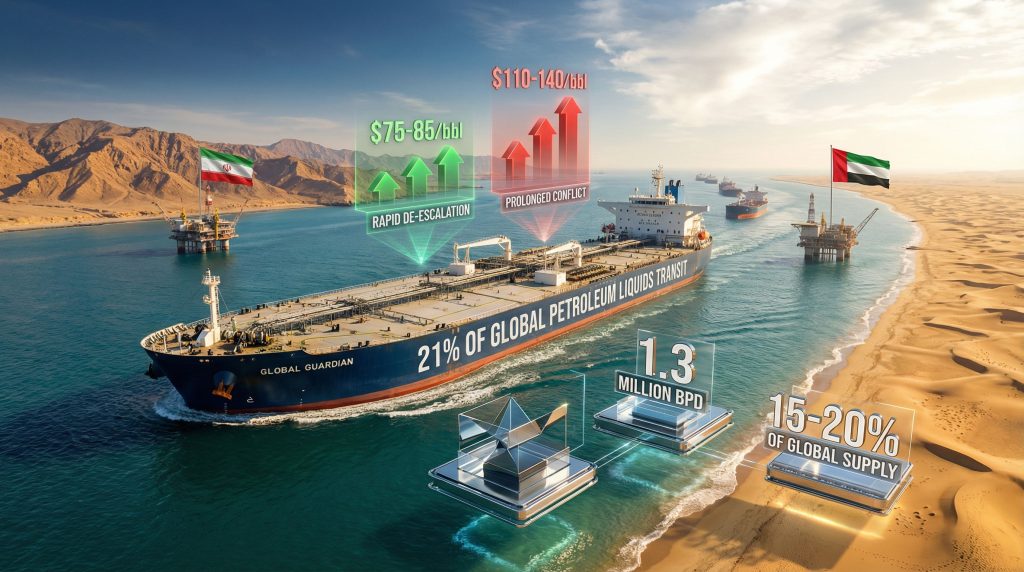
The Strait of Hormuz represents the world's most critical petroleum transit bottleneck, channeling 21% of global petroleum liquids through shipping lanes only two miles wide at their narrowest point. Market intelligence indicates most vessel owners have ceased transit operations through this corridor, creating a de facto closure despite some vessels successfully completing journeys under elevated risk premiums.
Historical precedent from the 1980s Iran-Iraq Tanker War demonstrates the vulnerability patterns when approximately 500 merchant vessels faced attacks during the eight-year conflict, resulting in over 100 vessel losses. These incidents established insurance war risk premium frameworks and alternative routing protocols that remain relevant for contemporary scenario modelling.
Alternative routing capacity limitations create significant cost implications for global supply chains. Vessels avoiding the Strait must utilise longer routes via the Cape of Good Hope or Suez Canal, adding substantial voyage time and freight costs. These additional expenses manifest directly in delivered crude prices, as evidenced by Alaska North Slope crude trading at $8.30 per barrel premium to July ICE Brent for May delivery, the highest premium since assessments began in 2018.
Supply Chain Resilience Modelling
Regional production buffer capacity assessment reveals complex dynamics beyond simple barrel counts. While Iranian baseline export capacity of 1.3 million barrels per day represents direct supply at risk, indirect effects through regional infrastructure exposure and logistics disruption amplify total impact significantly.
However, the broader context of US oil production decline has already created tighter global supply conditions, making markets more sensitive to any additional disruptions. This underlying production weakness limits the ability of alternative suppliers to compensate for Middle Eastern losses.
Strategic petroleum reserve deployment scenarios across major consuming nations demonstrate coordinated response capabilities. South Korea's KNOC operates nine stockpiling bases with 146 million barrel capacity, currently holding approximately 100 million barrels excluding international joint reserves. Government officials actively coordinate with refiners regarding potential SPR releases linked to export restrictions, indicating policy tools remain available for supply management.
When big ASX news breaks, our subscribers know first
Economic Transmission Mechanisms of Oil Price Volatility
Energy price shocks transmit through economic systems via multiple interconnected pathways, each operating on different time horizons and affecting distinct market segments. Current conflict dynamics illustrate these transmission mechanisms in real time, providing insight into how localised supply disruptions cascade into broader economic impacts.
Inflation Pass-Through Dynamics
Refinery economics demonstrate immediate elasticity adjustments during supply disruptions. Indian refiners shifted from purchasing Russian Urals crude at $12.35 per barrel discount to Dated Brent (February 27, 2026) to accepting $1-5 per barrel premium positioning by March 6, representing a swing of over 13 percentage points in relative valuation.
This dramatic pricing adjustment reflects refiners' willingness to absorb significant cost increases rather than face supply unavailability. The US administration responded by implementing tactical sanctions relief, permitting Indian importers to purchase Russian crude loaded before March 5 and delivered by April 4, explicitly aimed at reducing global refiner competition for non-blocked supplies.
US Energy Secretary Chris Wright explained the rationale for this temporary policy shift, noting that approximately 15 million barrels of Russian crude remained stranded off the Indian coast and could reach terminals within days. This intervention demonstrates government recognition of inflation transmission risks and willingness to adjust sanctions frameworks tactically to moderate price escalation.
Sectoral Impact Distribution Analysis
Transportation and logistics sectors experience immediate cost escalation effects. The Argus 3-2-1 crack spread at the US west coast reached multi-year highs during the conflict's first week, driven by surging diesel and jet fuel prices. These refined product price increases directly impact trucking, shipping, and aviation industries, creating cascading cost pressures throughout supply chains.
Manufacturing industries face differentiated exposure based on energy intensity and input substitution capabilities. Energy-intensive sectors including petrochemicals, fertilisers, and metals processing confront immediate margin compression as input costs rise faster than product pricing can adjust. Agricultural commodity markets experience secondary effects through fertiliser cost transmission and fuel expenses for harvesting and transport operations.
The timing of these impacts creates complex policy challenges. Most Asian refineries operate at planned maintenance schedules during March-April periods, reducing available capacity precisely when alternative supply sourcing becomes critical. This seasonal constraint amplifies supply tightness beyond the immediate conflict effects.
Multi-Scenario Oil Price Trajectory Modelling
Systematic scenario analysis requires frameworks that account for conflict duration, escalation intensity, and international response coordination. Current market pricing suggests traders anticipate extended uncertainty rather than rapid resolution, evidenced by term structure adjustments and options market volatility patterns.
| Scenario Framework | Duration | Brent Price Range | Key Transmission Mechanisms |
|---|---|---|---|
| Rapid De-escalation | 2-4 weeks | $75-85/barrel | Limited to risk premium adjustment |
| Extended Regional Conflict | 6-12 weeks | $85-110/barrel | Supply rerouting, SPR deployment |
| Prolonged Asymmetric Warfare | 3-6 months | $110-140/barrel | Structural supply chain adaptation |
Supply Disruption Magnitude Assessment
Regional production exposure extends beyond Iranian capacity to encompass broader Middle Eastern logistics networks. Current conflict affects approximately 15-20% of global supply through direct production losses and transportation disruption. UAE, Qatar, and Saudi Arabian facilities face intermittent attacks, though production capacity remains largely intact.
In addition to these immediate impacts, OPEC production impact considerations become crucial as member countries assess whether to increase output to compensate for disrupted Iranian supplies. This decision-making process adds another layer of uncertainty to supply projections.
The de facto closure of Hormuz transit creates bottlenecks affecting multiple regional producers simultaneously. Even producers maintaining full output capacity cannot export effectively, creating temporary supply overhang in the Persian Gulf region while global markets experience shortage conditions.
Strategic reserve coordination among International Energy Agency members provides established mechanisms for emergency response. However, effectiveness depends on release timing, volume commitments, and coordination with demand management measures across member countries.
Energy Markets and Geopolitical Risk Premium Pricing
Financial markets demonstrate sophisticated risk assessment capabilities through derivatives pricing and correlation adjustments. Options market volatility indicators show elevated put-call ratios for energy sector equities, while crude oil futures exhibit backwardation patterns consistent with supply shortage expectations.
Currency and Commodity Correlation Dynamics
Dollar strength impacts oil demand elasticity through purchasing power effects in emerging markets. Currency stress in oil-importing developing economies compounds affordability challenges, potentially reducing global consumption even as supply constraints drive price increases.
Gold-oil correlation patterns during geopolitical stress periods historically strengthen, reflecting common safe-haven demand and inflation hedge positioning. Current market conditions exhibit this correlation strengthening, indicating broad-based uncertainty rather than isolated energy sector concerns.
Term structure implications for long-dated oil contracts reveal market expectations regarding conflict duration and resolution probability. Contango patterns in forward curves suggest market participants anticipate eventual supply normalisation, though timing uncertainty creates elevated volatility across the term structure.
For instance, oil price rally dynamics observed in similar market stress conditions provide insight into how various factors interact to create sustained price movements beyond initial shock periods.
Strategic Response Options for Major Oil Consumers
National Energy Security Protocols
Government coordination mechanisms demonstrate varying sophistication levels and deployment readiness. China has already implemented suspension orders for clean petroleum product exports to ensure adequate domestic availability, indicating rapid policy response capabilities.
Emergency demand reduction measures include transportation fuel rationing, industrial allocation priorities, and public sector consumption restrictions. These tools remain largely unused in current conflict scenarios but represent available policy options for extended supply disruption periods.
Alternative supply sourcing acceleration programmes require lead time for implementation effectiveness. South Korean and Japanese buyers actively pursue Alaska North Slope crude purchases at significant premiums, demonstrating market-based adaptation mechanisms functioning alongside government policy responses.
Corporate Risk Management Strategies
Energy-intensive industries implement hedging strategies through futures positions, physical inventory building, and supply chain diversification initiatives. However, hedge effectiveness diminishes during extreme price volatility periods when counterparty risks and margin requirements create additional constraints.
Capital allocation priorities shift toward energy security investments during supply crisis periods. Companies accelerate efficiency improvement projects, alternative energy sourcing arrangements, and strategic inventory accumulation to reduce exposure to future supply disruptions.
According to analysis by The Guardian's coverage of the conflict, stock markets have fallen as the war continues to drive up oil and gas prices, highlighting the broader economic implications of energy security disruptions.
Regional Market Differentiation and Arbitrage Opportunities
Asia-Pacific Energy Security Dynamics
Asian buyers demonstrate differentiated procurement strategies reflecting varying supply security priorities. Japanese firms pursue Alaska North Slope cargoes at approximately $2.00 per barrel premium to Dubai assessments on delivered basis, while maintaining existing Middle Eastern supplier relationships where possible.
South Korean refiners exhibit more cautious positioning, reluctant to offer April spot-loading commitments due to incoming crude supply uncertainty. This conservative approach reflects integration of refinery operations with domestic product supply obligations and government coordination requirements.
Chinese authorities balance export restriction policies with strategic reserve accumulation opportunities. The suspension of clean product exports preserves domestic supply cushions while potentially creating arbitrage opportunities for regional competitors.
North American Production Response Capacity
Alaska North Slope crude production benefits from geographic isolation from Middle Eastern conflict zones and established Pacific Rim distribution networks. The Jones Act fleet requirements create both constraints and advantages, limiting foreign vessel competition while ensuring dedicated US-flag capacity availability.
Freight cost dynamics significantly impact delivered pricing, with specialised US-flag tankers commanding premium rates for both domestic west coast delivery and trans-Pacific export. Some vessels typically serving California and Washington markets have been diverted to Asian routes, tightening domestic availability and supporting price premiums.
Canadian oil sands operations maintain steady production rates but face pipeline capacity constraints for increased throughput. Long-term investment decisions in oil sands expansion depend on sustained high price expectations rather than temporary crisis-driven premiums.
The next major ASX story will hit our subscribers first
Long-Term Structural Market Implications
Energy Transition Acceleration Scenarios
High oil prices historically accelerate renewable energy investment flows and electric vehicle adoption rates. Current price levels approach thresholds where alternative energy economics become compelling for broader consumer segments, potentially creating lasting demand destruction effects.
Nuclear power renaissance prospects improve under sustained high fossil fuel pricing, though lead times for new capacity remain substantial. Policy frameworks supporting nuclear development may receive enhanced political support during energy security crisis periods.
Moreover, critical minerals energy security becomes increasingly important as nations seek to reduce dependence on volatile fossil fuel markets through strategic stockpiling of materials essential for renewable energy technologies.
Geopolitical Realignment Consequences
Middle East energy alliance configurations face potential restructuring depending on conflict resolution outcomes. Traditional supplier-customer relationships may evolve toward more diversified sourcing arrangements and strategic partnership frameworks.
Russia-Iran energy cooperation deepening prospects reflect sanctions environment dynamics and shared interests in challenging Western energy dominance. However, practical implementation faces infrastructure constraints and market access limitations.
Western energy independence strategy evolution encompasses both supply diversification and demand reduction components. Policy frameworks supporting domestic production, strategic reserves, and efficiency improvements receive renewed emphasis during supply crisis periods.
Investment Portfolio Positioning for Energy Crisis Scenarios
Sector Rotation Strategies
Energy equity valuations under sustained high prices require careful analysis of upstream, midstream, and downstream company positioning. Integrated oil companies may benefit from refining margins and strategic positioning, while pure-play exploration companies face varying regional exposure impacts.
Defensive positioning in consumer discretionary sectors reflects anticipated spending pattern shifts under elevated energy costs. Transportation, hospitality, and retail sectors face margin pressure from increased operating costs and reduced consumer purchasing power.
Infrastructure and utility companies demonstrate mixed performance patterns depending on energy input requirements and regulatory recovery mechanisms. Natural gas utilities may benefit from crude oil substitution effects, while electricity generators face varied fuel cost impacts.
Alternative Asset Allocation Considerations
Commodity futures positioning across the energy complex requires sophisticated understanding of correlation relationships and storage economics. Crude oil, refined products, and natural gas markets exhibit varying supply-demand dynamics during geopolitical disruptions.
Real estate investment implications depend heavily on regional energy cost sensitivity and economic activity patterns. Industrial properties in energy-intensive regions may face valuation pressure, while energy-producing areas potentially benefit from increased economic activity.
Currency hedging strategies become critical for international investment exposure during energy crisis periods. Emerging market currencies face particular pressure from elevated import costs and potential capital flight effects.
Policy Response Effectiveness Modelling
Fiscal and Monetary Policy Coordination
Government fuel subsidy programmes face sustainability challenges under extended high price periods. Budget constraints and economic efficiency considerations limit the scope and duration of consumer price protection measures.
Central bank dual mandate tensions emerge when energy-driven inflation conflicts with employment stability objectives. Monetary policy response frameworks must balance inflation control with economic growth support during supply-driven price shocks.
International cooperation mechanisms for crisis management include coordinated strategic reserve releases, diplomatic intervention initiatives, and trade policy adjustments. Effectiveness depends on participating country commitment levels and implementation coordination.
Regulatory Framework Adaptation
Emergency energy market intervention tools encompass price controls, allocation systems, and trade restrictions. However, these measures often create unintended consequences and market distortions that complicate long-term recovery processes.
International sanctions regime effectiveness requires careful balance between economic pressure and supply chain disruption minimisation. Temporary sanctions relief measures, as implemented for Indian Russian crude imports, demonstrate policy flexibility while maintaining strategic objectives.
The complexity of modern energy markets demands sophisticated policy frameworks that account for financial market interactions, supply chain interdependencies, and international coordination requirements. Simple intervention approaches often prove inadequate for addressing multi-dimensional crisis scenarios effectively.
Consequently, the US-Iran war impact on oil prices extends far beyond immediate supply calculations to encompass complex interactions between geopolitical risk, market structure vulnerabilities, and policy response mechanisms. CNBC's analysis of mortgage and gas markets further illustrates how energy price volatility creates ripple effects throughout financial markets.
Understanding these interconnected dynamics becomes essential for investors, policymakers, and business leaders navigating energy market volatility during geopolitical crisis periods. The current conflict provides valuable real-time data for refining risk assessment models and developing more resilient energy security strategies for future scenarios.
This analysis is for educational and informational purposes only and should not be construed as investment advice. Energy market investments carry significant risks, and past performance does not guarantee future results. Readers should consult qualified financial advisors before making investment decisions.
Want to Capitalise on Energy Market Volatility?
With oil prices reaching $90+ per barrel and geopolitical tensions creating unprecedented market opportunities, Discovery Alert's proprietary Discovery IQ model identifies energy and mining discoveries that could benefit from these volatile conditions. Begin your 14-day free trial today to receive instant notifications on significant ASX mineral discoveries, ensuring you're positioned ahead of the market during these turbulent times.