June 21, 2026
The Strategic Logic Behind Washington's Push Into East African Minerals
Global supply chains for critical minerals have never been more politically charged. Decades of underinvestment in diversified sourcing left Western economies exposed when pandemic-era disruptions revealed just how concentrated extraction and processing capacity had become in a handful of countries. That vulnerability, driven in part by a critical minerals demand surge, accelerated a fundamental rethinking of resource diplomacy, pushing Washington toward a new generation of bilateral mineral frameworks targeting nations with geological promise but limited existing development.
Kenya sits squarely within this strategic calculus. The US-Kenya critical minerals partnership currently advancing through negotiations reflects a calculated shift in how the United States approaches African resource diplomacy, prioritising early engagement with nations whose mineral assets remain largely unconfirmed at scale rather than competing for access to already-mature mining jurisdictions.
How Supply Chain Vulnerability Reshaped U.S. Mineral Diplomacy
The United States imports a significant share of the rare earth elements, battery metals, and specialty minerals essential to clean energy infrastructure, defense systems, and advanced electronics manufacturing. Much of the global processing capacity for these materials is concentrated in China, creating a structural dependency that U.S. policymakers have identified as a national security concern.
Furthermore, rare earth supply chains remain dangerously concentrated, a reality that has prompted Washington to move aggressively since 2024 to construct a web of bilateral mineral frameworks across multiple continents. The underlying logic is straightforward: secure preferential access to untapped geological resources before those assets attract competing investment, and build the institutional relationships necessary to sustain supply chains over the long term. Kenya fits this model with particular precision.
Why Kenya Emerged as a Priority Partner
Kenya is not a mining powerhouse by conventional metrics. The Democratic Republic of Congo dominates cobalt production. South Africa controls significant platinum group metal reserves. Zambia is a copper giant. Kenya's mining sector currently contributes roughly 1% of GDP, a figure that tells a story of underexploration rather than geological scarcity.
What makes Kenya attractive to Washington is precisely this gap between known geological potential and current production. The country has identified deposits of rare earth elements, niobium, lithium, graphite, copper, nickel, and coltan across several counties in recent years, but the broader resource base still requires systematic exploration and verification.
For a strategic partner seeking early-mover advantage, an incompletely mapped mineral landscape is an opportunity, not a disqualification. Kenya's geopolitical position amplifies its mineral appeal. As East Africa's most influential diplomatic hub, Nairobi functions as a gateway to a region that remains significantly underrepresented in global critical mineral supply chains.
The 2022 Strategic Trade and Investment Partnership as a Foundation
The minerals discussion does not emerge from a blank slate. Kenya and the United States launched a Strategic Trade and Investment Partnership in 2022, establishing a formal architecture for economic cooperation that predates the current minerals focus. In 2024, Washington elevated Kenya to the status of Major Non-NATO Ally, a designation held by very few sub-Saharan African nations.
That elevation is significant because it embeds the minerals conversation within a multi-layered relationship spanning security cooperation, trade facilitation, and development finance. The US-Kenya critical minerals partnership, when finalised, would extend rather than initiate a relationship already operating across multiple dimensions.
When big ASX news breaks, our subscribers know first
What Minerals Are at the Centre of the US-Kenya Deal?
The mineral portfolio under discussion spans several categories, each carrying distinct strategic value for U.S. supply chains.
| Mineral Category | Key Minerals Identified in Kenya | Primary End-Use Applications |
|---|---|---|
| Rare Earth Elements | REEs (various) | Clean energy, defense, advanced electronics |
| Battery Metals | Lithium, Graphite, Nickel | EV batteries, energy storage systems |
| Industrial Metals | Copper, Coltan | Telecommunications, semiconductors |
| Specialty Metals | Niobium | High-strength steel, aerospace alloys |
Rare earth elements represent the primary focus of advanced-stage negotiations. REEs are indispensable to permanent magnets used in electric vehicle motors and wind turbines, to guidance systems in precision defense hardware, and to the phosphors in energy-efficient lighting. Despite their name, rare earths are not geologically scarce, but economically viable, high-grade deposits accessible to Western supply chains certainly are.
Niobium deserves particular attention as a mineral that receives far less public coverage than lithium or cobalt despite its critical role in modern industrial economies. The overwhelming majority of global niobium supply originates from a single country, Brazil, creating a concentration risk that sits quietly beneath the radar of most supply chain discussions. Kenya's niobium occurrences, while requiring further assessment, represent a geologically meaningful diversification opportunity.
The Mrima Hill Deposit: A Multi-Billion Dollar Asset Under Assessment
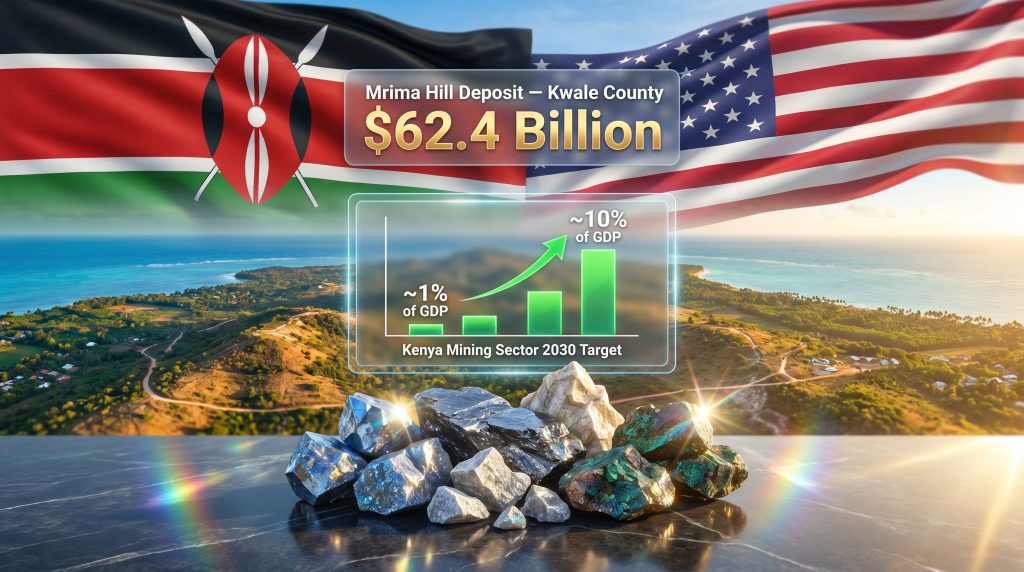
The Mrima Hill deposit in Kwale County represents the most significant known concentration of strategic minerals in Kenya. According to reporting on Kenya's mineral negotiations, estimates have placed the deposit's value at approximately $62.4 billion, though this figure must be interpreted carefully. It reflects geological resource estimates rather than confirmed, bankable reserves subject to full feasibility assessment.
Geological resource estimates and economic valuations based on them carry inherent uncertainty until supported by bankable feasibility studies. The $62.4 billion figure associated with Mrima Hill should be understood as indicative of geological potential, not confirmed economic value.
Mrima Hill contains rare earth elements alongside niobium and other minerals. The deposit has attracted interest for decades but has not advanced to large-scale production, in part due to historical regulatory and ownership complexities. Any partnership framework involving Mrima Hill would need to navigate these institutional histories in addition to the technical and infrastructure challenges involved.
How Kenya's Geological Profile Compares to Established African Mining Nations
Kenya's mineral profile is qualitatively distinct from the DRC, South Africa, or Zambia in one critical respect: the level of geological confirmation. Those nations have decades of systematic exploration, production history, and defined resource bases. Kenya's mineral inventory, while promising across multiple categories, remains at an earlier stage of characterisation.
This distinction matters enormously for investors and policymakers. A resource exists at a geological level. A reserve is the economically extractable portion confirmed through definitive feasibility studies. Much of Kenya's mineral potential currently occupies the resource stage, meaning significant exploration capital must flow before production timelines can be meaningfully established.
Is Kenya's Local Processing Demand a Game-Changer for African Resource Deals?
Perhaps the most structurally significant element of the US-Kenya critical minerals partnership is not what minerals are involved, but how Kenya insists they be handled. President William Ruto stated at the margins of the G7 summit that minerals extracted under any agreement must be processed within Kenya, establishing local value addition as a non-negotiable structural condition.
This position represents a deliberate departure from the extractive model that has historically characterised African resource agreements. Under that model, raw or partially processed materials leave the continent, and the economic value generated by refining, manufacturing, and downstream production accumulates elsewhere. Kenya is explicitly refusing that arrangement.
Understanding the Raw Material Export Problem
The economics of raw mineral export are deeply unfavourable to producing nations. A tonne of raw rare earth ore is worth a fraction of the same material after separation and processing into individual oxides, and a fraction again compared to the finished components manufactured from those oxides. Each processing step that occurs outside Kenya represents captured economic value that does not circulate in the Kenyan economy.
African governments have watched this dynamic play out for generations across commodities from cocoa to copper. The political consensus in Nairobi, and increasingly across the continent, is that mineral wealth must translate into domestic industrial development, not merely extraction royalties and export revenues. Energy security concerns similarly reinforce the case for retaining processing capacity onshore.
What Local Processing Would Actually Require
Kenya's processing conditionality is economically coherent in principle but demanding in practice. Building industrial-scale mineral processing infrastructure requires:
- Significant capital investment in processing plants, chemical reagents, and waste management systems
- Reliable energy supply at industrial scale, a genuine constraint in Kenya's current power infrastructure
- Skilled technical workforce capable of operating hydrometallurgical and pyrometallurgical processes
- Environmental management frameworks capable of handling the chemical byproducts of rare earth separation
- Logistics infrastructure connecting mining areas to processing facilities and export terminals
None of these requirements are insurmountable, but none are currently in place at the scale a serious minerals processing industry would demand. The processing conditionality, while sovereign and strategically sound, consequently adds a layer of complexity and capital requirement that will influence how any partnership framework is ultimately structured.
The Economic Multiplier Effect
The case for local processing extends well beyond royalty optimisation. Industrial processing facilities create skilled employment, generate demand for ancillary services, build technical knowledge bases, and anchor broader industrial development. Kenya's government views the minerals sector not merely as a revenue source but as a potential catalyst for the kind of structural economic transformation that shifts GDP composition over decades.
How Does This Deal Fit Into Kenya's 2030 Mining Sector Growth Strategy?
Kenya's ambition for its mining sector is striking in its scale. The government has articulated a target of growing mining's contribution to GDP from its current level of approximately 1% to 10% by 2030.
| Metric | Current Status | 2030 Target |
|---|---|---|
| Mining's Share of GDP | ~1% | ~10% |
| Mrima Hill Deposit Estimated Value | ~$62.4 billion | Requires full feasibility |
| Geological Assessment Status | Partially explored | Full assessment required |
| Key Minerals Identified | REEs, Niobium, Lithium, Graphite, Copper, Nickel, Coltan | Expanded inventory anticipated |
Achieving that target within the stated timeframe would require a transformation in exploration investment, regulatory efficiency, infrastructure development, and processing capacity that has few precedents in African mining history. It is an aspirational target that signals political commitment but should be evaluated against the genuine complexity of scaling a nascent mining sector at that pace.
The Exploration Investment Gap
The fundamental prerequisite for any large-scale mining sector is a well-defined, geologically confirmed resource base. Kenya does not yet have that across most of its mineral inventory. Exploration is a capital-intensive, time-consuming process.
Drilling campaigns, geophysical surveys, resource estimation, and preliminary economic assessments must all precede the feasibility studies that attract project financing. This exploration gap represents both the central challenge and the central opportunity in Kenya's minerals story. Closing it requires attracting junior and major mining companies willing to deploy exploration capital in a jurisdiction that is improving its regulatory environment but has not yet established a deep track record of large-scale mineral production.
Where Does the US-Kenya Minerals Deal Sit Within Broader Geopolitical Competition for African Resources?
China's position in global critical mineral supply chains is not primarily a function of geological good fortune. It reflects decades of deliberate industrial policy, investment in processing infrastructure, and strategic engagement with resource-rich nations across Africa, Latin America, and Asia. China now controls the processing capacity for the majority of the world's rare earth elements, even for material mined elsewhere.
Washington's engagement with Kenya is partly a response to that reality. Securing a partnership with an East African nation whose mineral assets are not yet committed to any supply chain gives the United States an opportunity to shape how those assets are developed from the earliest stages. The broader context of mining geopolitics makes Kenya's elevation to Major Non-NATO Ally status in 2024 all the more significant, signalling that this minerals engagement is embedded within a broader strategic architecture.
Kenya Navigating Washington, Beijing, and Brussels
Kenya's diplomatic sophistication is itself a strategic asset. Nairobi has maintained constructive relationships with both Washington and Beijing while engaging with European institutions on trade and development frameworks. This triangular positioning gives Kenya genuine negotiating leverage.
The European Union has also been active in constructing critical mineral partnerships across Africa as part of its Global Gateway initiative and broader supply chain diversification strategy. Kenya is therefore operating in an environment where multiple major economies are competing for resource partnerships, a position that strengthens Nairobi's hand considerably compared to earlier generations of African resource negotiations. Details of Kenya's push for local processing requirements have further reinforced this negotiating posture.
What Are the Key Risks and Unresolved Questions in the US-Kenya Framework?
As of June 2026, the US-Kenya critical minerals framework remains at an advanced negotiation stage. No specific investment figures, partner companies, project timelines, or formal ratification have been publicly announced. This incompleteness requires a clear-eyed assessment of the risks involved.
Risk 1: Geological Uncertainty
Kenya's mineral inventory, while geologically promising across multiple categories, has not been fully confirmed through the systematic exploration and feasibility work required to establish bankable reserves. Production timelines cannot be meaningfully defined until that work is complete.
Risk 2: Processing Infrastructure Deficit
The local processing conditionality set by Nairobi is economically rational but requires industrial infrastructure that does not currently exist at the necessary scale. Building it demands capital, time, and technical expertise that must be explicitly addressed in any partnership structure.
Risk 3: Absence of Confirmed Deal Parameters
No investment amounts, corporate partners, or specific project commitments have been confirmed publicly. The framework's transition from advanced negotiations to operational reality depends on resolving these specifics.
Risk 4: Geopolitical Counterpressure
A formalised US-Kenya mineral partnership will not go unnoticed by competing powers. How China and other actors respond — whether through competing offers, infrastructure investments, or diplomatic pressure — will shape the operating environment for any agreement.
Risk 5: Policy Continuity
Bilateral agreements are vulnerable to political transitions in both signatory countries. Ensuring that the terms and commitments of any minerals framework survive electoral cycles requires institutional embedding that goes beyond presidential-level agreements.
The next major ASX story will hit our subscribers first
How Does the US-Kenya Model Compare to Other U.S. Critical Mineral Agreements in Africa?
The United States has pursued mineral framework agreements with multiple African nations as part of its broader supply chain diversification strategy. What distinguishes the Kenya approach is the local processing conditionality. In many bilateral mineral frameworks, value addition provisions are aspirational rather than structural. Kenya has positioned domestic processing not as a desirable outcome but as a prerequisite.
This structural innovation, if successfully implemented, could establish a precedent with significant implications for how African nations negotiate resource access across the board. The DRC has moved toward restricting raw mineral exports in certain categories. Zambia has similarly pushed for greater beneficiation within its copper sector. Kenya's explicit processing conditionality adds to a growing continental consensus that raw material export arrangements are not acceptable as the default model.
Frequently Asked Questions: US-Kenya Critical Minerals Partnership
What minerals are covered under the US-Kenya critical minerals partnership?
The partnership covers rare earth elements as its primary focus, alongside niobium, lithium, graphite, copper, nickel, and coltan. These materials span battery technology, defense applications, telecommunications, and industrial manufacturing.
What is the Mrima Hill deposit and why is it significant?
Located in Kwale County, Mrima Hill is Kenya's most significant known concentration of rare earth elements and niobium. Indicative estimates have valued its mineral content at approximately $62.4 billion, though this reflects geological resource estimates rather than confirmed bankable reserves.
Has the US-Kenya critical minerals agreement been officially signed?
As of June 2026, the agreement is described as being at an advanced stage of negotiation. It has not been formally signed or ratified, and no specific investment figures, timelines, or corporate partners have been publicly confirmed.
Why does Kenya insist on local mineral processing rather than raw exports?
Kenya's position reflects a broader African political consensus that raw material exports capture only a small fraction of the economic value generated across the full mineral supply chain. Processing minerals domestically retains value, creates skilled employment, and builds industrial capacity.
How does Kenya's Major Non-NATO Ally status connect to the minerals deal?
Kenya's 2024 elevation to Major Non-NATO Ally status reflects the depth of the US-Kenya relationship across security, trade, and development dimensions. The minerals partnership sits within this multi-layered architecture rather than operating as a standalone resource agreement.
What is Kenya's current mining sector size and what is its growth target by 2030?
Mining currently contributes approximately 1% of Kenya's GDP. The government's stated target is to increase that contribution to 10% by 2030, a goal requiring substantial exploration investment, infrastructure development, and regulatory reform.
How does the US-Kenya deal relate to Washington's broader global minerals strategy?
The partnership is part of a wider U.S. effort to construct bilateral mineral frameworks with nations possessing untapped geological potential, reducing dependence on supply chains dominated by competing powers and securing access to materials essential for clean energy and defense manufacturing.
What the US-Kenya Critical Minerals Partnership Signals for African Resource Sovereignty
The most consequential dimension of the US-Kenya critical minerals partnership may not be the specific minerals involved or even the bilateral relationship itself. It is the precedent being set for how African nations can and should engage with powerful external partners seeking resource access.
Kenya's insistence on domestic processing as a structural condition represents a maturation of African resource negotiation. It treats mineral wealth not as a commodity to be extracted and exported but as an industrial development opportunity to be leveraged. Whether Kenya has the infrastructure, capital, and technical capacity to deliver on that vision within realistic timeframes remains an open question.
For investors and policymakers watching this space, the critical variables to monitor are the pace of exploration investment confirming Kenya's geological inventory, the specific infrastructure commitments attached to any finalised agreement, and the mechanisms built into the framework to ensure continuity across political transitions. The distance from a near-finalised framework to actual mineral production is measured in years of technical work, capital deployment, and institutional development. The US-Kenya critical minerals partnership is a genuinely significant diplomatic development, but its ultimate value will be determined by what happens after the signing ceremony.
Readers seeking ongoing coverage of African mining, energy, and economic policy developments can explore reporting from Ecofin Agency at ecofinagency.com, which provides sector-focused analysis across the continent.
Want to Track the Next Major Mineral Discovery Before the Broader Market Does?
The US-Kenya critical minerals partnership underscores just how rapidly the global race for strategic minerals is reshaping investment landscapes — and Discovery Alert's proprietary Discovery IQ model ensures subscribers receive real-time notifications the moment significant ASX mineral discoveries are announced, turning complex geological data into actionable opportunities. Explore historic examples of exceptional mineral discovery returns and begin your 14-day free trial today to position yourself ahead of the market.