June 20, 2026
Faith, Finance, and the Fight Over Latin America's Critical Minerals
Few forces in modern geopolitics operate as quietly yet as effectively as institutional religious authority. While investment banks model discount rates and governments negotiate trade corridors, the social licence to operate a mine in a majority-Catholic Latin American community often hinges on something far less quantifiable: the moral positioning of the local parish. That dynamic has recently collided with one of the most consequential resource debates of the decade, as Pope Leo mining rare earth minerals Latin America has become an unlikely but analytically significant intersection of ecclesiastical authority and strategic commodity politics.
When big ASX news breaks, our subscribers know first
Latin America's Critical Mineral Endowment: Why the Region Cannot Be Ignored
The scale of Latin America's underground wealth is difficult to overstate. The continent hosts some of the densest concentrations of strategically significant minerals on the planet. As Western governments scramble to diversify rare earth supply chains away from Chinese dominance, the region has moved from peripheral interest to central preoccupation for development financiers, technology manufacturers, and defence procurement agencies alike.
The 17 rare earth elements sit within a broader category of critical minerals demand that also includes copper, lithium, cobalt, and nickel. These materials are not interchangeable commodities. They are precision inputs embedded in the architecture of the modern economy:
- Neodymium and dysprosium power the permanent magnets in electric vehicle motors and wind turbines
- Lanthanum and cerium are essential for optical lenses, catalytic converters, and hydrogen fuel cells
- Europium and terbium provide the luminescence in LED displays and energy-efficient lighting
- Yttrium strengthens turbine blades and features in superconductor research
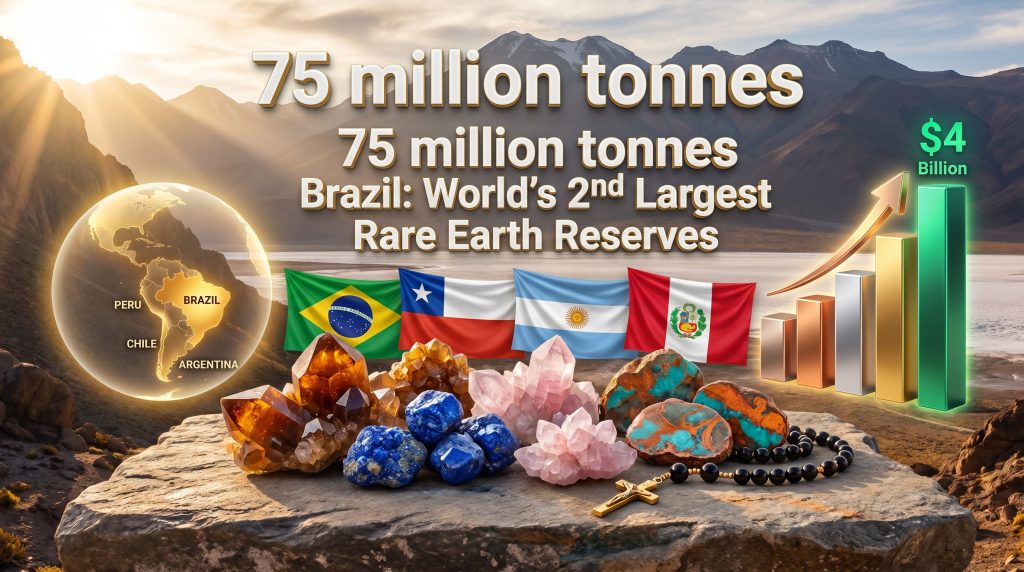
According to the US Geological Survey's most recent estimates, global rare earth oxide reserves total approximately 75 million tonnes (around 82.7 million US tons). More than half of those reserves are concentrated inside China, a reality that has driven Western policymakers toward near-panic over supply chain vulnerability. Brazil holds the world's second-largest national rare earth reserves, a fact that fundamentally repositions Latin America in any honest accounting of the global mineral supply landscape.
| Country | Primary Critical Minerals | Notable Characteristics |
|---|---|---|
| Brazil | Rare earth oxides, niobium | Second-largest rare earth reserves globally |
| Chile | Copper, lithium | World's largest copper producer; Atacama lithium hub |
| Argentina | Lithium | Core member of the "Lithium Triangle" |
| Peru | Copper, gold, silver | Major extraction hub with significant Indigenous land overlap |
| Bolivia | Lithium | Largest known lithium reserves, underdeveloped extraction |
The IADB's $4 Billion Pipeline and the Development Finance Argument
The Inter-American Development Bank, the primary multilateral lender serving Latin America and the Caribbean, has assembled a critical mineral investment pipeline valued at roughly $4 billion, concentrated predominantly across Chile, Argentina, and Brazil. Approximately three-quarters of that capital involves private sector co-investors, structuring the initiative as a blended finance vehicle rather than a straightforward public lending programme.
Ilan Goldfajn, the bank's president, travelled to Rome in June 2026 to present this investment thesis directly to Pope Leo XIV, a meeting that itself signals just how seriously development financiers have come to regard the Vatican's institutional influence as a material variable in the regional investment environment.
The IADB's core argument rests on a concept that development economists call in-country value-added processing. The logic runs as follows: Latin American nations that export raw or lightly processed ore capture only a fraction of the economic value embedded in their mineral endowments. By developing domestic refining, processing, and manufacturing capacity, host countries can position themselves further up the value chain, capturing employment, tax revenue, and industrial capability that historically flowed abroad.
The extraction-only model mirrors the colonial economic pattern that stripped Latin America's resource wealth for centuries while leaving local populations largely uncompensated. The processing argument is, at its core, an argument about who captures the value when the ground is opened.
Goldfajn was explicit that the opportunity is real but conditional, stating publicly that the region's mineral potential could be genuinely transformative provided the right standards are applied across labour conditions, environmental protections, and governance structures. He acknowledged that the IADB possesses the institutional toolkit to enforce those standards across its lending portfolio.
Pope Leo XIV: The Most Mining-Informed Pope in Modern History
A Biography Shaped by Extractive Communities
Understanding why the IADB's pitch carries particular complexity requires understanding Pope Leo XIV's biography. He spent approximately two decades as a missionary in Peru, working directly in communities whose lives were shaped, and often devastated, by extractive industry operations nearby. His pastoral postings read like a map of northern Peru's mining economy:
- Chulucanas, within the Archdiocese of Piura, sits adjacent to major copper mining projects that have generated persistent environmental and community conflicts
- Trujillo is historically associated with gold extraction and the social disruptions that accompany industrial-scale precious metal recovery
- Chiclayo functions as a major logistical and commercial hub servicing the extraction industries operating across northern Peru's interior
This geographic and pastoral history makes Leo XIV arguably the most operationally informed pope on the lived realities of mining communities in the contemporary era. Unlike predecessor positions shaped primarily by theological principle or secondhand advocacy, his views carry the weight of direct observation across two decades on the ground in one of the world's most active mining jurisdictions.
Bryan Harris, managing partner at Sabio, a Latin America-focused strategic advisory firm that consults for international mining companies in the region, has observed that Leo's years in Peru give him a form of personal credibility on this issue that is analytically distinct from institutional authority. Harris noted that the Pope's messaging on mining directly influences how dioceses and parishes across the continent engage with companies and projects. Furthermore, these church structures frequently form the organisational foundation of local opposition movements, meaning whether the resulting community posture toward an incoming project is confrontational or cooperative can determine project timelines, permitting outcomes, and ultimately whether capital is deployed at all.
The Vatican's Divestment Campaign: Institutional Opposition Takes Organised Form
Roughly two months after Leo XIV held a private audience with senior mining executives in January 2026, the Vatican moved in a direction that surprised many in the investment community. Rather than a softening of institutional opposition, the Church launched a formal campaign encouraging divestment from mining companies, anchored by the Church and Mining Network, an ecumenical Christian organisation with particularly deep roots across Latin America.
The campaign operates through three primary mechanisms:
- Portfolio review mandates directed at local dioceses and parishes, encouraging audit and restructuring of investment holdings with exposure to extractive industries
- Information-sharing initiatives designed to equip Indigenous communities with detailed knowledge about the nature, scale, and consequences of extraction occurring on or near their ancestral territories
- Moral pressure on institutional investors with religious affiliations, particularly those managing pension funds or endowments connected to Catholic institutions
The historical ironies embedded in this advocacy position are not lost on informed observers. Colonial-era extraction of silver and gold from Latin America enriched European Catholic institutions directly, with those metals literally adorning church interiors across the continent and beyond. The Church's current position as a champion of Indigenous communities against extractive exploitation represents a significant institutional pivot from that history.
Pope Francis' 2015 encyclical Laudato Si' established the theological and environmental framework that Leo XIV inherited. That document specifically identified mining-related harms including contamination of underground water systems from runoff, mercury pollution associated with gold mining operations, and sulphur dioxide emissions from copper smelting. Francis declared that Indigenous communities must serve as the primary dialogue partners in any decision-making process involving large-scale resource projects affecting their traditional lands.
Leo XIV has amplified this framework through his own public statements. During his April 2026 visit to three sub-Saharan African nations — Cameroon, Angola, and Equatorial Guinea — he publicly condemned what he characterised as the systematic colonisation of African mineral wealth by foreign mining corporations. A November 2026 return visit to Peru, including communities where he previously ministered, is anticipated to generate significant media and advocacy attention on the same themes.
The Processing Problem: An Underappreciated Environmental Risk
Why Extraction and Processing Are Not the Same Risk
One of the least-discussed dimensions of the rare earth debate — and one that carries significant implications for any responsible development framework — is the distinction between the extraction phase and the processing phase of rare earth production. These are not equivalent risk categories, and conflating them produces dangerously incomplete investment and policy analysis. The rare earth processing challenges involved are chemically intensive in ways that surface mining alone is not.
Separating individual rare earth elements from ore requires the application of heavy acids and organic solvents across multiple leaching and precipitation stages. The resulting waste streams, if containment systems fail or regulatory enforcement is inadequate, can contaminate groundwater aquifers over large geographic areas, sometimes irreversibly.
Harris, drawing on his advisory experience with mining companies operating in the region, has flagged this issue explicitly, noting that processing rare earths can be an extraordinarily dirty industrial process involving substantial chemical inputs that threaten water resources unless companies' sustainability commitments are continuously monitored and federal regulators maintain genuine enforcement capacity.
Critical caveat for investors: Project-level environmental assessments that focus primarily on extraction and surface disturbance risk understating the full liability profile of a rare earth operation. Processing infrastructure represents a distinct and often more chemically complex risk vector that requires separate regulatory treatment.
This distinction is particularly relevant in jurisdictions where regulatory capacity is limited or enforcement is inconsistent, which describes a significant portion of the Latin American policy landscape outside the more institutionally developed economies of Chile and Brazil. Consequently, understanding critical minerals geopolitics in the region requires accounting for this regulatory patchwork, not just headline reserve figures.
The next major ASX story will hit our subscribers first
What Responsible Extraction Actually Requires
The IADB's development finance framework, and the broader case being made to Vatican sceptics, rests on the proposition that modern rare earth mining can be conducted in ways that are materially and meaningfully different from historical precedent. That proposition is plausible but conditional. Five governance pillars must be genuinely implemented, not merely pledged:
- Labour standards with binding enforcement including wage floors, occupational health protocols, and recognised worker representation
- Environmental compliance frameworks with independent, continuous monitoring of water systems, air quality metrics, and land rehabilitation progress
- Governance and contract transparency including public disclosure of royalty structures, community benefit agreements, and government revenue flows
- Free, prior, and informed consent (FPIC) protocols that provide affected Indigenous communities with genuine decision-making authority, not simply consultation rights that can be overridden
- Domestic value-addition requirements that mandate in-country processing to ensure host nations capture downstream economic benefits
The critical challenge is that these conditions are interdependent. A project that satisfies environmental standards but bypasses FPIC protocols will still generate community resistance and reputational damage. A project that achieves community consent but lacks processing-phase environmental controls can still produce contamination outcomes that validate Church and civil society opposition. For instance, Chile's lithium strategy offers one regional model for how host nations are attempting to navigate these competing pressures at a national policy level.
Three Scenarios for Latin America's Rare Earth Decade
The trajectory of Pope Leo mining rare earth minerals Latin America represents over the coming decade is not predetermined. Three plausible pathways exist, each with materially different implications for investors, host communities, and the Vatican's engagement posture.
Scenario 1: Collaborative Development
Governance frameworks in Chile and Brazil attract IADB-backed blended finance on terms that genuinely embed FPIC protocols, local processing mandates, and third-party environmental monitoring. Evidence of community benefit accumulates. Church networks shift from opposition to constructive engagement. Latin America captures a meaningful share of the global rare earth supply chain, reducing Western dependence on Chinese production.
Scenario 2: Contested Extraction
Projects advance without adequate Indigenous consultation or processing-phase environmental safeguards. Church and community networks mobilise sustained opposition, increasing permitting delays and cost overruns. ESG-focused European institutional investors, the primary target audience for the IADB's $4 billion pipeline, limit exposure to reputationally complex assets. Capital costs rise and project economics deteriorate.
Scenario 3: Regulatory Divergence
Chile and Brazil develop credible governance regimes and attract institutional capital on competitive terms. Smaller jurisdictions with weaker regulatory infrastructure experience the contamination events and community conflicts that historically characterised the sector. Regional reputational damage constrains the broader Latin American rare earth investment thesis, even for projects in stronger governance environments.
Frequently Asked Questions
What is Pope Leo XIV's position on rare earth mining in Latin America?
Leo XIV has not issued a specific formal policy statement on rare earth mining. However, his public condemnation of mineral colonisation during his 2026 Africa visit, his remarks denouncing profit-driven resource exploitation at the expense of vulnerable populations, and the Vatican's formal divestment campaign collectively indicate deep institutional scepticism toward extractive industries operating without robust community and environmental protections.
Why does the Vatican's position matter to mining investors?
In Latin America's majority-Catholic societies, diocese and parish networks frequently serve as the primary organisational infrastructure through which communities coordinate responses to proposed mining projects. An adversarial Church posture can translate into sustained and well-organised opposition movements, directly affecting permitting timelines and capital risk profiles.
How large are Brazil's rare earth reserves?
According to the US Geological Survey, global rare earth oxide reserves total approximately 75 million tonnes. Brazil holds the world's second-largest national reserves, behind China, which controls more than half of all known deposits. This positions Brazil as a structurally significant alternative source for non-Chinese rare earth supply chains.
What distinguishes rare earth processing risk from extraction risk?
Extraction primarily involves surface and subsurface disturbance, water usage, and habitat disruption. Processing requires the application of heavy acids and organic solvents to separate individual elements from ore concentrates. Without robust containment infrastructure and continuous regulatory enforcement, processing operations carry significant groundwater contamination risk that is chemically distinct from and often more persistent than extraction-phase impacts.
What is the Church and Mining Network?
It is an ecumenical Christian organisation active primarily across Latin America that supports Indigenous communities affected by extractive operations and advocates for church-affiliated institutions to review and, where appropriate, divest from mining-exposed investment portfolios. The broader lessons from this region's experience with Pope Leo mining rare earth minerals Latin America will likely inform how global institutional investors approach community engagement standards across all frontier mining jurisdictions going forward.
Want to Track the Next Major ASX Mineral Discovery the Moment It's Announced?
Discovery Alert's proprietary Discovery IQ model scans ASX announcements in real time, delivering instant alerts on significant mineral discoveries — including critical minerals and rare earths — so subscribers can identify actionable opportunities ahead of the broader market. Explore historic discoveries and their returns or start your 14-day free trial today to gain a market-leading edge.