June 20, 2026
The Rare Earth Chessboard: Why the Processing Gap Matters More Than the Mine
The global race for rare earth elements has never really been about who sits on the largest deposits. It has always been about who can turn raw ore into functional materials. This distinction separates mineral wealth from industrial power, and it is precisely this gap that explains why a country ranking third in the world by rare earth reserve volume still finds itself acutely vulnerable every time a major supplier restricts exports.
The geopolitics of critical minerals operates on a deceptively simple principle: controlling the refinery is more powerful than controlling the mine. China understood this decades ago and systematically built processing infrastructure that now handles an estimated 85 to 90 percent of global refined rare earth output, even though its share of global reserves is considerably smaller than that processing dominance might imply. Nations that failed to invest in the metallurgical middle of the supply chain now find themselves structurally exposed, regardless of what lies beneath their own soil.
Furthermore, the rare earth supply chain dynamics that underpin this reality have become increasingly important to policymakers worldwide. India sits at the centre of this paradox more sharply than almost any other major economy.
When big ASX news breaks, our subscribers know first
India's Structural Rare Earth Vulnerability: A Quantified Reality
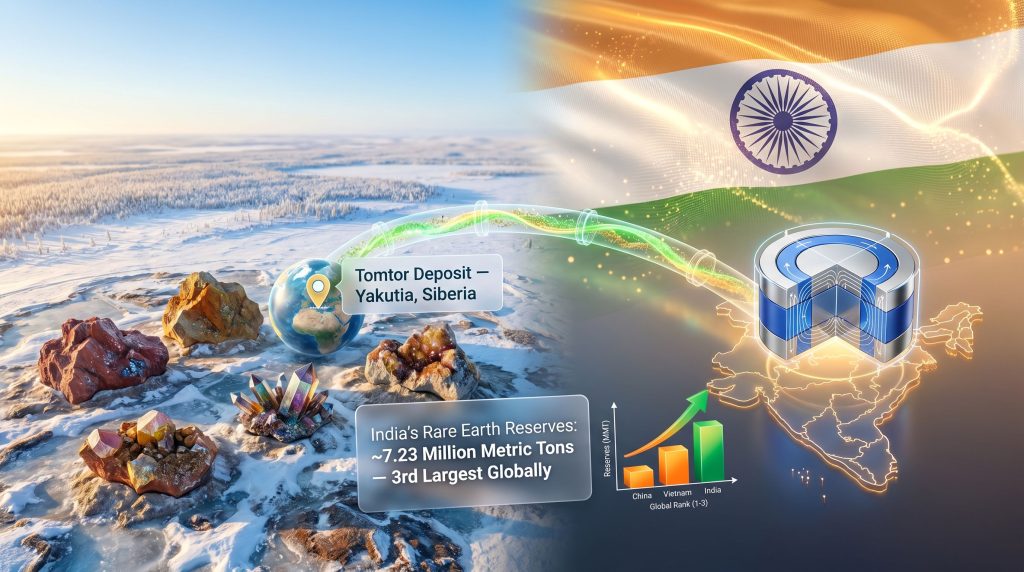
India holds approximately 7.23 million metric tons of rare earth reserves, placing it third globally. Yet nearly all of the processed rare earth materials consumed by Indian manufacturers are sourced from imports, with China historically supplying the dominant share. India currently operates no commercial-scale rare earth separation or refining infrastructure, and domestic neodymium-iron-boron (NdFeB) permanent magnet production is effectively non-existent at an industrial level.
This is not a minor operational gap. It is a foundational industrial weakness.
| Metric | Estimated Figure |
|---|---|
| India's total rare earth reserves | ~7.23 million metric tons |
| Global reserve ranking | 3rd largest |
| Domestic commercial refining capacity | Negligible / pre-commercial |
| Primary refined REE import source | China (dominant share) |
| Domestic NdFeB magnet production | None at commercial scale |
When China tightened its controls on rare earth magnet and oxide exports in 2025 and into 2026, the downstream effect on Indian manufacturers was immediate. Industries dependent on high-performance permanent magnets, including electric vehicle assemblers, defence electronics producers, and industrial motor manufacturers, faced acute supply constraints. The shock exposed a blind spot that had been tolerated for years but could no longer be deferred.
India's rare earth predicament is a textbook case of resource paradox: enormous geological endowment combined with near-total dependence on foreign processing capability. The China export shock did not create this vulnerability, it simply made it impossible to ignore.
What makes India's domestic reserve base particularly frustrating from a strategic standpoint is the nature of the barriers involved. The rare earth processing challenges India faces are real and significant, requiring advanced hydrometallurgical separation technology, substantial capital investment, and long development timelines. These are not obstacles that mineral discovery alone can solve.
What Makes Siberia's Tomtor Deposit Strategically Compelling
The Tomtor deposit, situated in Russia's Yakutia region of Siberia, occupies a unique position in the global rare earth supply landscape. It is widely regarded among mineralogists and resource analysts as one of the largest undeveloped rare earth deposits on Earth, distinguished not only by its scale but by its ore chemistry.
The Geological Characteristics That Set Tomtor Apart
Unlike many rare earth deposits that are dominated by lighter, more abundant elements such as lanthanum and cerium, Tomtor's ore profile contains meaningful concentrations of heavy rare earth elements alongside critical light REEs. Heavy rare earths, including dysprosium and terbium, are far scarcer globally and command significantly higher prices. They are also the elements most critical for maintaining magnet performance at elevated operating temperatures, which is essential for EV traction motors that cycle through demanding thermal conditions.
The deposit also contains notable concentrations of niobium and scandium, both of which carry independent strategic and commercial value. Niobium is essential for high-strength steel alloys used in infrastructure and aerospace, while scandium is a critical input for aluminium alloys and solid oxide fuel cells.
Tomtor's development history is instructive. Despite its scale and compositional richness, the deposit remained commercially undeveloped for decades due to its remote Arctic location, extreme seasonal conditions, and the capital-intensive logistics required for any serious extraction programme. Rosneft's acquisition of the deposit in 2025 marked a significant strategic departure for Russia's largest oil producer, signalling an institutional pivot toward critical minerals as a revenue and geopolitical instrument.
Why Rosneft's Entry Into Critical Minerals Matters
Rosneft's move into rare earth asset ownership is best understood within the broader context of Russia's post-2022 economic reorientation. Western sanctions have systematically constrained Russia's ability to monetise its hydrocarbon wealth through traditional channels, creating strong institutional incentives to develop alternative export-oriented revenue streams.
Critical minerals, particularly those in demand across Asian manufacturing economies, represent a natural fit. Russia holds significant rare earth reserve concentrations across Siberia and the Murmansk region, and unlike oil exports, rare earth supply relationships can be structured in ways that deepen bilateral economic integration. Russia's move into Siberian rare earths has consequently drawn considerable international attention as a strategic development beyond simple commodity transactions.
The India-Russia Rare Earth Framework: Architecture and Intent
The formal structure of the India-Russia rare earth engagement originated from the December India-Russia annual summit, where both governments committed to launching collaboration in the rare earth and critical minerals sector. What followed was a phased technical engagement rather than an immediate commercial agreement, reflecting the complexity of what is actually being attempted.
The initial phase involves studying the mineral composition of Tomtor ore samples. This is not a trivial step. Before any processing technology can be selected or any refinery investment justified, Indian researchers need to characterise the specific REE oxide ratios, impurity profiles, and physical properties of Tomtor material. Different ore chemistries require fundamentally different separation approaches, and mismatching processing technology to ore type is a costly error that has derailed rare earth projects before.
Under the agreed protocol, rare earth material will be processed within Russia before physical shipment to Indian research facilities, allowing Indian scientists to work with processed concentrates rather than raw ore.
The Institutional Architecture Behind the Partnership
The technical substance of this engagement is carried by a specific set of institutional relationships:
| Institution | Country | Role |
|---|---|---|
| Rosneft | Russia | Tomtor deposit owner; REE asset holder |
| JSC Giredmet (Rosatom division) | Russia | Processing technology developer; MOU signatory |
| IREL (India Rare Earths Ltd.) | India | State miner; primary government engagement entity |
| Nexon Geochem | India | Private sector R&D partner; MOU signatory |
| TEXMiN / IIT (ISM) | India | Academic-technical partner; NdFeB magnet R&D |
JSC Giredmet is the element of this framework that deserves the closest analytical attention. As the scientific and technical arm of Rosatom's research division, Giredmet carries decades of Soviet-era metallurgical heritage, including expertise in rare earth separation chemistry that was developed largely in isolation from Western research traditions. This means Giredmet's processing methodologies may approach rare earth refining from different chemical and engineering starting points than those employed by Western or Australian operators.
In May 2026, Giredmet signed a memorandum of understanding with India's Nexon Geochem covering research and development of rare earth raw material processing technologies. Separately, it signed a letter of intent with TEXMiN, the Technology Innovation in Exploration and Mining Foundation affiliated with IIT (Indian School of Mines). The TEXMiN agreement is the most technically ambitious element of the framework, targeting joint development of the full metallurgical cycle for producing NdFeB permanent magnets, including pilot-scale validation of Giredmet's proprietary technologies.
Understanding the NdFeB Magnet Production Challenge
It is worth pausing to explain why NdFeB magnet production is treated as such a strategic prize. The production of a functional NdFeB magnet from mined ore is not a single industrial step. It is a multi-stage value chain that includes:
- Mining and concentration of rare earth bearing ore
- Hydrometallurgical separation to isolate individual rare earth oxides
- Reduction and alloying to produce neodymium-iron-boron alloy in the correct compositional ratios
- Powder processing to create fine alloy powder with controlled particle size
- Sintering or bonding to produce the final magnet geometry
- Surface treatment and coating to protect against corrosion
Each of these steps requires specialised equipment, chemistry, and process control. Countries that have attempted to shortcut this chain by importing partially processed materials have found themselves perpetually dependent on the upstream supplier for any step they cannot perform domestically. India's objective through the Giredmet-TEXMiN agreement is to develop capability across the full chain, not just at the mining end.
NdFeB magnets are the highest-performance commercially available permanent magnets. They are irreplaceable in EV traction motors, wind turbine generators, industrial robotics, and defence guidance systems. Developing domestic production capability is not simply an industrial ambition for India. It is a defence and energy security imperative.
How the Tomtor Engagement Fits India's Broader Critical Minerals Strategy
India's engagement with India Rosneft Siberian rare earth reserves does not exist in isolation. It is one component within a deliberate multi-vector diversification strategy built around the recognition that no single bilateral partnership can resolve a structural dependency of this magnitude.
India's Critical Minerals Mission, which covers over 30 identified minerals considered essential to the energy transition and defence manufacturing, has driven parallel engagement with multiple partners. The critical minerals demand surge globally has, furthermore, intensified competition for exactly the kinds of deposits and processing partnerships India is now pursuing:
- Australia: lithium and cobalt sourcing, with Australian producers offering geopolitical alignment and established processing infrastructure
- Argentina: lithium brine resources, particularly relevant to battery supply chains
- Africa: graphite, manganese, and cobalt, with several bilateral agreements at varying stages of development
- Russia: rare earth elements, specifically targeting processing technology transfer alongside raw material access
The Russia engagement is distinctive because it offers something the other partnerships currently cannot: advanced processing science. Australia has world-class rare earth mining operations but limited domestic refining capability. Africa has resources but early-stage processing infrastructure. Russia, through institutions like Giredmet, has genuine metallurgical depth that took decades to build.
Comparing India's REE Partnership Options
| Partnership Dimension | Russia (Tomtor/Rosneft) | Australia | Africa (Various) | Domestic Development |
|---|---|---|---|---|
| Reserve scale | Very large (undeveloped) | Moderate | Variable | Large but dispersed |
| Processing technology maturity | Advanced (Giredmet) | Limited | Limited | Nascent |
| Geopolitical risk | High (sanctions exposure) | Low | Moderate | Low |
| Timeline to commercial supply | Medium to long term | Medium term | Long term | Long term |
| NdFeB magnet capability | Yes (via Giredmet) | No | No | Under development |
The Geopolitical Risk Calculus: Sanctions, Autonomy, and Strategic Exposure
Any honest assessment of the India-Russia rare earth framework must address the sanctions dimension directly. Russia remains subject to extensive Western financial and technology sanctions following the 2022 invasion of Ukraine. Indian institutions engaging with sanctioned Russian entities face potential secondary sanctions exposure, financing complications, and reputational considerations in their relationships with Western partners.
This creates a genuine strategic tension. India has maintained its long-standing doctrine of strategic autonomy, refusing to align exclusively with either Western or non-Western blocs, and the rare earth partnership with Russia is a direct expression of that doctrine. However, strategic autonomy has a cost ceiling, and deep institutional entanglement with sanctioned Russian entities could constrain India's access to Western capital markets and technology in ways that matter across other sectors.
Reducing dependence on Chinese rare earth supply is a legitimate strategic objective. But structuring that diversification around a deep bilateral dependency on Russian supply substitutes one concentration risk for another. The optimal outcome is genuine multi-polarity across supply sources, not a bilateral pivot.
The Quad critical minerals framework, which includes the United States, Australia, Japan, and India, reflects a parallel effort to build alternative rare earth supply chains through Western-aligned partnerships. The Minerals Security Partnership (MSP) represents an additional institutional architecture through which India could access financing and technology for rare earth development without the sanctions complications that Russian engagement introduces.
India's challenge is to extract maximum value from the Russia technical engagement, particularly around processing technology, without allowing that relationship to deepen into a strategic dependency that limits its options within Western-aligned frameworks.
A Step-by-Step Pathway From Talks to Commercial Reality
The road from current diplomatic and research engagement to actual rare earth supply is long and technically demanding. The realistic progression looks like this:
- Ore characterisation of Tomtor samples by Indian research institutions
- Processing technology matching between Tomtor ore chemistry and Giredmet separation capabilities
- Pilot validation of processing workflows, conducted initially within Russia
- Technology transfer assessment to determine what can realistically be replicated within India
- Full metallurgical cycle pilot for NdFeB magnet production, led through the TEXMiN-IIT (ISM) collaboration
- Commercial structure negotiation: joint venture, offtake agreement, or direct investment in Tomtor development
- Infrastructure planning for any India-side processing capacity that pilot validation supports
Each of these steps carries its own technical, financial, and geopolitical dependencies. The process will not be measured in months. Realistically, meaningful commercial rare earth supply from India Rosneft Siberian rare earth reserves is a medium to long-term proposition, with the processing technology transfer elements potentially yielding results on a shorter timeline than the deposit development itself.
The next major ASX story will hit our subscribers first
Key Takeaways for Understanding India's Rare Earth Positioning
Several conclusions emerge from a thorough examination of the India Rosneft Siberian rare earth engagement:
- Processing capability, not reserve ownership, is the strategic prize. India's engagement with Giredmet is ultimately about acquiring metallurgical knowledge that cannot be easily bought on the open market.
- The Tomtor deposit's undeveloped status cuts both ways. It represents enormous potential but also real technical and logistical risk that years of pilot work will be required to properly quantify.
- Russia's Soviet-era metallurgical heritage is a genuine and underappreciated asset. Giredmet's processing science was developed independently of Western rare earth research traditions and may offer approaches that differ substantially from what India could access through Western partnerships.
- India's multi-vector strategy is the correct framework but requires careful management to ensure that the Russia engagement does not create new strategic dependencies that offset the diversification gains.
- The NdFeB magnet production goal through TEXMiN/IIT (ISM) represents the most transformative potential outcome of this entire framework, and its success or failure will ultimately determine whether the partnership delivers genuine industrial sovereignty or remains a raw material access arrangement.
The broader lesson is one that extends well beyond India's specific circumstances. In the critical minerals era, China's rare earth strategy has demonstrated conclusively that the countries and companies that build processing capability will hold structural advantages over those that simply control geological deposits. India's approach to Siberian deposits is consequently one part of a much larger effort to close that gap, and the distance yet to travel remains considerable.
Want to Know Which ASX Companies Are Developing Critical Mineral Discoveries Right Now?
Discovery Alert's proprietary Discovery IQ model scans ASX announcements in real time, instantly identifying significant mineral discoveries — including critical and rare earth elements — and delivering actionable insights directly to subscribers before the broader market reacts. Explore historic discoveries and their returns to understand what major mineral finds can mean for investors, and begin your 14-day free trial at Discovery Alert to position yourself ahead of the market.