
June 30, 2026
The Macroeconomic Framework Behind U.S. LNG Exports
The transformation of America's energy landscape reflects unprecedented structural shifts that extend far beyond simple supply and demand metrics. Today's U.S. LNG exports and energy prices surge represents a fundamental recalibration of global energy economics, where domestic production capacity expansion intersects with international arbitrage opportunities to create entirely new market dynamics. Furthermore, these developments interconnect with broader economic trends, including the US natural gas forecast and evolving trade relationships.
Production Capacity Expansion and Capital Investment Cycles
American liquefaction infrastructure development follows distinct investment cycles that reveal the scale of capital deployment reshaping energy markets. New liquefaction facilities are systematically coming online through 2027, with the Gulf Coast emerging as the dominant geographic concentration hub for export infrastructure.
Current export trajectories demonstrate remarkable growth patterns:
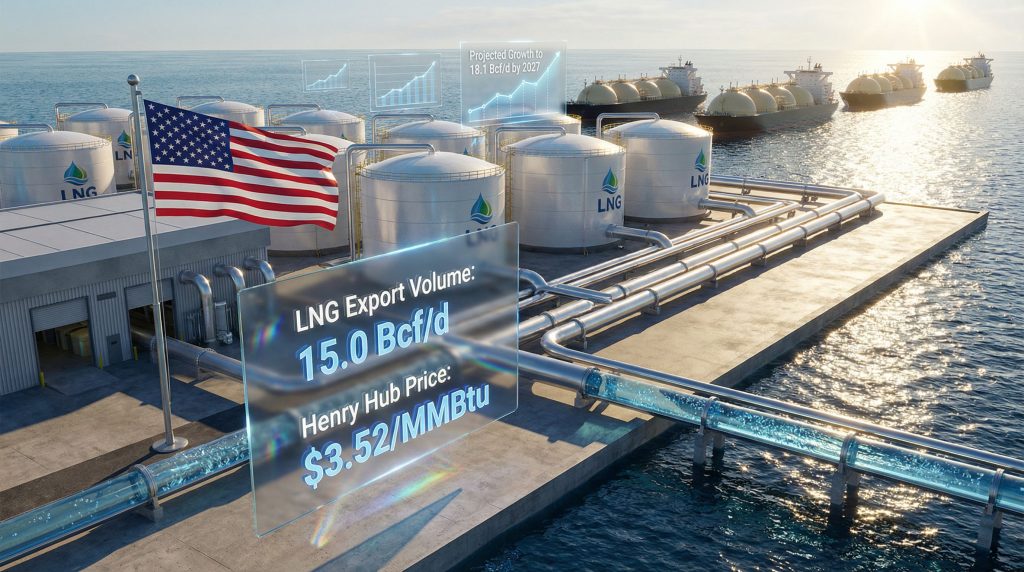
- 15.0 billion cubic feet per day (Bcf/d) in 2025, representing a 25% increase from 2024 levels
- Projected growth to 16.4 Bcf/d in 2026
- Expected expansion to 18.1 Bcf/d by 2027
The infrastructure buildout timeline reflects coordinated private sector financing patterns supporting multiple facilities currently in various stages of construction, commissioning, and regulatory approval. These capital expenditure programs generate significant economic multiplier effects through job creation and regional development impacts, particularly concentrated along the Gulf Coast corridor where existing petrochemical infrastructure provides synergistic advantages.
Regional production hubs benefit from established pipeline networks, storage facilities, and skilled workforce concentrations that reduce overall project development costs. The geographic concentration creates economies of scale that enhance the competitiveness of American LNG in international markets while simultaneously intensifying feedgas demand in specific domestic regions.
Supply Chain Integration with Global Markets
The integration of U.S. LNG exports and energy prices into global supply chains has fundamentally altered domestic natural gas consumption hierarchies. Export facilities now represent the third-largest consumer segment for American natural gas, having surpassed residential consumption in recent years and establishing a new sectoral demand ranking.
Current consumption hierarchy by volume:
- Power generation (largest consumer)
- Industrial and manufacturing sectors
- LNG export feedgas demand
- Residential consumption (now fourth)
This restructuring reflects the scale of feedgas procurement required by export terminals and demonstrates how international price arbitrage opportunities can reshape domestic market structures. Natural gas exporters maintain competitive advantages in feedgas procurement because international LNG export prices currently trade at approximately double the Henry Hub price, creating favourable economics that justify premium pricing for domestic supply.
Transportation infrastructure development parallels export capacity expansion, with pipeline systems adapting to serve new demand centres while maintaining service to traditional consumption regions. Storage and logistics operations increasingly focus on seasonal demand balancing and inventory management strategies that accommodate both domestic consumption patterns and international delivery requirements.
When big ASX news breaks, our subscribers know first
What Economic Forces Drive Domestic Price Pressures?
Understanding the economic mechanisms driving domestic price pressures requires analysis of competing demand structures and the price formation processes that determine market clearing levels. The interaction between export demand and traditional consumption creates complex dynamics that influence pricing throughout the natural gas value chain. These pressures similarly affect broader US economy tariffs 2025 considerations as energy costs impact inflation.
Demand Competition Analysis
Sectoral demand competition intensifies as U.S. LNG exports and energy prices create new arbitrage relationships between domestic and international markets. Each consumer segment exhibits different price elasticity characteristics, leading to varied responses when supply constraints emerge or seasonal demand patterns shift.
Power generation maintains its position as the largest natural gas consumer, but faces increasing competition from export facilities during periods of supply tightness. The sector's demand profile includes both baseload generation and peaking capacity, creating different pricing sensitivities depending on operational requirements and alternative fuel availability.
Industrial users represent the second-largest consumption segment and often exhibit limited short-term demand flexibility due to production process requirements. Energy-intensive manufacturing, petrochemical operations, and other industrial applications frequently operate on longer-term supply contracts, but face significant cost pressures when market prices exceed contracted levels.
The emergence of LNG feedgas demand as the third-largest consumer category reflects export facility operational requirements that typically maintain consistent demand levels regardless of seasonal variations. This demand stability can provide price support during traditionally low-demand periods while contributing to supply tightness during peak consumption seasons.
Artificial intelligence infrastructure and data centre expansion represent emerging demand drivers that compound existing consumption growth. These facilities require 24/7 uninterrupted power supply, making natural gas particularly valuable as "the most flexible among all energy sources and an abundant domestic resource" compared to intermittent renewable alternatives.
| Demand Sector | Consumption Ranking | Price Sensitivity | Seasonal Variation |
|---|---|---|---|
| Power Generation | #1 (Largest) | Moderate | High |
| Industrial/Manufacturing | #2 | Low | Low |
| LNG Export Feedgas | #3 | Very Low | Very Low |
| Residential | #4 | High | Very High |
Market Structure and Price Formation
Henry Hub benchmark dynamics serve as the primary price discovery mechanism for American natural gas markets, with export terminal demand competing directly against domestic consumers at this central pricing point. The benchmark's role extends beyond simple price reporting to encompass the transmission mechanism through which international arbitrage opportunities influence domestic cost structures.
Price trajectory analysis reveals consistent upward pressure:
- 2025 Baseline: $3.52/MMBtu
- 2026 Projection: $4.31/MMBtu (22.4% increase)
- 2027 Forecast: $4.38/MMBtu
These price increases reflect the fundamental supply-demand rebalancing occurring as export capacity expands faster than domestic production growth. Regional basis differentials capture transportation costs and local supply-demand imbalances, with areas proximate to export facilities often experiencing smaller price impacts than distant consumption centres.
Storage utilisation patterns play crucial roles in price volatility management, as inventory levels influence market participants' willingness to pay premium prices during supply disruptions or demand spikes. Seasonal storage injection and withdrawal cycles interact with export demand to create more complex inventory management requirements than traditional domestic-only markets.
Weather-driven demand shocks maintain significant influence over short-term price movements, particularly during extreme temperature events that stress both heating and cooling demand. However, the presence of consistent export demand provides a price floor that limits downward price movements during mild weather periods when traditional domestic demand declines.
How Do LNG Exports Impact Different Economic Sectors?
The sectoral impacts of expanding U.S. LNG exports and energy prices create winners and losers across the American economy, with effects varying significantly based on energy intensity, geographic location, and competitive positioning relative to international markets. These dynamics also contribute to broader US‑China trade war impacts as energy becomes a strategic commodity.
Industrial Competitiveness Effects
Manufacturing cost structures face direct impacts from higher natural gas prices, particularly in energy-intensive industries where fuel and feedstock costs represent significant portions of total production expenses. The industrial sector's position as the second-largest natural gas consumer creates vulnerability to price increases driven by competing LNG feedgas demand.
Petrochemical sector impacts demonstrate the complexity of export-driven market changes. Companies utilising natural gas liquids as feedstocks for chemical production face increased competition from export facilities targeting the same raw materials. This competition can increase input costs while simultaneously providing opportunities for companies with integrated operations that can optimise between domestic sales and export markets.
Regional industrial development patterns reflect the geographic concentration of export infrastructure and its proximity to traditional manufacturing centres. Areas near Gulf Coast export terminals may benefit from increased economic activity and infrastructure investment, while manufacturing regions distant from new supply sources could experience competitive disadvantages from higher delivered gas costs.
The analysis by Wood Mackenzie illustrates this dynamic, indicating that American LNG supply growth will impose costs on U.S. consumers while benefiting international customers. This trade-off highlights how export growth can undermine domestic industrial competitiveness in global markets, particularly for industries competing with international manufacturers who access lower-cost energy supplies.
Supply chain resilience considerations become increasingly important as domestic availability during global market disruptions may be limited by export commitments. Industrial users historically relying on abundant domestic supply may need to develop alternative sourcing strategies or adjust production processes to maintain competitiveness during supply shortfalls.
Residential and Commercial Energy Economics
Residential consumption's decline to fourth place in the natural gas demand hierarchy reflects the sector's displacement by LNG export feedgas demand. This shift carries significant implications for household energy costs and regional economic development patterns.
Utility rate structures translate wholesale price increases into consumer bill impacts through various pricing mechanisms. Average wholesale day-ahead electricity prices rose in 2025 compared to 2024, driven largely by higher natural gas costs to electric generators, which subsequently filter through to retail consumer electricity bills.
Regional cost variations emerge based on proximity to export infrastructure and local supply-demand dynamics. Areas with direct access to production regions may experience different price impacts than regions requiring long-distance transportation or those competing directly with export facilities for supply.
The continuation of higher energy bills provides no relief for 2026, as booming U.S. LNG exports intensify competition for domestic gas output. The substantial price differential between international LNG markets (approximately double Henry Hub prices) and domestic prices creates structural upward pressure on consumer costs that persists as long as export arbitrage opportunities remain attractive.
Energy burden analysis reveals particular vulnerability among low-income households, which typically spend higher percentages of disposable income on energy costs. Price increases driven by export demand create regressive impacts that disproportionately affect households with limited ability to reduce consumption or improve energy efficiency.
What Are the Long-Term Structural Implications?
Long-term structural changes in American energy markets reflect the permanent reconfiguration of supply-demand relationships and infrastructure development patterns that support sustained export growth while meeting domestic consumption requirements. These changes also influence neighbouring markets, including Canada energy transition 2025 initiatives.
Production Response Mechanisms
Production growth trajectories demonstrate the supply response to higher price signals, with U.S. natural gas marketed production projected to increase 2% to average 120.8 Bcf/d in 2026, then rise another 1% to reach a record-high 122.3 Bcf/d in 2027.
Basin-specific development patterns reveal how different geological formations respond to price incentives:
- Haynesville and Appalachia serve as gas-directed shale basins responding directly to price signals
- Permian Basin contributes associated gas from oil production with increasing gas-to-oil ratios (GOR)
- All three major basins (Appalachia, Permian, Haynesville) contribute to production growth
Technology adoption impacts accelerate as higher prices justify investments in drilling efficiency improvements, enhanced recovery techniques, and processing optimisation. These technological advances help offset depletion effects in mature formations while reducing breakeven costs for marginal resources.
Associated gas dynamics in oil-directed basins create complex supply relationships where natural gas production levels depend partly on oil price incentives and drilling activity levels. The increasing gas-to-oil ratios in formations like the Permian Basin provide additional gas supply growth even when oil prices remain relatively stable.
Infrastructure Investment Requirements
Pipeline capacity development must accommodate both increased production volumes and changing flow patterns as export facilities create new demand centres. Transportation bottlenecks can limit the efficiency of supply response and create regional price differentials that persist until infrastructure expansion eliminates constraints.
Processing facility expansion becomes necessary as production growth requires additional midstream capacity for gathering, processing, and transportation. These infrastructure investments typically follow production growth with time lags that can temporarily constrain supply response to price signals.
Strategic storage capacity planning adapts to serve both traditional seasonal demand balancing and the more consistent demand patterns of export facilities. Storage operators may need to modify operational strategies to optimise between traditional seasonal arbitrage opportunities and the steady-state requirements of LNG export operations.
Grid reliability considerations become increasingly complex as natural gas serves both traditional power generation and export markets. Maintaining backup capacity and fuel security for critical power generation requires coordination between gas supply planning and electric system reliability requirements.
How Do Global Market Dynamics Influence Domestic Pricing?
International market integration fundamentally alters domestic price formation by creating arbitrage relationships that link American natural gas costs to global LNG pricing structures and geopolitical risk factors affecting international energy trade. Consequently, global supply decisions, such as OPEC production impact 2025 determinations, increasingly influence domestic markets.
International Price Arbitrage
Export price premiums provide the economic foundation for continued export growth despite domestic supply constraints. International LNG export prices currently trading at approximately double the Henry Hub price create substantial profit margins that justify higher feedgas procurement costs and drive continued facility development.
This price differential allows exporters to outbid domestic consumers during supply tightness while maintaining profitable operations. The arbitrage opportunity persists as long as international markets value LNG significantly above domestic natural gas prices, creating sustained upward pressure on American benchmarks.
Asian LNG premium dynamics represent a crucial component of export economics, with Asian importing nations historically paying premium prices for reliable LNG supply. These premiums reflect supply security concerns, limited pipeline access to alternative sources, and the strategic value of diversified supply portfolios.
European market integration has accelerated following geopolitical disruptions that reduced Russian pipeline supply reliability. European demand for American LNG has increased price competition and created additional arbitrage opportunities that support export facility economics while contributing to domestic price pressures.
Currency exchange impacts influence export competitiveness through dollar strength effects on international purchasing power. A stronger dollar can reduce foreign buyers' purchasing capacity while potentially improving the relative attractiveness of domestic consumption for American users.
Geopolitical Risk Factors
Energy security considerations balance the strategic value of export capabilities against domestic energy affordability concerns. Export infrastructure provides geopolitical leverage and supports international alliance relationships, but these benefits must be weighed against potential domestic economic impacts.
Trade policy implications encompass tariff structures, sanctions regimes, and international agreements that influence LNG market access and pricing. Changes in trade relationships can rapidly alter export economics and domestic supply availability.
Climate policy interactions create regulatory uncertainties that affect long-term investment decisions in both export infrastructure and domestic supply development. Carbon pricing mechanisms, environmental regulations, and renewable energy mandates influence the relative attractiveness of natural gas investments.
Supply chain diversification efforts by international buyers seek to reduce dependence on volatile or unreliable supply regions. American LNG benefits from perceptions of supply reliability and political stability, supporting premium pricing in international markets.
What Policy Mechanisms Could Address Price Pressures?
Policymakers face complex trade-offs between supporting export growth for economic and strategic benefits while addressing domestic energy affordability concerns that affect consumer welfare and industrial competitiveness.
Regulatory Framework Options
Export licensing modifications could potentially balance domestic supply availability with international market commitments. However, such changes might undermine investor confidence in long-term project economics and reduce America's credibility as a reliable LNG supplier.
Infrastructure permitting streamlining can accelerate pipeline and facility approvals that relieve supply bottlenecks contributing to price pressures. Faster permitting processes support both export capacity expansion and domestic supply accessibility improvements.
Market transparency measures through improved price discovery and reporting mechanisms help market participants make more informed decisions while reducing information asymmetries that can contribute to price volatility.
Strategic reserve utilisation provides potential government intervention capabilities during supply emergencies or extreme price events. However, reserve capacity limitations and market intervention risks require careful consideration of unintended consequences.
Economic Incentive Structures
Tax policy considerations encompass production incentives, consumer protection measures, and revenue generation strategies that could influence supply-demand balances. Production tax credits might encourage domestic supply growth, while consumer assistance programmes could mitigate affordability impacts.
Regional development programmes can support communities experiencing energy cost increases through economic diversification initiatives, infrastructure investments, or targeted assistance programmes that offset higher energy expenses.
Industrial competitiveness support may include energy cost assistance for manufacturing sectors, research and development incentives for energy efficiency technologies, or trade policies that account for energy cost disadvantages in international competition.
Consumer assistance programmes provide targeted relief for vulnerable populations through low-income energy assistance, weatherisation programmes, or rate design modifications that reduce the regressive impacts of higher energy costs.
The next major ASX story will hit our subscribers first
Statistical Analysis: Key Market Indicators
Quantitative assessment of market trajectories reveals the scale and timing of structural changes occurring in American natural gas markets as export growth reshapes supply-demand relationships.
| Metric | 2025 Baseline | 2026 Projection | 2027 Forecast |
|---|---|---|---|
| LNG Export Volume | 15.0 Bcf/d | 16.4 Bcf/d | 18.1 Bcf/d |
| Natural Gas Production | 118.4 Bcf/d | 120.8 Bcf/d | 122.3 Bcf/d |
| Henry Hub Price | $3.52/MMBtu | $4.31/MMBtu | $4.38/MMBtu |
| Export Share of Production | 12.7% | 13.6% | 14.8% |
These metrics demonstrate the accelerating pace of export growth relative to production increases, with export share of total production rising from 12.7% in 2025 to 14.8% by 2027. The corresponding price increases reflect tightening supply-demand balances as export demand competes more intensively with domestic consumption.
Long-term price projections extend these trends substantially, with Wood Mackenzie forecasting that LNG export growth combined with data centre demand will boost U.S. gas demand by nearly 40% over the next 10 years. This demand surge could lift average Henry Hub prices to $4.9/MMBtu during the 2030-2035 period, representing approximately 50% increase compared to 2025 levels.
Economic Impact Assessment Framework
Comprehensive impact assessment requires analysis of both short-term market adjustments and medium-term structural changes as the American energy system adapts to sustained export growth and evolving demand patterns.
Short-Term Market Adjustments (2026-2027)
Price volatility patterns intensify during the adjustment period as markets adapt to new supply-demand relationships. Seasonal variations may become more pronounced as export demand provides a higher price floor during traditionally low-demand periods while contributing to supply tightness during peak seasons.
Production response timing exhibits typical lag effects between price signals and actual supply increases. Drilling activity, completion operations, and new well production require months to respond to price incentives, creating temporary periods where demand growth outpaces supply response.
Consumer adaptation strategies emerge as households and businesses respond to higher energy costs through demand reduction, efficiency improvements, and fuel switching where feasible. These behavioural responses help moderate demand growth but may require time to fully impact market balances.
Regional economic redistribution creates winners and losers across different geographic areas. Export facility locations experience economic benefits from construction activity and ongoing operations, while distant consumption centres may face competitive disadvantages from higher delivered energy costs.
Medium-Term Structural Changes (2028-2030)
Infrastructure development cycles reach completion for major pipeline and facility projects currently in planning or construction phases. These capacity additions should help alleviate supply bottlenecks while supporting both export growth and domestic supply accessibility.
Technology deployment impacts accelerate as higher price incentives justify investments in efficiency improvements, alternative energy sources, and advanced extraction techniques. These technological advances help moderate cost increases while supporting supply growth.
Market maturation effects reduce volatility as export capacity stabilises and supply response mechanisms adapt to new demand patterns. More predictable price relationships should emerge as market participants develop experience with integrated domestic-international market dynamics.
International competition dynamics evolve as global LNG supply capacity expands and new exporting regions develop competing facilities. American LNG may face increased competition that moderates export price premiums and potentially reduces domestic price pressures.
Risk Assessment: Potential Market Scenarios
Scenario analysis provides insight into potential outcomes under different combinations of supply growth, demand development, and policy intervention possibilities.
High Export Growth Scenario
Accelerated facility construction could result in earlier-than-expected capacity additions if permitting processes accelerate, financing becomes more readily available, or technological advances reduce construction timelines. This scenario would intensify domestic supply competition and price pressures.
Strong international demand from sustained Asian import requirements, continued European supply diversification, or emerging market LNG adoption could support premium pricing for American exports. Robust international demand would justify higher domestic feedgas costs and maintain export arbitrage opportunities.
Limited production response due to regulatory constraints, resource depletion, or capital availability limitations could prevent supply growth from keeping pace with combined domestic and export demand increases. Supply constraints would amplify price increases and economic adjustment costs.
Consumer impact magnitude under this scenario could include significant residential and commercial energy bill increases, reduced industrial competitiveness, and potential political pressure for policy interventions to address affordability concerns.
Balanced Growth Scenario
Moderate export expansion following current projections with steady capacity additions matching established timelines provides the most likely baseline case for market development. This scenario assumes continued policy support and favourable financing conditions for planned projects.
Responsive production increases through adequate upstream development, reasonable regulatory frameworks, and sufficient capital investment should enable supply growth that partially offsets export demand increases while supporting modest price increases.
Regional price variations could create different impact levels across geographic areas, with some regions experiencing manageable cost increases while others face more significant adjustments based on supply accessibility and transportation constraints.
Policy intervention potential might include targeted measures to address specific impacts without fundamentally altering market dynamics. Assistance programmes, infrastructure investments, or regulatory adjustments could help manage transition costs.
Constrained Export Scenario
Infrastructure delays due to permitting challenges, construction difficulties, or financing constraints could slow export capacity growth below current projections. Reduced export pressure would moderate domestic price increases and consumer impacts.
Weak international demand resulting from global economic slowdowns, alternative supply development, or demand destruction from high prices could reduce export arbitrage opportunities and limit domestic price pressures.
Strong production growth exceeding current expectations through technological advances, new resource discoveries, or regulatory improvements could provide abundant domestic supply that accommodates export growth while maintaining reasonable prices.
Consumer benefit realisation under this scenario would include lower energy costs supporting economic growth, maintained industrial competitiveness, and reduced political pressure regarding energy affordability concerns.
This analysis is based on current market data and expert projections. Energy markets remain subject to significant volatility due to geopolitical events, technological changes, weather patterns, and policy modifications that could materially alter projected outcomes. Readers should consider multiple scenarios when making energy-related decisions and consult with qualified professionals for specific situations.
Seeking Exposure to Energy Market Opportunities?
Discovery Alert's proprietary Discovery IQ model delivers real-time alerts on significant ASX mineral discoveries, including critical energy transition minerals that power the global shift towards sustainable energy systems. Explore how major mineral discoveries can generate substantial returns by examining historic examples of exceptional market performance, then begin your 14-day free trial today to position yourself ahead of the market.