August 24, 2026
When the Chokepoint Closes: Understanding the Full Weight of the US Naval Blockade of Iran Oil Exports
Every major oil price shock in modern history shares a common thread: a physical interruption to the movement of crude, not merely a political disagreement about its trade. The 1973 Arab oil embargo, the Iranian Revolution of 1979, and Iraq's invasion of Kuwait in 1990 each demonstrated that when the geography of oil transit is disrupted, the consequences radiate far beyond the country at the centre of the conflict. The US naval blockade of Iran oil exports, which began enforcing on April 13, 2026, belongs to this same category of events — but with a scope that analysts and international energy bodies have described as exceeding any previous disruption in recorded history.
What makes this situation structurally different from prior sanctions regimes is the shift from financial coercion to physical interdiction. Rather than relying on third-party compliance with banking restrictions or secondary sanctions, US Central Command (CENTCOM) is applying direct force to deny Iranian crude access to international markets. Furthermore, the geopolitical risk landscape surrounding this enforcement action is reshaping energy strategy across multiple continents simultaneously.
When big ASX news breaks, our subscribers know first
The Mechanics of Maritime Economic Warfare
A naval blockade differs fundamentally from a trade embargo in one critical dimension: physical enforcement. While sanctions depend on other nations choosing compliance, a blockade uses naval assets to intercept, redirect, and board vessels carrying prohibited cargo. CENTCOM's operational posture involves identifying tankers departing Iranian ports, intercepting those vessels before they can clear the Gulf of Oman, and either forcing their return or redirecting them away from delivery destinations.
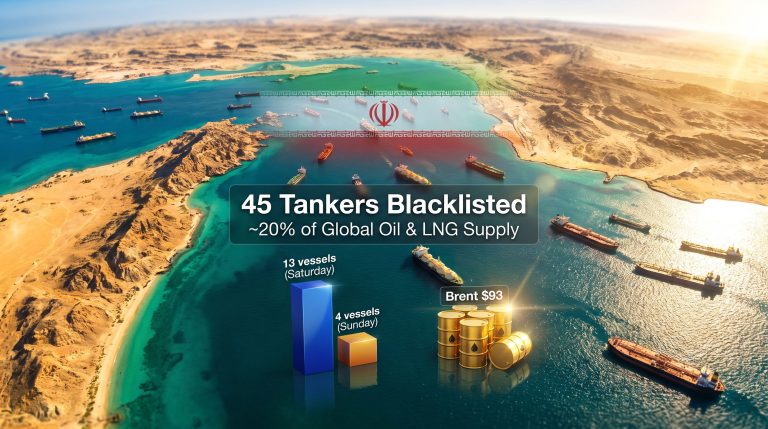
The Strait of Hormuz sits at the centre of this enforcement architecture. Roughly 20% of globally traded oil transits this single narrow passage between the Persian Gulf and the Gulf of Oman, making it the most consequential maritime chokepoint on earth. Its closure — or near-closure — does not merely affect Iran. It simultaneously constrains export flows from Saudi Arabia, the UAE, Kuwait, and Iraq, all of whom depend on Hormuz passage for the bulk of their seaborne crude shipments.
The cumulative data emerging from this enforcement operation illustrates just how rapidly physical blockade mechanics translate into quantifiable economic pressure:
| Metric | Pre-Blockade (March 2026) | Post-Blockade (April 13–25, 2026) |
|---|---|---|
| Iranian crude exports | ~23.4 million barrels/month | Est. ~4 million barrels cleared Gulf of Oman |
| Export volume decline | Baseline | Over 80% reduction |
| Tankers idling near Chabahar | Minimal | At least 10 confirmed via satellite imagery |
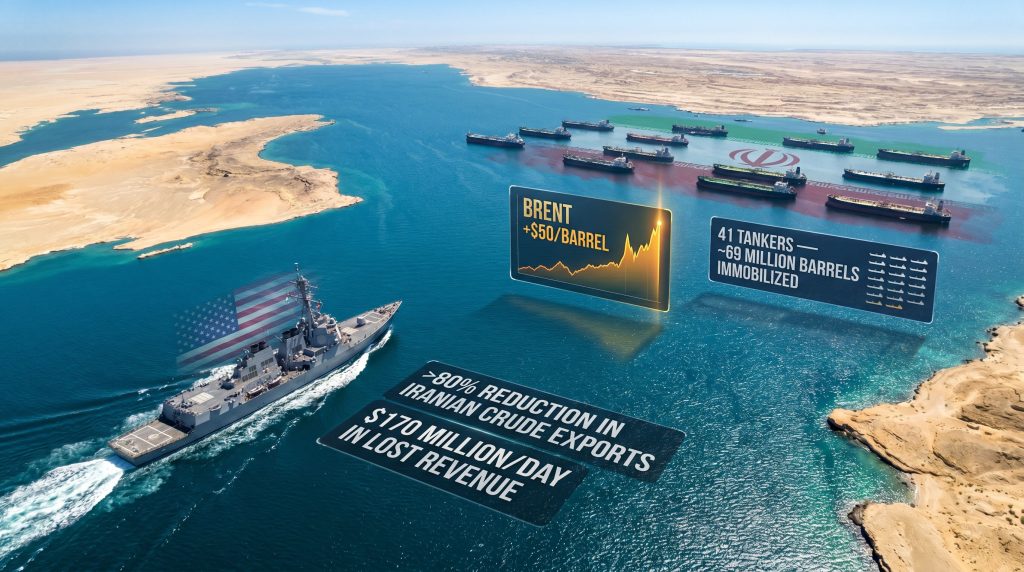
| Immobilised tanker fleet | N/A | 41 tankers carrying ~69 million barrels |
| Estimated daily revenue loss | N/A | ~$170 million/day |
| Onshore storage utilisation | Below threshold | ~60% full; over 50 million barrels held |
| Total onshore storage capacity | 86 million barrels | Approaching critical constraint |
Sources: Vortexa, LSEG, Kpler, CENTCOM, Reuters/Zawya, May 1, 2026.
CENTCOM publicly disclosed on April 30, 2026 that 41 tankers carrying approximately 69 million barrels of Iranian crude were currently immobilised — a figure that functions simultaneously as operational reporting and psychological pressure, signalling to Tehran that the blockade's scope is both measurable and expanding.
Iran's Export Infrastructure and Its Physical Breaking Points
The Kharg Island Concentration Risk
Iran's crude export architecture contains a singular vulnerability that makes it unusually susceptible to maritime interdiction: Kharg Island handles an estimated 90% of total Iranian crude export volume. This concentration of export capacity into a single terminal means that effective enforcement at the Gulf of Oman's exit creates a near-complete chokehold on Iranian oil revenues without requiring the blockade to cover multiple dispersed facilities.
Iran produced approximately 3.24 million barrels per day (bpd) in February 2026, according to Reuters reporting, with roughly half directed toward domestic refining. The remaining production — around 1.6 million bpd — represents the export volume that blockade enforcement is designed to deny. Maritime intelligence firm TankerTrackers confirmed via satellite imagery that loading operations at Kharg Island were continuing despite blockade conditions, revealing an important technical dynamic: upstream production operates with significant operational inertia and cannot be stopped instantaneously when export pathways are sealed.
The Storage Saturation Timeline
This is where the blockade's most underappreciated consequence emerges. When production continues but exports cease, crude accumulates in onshore storage infrastructure at an accelerating rate. Kpler's analytics confirmed that Iran's onshore storage stood at approximately 60% capacity by late April 2026, with stocks exceeding 50 million barrels against total infrastructure capacity of 86 million barrels.
These crude oil logistics constraints compound over time in ways that are difficult to reverse quickly.
Industry analysts at Kpler estimated that forced production curtailments could begin within one to two weeks of peak blockade enforcement, while energy consultancy FGE NextantECA projected mid-June 2026 as the point at which storage saturation would make output cuts structurally unavoidable.
The engineering reality underlying these projections deserves attention. Mature oil fields — and Iran's major producing fields average over four decades of operational history — face specific risks during forced shutdowns that extend well beyond any political resolution:
- Asphaltene deposition in wellbore tubing and surface facilities, requiring chemical treatment and mechanical cleaning before restart
- Formation damage from reservoir pressure imbalances during shut-in periods, potentially reducing long-term recovery rates
- Emulsion formation in pipeline infrastructure as crude cools and water-oil interfaces destabilise
- Wax crystallisation in pipelines operating below pour-point temperatures during low-flow conditions
Each of these phenomena adds cost and time to eventual production restoration, meaning the longer the blockade persists, the more expensive Tehran's recovery becomes regardless of when a diplomatic resolution is achieved.
Shadow Fleet Operations: Iran's Evasion Toolkit and Its Limits
Iran has spent more than a decade refining its capacity to move crude through channels that evade standard maritime surveillance. The blockade has not eliminated this capability, but it has materially degraded it. However, as trade war oil impact dynamics intensify globally, the pressure on these evasion channels is growing considerably.
How the Evasion Architecture Works
Iran's shadow fleet operations rely on a layered set of techniques:
-
AIS transponder deactivation — vessels disable their Automatic Identification System transponders, effectively disappearing from standard maritime tracking databases. However, satellite-based Synthetic Aperture Radar (SAR) and thermal imaging systems can still detect vessel signatures independent of transponder activity, making this technique imperfect against sophisticated enforcement.
-
Ship-to-ship (STS) transfers — Iranian crude is transferred between vessels in international waters beyond enforcement zones, with the receiving vessel typically flagged to a third-country jurisdiction. This physically separates the cargo from its Iranian origin, complicating interdiction authority.
-
Third-country port transshipment — cargo is routed through intermediary ports in jurisdictions with weaker sanctions enforcement frameworks, obfuscating the origin-to-destination chain before final delivery.
-
Obscure-flag vessels — tankers registered to jurisdictions with minimal maritime enforcement capacity and complex shell-company ownership structures are used to obscure cargo provenance and reduce flagging database correlation.
| Evasion Method | Short-Term Effectiveness | Detection Difficulty |
|---|---|---|
| AIS transponder deactivation | Moderate — SAR satellite still detects vessels | Medium |
| Ship-to-ship transfers | High — difficult to intercept in open water | High |
| Third-country transshipment | Medium — relies on compliant intermediaries | Medium–High |
| Obscure-flag vessels | Medium — cross-referenceable against registries | Medium |
The Measurement Gap: Where Vortexa and Kpler Diverge
A critically important analytical discrepancy exists in the blockade data. Vortexa estimated that approximately 4 to 4.6 million barrels of Iranian crude — valued at roughly $400 million — successfully moved through the Gulf of Oman during the April 13–25 enforcement window. Kpler, by contrast, reported observing no Iranian crude tankers exiting the Gulf of Oman since the blockade began.
This divergence is not a data quality failure — it reflects the genuine limits of tracking dark vessels using different satellite constellation assets and analytical methodologies. The gap between these two estimates illustrates a fundamental truth about blockade enforcement against a state with sophisticated evasion infrastructure: precise measurement of leakage is structurally impossible, and both the enforcing party's claims of near-total interdiction and independent trackers' lower-bound estimates carry inherent uncertainty.
The Global Oil Market Consequences: Beyond an Iran-Specific Shock
The US naval blockade of Iran oil exports has triggered a supply disruption that extends well past Tehran's export losses. The International Energy Agency characterised the combined impact as the largest single oil output disruption in recorded history — a designation that reflects the compound nature of the shock.
Brent crude futures rose by approximately $50 per barrel following the outbreak of the US-Iran conflict on February 28, 2026, according to Reuters reporting. Consequently, this price movement transmits directly into refined product markets — gasoline, diesel, and jet fuel — with typical 1-2 week lags, creating sustained consumer price inflation across every oil-importing economy. The oil price movements triggered by this disruption are unlike anything previously modelled in modern energy market scenarios.
The Temporary Sanctions Waiver: Tactical Adjustment or Strategic Retreat?
In April 2026, Washington granted Tehran a short-term sanctions waiver on energy exports, explicitly aimed at dampening the price escalation that Brent's $50/bbl surge had generated. This decision reveals the fundamental tension embedded in blockade strategy: maximum economic pressure on an adversary simultaneously imposes domestic political costs through elevated fuel prices.
The waiver signals that US policymakers identified a price tolerance threshold — a level of Brent pricing beyond which domestic political blowback outweighed the strategic benefits of unrelenting export denial. Its temporary framing indicates this is a pressure management tool, not a strategic concession.
The simultaneous closure of the Strait of Hormuz — affecting Saudi Arabian, Emirati, Kuwaiti, and Iraqi export flows alongside Iran's — transforms this from a bilateral enforcement action into a systemic Gulf energy disruption with global macroeconomic transmission.
The Domestic Iranian Economic Cascade
Currency Collapse as a Leading Indicator
Iran's currency, the rial, fell to a record low against the US dollar in late April 2026, reflecting financial markets pricing three interconnected risk dimensions simultaneously: immediate export revenue collapse from the 80%+ export reduction, medium-term foreign exchange reserve depletion from sustained daily losses, and long-term macroeconomic contraction from forced production curtailments.
At an estimated $170 million per day in foregone export revenue, a 30-day sustained blockade represents approximately $5.1 billion in lost income. This figure understates total financial damage by excluding:
- Idle tanker charter fees accumulating on immobilised vessels
- Storage infrastructure operating costs for 50+ million barrels of stranded crude
- Long-term reputational damage to Iran as a reliable supplier for Asian refinery customers
- Domestic refinery feedstock disruptions creating secondary gasoline shortages within Iran itself
The paradox of a crude-exporting nation simultaneously experiencing domestic fuel shortages stems from Iran's refinery configuration. As crude accumulates in onshore storage and export terminals, pipeline feedstock flows to domestic refineries can become disrupted by storage overpressure dynamics and tanker scheduling failures, creating refined product scarcity in parallel with crude oversupply.
The next major ASX story will hit our subscribers first
China's Position: The Geopolitical Fault Line
China absorbs the overwhelming majority of Iran's discounted crude exports, making Beijing the central third-party stakeholder in any extended blockade scenario. Some Iranian oil continues reaching Chinese refiners through shadow fleet channels, but at materially reduced volumes and significantly elevated logistics costs — costs that ultimately flow through to Chinese refinery margins and petrochemical feedstock pricing.
In addition, the broader US-China trade tensions add a further layer of complexity to Beijing's strategic calculus, as China must simultaneously manage supply disruption risk and diplomatic friction with Washington.
Three distinct trajectories define the range of possible outcomes for the China-Iran oil corridor:
Scenario A — Sustained Blockade with Partial Leakage
Iranian exports remain suppressed at 15-25% of pre-blockade levels through shadow fleet operations. China absorbs higher per-barrel logistics premiums; Iranian fiscal pressure intensifies toward production curtailment thresholds; Brent remains elevated above pre-conflict levels.
Scenario B — Negotiated Resolution with Partial Sanctions Relief
Iran accepts concessions — potentially including nuclear programme constraints — in exchange for blockade suspension. Iranian exports partially resume; Brent retreats from peak levels; Gulf Arab spare capacity acts as a natural price ceiling.
Scenario C — Escalation via IRGC Maritime Retaliation
Iranian Revolutionary Guard Corps attacks on US naval assets or regional shipping lanes deepen the Hormuz closure; the regional oil supply shock intensifies; global recession risk rises materially as energy markets price extended disruption duration.
The Nuclear Dimension: What the Blockade Is Actually Seeking
The US naval blockade of Iran oil exports functions as an integrated coercive instrument within a broader geopolitical negotiation framework — not purely as an energy policy tool. US demands extend beyond crude export cessation, encompassing comprehensive concessions related to Iran's nuclear enrichment programme.
Iran's counter-proposal — offering to ease Strait of Hormuz movement restrictions in exchange for blockade suspension — was rejected as insufficient, a public signal that Washington is using revenue denial as leverage for a comprehensive strategic settlement rather than accepting incremental confidence-building measures.
Pakistan has been reported as a potential diplomatic intermediary between Washington and Tehran, suggesting back-channel negotiations are occurring in parallel with escalating enforcement pressure. This dual-track approach — maximum physical coercion combined with diplomatic access — reflects a coercive diplomacy model rather than a strategy oriented purely toward economic destruction.
Stakeholder Risk Matrix: Who Bears the Greatest Exposure
| Stakeholder | Primary Risk | Severity |
|---|---|---|
| Iran (government) | Fiscal collapse, production shutdown, infrastructure damage | Critical |
| Iran (population) | Fuel shortages, currency devaluation, economic contraction | Severe |
| China | Disrupted crude supply, elevated import costs, diplomatic friction | Moderate–High |
| Gulf Arab producers | Hormuz closure limits their own export capacity | High |
| Global oil consumers | Elevated fuel prices, inflationary pressure | Moderate |
| US domestic | Gasoline price inflation, political blowback | Moderate |
| Global shipping | Tanker market distortion, floating storage cost escalation | Moderate |
A consequence that has received insufficient analytical attention is the infrastructure damage risk embedded in forced production shutdowns. Once Iran's storage capacity is exhausted and upstream wells are shut in, reservoir pressure management failures can permanently impair recovery rates in mature fields. This creates a structural asymmetry: the longer the blockade persists, the greater the long-term production capacity Iran sacrifices, paradoxically reducing Tehran's economic negotiating leverage in any eventual settlement even after enforcement is lifted.
Frequently Asked Questions
What is the US naval blockade of Iran and when did it begin?
The US naval blockade of Iranian ports and surrounding waters commenced on April 13, 2026, as part of a broader US military and economic pressure campaign following the outbreak of conflict on February 28, 2026. US forces have been intercepting, boarding, and redirecting vessels carrying Iranian crude cargo, with the blockade declared open-ended until a diplomatic agreement is reached.
How much has Iran's oil export volume fallen since the blockade began?
Shipping intelligence data from Vortexa indicates Iranian crude exports declined by more than 80% during the April 13–25, 2026 period compared to March 2026 levels, when Iran exported approximately 23.4 million barrels. Only an estimated 4 million barrels are believed to have successfully cleared the Gulf of Oman during the blockade's initial enforcement phase.
Is the blockade completely stopping Iranian oil exports?
No. Independent maritime tracking data indicates Iran has continued to move an estimated 4 to 4.6 million barrels through shadow fleet operations, including dark-running tankers and ship-to-ship transfers. The blockade is highly disruptive but not fully airtight, reflecting Iran's extensive experience with sanctions-evasion logistics built over more than a decade.
What happens if Iran runs out of oil storage capacity?
Once onshore storage — currently estimated at approximately 60% of its 86-million-barrel total capacity — reaches saturation, Iran will be physically compelled to curtail upstream crude production. Industry analysts estimate this threshold could be reached as early as mid-June 2026, with production cuts potentially causing permanent damage to well infrastructure if sustained beyond short-duration shut-in periods.
How has the blockade affected global oil prices?
Brent crude futures rose by approximately $50 per barrel following the onset of the US-Iran conflict in late February 2026. The IEA has described the resulting supply disruption as the largest in recorded history, driven by both the direct loss of Iranian crude and the effective restriction of Strait of Hormuz passage, which simultaneously constrains exports from Saudi Arabia, the UAE, Kuwait, and Iraq.
What is China's position on the blockade?
China, as Iran's primary crude buyer, is directly affected by the blockade's supply disruption. While some Iranian oil continues reaching Chinese refiners through covert logistics channels, volumes are materially reduced and costs are elevated. The situation creates ongoing geopolitical tension between US enforcement objectives and China's energy security interests, with the outcome of this tension representing one of the blockade's most consequential long-term uncertainties.
Disclaimer: This article contains forward-looking analysis, scenario projections, and third-party data estimates. All figures relating to export volumes, storage utilisation, and price movements are drawn from reporting by Reuters/Zawya (May 1, 2026) and attributed maritime analytics firms including Vortexa and Kpler. Scenario projections represent analytical frameworks, not confirmed outcomes. Readers should conduct independent research before drawing investment or strategic conclusions. Further regional energy market context is available via Zawya's Energy coverage at zawya.com/en/business/energy.
Want to Track the Market Impact of Major Geopolitical Disruptions on ASX Resource Stocks?
Discovery Alert's proprietary Discovery IQ model delivers real-time alerts on significant ASX mineral discoveries, instantly equipping investors to identify actionable opportunities even as global energy markets shift — explore historic examples of exceptional discovery returns or begin your 14-day free trial today to position yourself ahead of the broader market.