August 25, 2026
The Structural Paradox at the Heart of American Energy
Every major geopolitical disruption in modern history has forced the same uncomfortable question back onto Washington's agenda: should the United States restrict its own energy exports to protect domestic consumers? The pattern repeats with predictable regularity. A supply shock emerges, international prices spike, domestic fuel costs climb, and politicians on both sides of the aisle begin floating the idea of keeping American oil and gas at home.
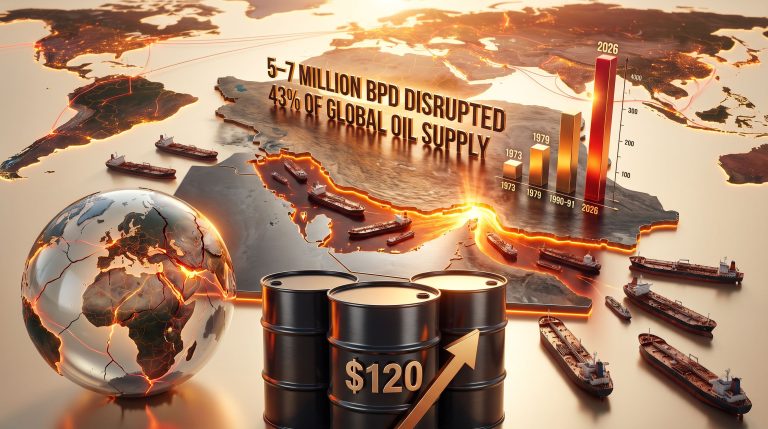
What makes the current episode distinctive is the scale of the disruption. The closure of the Strait of Hormuz has removed a substantial portion of globally traded petroleum from accessible markets. The resulting scramble for alternative supply has elevated U.S. crude exports to record levels, widened the price differential between domestic and international benchmarks to extraordinary magnitudes, and pushed fuel costs in states like California past $6 per gallon. The political pressure building around U.S. oil export restrictions is no longer theoretical.
Understanding why the debate is more complicated than it appears requires working through the actual mechanics of American energy production, refinery infrastructure, and global price arbitrage. The dynamics of oil trade geopolitics add further complexity, rather than the simplified narratives that tend to dominate political discourse.
When big ASX news breaks, our subscribers know first
America's Crude Paradox: World's Largest Producer, Structural Net Importer
The United States produced 13.6 million barrels per day (mbpd) of crude oil as of February 2026, according to the U.S. Energy Information Administration, making it the single largest crude-producing nation on earth. Russia, the second-largest producer, supplied approximately 9.9 mbpd as of December 2025. By raw production volume, the U.S. dominance is unambiguous.
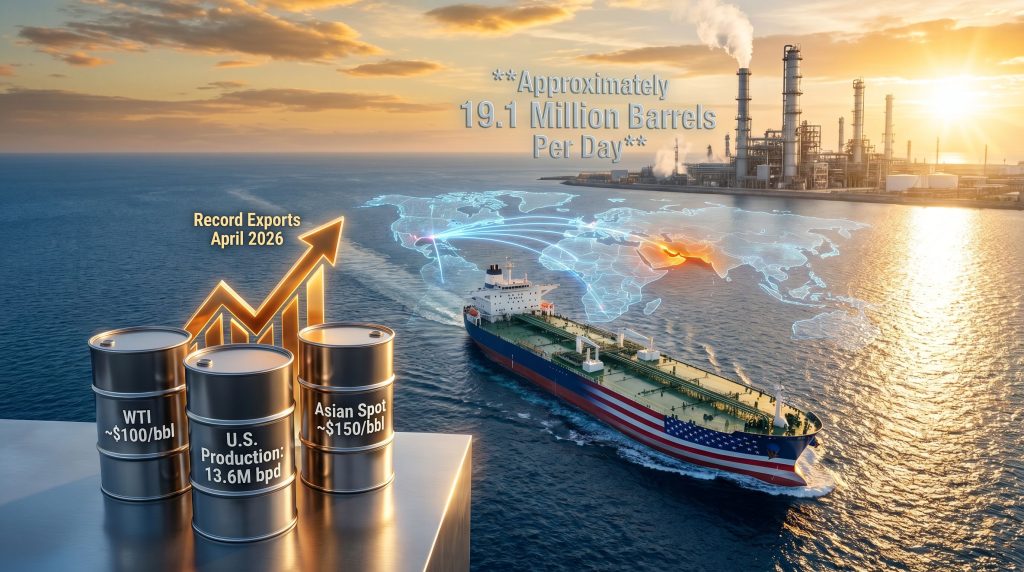
Yet American refineries processed approximately 21.1 mbpd of finished petroleum products as of late April 2026. Stripping out roughly 2 mbpd of natural gas plant liquids, which do not flow through the conventional petroleum refinery stream, leaves an adjusted throughput figure of approximately 19.1 mbpd. The arithmetic is straightforward: 13.6 mbpd of domestic crude production against 19.1 mbpd of refinery demand creates a structural shortfall of approximately 5.5 mbpd that must be filled from elsewhere, regardless of how much crude the U.S. exports.
That gap is covered through a combination of three sources:
- Crude oil imports from international suppliers
- Refinery gain, estimated by the EIA at approximately 6.3 percent of total throughput, equating to roughly 1.2 mbpd of volumetric expansion created during the refining process itself
- Ethanol, butane, and other chemical blendstocks mixed into finished fuels
The U.S. refinery system processes approximately 19.1 million barrels per day of petroleum products. Domestic crude production covers only 13.6 million barrels of that requirement. No volume of export restrictions changes this fundamental arithmetic without corresponding refinery reconfiguration.
This is the central paradox that policy discussions frequently overlook. America's "energy dominance" in production terms coexists with a structural dependence on imported crude that cannot be wished away through executive action or political messaging.
Why Refinery Configuration Is the Overlooked Variable
The quality mismatch between what American shale fields produce and what American refineries are configured to process is one of the least understood aspects of the domestic energy debate. The U.S. shale revolution predominantly generates light, low-sulfur crude oil. American refineries, however, were largely built and subsequently upgraded over decades to process heavier, higher-sulfur crude predominantly sourced from the Middle East, Mexico, and Venezuela.
This infrastructure gap means that if U.S. light crude exports were restricted, the surplus light oil would have nowhere productive to go domestically. Refineries configured for heavy crude cannot simply switch feedstocks without significant capital investment and operational disruption. The counterintuitive consequence of restricting light crude exports could therefore be reduced refinery throughput rather than increased domestic fuel production, potentially tightening, not loosening, the domestic supply of gasoline and diesel.
A Regulatory History: From 40-Year Ban to Open Markets
The current export framework did not emerge from a single philosophical commitment to free markets. It evolved through crisis, legislation, and the transformative economics of shale technology.
The 1975 Foundation and Its Exceptions
Following the 1973 Arab oil embargo, Congress enacted the Energy Policy and Conservation Act of 1975, which codified broad restrictions on crude oil exports. The intent was straightforward: preserve domestic supply during a period of acute scarcity and shield American consumers from international price volatility. The ban was not absolute, however. A structured set of exceptions permitted exports in specific circumstances:
- Alaskan North Slope crude oil
- Crude destined for specific Canadian supply arrangements
- Deliveries within U.S. territories
- California crude directed to Pacific Rim markets under particular conditions
These exceptions reflected political negotiation rather than policy principle, carving out commercially or strategically convenient pathways while maintaining the broader prohibition.
The Shale Revolution and the 2015 Legislative Shift
For four decades, the framework held. Then American shale production began scaling at a pace that fundamentally altered the domestic supply picture. By the early 2010s, U.S. producers were generating more light crude than domestic refineries could efficiently absorb, creating price discounts on domestic benchmarks and suppressing producer revenues.
On December 18, 2015, Congress lifted the 40-year export prohibition as part of an omnibus spending bill. The shale industry had successfully argued that restricting exports artificially penalised American producers, creating a structural disadvantage relative to foreign competitors who could sell freely on global markets.
The post-2015 framework flipped the regulatory logic entirely. Exports became permissible by default, requiring no licence except when trading with embargoed or sanctioned nations. The burden shifted from exporters proving compliance to trading partners being explicitly prohibited. According to EIA export data, this liberalisation triggered a sustained and dramatic rise in monthly crude export volumes.
What Emergency Powers Actually Allow
The question of whether a president can reimpose restrictions is frequently debated but rarely examined precisely. The legal architecture provides the following:
| Legal Instrument | Scope | Duration |
|---|---|---|
| Energy Policy and Conservation Act | Crude oil export restrictions | Up to 1 year under national emergency declaration |
| International Emergency Economic Powers Act (IEEPA) | Broader commodity controls, potentially including refined products | Flexible, subject to Congressional review |
| Export Administration Regulations | Licensing requirements for sanctioned nations | Ongoing, case-by-case |
The statutory language establishes that presidential authority to restrict crude exports exists but is time-limited and requires formal emergency declaration. Extending controls to refined petroleum products such as gasoline, diesel, and jet fuel would likely require invoking IEEPA, which carries broader reach but also greater legal and political complexity.
The Arbitrage Engine Driving Record Export Volumes
The mechanics driving U.S. crude exports to record levels in April 2026 are not regulatory failures or policy missteps. They are the predictable outputs of a functioning global commodity market operating under extreme supply stress.
When WTI crude trades at approximately $100 per barrel while physical crude for immediate delivery in Asian spot markets reaches approximately $150 per barrel, the economic incentive to load tankers in U.S. Gulf Coast ports and sail them to Asian buyers is overwhelming. The $50 per barrel differential easily covers tanker freight costs, financing, and insurance, leaving substantial margin for commodity traders.
The global price environment as of early May 2026 illustrates the scale of the dislocation:
| Benchmark | Approximate Price Level | Primary Driver |
|---|---|---|
| WTI Crude (U.S.) | ~$102/bbl | Domestic benchmark, partially buffered by SPR releases |
| Brent Crude | ~$110/bbl | Global benchmark incorporating war risk premium |
| WTI Midland | ~$105/bbl | Premium U.S. export grade |
| OPEC Basket | ~$121/bbl | Blended producer pricing amid supply scarcity |
| Asian Spot Market (early April) | ~$150/bbl | Hormuz closure-driven scarcity premium |
Source: OilPrice.com live market data, May 4, 2026. Prices are indicative and subject to continuous change.
The self-reinforcing nature of this dynamic deserves emphasis. As U.S. crude exits domestic markets toward higher-paying international buyers, domestic supply tightens. Tighter domestic supply pushes WTI prices upward. Rising WTI narrows, but does not eliminate, the arbitrage differential. The export incentive persists until either international prices fall or domestic prices rise sufficiently to close the gap. Furthermore, OPEC's market influence during this period has amplified the pressure on global benchmarks, leaving the arbitrage window stubbornly wide.
The LNG Dimension: A Parallel Crisis
The crude oil debate cannot be fully separated from the LNG export question, which follows a structurally similar logic. The United States holds the position of the world's largest LNG exporter. The Hormuz closure has removed approximately 20 percent of global LNG supply from accessible markets, dramatically amplifying demand for American cargoes. In addition, the LNG supply outlook for 2025 and beyond had already pointed toward tightening global balances before the current crisis emerged.
The precedent for LNG export liberalisation is instructive. Domestic natural gas producers successfully secured the right to unlimited exports by arguing that natural gas should be treated as any other American commercial good, freely available to the highest international bidder. The industry understood precisely what it was pursuing: by linking domestic prices to higher international benchmarks, export rights would structurally elevate domestic producer revenues. American consumers would pay more; American producers would earn more.
Consequently, U.S. natural gas prices have come under significant upward pressure as international demand draws volumes away from domestic markets. The current crisis has activated that dynamic at scale.
What Export Restrictions Would and Would Not Achieve
The political appeal of U.S. oil export restrictions rests on an intuitive logic: if American crude stays in America, American consumers should pay less. The structural reality is considerably more complicated.
Energy Secretary Chris Wright's position, as documented in May 2026, was unambiguous. The administration has confirmed it is not studying an export ban, with stated intentions to grow American exports across crude oil, LNG, jet fuel, diesel, and gasoline. The administration's posture treats export volume as a marker of economic and geopolitical strength.
What would actually happen if restrictions were imposed? Energy analysts broadly outline the following transmission pathway:
| Impact Category | Expected Outcome |
|---|---|
| Domestic crude price | Possible short-term decline for light crude specifically |
| Refinery throughput | Likely reduction due to crude quality mismatch |
| Domestic fuel prices | Risk of increase from reduced refinery output |
| Global oil prices | Probable rise as U.S. supply exits international markets |
| U.S. import costs | Higher, as global benchmarks rise without U.S. supply pressure |
| Allied energy security | Weakened; European and Asian allies face tighter supply |
| Adversary market access | Expanded; Russia and Iran gain leverage in Asian markets |
Critical Warning: The structural incompatibility between U.S. light crude production and U.S. heavy crude refinery configuration means that restricting exports does not automatically translate into increased domestic fuel supply. Refineries that cannot efficiently process light crude would face operational constraints rather than expanded throughput opportunities.
Furthermore, as analysts at the Columbia University Centre on Global Energy Policy have noted, restricting U.S. oil exports would likely backfire by raising global prices and undermining the very supply security the policy seeks to protect. Both the Biden administration following Russia's 2022 invasion of Ukraine and various Trump-era policy reviews examined export restriction options without enacting them. The analytical conclusions in each case pointed toward the same counterproductive outcomes. The trade war oil markets dynamic has historically produced similar unintended consequences, reinforcing why blunt export controls tend to disappoint policymakers.
How Other Nations Are Responding: The Hoarding Reflex
The instinct to restrict energy exports during supply crises is not unique to American political debate. China has directed its refiners to halt fuel exports amid the global market squeeze, while Thailand suspended its oil exports and tightened monitoring protocols following escalation of the Middle East conflict.
The distinction between China's approach and the U.S. policy debate is important to preserve analytically. China's directive reflects sovereign resource management during acute uncertainty, a precautionary measure by a country that is a net energy importer seeking to protect domestic supply. Thailand's suspension reflects similar import-dependent vulnerability management.
The United States, by contrast, is debating whether to restrict exports of commodities it produces in surplus, which is a fundamentally different policy question. The consequences of U.S. restriction would extend well beyond American borders in ways that China's actions do not.
Southeast Asia's emerging petroleum security pact, reported in late April 2026, reflects the regional anxiety generated by supply chain fragility. Nations across the Indo-Pacific are reconsidering their energy security architectures precisely because they have become over-reliant on Hormuz-transiting supply chains. This regional vulnerability increases the strategic value of U.S. exports as an alternative supply source, simultaneously strengthening the geopolitical argument against American restrictions.
Strategic Risk: Any U.S. decision to restrict crude or LNG exports would create immediate market vacuums across European and Asian import markets. Russia's oil revenues are already surging as the world scrambles for alternative supply. Reducing U.S. export volumes would expand the market space available to suppliers operating outside Western sanctions architecture.
The next major ASX story will hit our subscribers first
The Political Threshold Question: At What Price Does Public Pressure Become Irresistible?
The most honest assessment of whether U.S. oil export restrictions will eventually be imposed is not an economic one. It is a political one. The question is not whether restrictions would work as intended; analysts broadly conclude they would not. The question is at what domestic fuel price level public discontent becomes legislatively irresistible.
California retail gasoline exceeding $6 per gallon in late April 2026 provides an early data point. Pakistan's Prime Minister, citing a 167 percent increase in oil import costs since the Iran War began, illustrates the extreme endpoint of what import-dependent economies face. While the U.S. is insulated from that degree of vulnerability by its domestic production capacity, the directional pressure on American consumer fuel costs is clearly upward.
The four realistic policy pathways forward carry distinct risk profiles:
- Status quo continuation: Exports remain unrestricted, domestic prices continue rising, the U.S. maintains its credibility as the world's swing supplier during the Hormuz crisis
- Targeted export licensing: Selective licensing for specific grades or destinations, reviving elements of the pre-2015 exception-based framework with limited consumer price impact
- Emergency export suspension: Presidential emergency authority invoked, domestic crude prices potentially decline, refined product shortages emerge, allied relationships damaged
- LNG-specific restrictions: Separate regulatory architecture applied to natural gas exports, complicated by long-term supply contracts with allied nations
Each pathway involves genuine trade-offs between domestic consumer relief and geopolitical positioning, and none delivers the clean consumer benefit that political rhetoric typically promises.
Frequently Asked Questions: U.S. Oil Export Restrictions
Can the U.S. President legally reimpose crude oil export restrictions?
Yes. Under the Energy Policy and Conservation Act, the President retains authority to reimpose crude oil export restrictions for up to one year through a national emergency declaration. Broader authority under IEEPA may extend to refined petroleum products, though this would face significant legal and political scrutiny.
How did the U.S. end up with unrestricted crude oil exports?
Congress lifted the 40-year export prohibition on December 18, 2015, embedded within an omnibus spending bill. The shale revolution had created a surplus of domestic light crude that U.S. refineries could not efficiently absorb, generating producer pressure to access higher international prices.
Would restricting exports actually lower gasoline prices?
The analytical consensus suggests the effect would be limited or counterproductive. Because U.S. refineries are largely configured for heavy imported crude rather than domestic light oil, a domestic light crude surplus would constrain refinery throughput rather than increase fuel output. Third Way's analysis of this issue similarly concludes that banning oil or gas exports would be a bad idea with few meaningful consumer benefits.
How significant is the current price differential driving exports?
Physical crude oil for immediate delivery in Asian markets reached approximately $150 per barrel in early April 2026, while WTI traded near $100 per barrel. This $50 differential is extraordinary by historical standards and creates powerful commercial incentives that administrative messaging alone cannot overcome.
What is the Strategic Petroleum Reserve's role in this situation?
SPR releases can temporarily shift the U.S. into net crude export status, but engineering and legal constraints establish minimum storage thresholds for cavern structural integrity. SPR drawdowns cannot continue indefinitely and cannot substitute for a durable long-term export policy framework.
Disclaimer: This article is intended for informational and educational purposes only. It does not constitute financial, investment, or legal advice. Commodity price data is indicative and subject to rapid change. Readers should consult qualified professionals before making any investment or policy-related decisions.
Want to Stay Ahead of the Next Major ASX Mineral Discovery?
While global energy markets navigate extraordinary supply disruptions, Discovery Alert's proprietary Discovery IQ model delivers real-time alerts on significant ASX mineral discoveries — instantly converting complex data across 30+ commodities into clear, actionable insights for both traders and long-term investors. Explore historic discoveries and their remarkable returns, then begin your 14-day free trial at Discovery Alert to position yourself ahead of the market.