
May 16, 2026
The Structural Economics Behind US Oil Refiners Profit From Biofuels Mandates
Renewable fuel economics have always been cyclical, but cycles tend to be shaped less by market forces than by the regulatory architecture surrounding them. When governments encode blending obligations into law, they do not simply nudge demand — they manufacture a compliance-driven floor beneath which demand cannot fall regardless of prevailing spot prices. That fundamental mechanism is precisely what has transformed the US biofuel sector in 2026, with US oil refiners profit from biofuels mandates converting what was a prolonged margin destruction story into one of the more striking refinery profit recoveries in recent memory.
Understanding why this reversal is happening now, and whether it can last, requires examining the architecture of the US Renewable Fuel Standard, the credit markets it generates, the feedstock chains that supply it, and the geopolitical forces that continue to complicate the picture. Furthermore, broader commodity market volatility and crude oil price trends play an important role in shaping the overall commercial environment in which these dynamics unfold.
When big ASX news breaks, our subscribers know first
Why the EPA's 2026 Mandate Escalation Represents a Structural Break
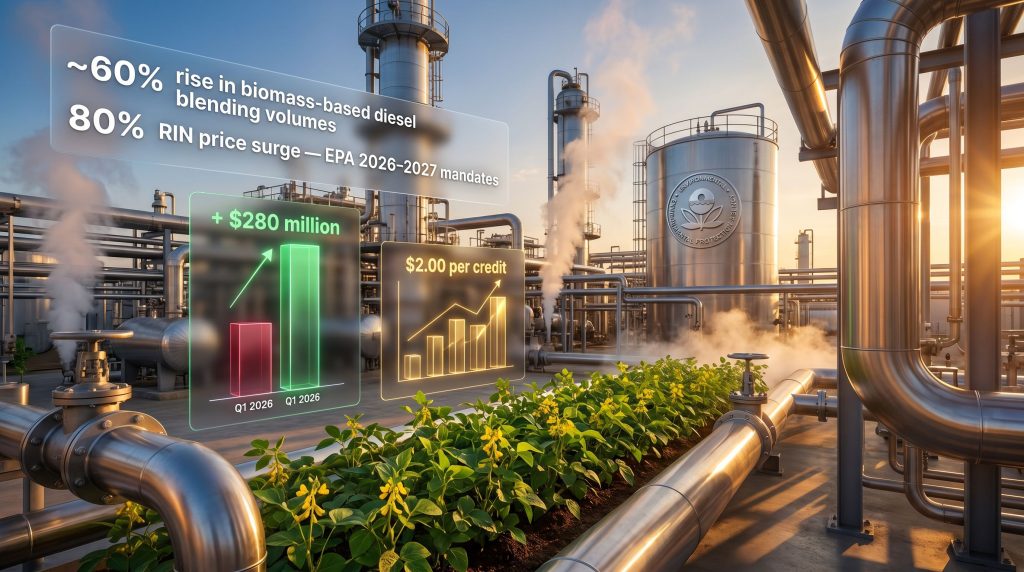
In late March 2026, the US Environmental Protection Agency finalised blending requirements for 2026 and 2027 that represented a qualitative departure from previous years. Rather than incremental adjustments, the new rules mandated a roughly 60% increase in required biomass-based diesel blending volumes, layered on top of the longstanding obligation to blend approximately 15 billion gallons of corn-based ethanol annually into the nation's gasoline supply. The two-year coverage window of the ruling was itself significant, offering producers something the sector had chronically lacked: forward visibility.
| Mandate Component | Detail |
|---|---|
| Biomass-based diesel requirement | ~60% increase in required blending volumes |
| Ethanol blending target | ~15 billion gallons per year |
| Policy coverage period | 2026 and 2027 |
| Regulatory authority | U.S. Environmental Protection Agency (EPA) |
| Primary compliance mechanism | Renewable Identification Numbers (RINs) |
The combination of a steep volume increase and multi-year certainty is not a minor policy calibration. It effectively redefined the commercial risk profile of US biofuel production, and markets responded accordingly.
How the RIN Credit Market Creates Refinery Revenue From Compliance
The Mechanics of Renewable Identification Numbers Explained
Most discussions of biofuel policy focus on blending volumes and feedstock costs. Far less attention is typically paid to the secondary credit market that sits at the centre of how US oil refiners profit from biofuels mandates, yet this mechanism is arguably the most important financial lever in the entire system.
Every gallon of qualifying biofuel blended into the fuel supply generates a Renewable Identification Number. These RINs function as tradable compliance credits. Refiners that exceed their blending obligations accumulate surplus credits, while those unable to blend sufficient volumes are legally required to purchase credits from the open market to satisfy their obligations under the Renewable Fuel Standard.
RINs are not merely compliance tools. For refiners with the infrastructure to over-blend, they represent a direct, recurring revenue stream whose value scales with mandate stringency and market tightness.
The two primary RIN categories relevant to current market dynamics are:
- D4 credits, generated through biodiesel and renewable diesel blending
- D6 credits, generated through corn-based ethanol blending
- Both categories saw price surges exceeding 80% in 2026, reaching above $2.00 per credit, according to LSEG data
The key insight here is that higher mandates compress the available pool of credits relative to compliance demand, which mechanically forces prices upward. This is not a market anomaly — it is the designed behaviour of a scarcity-based compliance architecture. When the EPA raises volume obligations, it does not simply create more demand for biofuels. It simultaneously tightens the credit market, amplifying the revenue benefit for over-blending refiners and raising the cost of non-compliance for those without sufficient blending infrastructure.
How Credit Scarcity Reinforces Demand Floors
A seldom-discussed dynamic in the RIN market is the relationship between small refinery exemptions and aggregate market tightness. When the EPA grants exemptions to smaller operators, the compliance volume that those refiners would have had to satisfy is effectively removed from the market demand side. If that removed obligation is not reallocated to other obligated parties, the total compliance demand for RINs decreases, which suppresses credit prices.
Conversely, when the EPA reduces the number or scale of exemptions, previously sheltered volume returns to the obligation pool, tightening the market and supporting RIN prices. This makes the EPA's small refinery exemption policy a secondary but consequential lever on RIN valuations — one that large integrated refiners monitor closely because it directly affects the premium they can realise on surplus credits.
Financial Performance: What the Numbers Reveal
The financial impact of the mandate escalation became visible almost immediately in first-quarter 2026 earnings. The year-on-year swings in renewable fuel divisions at major US refiners were not marginal improvements — they were structural reversals.
| Refiner | Q1 Prior Year Result | Q1 2026 Result | Year-on-Year Swing |
|---|---|---|---|
| Valero Energy | -$141 million loss | +$139 million profit | +$280 million |
| HF Sinclair | -$17 million loss | +$133 million profit | +$150 million |
| Phillips 66 | Significant loss | Substantially narrowed loss | Improving trajectory |
Valero, which operates as the largest biofuel producer in the United States, also reported that profits from its ethanol division more than quadrupled over the same period. Phillips 66 disclosed that its renewable diesel processing facilities were running above nameplate capacity as of early 2026, reflecting a level of operational intensity the sector had not seen during the preceding downturn years.
The scale of these swings highlights a structural advantage held by large integrated refiners. These companies built or acquired biofuel infrastructure during the expansion cycle of 2019 to 2023 and, despite absorbing significant losses during the subsequent oversupply period, retained the physical capacity to generate surplus RINs at scale when mandate conditions turned favourable. Smaller operators who did not make those capital commitments are now net buyers in the RIN market rather than net sellers.
The Boom-Bust Cycle That Preceded the 2026 Recovery
The current profitability environment did not emerge from a stable baseline. Between 2019 and 2023, renewable diesel capacity in the United States expanded at an aggressive pace, driven by a combination of favourable federal tax credits, state-level low carbon fuel standard premiums in California, and producer optimism about long-term biofuel demand growth. However, production capacity grew faster than mandated demand, and when federal policy signals became ambiguous, the resulting oversupply crushed margins across the sector.
By 2024, the consequences were stark:
- Chevron idled two biodiesel production facilities in the US Midwest, citing sustained unfavourable market conditions
- Vertex Energy suspended renewable diesel operations at its Mobile, Alabama refinery and reverted to conventional fossil fuel processing
- Multiple smaller producers exited the market entirely or placed expansion plans on indefinite hold
These retreats were not simply business failures. They revealed an important structural truth about the renewable fuel sector: capital commitments in biofuel infrastructure are highly sensitive to policy continuity. When mandate trajectories are uncertain or when exemptions are broad, the investment case for building new capacity deteriorates rapidly regardless of underlying technology costs. The 2024 wave of capacity idling was as much a response to regulatory ambiguity as it was to market oversupply.
Key Risk Factors That Could Undermine the Profit Recovery
The Soybean Oil Constraint
Renewable diesel and biodiesel production in the United States is heavily dependent on vegetable oil feedstocks, with soybean oil representing the dominant input. This creates a supply chain vulnerability that mandate strength alone cannot resolve.
Strong biofuel blending demand is already pulling soybean oil into the fuel supply at elevated volumes. Simultaneously, spring maintenance cycles at soy crushing facilities periodically constrain the supply of processed oil, creating temporary price spikes. If those price spikes persist — or if agricultural supply conditions deteriorate due to weather events or export demand surges — feedstock inflation can erode refinery margins even in a strong mandate environment.
The economic logic is straightforward: RIN revenue improves realised prices on the output side of the production equation, but if input costs rise at a faster rate, the net margin benefit diminishes. Traders and market analysts have flagged this feedstock cost dynamic as the most immediate risk to the sustainability of the current profit cycle.
When Conventional Diesel Outcompetes Renewable Alternatives
A second, less frequently discussed risk involves the competition between renewable diesel and conventional diesel production within flexible refinery systems. Geopolitical disruptions affecting global crude and diesel supply — including the price effects associated with trade war oil impact and broader supply shocks — pushed conventional diesel prices up by approximately 46% in the relevant period, according to reporting sourced from Reuters via ETEnergyworld.
When conventional diesel margins spike sharply due to geopolitical supply disruptions, refiners with flexible processing infrastructure face a genuine economic incentive to maximise fossil diesel output over renewable diesel, even where biofuel mandates remain in force. This creates a structural tension between policy compliance and short-term profit optimisation, as noted by Arif Gasilov, a partner at sustainability and ESG consulting firm Gasilov Group.
This tension is real and underappreciated. Biofuel mandates impose a compliance floor on blending volumes, but they do not fully prevent refiners from rationally reallocating incremental processing capacity toward higher-margin conventional products during periods of fuel price dislocation. The mandate ensures a minimum level of biofuel output, but it does not guarantee that biofuel production will be maximised when the economics of conventional refining are exceptionally strong.
The next major ASX story will hit our subscribers first
The Stakeholder Landscape: Who Wins, Who Loses, and Who Pays
The economics of US biofuel mandates distribute costs and benefits unevenly across the supply chain. Understanding this distribution is essential for assessing the political durability of the current policy architecture, particularly given the ongoing US tariff impacts that are reshaping cost structures across multiple industries simultaneously.
| Stakeholder Group | Mandate Impact | Primary Concern |
|---|---|---|
| Large integrated refiners | Net beneficiary via RIN credit sales | Capital allocation certainty for new capacity |
| Small and independent refiners | Higher net compliance costs | Profitability and retail price pass-through |
| Biofuel producers | Guaranteed demand floor, stronger pricing power | Feedstock cost inflation |
| Agricultural sector (soy, canola) | Higher crush margins and oil demand | Supply chain capacity constraints |
| Consumers | Potential retail fuel price increases | Pump price affordability |
Small and independent refiners occupy a particularly challenging position. Without the blending infrastructure of their larger peers, they are structural buyers of RIN credits. When mandate volumes rise and RIN prices increase, their compliance costs escalate without a corresponding revenue offset. This dynamic creates recurring political pressure for small refinery exemptions and has historically been a source of significant friction between the refining industry and agricultural interests, which benefit from the guaranteed demand that mandates create for their crops.
Global Comparison: How the US RFS Differs From International Blending Frameworks
The US Renewable Fuel Standard is architecturally distinct from the biofuel policy frameworks used in other major economies, and those differences have real implications for the profit opportunities it creates.
| Country/Region | Mandate Mechanism | Key Feedstock | Blending Target |
|---|---|---|---|
| United States | RFS plus tradable RIN credits | Corn ethanol, soybean oil | ~15 billion gallons ethanol plus escalating biodiesel |
| European Union | Renewable Energy Directive (RED III) | Waste oils, advanced biofuels | 14.5% of transport energy by 2030 |
| Brazil | RenovaBio decarbonisation credits | Sugarcane ethanol | Decarbonisation credit-based system |
| India | National Biofuel Policy | Sugarcane, agricultural residues | 20% ethanol blending target by 2025 |
The RIN trading mechanism is a distinctly American construct. Most international frameworks impose blending obligations but do not create the same type of liquid secondary credit market that allows over-compliant refiners to monetise excess blending. This is why the profit dynamics observed at Valero, HF Sinclair, and Phillips 66 are difficult to replicate under European or Brazilian policy structures, even where blending mandates are comparably ambitious.
Scenario Projections: Three Pathways for the US Renewable Fuel Sector
Whether the current profit cycle represents a durable structural shift or a temporary confluence of favourable conditions depends on how several interdependent variables evolve. Three plausible scenarios bracket the range of outcomes:
Scenario 1: Policy Continuity With Stable Feedstock Costs
The EPA maintains its blending trajectory through 2027 and beyond. Soybean oil supply normalises as crush capacity expands in response to elevated crush margins. RIN prices remain elevated but stable. In this scenario, large integrated refiners sustain profitability in renewable fuel divisions and begin committing capital to modest capacity expansions.
Scenario 2: Feedstock Inflation Erodes Margin Recovery
Soybean oil prices spike due to a combination of export demand competition, agricultural supply shocks, and crush capacity bottlenecks. Input cost inflation outpaces RIN revenue gains, compressing margins despite strong mandate volumes. Capital investment hesitancy returns, similar to patterns observed in 2023 and 2024.
Scenario 3: Geopolitical Disruption Accelerates Fossil Fuel Prioritisation
Prolonged conventional diesel price elevation driven by supply disruptions creates sustained economic incentives for refiners to redirect flexible processing capacity toward conventional products. Biofuel production meets compliance minimums but does not expand. The mandate creates a floor, not a growth catalyst. In this context, the oil price rally dynamics observed in recent months become a direct headwind to renewable fuel margin expansion.
The critical distinction between the current profit cycle and previous boom periods is the presence of multi-year regulatory certainty. Historically, policy ambiguity — not market conditions — was the primary deterrent to long-term capital commitment in renewable fuel infrastructure. According to Geoff Moody, senior vice president of government relations and policy at the American Fuel and Petrochemical Manufacturers, whether the current environment proves to be a sustained shift will ultimately depend on how these variables evolve over time.
Frequently Asked Questions: US Oil Refiners and Biofuel Mandate Profits
What are biofuel mandates and how do they affect oil refiner profits?
Biofuel mandates require refiners to blend specified volumes of renewable fuels into their products each year. When refiners exceed these requirements, they generate tradable RIN credits that can be sold to other obligated parties, creating a direct revenue stream that improves overall profitability.
Why did US refiners lose money on renewable fuels before 2026?
Rapid capacity expansion between 2019 and 2023 created an oversupply of renewable diesel at a time when policy signals were ambiguous and demand growth was slower than anticipated, resulting in sustained margin compression.
What is a RIN credit and how does it generate revenue for refiners?
A RIN is a tradable compliance credit issued for each gallon of qualifying biofuel blended. Refiners that blend more than their legal minimum can sell surplus RINs to those that cannot meet their obligations, generating income proportional to blending volumes and prevailing credit prices.
Which types of refiners benefit most from higher biofuel blending requirements?
Large integrated refiners with existing biofuel infrastructure are the primary beneficiaries. They can generate surplus RINs at scale and absorb feedstock cost volatility more effectively than smaller independent operators.
Can diesel price spikes undermine the profitability of renewable fuel production?
Yes. When conventional diesel margins are unusually high, refiners with flexible processing capacity may rationally redirect throughput away from renewable diesel toward conventional output, particularly when the incremental margin from conventional production exceeds the combined value of renewable diesel output plus RIN credits.
What feedstocks are most critical to US biodiesel and renewable diesel production?
Soybean oil is the dominant feedstock, followed by canola oil and waste fats and oils. The cost and availability of these inputs are the primary variable cost drivers for renewable diesel margins. Furthermore, the commodity market volatility affecting agricultural inputs adds an additional layer of uncertainty for producers reliant on these supply chains.
Are higher biofuel mandates likely to raise consumer fuel prices?
Higher RIN compliance costs for non-blending or under-blending refiners can be passed through to retail fuel prices, though the magnitude depends on competitive market dynamics and the extent to which compliance costs are absorbed versus transferred. Reporting from Reuters has highlighted that new biofuel quotas may in fact worsen price spikes during periods of geopolitical tension.
How do small refinery exemptions affect the overall mandate compliance market?
When the EPA grants exemptions to small refiners, it reduces the aggregate compliance demand for RIN credits, which can suppress credit prices and reduce the revenue benefit for large over-blending refiners. The scope of these exemptions is therefore a consequential secondary variable in RIN market dynamics.
Key Takeaways
- The EPA's 2026 to 2027 mandate requiring a ~60% increase in biomass-based diesel blending created a structural demand floor that reversed years of margin erosion for major US refiners
- RIN credit prices surging over 80% to above $2.00 per credit (LSEG data) represent a direct revenue mechanism for over-blending refiners operating within the compliance credit market
- Year-on-year profit swings exceeded $280 million at Valero and $150 million at HF Sinclair, signalling a sector-wide structural reversal rather than isolated corporate outperformance
- Soybean oil feedstock inflation and the competitive pull of conventional diesel production during geopolitical price spikes represent the two primary threats to sustained profitability
- The presence of multi-year regulatory certainty is the single most important distinguishing feature of the current cycle compared to previous boom periods, yet whether this translates into durable new capacity investment remains the defining unanswered question for the sector's long-term trajectory
Disclaimer: This article contains forward-looking scenario analysis and market commentary that involves assumptions about future regulatory, commodity, and geopolitical conditions. These scenarios are not investment advice and should not be relied upon as predictions of future performance. Readers should conduct independent due diligence before making any investment or business decisions related to the US biofuel sector.
Want To Stay Ahead of the Next Major Commodity Discovery?
While regulatory shifts in the US biofuel sector illustrate how policy-driven demand floors can generate substantial returns, the same principle of acting early on structural opportunities applies directly to mineral discovery investing — and Discovery Alert's proprietary Discovery IQ model scans ASX announcements in real time to deliver instant alerts on significant finds, ensuring subscribers can act before the broader market catches on. Explore how major mineral discoveries have historically generated exceptional returns on Discovery Alert's dedicated discoveries page, and begin a 14-day free trial to position yourself at the forefront of the next transformative opportunity.