May 20, 2026
The Enforcement Architecture Behind U.S. Sanctions on Iranian Oil Exports
Global oil markets have always been shaped as much by legal architecture as by geology or logistics. The enforcement mechanisms that govern which barrels can move, through which vessels, and via which financial channels are as consequential to crude pricing as any OPEC production decision. Nowhere is this more visible than in the evolving structure of U.S. sanctions on Iranian oil exports, a system that has grown from a set of bilateral trade restrictions into one of the most complex multilateral enforcement frameworks in modern energy history.
Understanding how this system actually works, and where it demonstrably fails, is increasingly essential for energy market participants, compliance professionals, and investors with any exposure to global crude or petrochemical flows. Furthermore, OPEC's market influence intersects directly with these enforcement dynamics, creating compounding price effects across global supply chains.
When big ASX news breaks, our subscribers know first
How the Legal Framework for U.S. Iran Sanctions Actually Functions
The foundation of U.S. authority to restrict Iranian oil trade rests primarily on the International Emergency Economic Powers Act (IEEPA), which grants the executive branch broad powers to regulate commerce with foreign nations during declared national emergencies. This authority flows through a series of Executive Orders and is administered day-to-day by the Treasury Department's Office of Foreign Assets Control (OFAC), which maintains the Specially Designated Nationals (SDN) list, issues general licences, and enforces compliance across the U.S. financial system.
The enforcement architecture is not a simple on/off switch. It operates across two distinct but interconnected layers:
- Primary sanctions apply to U.S. persons and institutions, prohibiting them from engaging in virtually any transaction involving Iranian energy, financial services, or designated entities.
- Secondary sanctions extend enforcement reach globally, allowing the U.S. to penalise non-American banks, shipping companies, refineries, and trading firms that engage with sanctioned Iranian entities, even where no U.S. dollar or U.S. person is involved.
This secondary sanctions layer is what gives the U.S. its outsized influence over Iranian oil flows despite not being a direct participant in those transactions. It creates compliance obligations for institutions in Europe, Asia, and the Middle East that have no direct link to the U.S. but maintain correspondent banking relationships or trade finance operations that could indirectly touch Iranian energy revenues. For broader context, the sanctions on oil trading landscape illustrates how these secondary mechanisms operate across multiple sanctioned producers simultaneously.
The Policy Spectrum: Waivers, Designations, and Maximum Pressure
U.S. Iran sanctions policy has never operated at a single fixed intensity. Administrations have oscillated between granting Significant Reduction Exceptions (SREs) that allowed specific countries to continue purchasing reduced volumes of Iranian crude, issuing temporary OFAC general licences for individual cargo transactions already in transit, and deploying full-scale enforcement campaigns designed to drive Iranian exports toward zero.
In early 2026, a narrow 30-day general licence was issued authorising a limited Iranian oil delivery that was already loaded and in transit. Legally, this type of authorisation is highly specific, covering a defined transaction window and not constituting a broader policy shift toward sanctions relief. Market observers should not interpret temporary cargo authorisations as signals of diplomatic thaw unless accompanied by broader policy statements.
The current posture, operating under what U.S. Treasury Secretary Scott Bessent has described as the "Economic Fury" doctrine, represents a sustained, multi-vector enforcement campaign targeting not only vessels but the financial intermediaries, exchange houses, and front company networks that sustain Iranian oil revenue generation.
Policy Framework Note: U.S. sanctions on Iranian oil exports are not binary. The enforcement system operates on a spectrum from narrow, time-limited cargo waivers to broad SDN designations, making compliance risk highly situational for international counterparties at every point in the supply chain.
The May 2026 OFAC Action: Scope, Targets, and Legal Significance
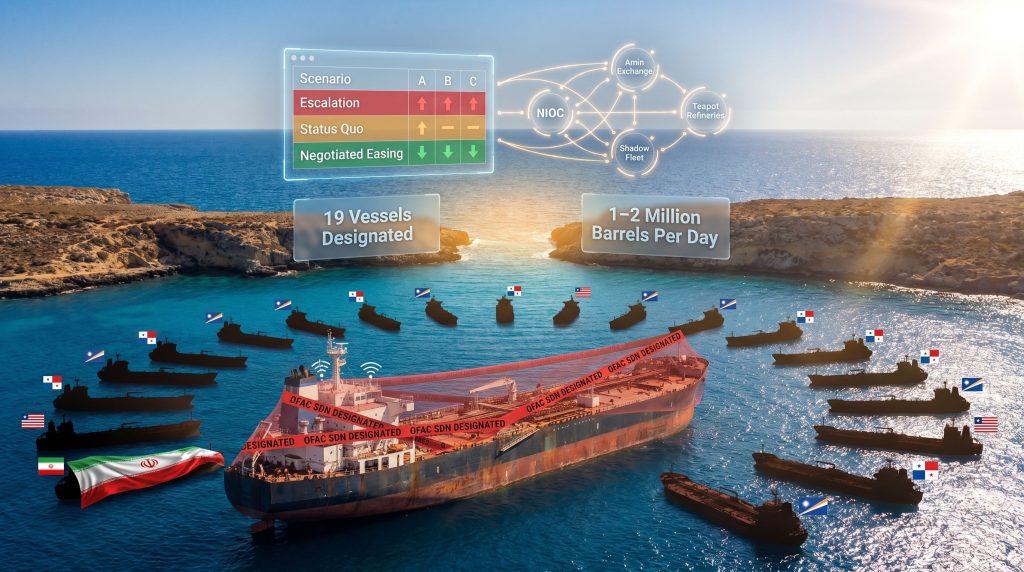
In May 2026, OFAC announced the designation of 19 vessels alongside a broader network of shipping, financial, and trading entities connected to Iranian energy exports. This action represented the most expansive maritime designation in recent enforcement cycles, extending well beyond crude tankers to encompass LPG carriers and chemical tankers. According to OFAC's Iran sanctions programme, these designations form part of a sustained statutory framework with deep legislative roots.
The cargo types covered by the designations spanned the full breadth of Iran's hydrocarbon export portfolio:
- Iranian-origin crude oil
- Liquefied petroleum gas (LPG)
- Methanol and naphtha
- Petrochemicals and chemical feedstocks
The geographic and corporate footprint of the targeted vessels reflects the deliberate opacity of shadow fleet operations. Flag registrations were tied to open-registry jurisdictions including the Marshall Islands, Panama, and Liberia, while beneficial ownership structures were routed through Hong Kong and other intermediary jurisdictions specifically chosen to fragment the paper trail connecting vessels to Iranian principals.
The Shadow Fleet and Its Supporting Financial Infrastructure
The shadow fleet is not simply a collection of old tankers sailing with their AIS transponders disabled. It is a sophisticated logistics and financial system specifically engineered to survive iterative rounds of sanctions enforcement. The infrastructure supporting Iranian oil exports in 2025 and 2026 involves multiple coordinated layers:
| Infrastructure Layer | Function | Key Jurisdictions |
|---|---|---|
| Shadow Fleet Vessels | Obscure cargo origins and vessel identity to bypass maritime designations | Marshall Islands, Panama, Liberia |
| Front Company Networks | Mask Iranian beneficial ownership in trading and logistics | UAE, Türkiye, Hong Kong |
| Currency Exchange Networks | Facilitate cross-border transfers for sanctioned Iranian banks | Iran, UAE, Türkiye |
| Petrochemical Trade Finance | Fund export operations linked to NIOC and downstream producers | Multiple offshore jurisdictions |
A critical element of the May 2026 action was the designation of Iran-based Amin Exchange, identified by OFAC as a foreign currency exchange network that processed transactions on behalf of sanctioned Iranian banks, petrochemical exporters, and the National Iranian Oil Company (NIOC). Amin Exchange operated through front companies spread across the UAE, Türkiye, and Hong Kong, enabling cross-border financial flows that bypassed the formal correspondent banking system.
This targeting of a currency exchange network, rather than just vessels, signals an important strategic evolution in U.S. enforcement. Earlier enforcement cycles focused heavily on maritime assets. The shift toward financial node disruption reflects recognition that vessel designations alone have proven insufficient to halt Iranian export revenues, because the shadow fleet simply adapts by cycling ownership structures and re-flagging vessels.
Enforcement Insight: By targeting exchange houses and financial intermediaries rather than just tankers, the U.S. is attempting to close the revenue repatriation loop, not just the export logistics chain. This is a materially different enforcement strategy with broader compliance implications for financial institutions.
The Enforcement Gap: Why Iranian Oil Exports Continue Despite Sanctions
Despite the breadth and legal sophistication of U.S. sanctions on Iranian oil exports, Iran has continued exporting an estimated 1 to 2 million barrels per day, with the majority of those flows absorbed by Chinese buyers. This persistent export volume, sustained through shadow fleet logistics and opaque financial channels, represents the central challenge of unilateral sanctions enforcement in a fragmented global tanker market.
Several structural factors explain why the enforcement gap persists:
- Open-registry jurisdiction complexity means that vessels can be re-flagged rapidly after designation, effectively cycling through new legal identities faster than enforcement actions can track them.
- Beneficial ownership opacity in Hong Kong and other intermediary jurisdictions makes it difficult to establish the legal linkages required to sustain designations under judicial review.
- AIS manipulation allows shadow fleet vessels to obscure their locations, cargo origins, and port calls, degrading the intelligence picture available to enforcement agencies.
- Limited multilateral coordination means that jurisdictions outside the U.S. enforcement perimeter, including China, are not legally obligated to comply with OFAC designations.
China's Teapot Refineries: The Variable That Determines Real-World Effectiveness
The single most consequential factor in determining whether U.S. sanctions on Iranian oil exports achieve their intended volume reduction is not the number of vessels designated. It is the purchasing behaviour of China's independent refining sector, colloquially known as "teapot" refineries.
These privately owned or semi-private Chinese refineries, concentrated in Shandong province, operate outside the compliance frameworks applied by China's major state-owned energy enterprises. They have served as the primary destination for discounted sanctioned crude, including Iranian, Russian, and Venezuelan barrels, precisely because their smaller scale and domestic focus insulates them from the reputational and market access risks that deter larger institutional buyers.
The May 2026 OFAC action included a specific secondary sanctions warning directed at teapot refiners, a significant escalation in tone given that previous warnings had been more generalised toward the Chinese refining sector as a whole. US-China trade tensions add a further layer of complexity here, as enforcement credibility against Chinese buyers is constrained by broader diplomatic and commercial considerations. Whether these warnings translate into behavioural change depends on the credibility of enforcement follow-through and the economic calculation facing individual refiners, who typically purchase Iranian crude at discounts of $5 to $10 per barrel below comparable benchmark grades.
Enforcement Trajectories and Their Market Implications
| Scenario | Policy Posture | Estimated Iranian Export Impact | Crude Price Effect |
|---|---|---|---|
| Escalation | Expanded SDN designations plus secondary sanctions enforcement on Chinese refiners | Reduction of 500K to 800K bpd | Upward Brent pressure; tighter global supply |
| Status Quo | Continued vessel and entity designations without Chinese buyer enforcement | Minimal volume reduction; shadow fleet adaptation | Moderate risk premium; limited price movement |
| Negotiated Easing | Expanded waivers tied to diplomatic engagement | Potential addition of 500K to 1M+ bpd | Downward price pressure; surplus risk |
Disclaimer: The above scenarios represent analytical frameworks for market assessment purposes only and do not constitute investment advice. Actual outcomes will depend on geopolitical developments, diplomatic negotiations, and enforcement decisions that are inherently unpredictable.
The Strait of Hormuz Dimension: Regional Conflict as a Sanctions Multiplier
The enforcement environment does not exist in isolation from broader regional dynamics. The ongoing disruptions linked to the Strait of Hormuz have compounded the market impact of individual vessel designations by simultaneously tightening the available tanker supply and elevating geopolitical oil price risks across global crude and LNG markets.
NATO's active consideration of a Hormuz mission to address shipping flow disruptions reflects growing multilateral concern about the intersection of Iranian sanctions enforcement and regional maritime security. For tanker operators, the combined effect creates a layered compliance and operational risk environment:
- Flag state liability for vessels operating under open-registry jurisdictions linked to designated Iranian cargo
- P&I club coverage implications when vessels appear on OFAC's SDN list, potentially voiding standard marine insurance coverage
- Port access restrictions in U.S.-aligned jurisdictions for any vessel with documented SDN exposure
- Freight rate volatility as shadow fleet vessel removals reduce effective tanker supply for specific trade routes
Secondary Sanctions Exposure: What Financial Institutions Need to Know
For banks, trading houses, and commodity finance desks, the expansion of OFAC's enforcement architecture into exchange house networks and front company designations creates new categories of compliance exposure that extend well beyond direct Iranian counterparties. The trade war economic impact on global financial flows further complicates the risk calculus for institutions navigating multiple simultaneous enforcement environments.
The U.S. Treasury has explicitly warned international financial institutions to remain alert to how Iran's government uses intermediary networks to manipulate cross-border financial systems. For compliance teams, this translates into specific operational requirements:
- Conducting enhanced due diligence on correspondent banking chains that pass through UAE, Türkiye, or Hong Kong-linked financial intermediaries
- Reviewing vessel chartering counterparty documentation for ownership structures that match shadow fleet red flags
- Auditing commodity trade finance documentation for cargo origins and flag state consistency
- Monitoring for exchange house intermediaries in payment chains associated with petrochemical feedstock purchases
The designated jurisdictions of the UAE, Türkiye, and Hong Kong are not subject to blanket U.S. sanctions, but they have been explicitly identified as locations where Iranian front company operations have been concentrated. This creates a materially elevated due diligence obligation for any institution with significant transactional exposure to these markets.
The next major ASX story will hit our subscribers first
LPG and Petrochemicals: The Underappreciated Revenue Dimension
Most market commentary focuses on crude oil volumes and their effect on global supply balances. The petrochemical and LPG dimensions of Iranian export sanctions receive considerably less attention but carry significant implications for Asian chemical feedstock markets. According to analysis from the Council on Foreign Relations, the interplay between partial enforcement and revenue diversification has consistently allowed Iran to adapt its export strategy across multiple hydrocarbon categories.
Iranian LPG exports have historically served as an important secondary revenue stream, particularly when crude export channels face intensified enforcement pressure. Similarly, methanol, naphtha, and petrochemical exports processed through entities linked to NIOC represent a meaningful portion of total hydrocarbon export revenue that sanctions enforcement must address to achieve its stated objectives.
The inclusion of LPG carriers and chemical tankers in the May 2026 designation round signals that enforcement is increasingly calibrated to address the full spectrum of Iran's hydrocarbon monetisation infrastructure, not just the crude oil supply chain.
The Strategic Paradox at the Core of Maximum Pressure
There is a structural tension embedded in aggressive unilateral sanctions enforcement that analysts and policymakers have not fully resolved. Each successive round of vessel designations and financial network disruptions creates short-term enforcement wins while simultaneously incentivising the shadow fleet to become more sophisticated, more opaque, and more resilient.
The shadow infrastructure that now supports Iranian oil exports is considerably more elaborate than anything that existed before the reimposition of maximum pressure policies. Open-registry jurisdictions have developed institutional experience in handling re-flagging requests quickly. Beneficial ownership structures have become more multi-layered. AIS manipulation techniques have become more routine.
This adaptation dynamic creates a diminishing returns problem for enforcement escalation as a standalone strategy. The case for multilateral enforcement coordination, particularly mechanisms that can create compliance obligations for Chinese market participants, is analytically strong precisely because unilateral U.S. enforcement has demonstrated its ceiling. A comprehensive overview of the international sanctions against Iran illustrates just how long this adaptation cycle has been under way.
Analytical Note: The long-term effectiveness of U.S. sanctions on Iranian oil exports may depend less on the number of vessels designated and more on whether enforcement architecture can evolve to close the China-linked demand gap that currently absorbs the majority of sanctioned Iranian barrels.
Key Takeaways for Market Participants
- 19 vessels were designated in May 2026 across crude tanker, LPG carrier, and chemical tanker categories, representing the broadest maritime enforcement action in recent cycles
- Shadow fleet infrastructure spans Marshall Islands, Panama, Liberia, and Hong Kong-linked ownership structures, reflecting deliberate jurisdictional fragmentation
- Amin Exchange designation signals a strategic shift toward disrupting financial repatriation networks, not just export logistics
- Chinese teapot refineries remain the pivotal demand-side variable that determines whether sanctions translate into real volume reductions
- Secondary sanctions exposure is now explicitly material for banks, trading firms, and shipping operators with indirect Iranian energy exposure
- Hormuz disruptions amplify the market impact of vessel designations by compressing available tanker supply and elevating regional risk premiums
- Petrochemical and LPG enforcement represents an underappreciated dimension that extends the compliance perimeter well beyond crude oil markets
This article is intended for informational purposes only and does not constitute legal, compliance, or investment advice. Readers with specific sanctions compliance obligations should consult qualified legal counsel familiar with OFAC regulatory requirements.
Want to Identify ASX Resource Opportunities Emerging From Global Energy Market Shifts?
Discovery Alert's proprietary Discovery IQ model delivers real-time alerts on significant ASX mineral discoveries, translating complex market dynamics into actionable investment insights for both short-term traders and long-term investors. Explore how historic discoveries have generated substantial returns on Discovery Alert's dedicated discoveries page, and begin your 14-day free trial today to position yourself ahead of the market.