August 22, 2026
The Geological Clock Ticking Beneath the U.S. Shale Boom
Every oil price supercycle eventually confronts the same uncomfortable reality: the geology does not care about the market. Beneath the celebratory headlines about American energy dominance, a more complex and constrained picture is emerging. U.S. shale opens the taps carefully not because producers lack ambition, but because the reservoir physics, investor mandates, and geopolitical uncertainties have converged into a framework that makes measured restraint the most rational course of action available.
Understanding why requires moving past the production headline numbers and into the structural mechanics of how shale fields actually work, how capital actually flows, and how the industry's institutional memory shapes decisions when oil trades above $100 per barrel. Furthermore, the crude oil price trends of recent years provide essential context for interpreting these decisions.
When big ASX news breaks, our subscribers know first
The Frac Spread Signal: What the Numbers Actually Tell Us
The most granular leading indicator of near-term shale output is not the rig count. It is the frac spread count, a metric that tracks the number of active hydraulic fracturing crews operating across the major producing basins at any given time.
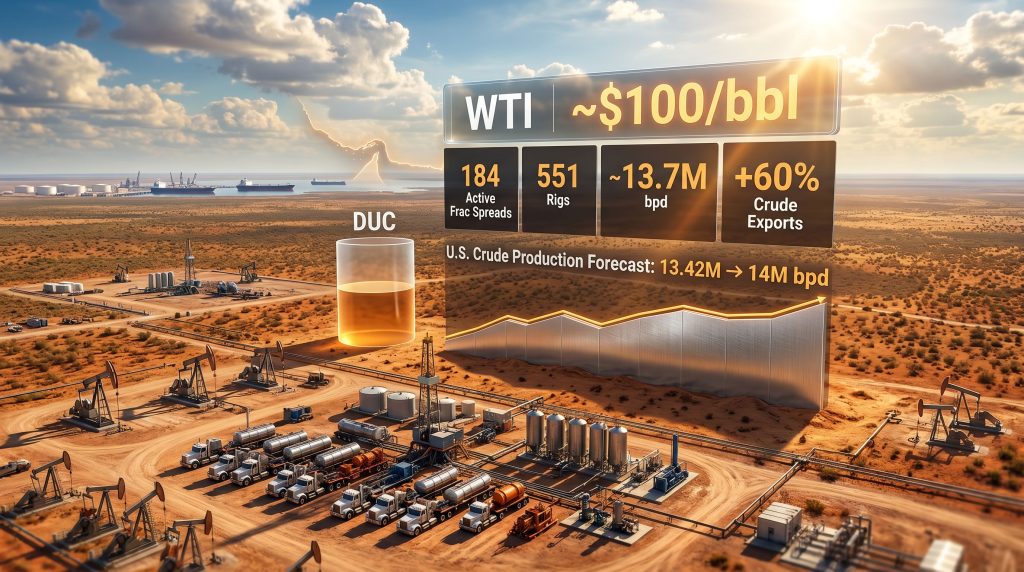
According to Primary Vision, which monitors this data in near real-time, the frac spread count has risen approximately 20% since January 2026, reaching 184 active fracking teams by mid-May. This is a meaningful acceleration. Frac spread expansion signals that operators are advancing already-drilled wells toward production, a process that moves considerably faster than starting a new drilling cycle from scratch.
At the same time, the rig count tells a different story. Baker Hughes data from the second week of May 2026 shows the U.S. oil rig count at 551 rigs, which is actually 25 fewer rigs than were operating at the same point a year earlier. The divergence between these two data sets is not a contradiction. It is the signature of a deliberate strategic posture, closely linked to the broader U.S. shale drilling slowdown that has defined recent industry behaviour:
- Complete existing inventory fast to capture near-term revenue at elevated prices
- Avoid committing capital to full new drilling cycles that require multi-year payback periods
- Preserve financial flexibility against the risk of a sudden price correction if the geopolitical situation resolves
This bifurcation between fracking activity and drilling activity is precisely what capital-disciplined production management looks like in practice.
Drilled-But-Uncompleted Wells: The Industry's Hidden Buffer
The concept of a drilled-but-uncompleted well, or DUC, is not widely understood outside the industry. When an operator drills a horizontal well in a shale formation, the well itself is not immediately productive. The hydrocarbons are locked in tight rock formations and can only flow once the wellbore has been hydraulically fractured, a separate and subsequent operation involving the high-pressure injection of water, sand, and chemicals to crack open the reservoir rock.
DUC wells represent a pre-positioned production reserve. They sit on the balance sheet as sunk drilling costs, waiting for the optimal moment to be completed. The capital efficiency advantage is meaningful: completing a DUC avoids the full mobilisation cost of a new rig, eliminates the time required to drill to total depth, and allows production to be brought online within weeks rather than months.
Reuters noted that DUC completions represent a capital-efficient pathway to adding output without committing to a full new drilling cycle, and the current data confirms that producers are leaning heavily on this mechanism as their primary production response tool. (Reuters, Ron Bousso, May 2026)
However, DUC inventories are finite. The critical insight that does not always surface in mainstream coverage is this: once the DUC buffer is exhausted, the production response curve becomes structurally less flexible. At that point, any further output growth requires conventional drilling timelines, which extend from months to years depending on the complexity of the well programme and the availability of equipment and labour.
The Permian's Dual Role: Growth Engine and Depletion Frontier
Almost the entire U.S. production response to the current Middle East supply disruption is concentrated in a single basin: the Permian, straddling West Texas and southeastern New Mexico. This geographic concentration is both the industry's greatest strength and its most significant structural vulnerability.
The Permian became the centrepiece of the global shale story for legitimate geological reasons. Its stacked pay zones, multiple productive formations, and vast geographic extent gave operators decades of running room. The basin attracted tens of billions of dollars in acquisitions from integrated majors seeking premium-tier shale exposure, and its production profile drove the United States to become the world's largest crude producer.
But the same hydraulic fracturing physics that makes the Permian so attractive also defines its limitations. The fast-start, fast-decline production profile that characterises all shale wells is not unique to marginal acreage. It applies equally to the most productive zones in the basin. Industry warnings about the progressive depletion of so-called Tier 1 acreage have been circulating among petroleum geologists and independent analysts for several years. Those warnings are now becoming operationally relevant rather than theoretical.
According to analysis published by the AAPG, as the highest-quality acreage is drilled through, operators are forced to step out into Tier 2 and Tier 3 locations. These wells produce at lower initial rates, decline faster, and require higher sustained oil prices to generate adequate returns. The breakeven economics on marginal Permian acreage sit meaningfully above those on core acreage, and that gap widens with each successive development campaign.
The wells being drilled and fracked in response to current elevated prices may well be positioned on acreage with higher breakeven thresholds. At WTI around $100 per barrel, those economics remain viable. The problem is that the durability of that price environment is entirely contingent on geopolitical developments that no operator can control or reliably forecast.
Production Reality vs. Forecast Optimism
The U.S. Energy Information Administration's own forecast trajectory illustrates the structural tension at play. Prior to the current conflict period, the EIA projected that average daily production would decline from approximately 13.42 million bpd in 2025 to 13.37 million bpd in 2026, reflecting its assessment that rig attrition was beginning to outpace productivity improvements across the major shale plays. Consequently, the U.S. oil production decline observed in this period was not entirely unexpected by industry analysts.
Revised expectations, driven by the conflict-induced price environment, now point toward average daily production potentially reaching 14 million bpd in 2026. As of early May 2026, actual output stood at approximately 13.7 million bpd, indicating that the gap between current reality and the revised target remains non-trivial.
| Metric | Figure | Context |
|---|---|---|
| EIA pre-conflict 2026 forecast | 13.37 million bpd | Below 2025 levels; rig attrition cited |
| Revised 2026 production target | ~14.00 million bpd | Price-driven optimism, not geological revision |
| Actual output (early May 2026) | ~13.70 million bpd | Gap remains vs. revised target |
| Active oil rigs (May 2026) | 551 rigs | 25 fewer than same period in 2025 |
| Active frac spread count | 184 teams | Up ~20% since January 2026 |
| U.S. crude exports (April 2026) | ~6.5 million bpd | Up ~60% from February 2026 |
| WTI benchmark | ~$100/bbl | Highest sustained level in recent years |
The revised forecast reflects a pricing assumption, not a geological breakthrough. The Permian has not suddenly acquired new Tier 1 acreage. The EIA's original concern about rig attrition and productivity plateauing has not been invalidated by higher prices. It has simply been temporarily overridden by the economic incentive to drill into progressively costlier ground.
Capital Discipline as a Structural Constraint, Not Just a Trend
The post-COVID capital discipline framework that reshaped the shale industry has not been suspended by $100 oil. Institutional investors who endured years of value destruction during the boom-bust cycles of the 2010s extracted durable commitments from management teams: prioritise free cash flow generation, return capital to shareholders, and do not repeat the error of drilling aggressively into price spikes that subsequently reversed.
Evidence of this posture persists in the Dallas Federal Reserve's quarterly energy survey, conducted in March 2026 during the early stages of the conflict. Executive responses reflected a preference for measured production increases rather than broad-based rig deployment, confirming that the industry's risk calculus had not fundamentally shifted despite the most favourable price environment in years.
The financial mechanics of this discipline play out in three observable behaviours:
- Dividend maintenance and share buybacks funded by elevated cash flows rather than reinvestment into new drilling programmes
- Hedging activity locking in a portion of forward production at current prices, which signals that management teams treat the current price level as potentially temporary
- DUC completion prioritisation over new well spudding, preserving balance sheet flexibility while still growing near-term output
The precedent from previous cycles is instructive. Companies that drilled aggressively into the 2014 and 2018 price environments without adequate hedging faced severe financial distress when prices corrected sharply. That institutional memory is a binding constraint on current behaviour, arguably as powerful as any geological limitation. In addition, oil market volatility driven by trade tensions has further reinforced management caution.
The next major ASX story will hit our subscribers first
The Export Surge and Its Infrastructure Ceiling
U.S. crude exports surged approximately 60% between February and April 2026, reaching roughly 6.5 million barrels per day, a figure that represents an all-time high for American crude shipments. This export performance has positioned the United States as the effective swing supplier in the current global supply disruption, redirecting trade flows that previously ran through Middle Eastern channels.
Simultaneously, the U.S. government dispatched Strategic Petroleum Reserve crude to Asian markets, a rare manoeuvre that underscores the severity of the global supply gap. SPR releases are a finite instrument. Their deployment signals both the magnitude of the supply disruption and the reduction of the national buffer available for future emergencies.
What rarely receives sufficient attention in export volume discussions is the infrastructure ceiling. Gulf Coast export terminal throughput, pipeline capacity linking the Permian to coastal loading facilities, and available tanker tonnage all impose physical upper bounds on how quickly export volumes can scale. Furthermore, U.S. crude inventories remain a critical variable in determining how much production can be exported versus absorbed domestically. The production ceiling is not solely geological; it is also logistical, and the two constraints interact in ways that compress the realistic upside scenario for U.S. export growth.
Geopolitical Risk and the Asymmetry of Investment Decisions
The single most consequential variable for U.S. shale investment planning in 2026 is not the oil price itself. It is the expected duration of the Middle East supply disruption.
Iran's consolidating influence over the Strait of Hormuz, which a Reuters investigation in May 2026 documented in detail including island checkpoints and diplomatic positioning, suggests that a rapid normalisation of energy flows is not the base case. However, oil markets have repeatedly demonstrated extreme price sensitivity to even unverified diplomatic signals. A single news item suggesting ceasefire talks, regardless of its ultimate veracity, has historically been sufficient to trigger sharp downward price moves within hours.
This dynamic creates a deeply asymmetric risk profile for producers considering aggressive capital deployment. As reported by Argus Media, shale firms have consistently signalled subdued spending intentions, reflecting exactly this risk calculus:
- The cost of over-investing into a price spike that reverses: stranded capital committed to high-breakeven wells in an environment that no longer justifies the economics
- The opportunity cost of under-investing into a price environment that proves durable: foregone production that competitors capture instead
For most management teams operating under institutional capital discipline mandates, the first risk is far more damaging than the second. This explains why only five rigs were added in the second week of May 2026, a signal of engagement with the opportunity rather than a genuine acceleration.
| Scenario | Geopolitical Outcome | Production Response | WTI Price Range |
|---|---|---|---|
| Prolonged conflict | Hormuz disruption extends through H2 2026 | Gradual rig additions; DUC completions accelerate | $95 to $110/bbl |
| Diplomatic resolution | Ceasefire or agreement within 60 to 90 days | Rig additions halt; hedging locks current prices | $70 to $80/bbl |
| Escalation | Conflict widens; additional supply disruptions | Emergency response; SPR coordination | $130 to $150/bbl |
The Long-Term Swing Producer Question
Beneath the immediate production and export data lies a more consequential question: can U.S. shale sustainably fulfil the global swing producer role that current market conditions are demanding of it?
The honest answer is conditional. In the near term, DUC completions and measured rig additions can bridge a meaningful portion of the global supply gap. In the medium term, however, the geological degradation of Tier 1 acreage, combined with the rising marginal cost of incremental barrels, creates a structural floor for the oil price required to justify continued production growth at current levels.
If the industry continues prioritising cash extraction over reinvestment through 2026 and into 2027, the productive capacity being consumed today may not be adequately replaced. The strategic irony is significant: at the precise moment global supply chains are being reconfigured around U.S. production, the geological and financial constraints on that production are tightening.
U.S. shale opens the taps carefully because the alternative, opening them fully, risks exhausting both the DUC inventory and investor goodwill simultaneously, while exposing highly leveraged well programmes to a price environment that could shift materially on a single diplomatic headline.
This article is intended for informational purposes only and does not constitute financial or investment advice. Forward-looking production estimates, price forecasts, and scenario analyses involve significant uncertainty. Readers should conduct their own due diligence before making any investment decisions.
Want To Identify The Next Major Mineral Discovery Before The Broader Market Does?
While U.S. shale producers navigate geological constraints and capital discipline, Discovery Alert's proprietary Discovery IQ model scans ASX announcements in real time, instantly alerting subscribers to significant mineral discoveries with the potential for substantial returns — explore Discovery Alert's discoveries page to see the historic outcomes major finds have delivered, and begin a 14-day free trial to secure a genuine market-leading edge.