August 7, 2026
Market volatility rarely emerges from technical indicators alone. Instead, geopolitical tensions create cascading effects that reshape entire energy ecosystems, forcing investors to reassess fundamental assumptions about supply security and price discovery mechanisms. The current Middle Eastern strategic landscape presents a complex matrix of military positioning, domestic political calculations, and global economic interdependencies that could fundamentally alter commodity markets. As concerns mount over a potential limited U.S. strike on Iran, markets are grappling with unprecedented uncertainty around energy security and regional stability.
Strategic Military Positioning and Market Implications
Modern military interventions operate within carefully constructed parameters designed to achieve specific policy objectives while minimising unintended consequences. The concept of surgical strikes has evolved significantly from Cold War-era proxy conflicts, incorporating precision targeting technologies and real-time intelligence coordination with regional allies.
Operational Framework for Limited Engagement
Contemporary limited military actions focus on high-value strategic assets while deliberately avoiding civilian infrastructure and economic production facilities. This approach reflects lessons learned from previous Middle Eastern operations where broader infrastructure targeting created prolonged regional instability and commodity market disruption.
Intelligence sources indicate current U.S. positioning includes two aircraft carriers deployed with supporting fighter jets and refueling tankers, representing significant force projection capability without crossing thresholds that would signal preparation for sustained ground operations. According to Aaron Hill, Chief Market Analyst at FP Markets, this positioning coincides with a 10-15 day diplomatic ultimatum regarding nuclear negotiations, creating clear temporal boundaries for potential military action.
Alliance Coordination and Regional Dynamics
Gulf state cooperation remains essential for any limited strike scenario, providing both logistical support and regional legitimacy. Historical precedents from Syrian operations demonstrate that coordinated action with regional partners significantly reduces operational complexity while maintaining strategic flexibility for rapid de-escalation.
The capture of former Venezuelan President Nicolás Maduro has fundamentally altered U.S. strategic positioning, according to Morningstar analysis. This development provides what Joshua Aguilar, Morningstar's Equity Director, characterises as enhanced negotiating leverage through successful military operations and access to Venezuelan heavy-sour crude as a potential substitute for Iranian exports.
Furthermore, this strategic shift influences broader regional calculations, particularly given the evolving Saudi exploration strategy that could reshape Middle Eastern energy dynamics.
When big ASX news breaks, our subscribers know first
Energy Market Scenario Analysis
Global energy markets operate through interconnected supply chains where regional disruptions create ripple effects far beyond immediate geographic boundaries. Understanding these transmission mechanisms requires examining multiple probability-weighted scenarios and their corresponding market responses.
Base Case: Contained Supply Impact
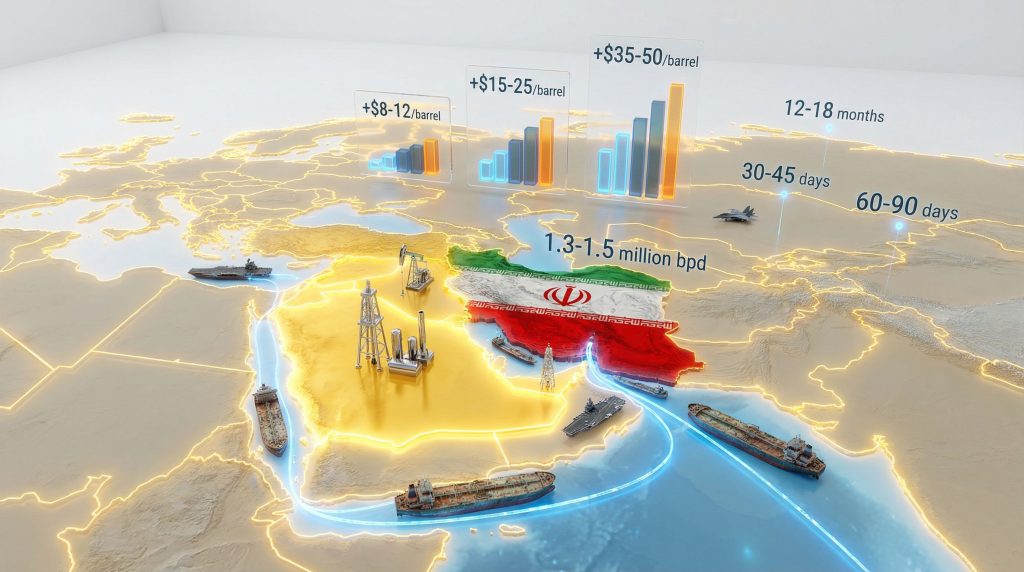
Under minimal disruption scenarios, Iranian oil export capacity of approximately 1.3-1.5 million barrels per day would remain largely intact, with any price movements reflecting risk premiums rather than physical supply shortages. Current market fundamentals support this assessment, with Brent crude trading at $71.76 per barrel as of February 20, 2026, representing approximately 20% growth since early January 2026.
Morningstar maintains that global physical flows would remain unaffected under limited strike scenarios, preserving what Aguilar describes as intact global surplus conditions. This assessment suggests that price action would stem entirely from geopolitical premium adjustments rather than fundamental supply-demand imbalances.
J.P. Morgan's commodity strategy team, led by Natasha Kaneva, projects that market balances will generate sizable surpluses later in 2026, requiring production cuts of approximately 2 million barrels per day to prevent excessive inventory accumulation in 2027. These analysts project price stabilisation around $60 per barrel Brent under baseline assumptions, indicating current pricing reflects significant risk premium incorporation.
Moderate Escalation: Infrastructure Vulnerability
Regional shipping lane disruptions present the most significant moderate-impact scenario for global energy markets. The Strait of Hormuz handles approximately 20-25 million barrels per day of crude oil and petroleum products, representing roughly 20% of global petroleum liquids transit.
Morningstar assessment indicates that Strait of Hormuz closure probability remains remote, though Aguilar acknowledges this scenario would represent the most severe case for global oil prices. Insurance premium escalations for tanker traffic could create immediate cost pressures even without physical closures, as Lloyd's of London syndicates typically adjust war risk premiums within 24-48 hours of elevated threat assessments.
Alternative routing through the Red Sea and Suez Canal adds approximately 2,700 nautical miles to Asia-bound shipments, creating logistical bottlenecks and increasing transit time by 12-15 days. This extended routing would strain global tanker fleet capacity and elevate freight rates across multiple commodity categories.
High-Impact Scenario: Regional Conflict Expansion
Severe escalation scenarios involve coordinated responses from regional proxies and potential OPEC+ production adjustments. Iraq's southern export terminals handle approximately 3.5 million barrels per day, while Kuwait contributes roughly 2.4 million barrels per day to global supply. Both nations maintain critical infrastructure within range of potential retaliatory actions.
OPEC+ spare capacity currently stands at approximately 4-5 million barrels per day, primarily concentrated in Saudi Arabia and the United Arab Emirates. However, accessing this capacity requires 30-90 days for full deployment, creating temporary supply gaps that could drive significant price volatility.
| Scenario | Brent Price Impact | Duration | Recovery Timeline |
|---|---|---|---|
| Limited Strike | +$8-12/barrel | 2-4 weeks | 30-45 days |
| Moderate Escalation | +$15-25/barrel | 6-8 weeks | 60-90 days |
| Severe Conflict | +$35-50/barrel | 3-6 months | 12-18 months |
Risk Premium Dynamics and Market Psychology
Commodity markets incorporate geopolitical uncertainty through complex risk assessment mechanisms that often disconnect from immediate supply fundamentals. Understanding these pricing dynamics requires examining both institutional positioning and retail investor behaviour patterns during crisis periods.
Current Market Positioning Analysis
February 2026 pricing data reveals significant year-to-date appreciation across benchmark crude grades, with WTI reaching $67.01 per barrel representing year-to-date highs. This contradicts earlier bearish prognostications related to supply glut concerns, demonstrating how rapidly market sentiment can shift based on geopolitical developments.
Morningstar maintains its $65 per barrel Brent midcycle estimate, implying current pricing incorporates approximately $6-7 per barrel geopolitical premium above fundamental values. This premium reflects market assessment of elevated probability for supply disruption scenarios.
In addition, broader market dynamics are being influenced by concerns about tariffs impact on markets, which could exacerbate energy price volatility through currency adjustments and trade flow disruptions.
J.P. Morgan analysts continue assigning low geopolitical risk premiums to Middle Eastern developments, suggesting institutional investors maintain relatively sanguine assessments of escalation probability. However, they acknowledge that proximity to major energy chokepoints could sustain geopolitically driven price rallies even as global fundamentals remain soft.
Institutional Investment Response Patterns
Commodity fund positioning typically adjusts within 24-48 hours of significant geopolitical developments, with momentum trading strategies amplifying initial price movements. Historical analysis of similar crises indicates that institutional investors often maintain elevated positioning for 4-6 weeks after initial events, regardless of fundamental supply conditions.
Energy sector equity valuations respond differently to geopolitical premiums than underlying commodity prices. Integrated oil companies benefit from higher crude prices through upstream operations, while independent refiners face margin compression from elevated input costs. This divergence creates sector rotation opportunities during extended crisis periods.
Currency impacts particularly affect oil-importing emerging market economies, where crude price increases combine with potential currency weakening to create compounded inflationary pressures. Historical precedents suggest that sustained oil price increases above $80 per barrel Brent typically trigger central bank policy responses in major importing nations.
For instance, investors may increasingly turn to gold as inflation hedge during periods of heightened energy-driven inflation expectations.
Domestic Political Calculations
U.S. election cycles create powerful incentive structures that influence military action timing and scope. The intersection of energy prices with voter sentiment generates constraints on policy makers that extend far beyond traditional foreign policy considerations.
Electoral Timeline and Economic Policy
Midterm elections scheduled for later in 2026 create temporal pressure points for decision-making regarding military action. Trump administration positioning on inflation management, including gasoline price stability, represents a cornerstone policy platform that directly conflicts with actions that could drive sustained energy cost increases.
Morningstar analysis emphasises domestic political incentives as the primary factor supporting limited U.S. strike on Iran probability over more extensive military engagement. This assessment reflects recognition that electoral consequences of sustained gasoline price increases often outweigh perceived foreign policy benefits of expanded military action.
J.P. Morgan analysts frame the decision-making calculus around economic costs relative to electoral dynamics, noting that affordability concerns remain central to U.S. political calculations. This creates institutional pressure for surgical approaches designed to avoid Iran's oil production and export infrastructure.
Congressional Authorization Dynamics
War Powers Resolution compliance requires Congressional notification within 48 hours of military action initiation, with authorisation requirements for operations extending beyond 60 days. Limited strike scenarios typically fall within executive authority for short-duration military actions, reducing legislative constraints on decision-making.
Historical precedents from Syrian strike authorisations demonstrate that limited engagement approvals face fewer Congressional obstacles than sustained military campaigns. This procedural framework supports higher probability assessments for contained military actions over extended operations requiring formal war declarations.
Media narrative management becomes crucial for maintaining public support during limited military operations. Previous administrations have demonstrated that clear communication regarding operation scope and duration significantly influences both Congressional and public backing for military action.
Furthermore, the recent US production executive order demonstrates the administration's focus on domestic energy security, which could influence strategic calculations around any potential military action.
Iranian Response Capabilities and Strategic Options
Understanding potential Iranian retaliation requires examining asymmetric warfare capabilities, proxy force deployment options, and nuclear programme acceleration scenarios. These response mechanisms operate across multiple domains and timelines, creating complex risk assessment challenges for market participants.
Asymmetric Retaliation Framework
Iranian proxy forces maintain operational capabilities across Iraq, Syria, Yemen, and Lebanon, providing multiple avenues for graduated response to U.S. military action. Hezbollah forces in southern Lebanon possess approximately 130,000 rockets and missiles, representing the most sophisticated proxy arsenal in the region.
Iraqi Shia militia groups control strategic positions near major oil infrastructure, including the Rumaila oil field and Basra export terminals. These forces demonstrated operational capability through previous attacks on oil facilities and could potentially target critical energy infrastructure as retaliation for U.S. strikes.
According to recent reports from CNN, Iran has been rapidly advancing its uranium enrichment capabilities, potentially complicating any military response calculations.
Houthi capabilities in Yemen have evolved significantly, incorporating drone swarm technologies and anti-ship missile systems capable of targeting commercial vessels in Red Sea shipping lanes. These capabilities could disrupt approximately 12% of global trade that transits through the Bab-el-Mandeb strait.
Cyber Warfare Dimensions
Iranian cyber warfare capabilities pose significant threats to U.S. energy infrastructure, with documented capabilities for targeting SCADA systems and critical infrastructure networks. Previous attacks on Colonial Pipeline and other energy facilities demonstrate vulnerability of petroleum product distribution systems to cyber disruption.
Attribution challenges in cyber domain create escalation risks, as determining responsibility for infrastructure attacks often requires weeks of forensic analysis. This timing mismatch between attack execution and response authorisation creates strategic advantages for asymmetric warfare approaches.
Critical infrastructure protective measures have improved significantly since 2020, with enhanced Department of Homeland Security coordination and private sector cybersecurity investments. However, distributed energy infrastructure remains inherently vulnerable to coordinated cyber attacks targeting multiple facilities simultaneously.
Nuclear Programme Considerations
Current Iranian uranium enrichment capacity enables production of weapons-grade material within 12-18 months under crash programme scenarios. International Atomic Energy Agency monitoring protocols provide early warning mechanisms but cannot prevent determined proliferation efforts.
Military strikes on nuclear facilities could accelerate rather than delay weapons development by eliminating international oversight mechanisms and justifying withdrawal from Non-Proliferation Treaty obligations. This paradoxical effect creates strategic complications for military action targeting nuclear infrastructure.
European Union mediation capabilities remain limited by U.S. sanctions frameworks and Iranian domestic political constraints. Previous negotiation successes required extensive sanctions relief packages that current geopolitical conditions make politically difficult to implement.
Intelligence sources suggest that Iran's nuclear programme has reached concerning thresholds, as reported by The Atlantic Council, which could influence timing considerations for any potential limited U.S. strike on Iran.
Global Supply Chain Integration Beyond Petroleum
Energy market disruptions create cascading effects throughout interconnected global supply chains, affecting natural gas transportation, critical mineral sourcing, and industrial commodity pricing. These secondary effects often persist longer than primary petroleum market impacts.
Natural Gas Market Interconnections
Liquefied Natural Gas shipping routes through the Persian Gulf handle approximately 25% of global LNG trade, creating vulnerability points for Asian spot markets. Alternative routing through Atlantic Basin suppliers adds $2-3 per MMBtu in transportation costs and extends delivery timelines by 2-3 weeks.
European natural gas markets maintain exposure to Middle Eastern supply disruptions through interconnected global pricing mechanisms, even though direct Iranian gas imports remain minimal. Pipeline gas from Russia continues providing baseload supply, but LNG imports have become essential for meeting peak demand periods.
Asian spot LNG markets typically demonstrate higher volatility during Middle Eastern crises, with prices increasing 15-25% during initial risk assessment periods. Japan and South Korea maintain strategic reserves equivalent to 2-3 weeks of consumption, providing limited buffer capacity for extended disruptions.
Critical Minerals and Industrial Impacts
Regional mineral supply chains face disruption risks extending beyond energy commodities. Aluminium production in the Gulf region represents approximately 12% of global capacity, with smelting operations requiring stable electricity supply and raw material transportation networks.
Petrochemical production capacity concentrated in Saudi Arabia and UAE could face operational constraints during extended regional conflicts. These facilities provide essential inputs for plastics, fertilisers, and industrial chemicals, creating supply chain vulnerabilities across multiple industries.
Global shipping insurance rates adjust immediately upon crisis escalation, with war risk premiums increasing 200-500% for vessels transiting contested waters. These insurance cost increases affect all commodity categories shipped through regional waters, not just petroleum products.
The next major ASX story will hit our subscribers first
Corporate Exposure and Strategic Positioning
International energy companies maintain diverse regional exposure profiles that create varying risk and opportunity dynamics during Middle Eastern conflicts. Understanding these corporate positioning differences helps assess investment implications across the energy sector.
International Oil Major Assessment
ExxonMobil maintains limited direct Iranian exposure but significant regional positioning through Iraqi Kurdistan operations and Qatari partnerships. The company's 2.1 million barrels per day global production capacity provides geographic diversification that limits regional concentration risks.
Chevron's 1.9 million barrels per day production portfolio includes substantial positions in Kazakhstan and Angola that could benefit from Middle Eastern supply disruptions through higher global commodity pricing. The company's refining operations also maintain flexibility to process alternative crude grades.
BP's integrated business model creates complex risk exposure through both upstream production assets and downstream refining capacity. The company's 2.2 million barrels per day production includes significant natural gas operations that could face transportation constraints during regional conflicts.
Total Energies maintains the highest regional exposure among European majors, with operations in UAE, Qatar, and Iraq representing approximately 15% of total production capacity. This concentration creates both operational risks and potential supply replacement opportunities.
Regional Producer Capabilities
Saudi Aramco maintains approximately 4 million barrels per day of spare production capacity, representing the world's largest swing production capability. This strategic reserve enables rapid market stabilisation but requires 30-60 days for full deployment across multiple field developments.
UAE production flexibility stems from multiple offshore fields and enhanced oil recovery technologies that enable rapid capacity adjustments. The country's 3.2 million barrels per day current production could potentially increase by 500,000-800,000 barrels per day within 90 days.
Iraqi Kurdistan Regional Government maintains independent export capabilities through Turkey pipeline system, providing alternative supply routes that bypass potential southern Iraq infrastructure vulnerabilities. Current capacity of 450,000 barrels per day could expand rapidly with international support.
Qatar's North Field expansion project, scheduled for completion in 2027, will increase LNG production capacity by 64 million tons per year. This expansion creates strategic importance for maintaining operational stability during regional conflicts.
Historical Crisis Response Patterns
Previous military actions provide essential frameworks for understanding market response patterns, though evolving technologies and market structures require careful interpretation of historical precedents.
Operation Desert Fox Market Analysis
The 1998 four-day bombing campaign against Iraq generated initial price increases of approximately $4-6 per barrel for both WTI and Brent crude, with recovery to pre-crisis levels occurring within 10-14 days. However, this precedent reflects significantly different market conditions, including higher global spare capacity and less interconnected financial markets.
Trading volume increased by 300-400% during the initial 48 hours of military action, indicating heightened market attention despite relatively contained price movements. Options markets demonstrated elevated implied volatility that persisted for approximately six weeks after military operations concluded.
Inventory accumulation patterns following Desert Fox showed gradual normalisation over 8-12 weeks, suggesting that supply chain adjustments require extended periods even after geopolitical tensions subside. This timeline provides guidance for recovery expectations under similar limited engagement scenarios.
Syrian Strike Precedent Analysis
Tomahawk missile deployments in 2017 and 2018 generated more limited market responses, with price increases of $1-3 per barrel lasting 3-7 days before returning to pre-strike levels. These contained responses reflected successful strategic communication regarding operation scope and duration.
Regional spillover effects remained minimal during Syrian operations, demonstrating that precise targeting and clear escalation boundaries can limit market disruption. However, Syrian operations avoided targeting major energy infrastructure, making direct comparisons with potential Iranian scenarios somewhat limited.
Energy infrastructure protection during Syrian strikes established precedents for avoiding civilian economic targets while maintaining military effectiveness. This approach supports current market assessments that surgical strikes would deliberately preserve Iranian oil production capacity.
Long-Term Strategic Energy Transformation
Regional conflicts often accelerate structural changes in global energy systems, driving investment patterns and policy frameworks that persist long after immediate crises resolve. Understanding these transformation dynamics helps assess lasting implications beyond short-term market volatility.
Energy Security Investment Acceleration
Crisis periods typically generate increased funding for renewable energy projects and energy storage technologies as nations seek supply security diversification. European Union accelerated renewable capacity additions by approximately 40% following 2022 Russian supply disruptions, demonstrating how geopolitical tensions drive long-term investment patterns.
Strategic mineral diversification efforts intensify during regional conflicts, with rare earth element sourcing and battery supply chains receiving enhanced policy attention. Critical mineral reserve development programmes often receive expedited permitting and increased financial support during energy security crises.
Nuclear power expansion discussions gain momentum during extended fossil fuel price volatility periods. Countries with existing nuclear capabilities often accelerate new plant construction timelines, while nations considering nuclear programmes expedite regulatory framework development.
Global Energy Alliance Restructuring
U.S.-Gulf state cooperation frameworks evolve during crisis periods, often resulting in enhanced military coordination agreements and expanded energy infrastructure partnerships. These institutional changes typically persist beyond immediate conflict resolution, creating lasting strategic relationships.
China-Iran energy partnerships face resilience testing during U.S. military action scenarios, with Chinese state-owned enterprises required to balance commercial interests against diplomatic considerations. Historical patterns suggest that Chinese energy investments in Iran remain stable despite short-term political tensions.
European energy independence acceleration programmes receive increased political support during Middle Eastern crises. These initiatives typically focus on LNG import diversification, renewable capacity expansion, and reduced Russian pipeline dependency.
Risk Management and Investment Considerations
Energy market participants require sophisticated hedging strategies and portfolio positioning approaches to navigate geopolitical volatility while maintaining operational flexibility. These risk management frameworks must address both immediate price volatility and longer-term structural shifts.
Hedging Strategy Framework
Crude oil futures markets provide primary hedging mechanisms for price volatility, though options strategies offer more precise risk management for specific probability scenarios. Calendar spreads enable protection against temporary supply disruptions while maintaining upside exposure for longer-term price appreciation.
Refining margin hedges become particularly important during geopolitical crises, as input cost volatility can create unpredictable profitability patterns. Crack spread options provide protection against margin compression while preserving flexibility for margin expansion scenarios.
Currency hedging gains importance for international energy investments during regional conflicts, as oil price increases often correlate with dollar strengthening that affects non-U.S. operations. Multi-currency exposure requires coordinated hedging strategies across commodity and foreign exchange markets.
Portfolio Positioning Opportunities
Energy sector rotation strategies capitalise on performance divergence between upstream producers and downstream refiners during crisis periods. Independent producers typically outperform integrated companies during short-term price spikes, while integrated companies provide more stable returns during extended volatility periods.
Defensive positioning in utilities and renewable infrastructure offers portfolio stability during energy market turbulence. These sectors often benefit from increased policy support and investment flows during fossil fuel supply security concerns.
Alternative energy investments, including battery storage and grid modernisation technologies, receive enhanced investor attention during energy security crises. These sectors often maintain performance momentum beyond immediate geopolitical tensions as structural energy transition trends accelerate.
Additionally, investors should consider the broader implications of Trump tariff implications on energy sector investment flows and international trade relationships.
Market Implications and Strategic Outlook
Current developments surrounding potential limited U.S. strike on Iran scenarios create complex risk-reward dynamics for energy market participants. While base case assessments suggest contained impacts on global supply chains, the interconnected nature of modern energy systems creates multiple transmission pathways for crisis effects.
Institutional positioning continues favouring scenarios where military action remains surgical and time-limited, avoiding Iranian production infrastructure while achieving strategic objectives. This assessment reflects both technical military capabilities and domestic political constraints that favour precision over extended engagement.
The Venezuelan situation adds strategic flexibility to U.S. decision-making by providing alternative heavy crude supplies that could substitute for Iranian exports during temporary disruptions. This development strengthens the analytical framework supporting contained escalation scenarios over more extensive military operations.
However, market participants must remain vigilant about escalation risks and secondary effects that could amplify initial disruptions. The complexity of modern supply chains and financial market interconnections means that even limited military actions could generate unpredictable consequences across multiple asset classes and geographic regions.
Disclaimer: This analysis involves forecasting geopolitical events and market responses that contain significant uncertainty. Military actions, market reactions, and energy supply disruptions can develop rapidly and unpredictably. Readers should consult qualified financial advisors and consider multiple scenario outcomes when making investment decisions. Past military actions and market responses may not predict future outcomes due to evolving technologies, market structures, and geopolitical conditions.
Could the next major energy discovery transform your portfolio?
Discovery Alert's proprietary Discovery IQ model delivers instant notifications on significant ASX energy and mineral discoveries, empowering subscribers to identify actionable opportunities ahead of broader market movements during times of heightened geopolitical uncertainty. Begin your 14-day free trial today and position yourself to capitalise on major mineral discoveries that have historically generated substantial returns for early investors.