July 20, 2026
Scenario Projection: What Shale Consolidation Looks Like When Supply Scarcity Meets Capital Urgency
The economics of resource depletion have a way of forcing decisions that operators might otherwise delay indefinitely. As premium drilling locations within mature shale plays become genuinely scarce, the window for acquiring them narrows, and the cost of inaction compounds. This dynamic, more than any single commodity price move, is reshaping the structure of U.S. upstream mergers and acquisitions from the ground up.
The shale industry's consolidation arc is not simply a story about deal sizes. It reflects a deeper transformation in how E&P companies think about long-term survival, capital productivity, and competitive positioning in an era where the easy acreage has largely already changed hands.
When big ASX news breaks, our subscribers know first
Why the Current U.S. Upstream M&A Cycle Is Structurally Different
The blockbuster merger wave of 2023 and 2024 was largely Permian-centric, defined by headline-grabbing combinations between some of the largest independent producers in North America. Total U.S. upstream M&A value ran at approximately $105 billion in 2024, before declining to roughly $65 billion in 2025 as price-driven hesitation and a widening bid-ask spread suppressed transaction volumes.
What has emerged in 2026 is qualitatively different. Deal activity is no longer concentrated in one basin or driven primarily by acreage accumulation. Instead, the forces now shaping U.S. upstream mergers and acquisitions include:
- Inventory quality over quantity: Acquirers are increasingly focused on the economic well life of remaining drilling locations rather than raw acreage totals
- Basin diversification: Multi-basin operators are commanding valuation premiums as single-basin commodity and regulatory risk becomes less tolerable to institutional investors
- Capital efficiency metrics: Price-per-flowing-barrel and breakeven analysis are displacing simple reserve replacement ratios as the dominant deal valuation framework
- Natural gas demand visibility: Structural LNG export growth and power sector consumption from AI infrastructure are making gas-weighted assets more competitively bid than at any point in the prior cycle
PwC has identified upstream consolidation as a structural necessity as shale basins mature and organic drilling programmes face diminishing marginal returns, reinforcing the view that the imperative has shifted from land accumulation to operational scale and technology integration.
Q1 2026's $38 Billion Result: Reading the Signal Correctly
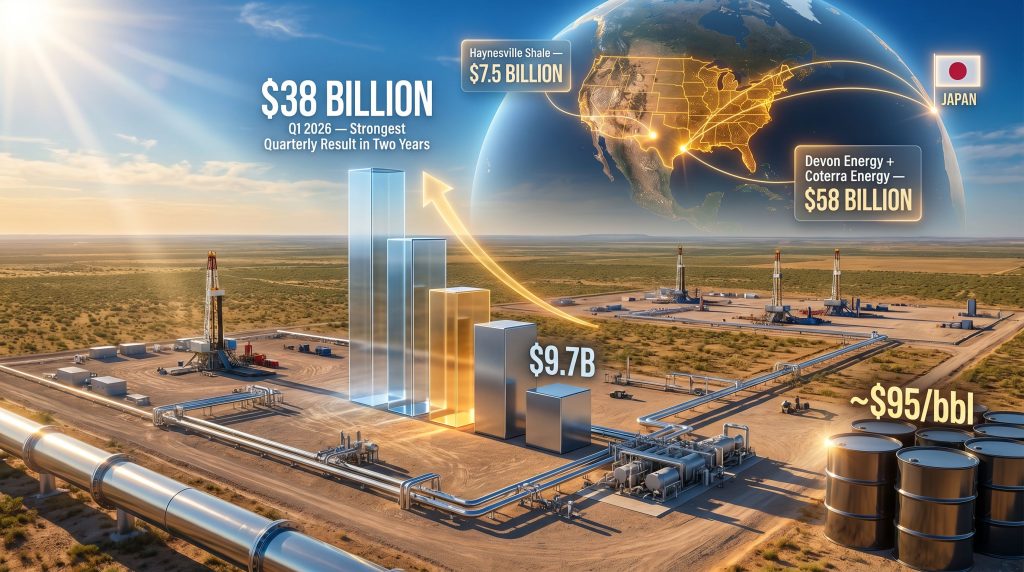
U.S. upstream deal value reached $38 billion in Q1 2026, the strongest quarterly total in two years. Activity was concentrated in January and February before a notable deceleration in March, driven by elevated market volatility linked to geopolitical disruption in the Middle East affecting energy trade routes.
The rebound reflects a convergence of three structural forces:
- Seller acceptance: After quarters of standoff over valuation expectations, sellers have become more willing to transact at current price decks
- Buyer confidence: Public E&P companies see a sustained higher-price environment as justification for pursuing transformative scale
- Private operator urgency: Private equity-backed producers recognise that top-tier acreage scarcity is a time-sensitive dynamic, making delayed exits increasingly costly
Enverus Intelligence Research has characterised the current environment as the early stages of another major consolidation wave, driven by the dual catalysts of elevated commodity prices and private operators seeking exits before premium acreage is fully absorbed by larger competitors.
What makes this consolidation wave distinctive is not its scale alone, but the fact that it is being driven simultaneously by oil price dynamics, natural gas demand fundamentals, and technology-enabled synergy potential. These three forces rarely align in the same cycle.
Commodity Price Expectations and Their Direct Impact on Deal Economics
The relationship between crude price levels and M&A velocity is well-established, but the current cycle adds important nuance. Furthermore, price expectations — not just spot prices — are driving deal decisions on both sides of the table. Monitoring crude price trends is, consequently, essential for understanding deal timing and structure throughout the cycle.
| Price Forecast Scenario | Brent Crude Estimate | Implication for M&A Activity |
|---|---|---|
| Base Case (2026 Remainder) | ~$95/barrel | Supports aggressive corporate deal pursuit |
| Elevated Case (2027) | ~$100/barrel | Accelerates private asset monetisation |
| Tail Risk (Hormuz Disruption) | Up to $150/barrel | Compresses deal timelines; raises urgency |
| Downside Case (Low Crude) | Below $65/barrel | Suppresses buyer appetite; SMID-cap focus |
Enverus expects Brent to average around $95 per barrel through the remainder of 2026 and approach $100 per barrel in 2027, supported by a combination of geopolitical risk premiums, historically low OECD crude inventories, constrained OPEC market influence, and subdued U.S. shale production growth.
The Strait of Hormuz situation adds a significant tail risk dimension. Morgan Stanley analysts have warned that a prolonged closure of this critical chokepoint could push Brent toward $150 per barrel by summer 2026. The United States has increased crude exports by approximately 3.8 million barrels per day as a partial global buffer, while China has reduced its own oil imports by roughly 5.5 million barrels per day.
However, Morgan Stanley's analysis notes that while China can likely sustain reduced import levels for several months, U.S. crude inventories face considerably more pressure, making timeline resolution a genuine urgency variable.
The Delaware Basin Consolidation Model: A Template for the Cycle Ahead
The defining corporate transaction of Q1 2026 was the merger between Devon Energy and Coterra Energy, structured as an all-stock deal in which Coterra shareholders received 0.70 Devon shares per Coterra share held. The combined enterprise value reached approximately $58 billion, with the transaction creating the dominant operator across the Delaware Basin spanning West Texas and New Mexico.
Key operational parameters of the combined entity include:
- Combined production exceeding 1.6 million barrels of oil equivalent per day (boepd)
- Multi-basin exposure across the Delaware Basin, Marcellus Shale, and Anadarko Basin
- Projected annual pre-tax synergies of $1 billion, to be realised through operational efficiencies and AI-assisted drilling and production optimisation
- Enhanced dividend capacity and expanded share buyback programmes underpinned by improved free cash flow generation
The all-stock structure is strategically significant. It allows transformative scale to be achieved without adding debt, preserving balance sheet flexibility for capital returns and future investment. This template is likely to be replicated as other basin-level consolidations unfold.
The Delaware Basin merger illustrates a broader principle: in mature shale plays, the companies that achieve dominant operational footprints first are best positioned to extract technology-driven efficiency gains that smaller competitors simply cannot replicate at scale.
What the Synergy Math Actually Means
The $1 billion pre-tax synergy target embedded in the Devon-Coterra combination is not simply a headcount reduction exercise. Increasingly, synergy delivery in large-scale upstream mergers depends on:
- AI-assisted drilling optimisation: Reducing non-productive time and improving lateral placement accuracy
- Predictive maintenance platforms: Extending economic well life by anticipating mechanical failures before they disrupt production
- Integrated reservoir management systems: Improving recovery factors across multi-well pad developments
- Supply chain consolidation: Negotiating scaled purchasing agreements across a larger combined asset base
Deloitte's structural analysis of upstream M&A confirms that AI-powered operational efficiency is now an explicit valuation input, not an afterthought, with acquirers assigning measurable premiums to targets that have already deployed operational AI tools.
Why Natural Gas Has Become the Most Competitively Bid Asset Class
Among the most important structural shifts in U.S. upstream mergers and acquisitions is the dramatic re-rating of natural gas-weighted assets. Historically viewed as lower-value relative to oil, gas assets are now attracting premium bids driven by three converging demand forces:
- LNG export infrastructure growth: Gulf Coast liquefaction capacity is expanding rapidly, creating durable long-term offtake demand for domestic gas production
- AI data centre power consumption: The electricity demands of large-scale AI computing infrastructure require significant baseload natural gas generation capacity
- Clean energy manufacturing: Battery gigafactories, semiconductor fabs, and other clean energy industrial facilities are adding substantial industrial gas demand
The natural gas demand outlook is being fundamentally re-rated, with Deloitte identifying it as the asset class experiencing the most significant valuation uplift in the current upstream M&A cycle, as buyers price in long-duration demand visibility that was largely absent in prior consolidation waves.
Haynesville Shale: The Strategic Gas Asset of the Cycle
The Haynesville Shale formation, spanning East Texas and Northern Louisiana, has become the focal point for gas-oriented deal activity. Its geographic position adjacent to Gulf Coast LNG export terminals makes it uniquely valuable in a world where wellhead-to-cargo integration is the most sought-after upstream business model.
Transaction Profile: Mitsubishi Corporation's Aethon Energy Acquisition
| Deal Parameter | Detail |
|---|---|
| Acquirer | Mitsubishi Corporation |
| Target | Aethon Energy Management's U.S. shale gas and pipeline assets |
| Total Transaction Value | $7.5 billion |
| Equity Purchase Component | $5.2 billion |
| Debt Assumed | $2.33 billion net interest-bearing debt |
| Acreage | ~380,000 acres |
| Current Production | 2.1 Bcf/d (~15 mtpa LNG equivalent) |
| Projected Production (2027/28) | 2.6 Bcf/d (~18 mtpa LNG equivalent) |
| Pipeline Infrastructure | 1,700+ miles of dedicated gathering and transport |
| Strategic Adjacency | Cameron LNG liquefaction facility |
This transaction represents Mitsubishi's largest-ever upstream acquisition. The strategic logic centres on an integrated wellhead-to-cargo model: upstream Haynesville production feeds directly into existing liquefaction tolling capacity at the Cameron LNG facility, allowing Mitsubishi to capture margin across the entire value chain from gas well to LNG cargo.
The Japanese government formally classified natural gas as an essential multi-decade energy transition fuel and has actively encouraged Japanese corporations to anchor long-term upstream equity positions overseas as a hedge against geopolitical supply disruption. This policy context explains why Japanese industrial conglomerates are willing to pay strategic premiums for U.S. gas assets that pure financial buyers would price differently.
The next major ASX story will hit our subscribers first
Who Is Buying U.S. Upstream Assets and Why
International acquirers accounted for approximately $7.4 billion of U.S. upstream acquisitions in 2025, the highest level of cross-border deal activity in seven years. This reflects a structural shift in the buyer landscape that extends well beyond opportunistic capital deployment.
| Buyer Category | Primary Motivation | Deal Focus | Activity Level |
|---|---|---|---|
| Large U.S. Public E&Ps | Inventory extension, scale efficiency | Corporate mergers, bolt-on acquisitions | High |
| International Majors and Corporates | Energy security, LNG integration | Gas-weighted assets, pipeline infrastructure | Elevated (7-year high) |
| Private Equity | Portfolio monetisation, exit optimisation | Asset sales, carve-outs | Moderating but active |
| SMID-Cap Public E&Ps | Basin consolidation, acreage adjacency | Bolt-on deals, non-core divestitures | Increasing |
| Infrastructure Funds | Yield, long-duration cash flows | Midstream-linked upstream, pipeline assets | Selective |
Foreign buyers are attracted by a combination of technically proven large-scale reserves, proximity to Gulf Coast LNG export infrastructure, relative U.S. regulatory stability compared to other major producing jurisdictions, and the strategic imperative to secure upstream equity as a geopolitical insurance mechanism. In addition, global trade disruption is reinforcing the appeal of U.S.-based energy assets as a more stable alternative to supply chains exposed to greater geopolitical friction.
The Multi-Basin Broadening: Beyond Permian Dominance
The Permian Basin defined the 2023 to 2024 consolidation supercycle, but the current environment reflects a meaningful geographic diversification of deal activity. Fewer large independent targets remain in the Permian after the wave of mega-mergers, pushing buyers to explore other prolific regions.
Notable Transactions from the Recent Consolidation Cycle
| Transaction | Basin Focus | Deal Type | Strategic Rationale |
|---|---|---|---|
| ExxonMobil and Pioneer Natural Resources | Permian | Corporate merger | Scale dominance, inventory depth |
| Chevron and Hess | Multi-basin and Guyana | Corporate merger | Reserve diversification, deepwater |
| Diamondback Energy and Endeavor Energy | Permian | Corporate merger | Delaware Basin consolidation |
| ConocoPhillips and Marathon Oil | Multi-basin | Corporate merger | Portfolio scale, gas optionality |
| Occidental and CrownRock | Permian | Asset acquisition | Midland Basin acreage extension |
| Devon Energy and Coterra Energy | Delaware, Marcellus, Anadarko | Corporate merger | Multi-basin scale, gas diversification |
| Mitsubishi and Aethon Energy | Haynesville | Cross-border asset deal | LNG integration, energy security |
Active consolidation is now occurring across the Anadarko Basin, DJ Basin, Eagle Ford, Appalachian formations including Marcellus and Utica, and the Haynesville. Each offers distinct commodity mixes, infrastructure profiles, and buyer rationales that differ substantially from Permian deal economics.
The Downside Scenario: What Happens When Crude Prices Fall
The inverse relationship between crude price levels and deal velocity was clearly demonstrated in Q3 2025, when U.S. upstream M&A fell to $9.7 billion, the third consecutive quarterly decline, as lower oil prices widened the bid-ask spread and froze transaction momentum.
In low-price environments, the M&A landscape shifts predictably:
- SMID-cap consolidation accelerates: Smaller operators with balance sheet pressure become motivated sellers even at discounted valuations
- Gas-weighted transactions increase as a proportion of total activity: Gas demand fundamentals are less correlated with near-term oil price movements
- Private equity sellers resist: PE-backed operators typically choose to hold assets rather than accept distressed valuations on inventory they believe will re-rate as prices recover
- Deal timelines extend: Financing costs and uncertainty compress buyer confidence, lengthening due diligence and negotiation periods
The primary downside risks to M&A activity include sustained crude price weakness below $65 per barrel, rising financing costs, regulatory uncertainty around permitting and emissions standards, and geopolitical events that create short-term volatility without resolving into sustained price support.
Forward Outlook: Catalysts and Risks Through 2027
Structural Catalysts Supporting Continued Consolidation
- Sustained Brent crude prices in the $95 to $100 per barrel range through 2026 and 2027
- Accelerating private operator exit activity as top-tier drilling inventory becomes progressively scarcer across mature basins
- Rising LNG export demand creating durable structural premiums for Haynesville and Appalachian gas assets
- International buyer interest at seven-year highs, introducing new sources of acquisition capital
- Technology-driven synergy realisation making large-scale corporate combinations more financially compelling than organic growth alternatives
Risk Factors Warranting Monitoring
- Geopolitical escalation creating short-term volatility that freezes deal timelines
- Regulatory and permitting uncertainty affecting asset valuations in specific basins
- Financing cost sensitivity for leveraged private equity-backed transactions
- Crude price correction below $65 per barrel suppressing both seller willingness and buyer confidence
The structural conditions supporting continued U.S. upstream consolidation — including maturing basin inventories, rising natural gas demand, international capital seeking U.S. exposure, and technology-enabled synergy potential — appear durable enough to sustain elevated M&A activity through the medium term. The composition of that activity is likely to shift progressively toward gas-weighted assets, multi-basin diversification strategies, and cross-border transactions as the Permian-centric phase of the consolidation cycle gives way to a more geographically and commodity-diverse era.
Frequently Asked Questions: U.S. Upstream Mergers and Acquisitions
What is U.S. upstream M&A and why does it matter?
U.S. upstream mergers and acquisitions encompass corporate transactions within the oil and natural gas exploration and production sector, including full company mergers, asset purchases, and joint venture restructurings. These deals reshape competitive dynamics, influence production growth trajectories, determine capital allocation priorities, and signal industry confidence in long-term commodity price outlooks.
What drove the $38 billion Q1 2026 result?
The two primary transactions were the Devon Energy and Coterra Energy all-stock merger creating a combined enterprise value of approximately $58 billion, and Mitsubishi Corporation's $7.5 billion acquisition of Aethon Energy's Haynesville Shale gas and pipeline assets. Together these deals accounted for the bulk of quarterly volume.
Why are natural gas assets attracting premium valuations?
Structural demand growth from LNG export capacity expansion, rising power consumption from AI data centres and clean energy manufacturing facilities, and government-level energy security mandates in major importing nations are collectively providing long-duration revenue visibility. Consequently, this supports premium valuations relative to oil-weighted assets in the current cycle.
How do all-stock mergers differ from cash acquisitions?
All-stock transactions allow companies to achieve transformative scale without increasing debt, preserving balance sheet flexibility for capital returns and future investment while aligning both shareholder bases in the combined entity's performance. Cash acquisitions provide sellers with immediate liquidity but can strain acquirer balance sheets, particularly during periods of commodity price volatility.
What suppresses U.S. upstream M&A activity?
Lower crude prices widen the valuation gap between buyers and sellers, reducing transaction volumes. Activity shifts toward smaller deals, gas-weighted asset transactions, and SMID-cap consolidation. Q3 2025's $9.7 billion quarterly total, the third consecutive quarterly decline, illustrates this dynamic in practice.
Disclaimer: This article is intended for informational and educational purposes only and does not constitute investment advice. Forecasts, price projections, and market outlooks referenced herein involve significant uncertainty and should not be relied upon as the basis for investment decisions. Past performance and historical M&A patterns are not indicative of future results. Readers should conduct their own research and consult qualified financial advisers before making investment decisions.
Want to Capitalise on the Next Major Resource Discovery Before the Broader Market Catches On?
While U.S. upstream consolidation reshapes the global energy landscape, significant mineral discovery opportunities continue to emerge on the ASX — and timing is everything. Discovery Alert's proprietary Discovery IQ model delivers real-time alerts the moment significant ASX mineral discoveries are announced, turning complex data across more than 30 commodities into clear, actionable insights for investors at every level. Explore historic discovery returns on Discovery Alert's dedicated discoveries page to understand just how transformative early positioning can be, and begin your 14-day free trial today to ensure you're never caught on the wrong side of a major announcement.