August 5, 2026
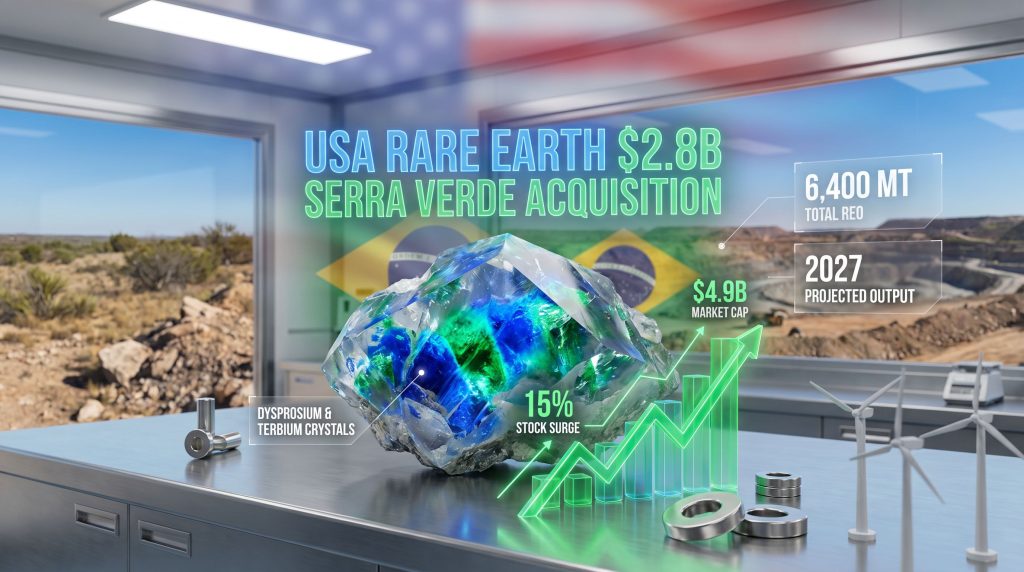
The USA Rare Earth $2.8B Brazil acquisition of Serra Verde represents a fundamental shift toward vertically integrated critical mineral platforms outside traditional Asian supply networks. Critical mineral supply chains face unprecedented transformation as Western economies confront strategic vulnerabilities in rare earth element access. The concentration of processing capabilities within single-source suppliers has created systemic dependencies that extend across defense manufacturing, renewable energy infrastructure, and advanced technology sectors. When supply disruptions materialise, entire industrial ecosystems experience cascading effects that can persist for years while alternative sources develop operational capacity.
Strategic Consolidation Reshapes Global Rare Earth Supply Architecture
This transaction creates the first comprehensive Western rare earth operation capable of competing directly with established Chinese supply chains through integrated mining, processing, and manufacturing capabilities. Furthermore, the deal demonstrates how critical minerals strategy initiatives are materialising through private sector consolidation.
Transaction Structure and Market Impact:
- Total Consideration: $2.8 billion comprising $300 million cash and 126.9 million shares
- Closure Timeline: Q3 2026 pending regulatory approvals
- Market Response: 15% share price surge elevating market capitalisation to $4.9 billion
- Strategic Rationale: Creating integrated mine-to-magnet supply chain independence
The acquisition combines Serra Verde's operational Pela Ema mine in Brazil with USA Rare Earth's development-stage Round Top project in Texas. Additionally, it includes European metallisation capabilities through Less Common Metals in the United Kingdom, and planned Oklahoma magnet manufacturing facilities launching in 2026.
Barbara Humpton, Chief Executive Officer of USA Rare Earth, characterised this transaction as creating an integrated platform positioned to serve as a cornerstone of global rare earth supply security for decades. The executive emphasised Serra Verde's unique position as the only producer outside Asia capable of supplying all four magnetic rare earths at industrial scale.
When big ASX news breaks, our subscribers know first
Heavy Rare Earth Elements Drive Strategic Technology Infrastructure
Heavy rare earth elements constitute the most strategically vulnerable segment of critical mineral supply chains due to their irreplaceable role in high-performance applications. Unlike light rare earths, these materials cannot be substituted without significant performance degradation in defense systems, renewable energy equipment, and advanced manufacturing processes.
Critical Application Domains:
| Sector | Primary Elements | Strategic Applications |
|---|---|---|
| Defence Systems | Dysprosium, Terbium | Precision-guided munitions, electronic warfare |
| Renewable Energy | Neodymium, Dysprosium | Wind turbine generators, EV motors |
| Advanced Manufacturing | Yttrium, Terbium | Robotics actuators, aerospace components |
| Medical Technology | Yttrium, Dysprosium | Medical imaging, surgical lasers |
Serra Verde Production Specifications:
Phase 1 operations target 6,400 metric tons of total rare earth oxide annually, with management projecting supply of over 50 percent of non-China heavy rare earth production by 2027. Phase 2 expansion potential offers production doubling opportunities, though specific investment requirements and timelines await additional engineering studies.
The ionic clay deposit at Pela Ema naturally concentrates heavy rare earth elements at 2-4 percent of total REO content, compared to 1-2 percent typical of hard-rock mining operations. This geological advantage translates directly into processing efficiency and cost structure benefits.
What are the technical requirements for dysprosium?
Modern wind turbine permanent magnet generators require neodymium-praseodymium-dysprosium-iron-boron alloys with specific dysprosium content to withstand operating temperatures exceeding 150°C. Without dysprosium doping, permanent magnet performance degrades precipitously above 120°C, necessitating system oversizing or operational derating.
Electric vehicle permanent magnet motors typically contain 500-800 grams of rare earth permanent magnet material, with dysprosium comprising 3-5 percent of total magnet weight. Large wind turbines contain 300-600 kilograms of permanent magnet material requiring precise dysprosium specifications for thermal stability.
Integrated Supply Chain Architecture Addresses Critical Vulnerabilities
Western rare earth supply chain development has historically suffered from fragmentation, with mining projects lacking processing capabilities and processing facilities depending on uncertain feedstock supply. This acquisition addresses multiple vulnerability points simultaneously through geographic diversification and operational integration. In addition, the development mirrors broader mining industry consolidation trends across critical mineral sectors.
Multi-Jurisdictional Asset Portfolio:
- Brazil Operations: Pela Ema ionic clay mining with 6,400 MT annual REO capacity
- Texas Development: Round Top heavy rare earth project advancing through feasibility studies
- European Processing: Less Common Metals metallisation and alloy production in the UK
- U.S. Manufacturing: Oklahoma magnet plant launching 2026 for direct customer supply
Supply Chain Integration Timeline:
Typical rare earth supply chain latency extends 120-180 days from ore extraction through finished magnet delivery. This includes quarterly mining cycles, 45-90 days for processing concentrate, 30-60 days for chemical separation, 15-30 days for metallisation, and 20-45 days for magnet manufacturing. Integration reduces working capital requirements and inventory management complexity while improving supply reliability.
How does processing technology create advantages?
Serra Verde's ionic clay extraction utilises in-situ leaching technology, reducing overburden removal costs by approximately 50-60 percent relative to hard-rock mining. The in-situ leaching benefits extend beyond cost reduction to include environmental advantages through reduced surface disturbance.
The simplified processing chemistry for ionic clay deposits requires fewer processing steps than hard-rock beneficiation, reducing throughput time by 25-35 percent. This efficiency advantage becomes crucial when managing supply chain disruptions or responding to market demand fluctuations.
Historical Supply Disruption Context:
China's 2010-2015 export quota restrictions reduced rare earth export allowances by 30-50 percent annually, causing dysprosium prices to surge from $5-10/kg to $250-400/kg. Similarly, terbium prices increased from $10-15/kg to $500-1,000/kg during this period. Manufacturers without secured supply contracts experienced production disruptions lasting 12-24 months while alternative sources developed.
Financial Projections Reflect Integrated Platform Economics
The transaction structure incorporates multiple risk mitigation mechanisms while targeting aggressive growth trajectories that reflect the economics of vertical integration rather than standalone mining operations. Furthermore, the financial structure aligns with current executive order on critical minerals priorities for domestic supply chain development.
Combined Entity Financial Targets:
| Metric | 2027 Target | 2030 Target |
|---|---|---|
| Combined EBITDA | $650 million | $1.8 billion |
| Cash Flow Conversion | ~80% | ~80% |
| Pro Forma Liquidity | $3.2 billion | TBD |
Revenue Stability Framework:
Serra Verde's 15-year offtake agreement covers 100 percent of Phase 1 production for neodymium, praseodymium, dysprosium, and terbium with minimum price floors. This contracted revenue base de-risks approximately 60-70 percent of projected cash flows during the critical production ramp period.
Government Financial Support Structure:
USA Rare Earth previously secured $1.6 billion in funding from U.S. government entities through Development Finance Corporation and Department of Commerce loan facilities. Serra Verde independently obtained $565 million in DFC financing specifically for expansion funding through positive cash flow achievement.
Combined pro forma liquidity reaches $3.2 billion, comprising approximately $1.2 billion in cash and $1.8 billion in milestone-based government funding tranches. This financial structure provides adequate capital for both integration execution and capacity expansion without dilutive equity financing.
What risk mitigation elements are in place?
- Operational Diversification: Multi-jurisdictional asset base reduces single-country policy risk
- Market Demand Security: Long-term contracts with strategic customers in defence and renewable energy
- Technology Validation: Proven ionic clay extraction and processing at commercial scale
- Government Alignment: Strategic importance recognition through official financing support
Market Dynamics Transform Through Strategic Consolidation
The creation of a Western-controlled, vertically integrated rare earth platform fundamentally alters competitive dynamics in critical minerals markets by establishing an alternative to Chinese supply networks with comparable scale and integration. This transformation parallels developments in European critical raw materials facility planning.
Supply Concentration Reduction Impact:
China currently controls approximately 85-90 percent of global rare earth separation capacity, 60-70 percent of mining production, and 70-75 percent of permanent magnet manufacturing. This transaction represents the first meaningful alternative at integrated platform scale rather than isolated mining or processing operations.
Strategic Customer Benefits:
- Supply Security: Diversified sourcing reduces geopolitical supply risk
- Quality Standards: Western ESG and technical specifications alignment
- Contract Flexibility: Alternative pricing mechanisms and terms
- Technology Access: Direct engagement with processing and manufacturing capabilities
Competitive Response Scenarios:
Successful execution could accelerate development timelines for competing Western rare earth projects, increase government support for domestic processing capabilities, and strengthen strategic partnerships between allied nations for critical mineral cooperation.
How will market structure evolve?
Traditional rare earth market structure separating mining, processing, and manufacturing into distinct sectors creates multiple transaction points and potential supply disruptions. Integrated platforms reduce these friction points while enabling direct customer relationships across the entire value chain.
Geopolitical Implications Extend Beyond Commercial Outcomes
This transaction represents industrial policy implementation through private sector consolidation, aligning commercial objectives with national security priorities across multiple allied jurisdictions. The deal demonstrates how the USA Rare Earth $2.8B Brazil acquisition serves broader strategic objectives beyond commercial returns.
Strategic Policy Alignment:
- U.S. Critical Minerals Strategy: Diversification away from single-source suppliers
- Brazil-U.S. Resource Partnership: Strengthened cooperation in critical mineral development
- Defence Industrial Base: Secure rare earth supply for military applications
- Allied Coordination: Framework for additional resource cooperation initiatives
Long-term Strategic Effects:
Reduced leverage of export restriction policies through alternative supply availability enhances negotiating positions in trade discussions. The precedent of successful Western rare earth integration may encourage similar consolidation in other critical mineral sectors.
What technology transfer opportunities exist?
Combining Brazilian ionic clay expertise, American project development capabilities, and European metallisation technology creates knowledge transfer opportunities that strengthen the entire Western rare earth technology base. This collaboration enhances innovation capacity across multiple jurisdictions.
The next major ASX story will hit our subscribers first
Ionic Clay Technology Advantages Over Traditional Hard Rock Mining
Serra Verde's Pela Ema operation represents the first commercial-scale ionic clay rare earth mine outside Asia, utilising extraction technology that offers significant advantages over conventional hard rock mining approaches.
Ionic Clay Processing Advantages:
| Factor | Ionic Clay | Hard Rock Mining |
|---|---|---|
| Heavy REE Concentration | 2-4% of total REO | 1-2% of total REO |
| Processing Complexity | Simplified acid leaching | Multi-stage beneficiation |
| Environmental Impact | Lower surface disturbance | Extensive overburden removal |
| Capital Requirements | Reduced infrastructure needs | Higher upfront investment |
| Production Ramp Timeline | 12-18 months | 24-36 months |
Extraction Process Efficiency:
Ionic clay deposits allow in-situ leaching extraction where sulphuric acid solutions percolate through clay formations, selectively dissolving rare earth elements. This process eliminates crushing, grinding, and flotation stages required for hard rock processing, reducing both energy consumption and processing infrastructure requirements.
Operational Metrics:
- Phase 1 Annual Capacity: 6,400 MT total rare earth oxide
- Resource Base: Long-term extraction potential from extensive clay deposits
- Processing Recovery: Higher extraction efficiency for heavy rare earths
- Environmental Footprint: Reduced waste rock generation and water consumption
The natural concentration of heavy rare earth elements in ionic clay deposits creates immediate strategic value, as these materials command premium pricing and represent the most supply-constrained segment of rare earth markets.
Execution Risks and Mitigation Strategies
Large-scale mergers in the mining sector face multiple execution challenges requiring comprehensive risk management across technical, operational, financial, and regulatory dimensions. However, the strategic nature of rare earth supply chains provides additional support mechanisms.
Integration Complexity Management:
| Risk Category | Specific Challenges | Mitigation Approach |
|---|---|---|
| Operational Integration | Multi-jurisdictional coordination | Experienced management teams |
| Regulatory Approval | Complex clearance requirements | Government strategic support |
| Production Scaling | Meeting aggressive targets | Proven technology base |
| Market Demand | Sustained customer requirements | Long-term contract security |
What are the technical execution risks?
Scaling ionic clay processing from current levels to full Phase 1 capacity requires operational optimisation across extraction, processing, and logistics systems. While the technology has been proven at commercial scale, achieving targeted production rates within projected timelines demands careful execution management.
Regulatory Approval Process:
Multi-jurisdictional transactions require regulatory clearance across Brazilian, American, and European frameworks. The strategic nature of rare earth supply chains may accelerate approval processes, though comprehensive review of foreign investment implications remains necessary.
Market Demand Validation:
Projected growth in electric vehicle, wind energy, and defence applications drives rare earth demand forecasts. However, technology substitution, recycling advancement, or demand growth slower than projected could impact pricing and volume assumptions.
Future Critical Minerals Investment Catalysed by Strategic Validation
Successful completion of this acquisition could establish a template for additional consolidation and investment in Western critical minerals assets across multiple commodity sectors. The USA Rare Earth $2.8B Brazil acquisition demonstrates commercial viability of large-scale critical mineral integration.
Sector Validation Impact:
- Commercial Viability Demonstration: Proof that Western rare earth projects can achieve competitive scale
- Valuation Benchmark Establishment: Pricing metrics for similar strategic assets
- Institutional Investor Attraction: Mainstream investment community engagement
- Technology Transfer Validation: Successful integration of diverse technical capabilities
How will government policy support expand?
The public-private partnership model validated through this transaction may encourage creation of additional financing facilities for critical mineral development. Allied resource cooperation initiatives could expand based on demonstrated success of multi-jurisdictional integration.
Strategic Asset Premium Development:
Critical mineral assets with integration potential or strategic customer relationships may command valuation premiums reflecting supply security value rather than purely commodity pricing. Development timelines for competing projects may accelerate to capture market opportunities before supply alternatives mature.
Investment Framework Evolution:
Traditional mining investment criteria focused on resource quality, extraction costs, and commodity pricing may expand to include supply chain integration potential, strategic customer access, and government policy alignment. ESG considerations and supply chain transparency requirements continue gaining importance in investment decision frameworks.
The acquisition represents a significant boost to Western supply chains, demonstrating how strategic consolidation can address critical mineral vulnerabilities through integrated platform development.
Technology Innovation Acceleration:
Successful integrated platforms create capital availability and customer relationships that support continued technology innovation in extraction, processing, and manufacturing. Research and development capabilities distributed across multiple jurisdictions enhance the overall innovation capacity of Western rare earth supply chains.
Disclaimer: This analysis is based on publicly available information and should not be considered investment advice. Rare earth markets involve significant technical, operational, and market risks. Readers should conduct independent research and consult qualified professionals before making investment decisions. Forward-looking statements involve uncertainties that could cause actual results to differ materially from projections.
Looking for Exposure to Critical Minerals Discovery Opportunities?
The consolidation of rare earth supply chains demonstrates the strategic importance of critical mineral assets and their potential for significant market returns. Discovery Alert's proprietary Discovery IQ model instantly identifies significant mineral discoveries across the ASX, empowering subscribers to spot actionable opportunities in critical minerals and other sectors before broader market recognition occurs.