May 13, 2026
The Processing Problem That Defines the Modern Rare Earth Race
Most discussions about rare earth supply chains begin and end with mining. Which country has the largest deposits? Who is drilling the most holes in the ground? These questions, while relevant, miss the more consequential issue entirely. The defining challenge of the 21st-century critical minerals race is not geological availability — it is the capacity to transform raw ore into usable, high-purity materials that power electric motors, missile guidance systems, and AI-enabling semiconductors.
This distinction sits at the heart of why Trump rare earth supply from Brazil has emerged as one of the most strategically consequential bilateral conversations of 2026. Brazil holds geological riches that rival anyone on the planet. However, geological wealth and strategic supply security are not the same thing, and the gap between them is where geopolitics, capital, and sovereignty all collide.
When big ASX news breaks, our subscribers know first
Rare Earths as Geopolitical Currency: How We Got Here
Rare earth elements were once the domain of metallurgists and specialty chemical engineers. Today they are discussed in national security briefings and foreign policy summits. The shift was not sudden — it accumulated over decades as modern technology grew increasingly dependent on a narrow set of elements with no practical substitutes. The critical minerals demand surge reshaping global supply chains has only intensified this urgency.
Consider the applications driving current demand:
- Neodymium and praseodymium are essential for the permanent magnets inside electric vehicle drivetrains and wind turbines
- Dysprosium and terbium provide thermal stability in those same magnets, preventing demagnetisation at high operating temperatures
- Yttrium and europium underpin display technologies and certain defence-grade laser systems
- Lanthanum and cerium support optical systems, catalytic converters, and battery electrode materials
The concentration of processing capacity in a single country represents a systemic vulnerability that no amount of diplomatic goodwill can quickly resolve. China controls approximately 90% of global rare earth refining and separation capacity, according to widely cited industry data. This dominance extends beyond mining into the chemical processing steps that actually determine whether a country is a strategic supplier or merely a dirt exporter.
Beijing has demonstrated willingness to deploy this leverage instrumentally. China's rare earth export restrictions on processing-stage materials sent shockwaves through Western defence and technology supply chains, accelerating what policy communities now call "friend-shoring" — the deliberate redirection of critical supply chains toward geopolitically aligned partners.
The rare earth challenge is fundamentally a processing problem, not a mining problem. A nation sitting on vast reserves without refining infrastructure remains a raw commodity exporter, not a strategic partner capable of reshaping global supply chains.
Brazil's Geological Profile: What the Numbers Actually Mean
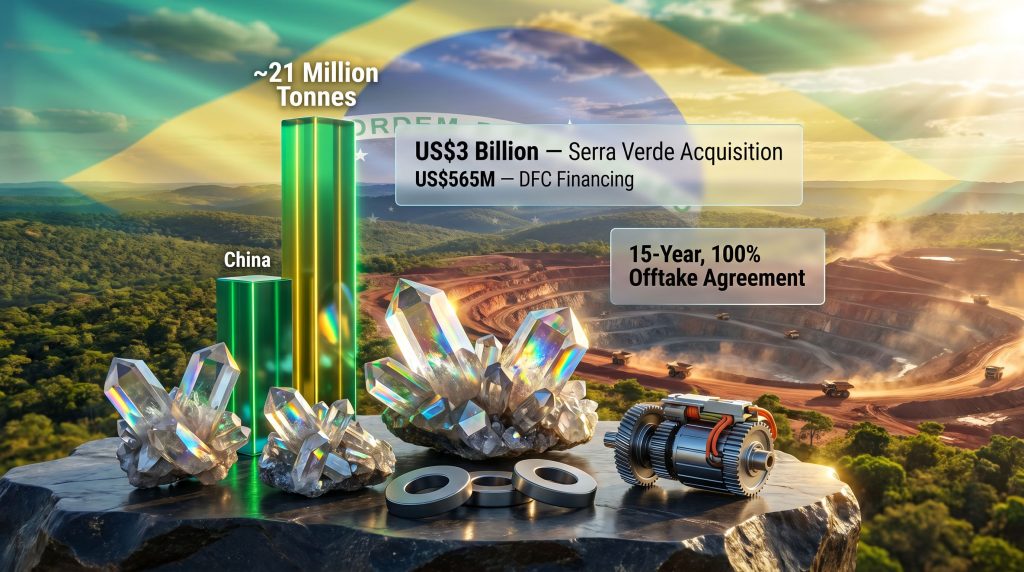
Brazil's position in the global rare earth conversation rests on a reserve base estimated at approximately 21 million tonnes, placing it second only to China worldwide. This figure, frequently cited by the Brazilian Mining Association, represents total in-ground resources rather than proven economically recoverable reserves — an important distinction that investors and policymakers sometimes conflate.
The geographic concentration of commercially relevant deposits spans several Brazilian states, with the Goiás region in central Brazil emerging as the most operationally significant. What makes the Brazilian reserve profile particularly noteworthy is the composition of those deposits. Heavy rare earth elements — specifically neodymium, praseodymium, dysprosium, and terbium — command the highest strategic premium because they are essential for NdFeB permanent magnets used across EV drivetrains, aerospace systems, and defence electronics.
The distinction between light and heavy rare earths matters enormously in commercial and strategic terms:
| Rare Earth Category | Key Elements | Primary Applications | Strategic Value |
|---|---|---|---|
| Light REEs | Lanthanum, Cerium, Neodymium | Catalysts, optics, motors | Moderate to high |
| Heavy REEs | Dysprosium, Terbium, Yttrium | High-performance magnets, defence | Very high |
| Magnetic REEs | Nd, Pr, Dy, Tb | NdFeB permanent magnets | Critical |
Brazil's Pela Ema mine in Goiás, operated by Serra Verde, is notable precisely because it can produce all four key magnetic rare earth elements simultaneously — a capability that only a handful of non-Asian operations anywhere in the world can claim. The mine commenced commercial operations in 2024, establishing Brazil's first large-scale rare earth production outside of laboratory or pilot-scale settings.
Projected to supply more than 50% of non-Chinese heavy rare earth output by 2027 upon completion of its Phase 2 expansion, the operation represents a rare combination of reserve quality and operational reality in a sector plagued by projects that promise but rarely deliver at scale.
The Serra Verde Acquisition: Decoding a US$3 Billion Strategic Bet
In April 2026, USA Rare Earth completed its acquisition of Serra Verde in a transaction valued at approximately US$3 billion, comprising roughly US$2.5 billion in stock consideration and approximately US$300 million in cash. The deal was backed by substantial US government participation, including equity stakes exceeding 15% from the Department of Commerce, alongside US$565 million in financing provided through the US Development Finance Corporation.
The financial architecture of the transaction is worth examining carefully:
- Equity structure included significant government equity stakes, signalling that Washington views this as a strategic infrastructure investment rather than a purely commercial transaction
- A 15-year, 100% offtake agreement was established with US government agencies and private sector buyers, providing long-term revenue certainty
- Floor pricing mechanisms were embedded into offtake terms specifically to protect the supply chain against Chinese market dumping — a known tactic used historically to undercut new entrants
- DFC financing at scale demonstrates the US government's willingness to deploy development finance tools in the critical minerals domain at a level not previously seen in South America
This deal effectively converts a Brazilian geological asset into a US-aligned supply chain node without requiring domestic US mining expansion. Furthermore, for a country where domestic rare earth processing infrastructure remains severely underdeveloped, acquiring operational capacity abroad through government-backed vehicles represents the fastest available pathway to supply security.
The acquisition is the largest single foreign investment in Brazilian rare earth infrastructure on record, and it establishes a direct supply pipeline from South American ore to American industrial and defence consumers — a pipeline that did not exist in any meaningful form before 2026. However, Brazil's antitrust investigation into the deal signals that Brasília intends to scrutinise the terms carefully before extending a full regulatory blessing.
The Trump-Lula Summit: Minerals Beneath the Diplomatic Surface
When Presidents Trump and Lula convened at the White House in early May 2026 for approximately three hours of bilateral engagement, the official framing centred on trade relations and diplomatic normalisation. The underlying agenda was considerably more specific, touching directly on Trump rare earth supply from Brazil and what each government needed from the other.
Washington's urgency was shaped in part by the timing of a forthcoming US diplomatic visit to China. Demonstrating credible alternative supply relationships before engaging Beijing added strategic weight to American negotiating posture — a calculation that made progress on Brazilian minerals cooperation particularly valuable in the weeks leading up to that visit.
Lula's position reflected a carefully constructed negotiating stance with two simultaneous objectives:
- Attracting foreign capital from any willing partner — explicitly including the United States, China, Germany, Japan, and France — without committing to exclusivity
- Retaining domestic value capture by mandating that all mineral processing and refining occur within Brazilian territory rather than exporting unprocessed ore
This insistence on domestic processing is not merely a commercial preference. It reflects a Brazilian national development framework in which critical mineral wealth must generate industrial capability, skilled employment, and technological transfer within Brazil's borders — not simply royalty payments and raw material exports.
A new Brazilian regulatory framework for critical minerals was approved immediately prior to the White House visit, signalling institutional readiness for structured investment partnerships while simultaneously establishing the rules under which such partnerships would operate.
Analysts who observed the summit characterised the engagement as a pragmatic alignment of overlapping interests rather than any deeper ideological convergence between two governments that remain quite different in political orientation. Critical minerals represented the singular domain where both leaders could demonstrate tangible deliverables without resolving the deeper bilateral tensions that persist across trade, climate, and regional governance issues.
The Lula-Trump summit functioned less as a diplomatic reset and more as a transactional alignment centred on resource access. Rare earths provided the one area of mutual benefit capable of bridging significant political distance between two administrations that agree on very little else.
Structural Barriers: The Gap Between Geological Wealth and Production Reality
Brazil's structural challenges in translating reserve endowment into sustained production capacity are well-documented and deserve serious analytical weight. Understanding these barriers is essential for investors and policymakers assessing realistic timelines for Brazilian rare earth supply contribution. The rare earth processing challenges facing the sector globally are particularly acute in the Brazilian context.
The Processing Infrastructure Deficit
Despite holding world-class reserves, Brazil currently lacks the downstream refining and separation infrastructure required to produce high-purity rare earth oxides and metals at commercial scale. This is the central vulnerability in the Brazilian rare earth story. Without domestic processing capability, Brazil captures only the lowest margin segment of the value chain — ore extraction — while the higher-value chemical separation and metallurgical processing steps remain concentrated in China and, to a lesser extent, in emerging facilities in Australia and the United States.
Regulatory and Permitting Complexity
Environmental licensing in Brazil is among the most complex and time-consuming globally. Bureaucratic overlap between federal, state, and municipal regulatory bodies creates approval timelines measured in years rather than months. Territorial disputes and indigenous land rights frameworks introduce additional project risk that cannot be easily managed through capital deployment alone.
Social License Challenges
Mining expansion in ecologically sensitive regions of Brazil faces organised civil society opposition. Community resistance has historically delayed or permanently blocked projects that were otherwise commercially sound. This social licence dimension is often underweighted in financial models built by external investors unfamiliar with Brazilian civil society dynamics.
The Sovereignty Risk Premium
As critical minerals negotiations become more politically prominent globally, the policy conversation within Brazil risks shifting from investment facilitation toward resource nationalism. Heightened sovereignty discourse could slow permitting approvals and deter foreign capital deployment at precisely the moment when demand for Brazilian minerals is peaking.
The tension between attracting US investment and maintaining strategic autonomy over national resource wealth represents Brazil's central policy dilemma as it navigates this geopolitical moment.
The next major ASX story will hit our subscribers first
Comparative Supply Chain Positioning: Where Brazil Fits
To properly contextualise Brazil's strategic importance, it is useful to position it against the other supply alternatives that Washington is simultaneously pursuing as part of its broader friend-shoring strategy. America's rare earth supply chain diversification efforts have made this kind of comparative analysis increasingly central to policy planning.
| Supply Source | REE Reserve Scale | Processing Capacity | US Alignment | Key Risk Factor |
|---|---|---|---|---|
| China | Dominant | ~90% global share | Adversarial | Geopolitical leverage |
| Brazil | ~21M tonnes (2nd globally) | Limited, developing | Pragmatic | Sovereignty conditions |
| Australia | Significant | Emerging (Lynas) | Strong | Scale constraints |
| United States | Moderate | Very limited | Full | Processing infrastructure gap |
| Canada | Moderate | Early-stage | Strong | Development timeline |
Brazil's combination of reserve scale, geographic proximity to US markets, and existing commercial production at Pela Ema gives it a structural advantage over most alternatives. Australia's Lynas Corporation, while operationally mature, operates processing facilities partly in Malaysia and faces scale constraints relative to the volumes Washington requires. Domestic US production remains constrained by severe processing infrastructure limitations despite renewed political focus on the sector.
Brazil's refusal to exclude Chinese investors from its minerals sector introduces a competitive dynamic that, paradoxically, may accelerate American deal-making rather than inhibit it. Washington's awareness that Beijing could capture access to Brazilian reserves if the US moves too slowly creates urgency that translates directly into the scale of financing commitments like the DFC's US$565 million contribution.
Beyond Rare Earths: The Full Critical Minerals Agenda
The US-Brazil critical minerals dialogue extends considerably beyond rare earth elements. A comprehensive picture of what is actually at stake includes:
- Niobium: Brazil controls an estimated 90% or more of global niobium production, a critical steel-strengthening additive with significant defence and aerospace applications. This near-monopoly position receives far less international attention than rare earths but represents an equally significant supply concentration risk for Western industrial supply chains
- Graphite: Essential for EV battery anodes, Brazil holds significant natural graphite deposits that are increasingly relevant as battery demand scales through the late 2020s
- Lithium: Emerging Brazilian lithium deposits are attracting early-stage exploration investment, though commercial-scale production remains some years away
- Nickel and Copper: Both play supporting roles in EV and grid infrastructure supply chains, and Brazil's production of each contributes to the broader critical minerals cooperation agenda
The Brazilian Mining Association projects total critical minerals investment of US$21.3 billion through 2030, with approximately US$2.4 billion specifically allocated to rare earth element development. These figures represent aspirational investment targets rather than confirmed capital commitments — a distinction that matters when assessing realistic production trajectory timelines.
Three Scenarios for How This Unfolds
The trajectory of US-Brazil rare earth cooperation is not predetermined. Furthermore, the rare earth supply chain importance underpinning these negotiations means that several distinct scenarios are plausible depending on how the key variables evolve over the next two to four years.
Scenario A: Structured Partnership with Processing Investment
US capital and technology flow into Brazilian refining infrastructure alongside extraction investment. Brazil achieves domestic value-added processing while securing long-term offtake agreements with US buyers. This outcome represents genuine supply chain diversification with shared economic benefit — and is the scenario both governments publicly endorse.
Scenario B: Raw Material Access Without Technology Transfer
US investment concentrates in extraction rather than processing, leaving Brazil as a commodity-stage supplier. This generates domestic political backlash and is unlikely to prove sustainable given Lula's explicit processing sovereignty conditions. Resource nationalism escalation becomes the probable outcome.
Scenario C: Multilateral Competition Drives Better Terms for Brazil
Chinese, European, and Japanese investors compete aggressively alongside US capital for Brazilian minerals access. Brazil leverages this competition to extract maximum technology transfer and processing investment commitments from all suitors. Brazil captures greater value chain share while the US faces tighter supply access conditions than Washington's current optimism anticipates.
Disclaimer: The scenarios outlined above represent analytical frameworks for thinking about potential future developments and do not constitute investment advice. Forward-looking projections in the critical minerals sector carry significant uncertainty and should not be relied upon as predictions of actual outcomes.
Key Milestones Worth Monitoring
For investors and analysts tracking this space, several near-term developments will be particularly informative:
- The Phase 2 expansion timeline at Pela Ema (targeted for mid-2027) and whether permitting and construction timelines hold
- Implementation progress on Brazil's newly approved critical minerals regulatory framework
- Evolution of US-Brazil bilateral trade and tariff negotiations, which provide the broader commercial context for minerals cooperation
- Whether additional US acquisitions or joint ventures in the Brazilian REE sector follow the Serra Verde template
- The degree to which Chinese investment activity in Brazilian minerals accelerates in response to US engagement, and how Brasília manages the resulting geopolitical tension
The broader lesson from the Trump rare earth supply from Brazil story may ultimately be this: in the modern critical minerals race, the most valuable assets are not necessarily those with the largest reserves, but those with the right combination of reserve quality, operational readiness, geopolitical positioning, and the domestic policy architecture to attract and sustain foreign capital without surrendering strategic control. Brazil has most of these attributes. Whether it can resolve the processing gap before the geopolitical window narrows is the defining question of the next three years.
Want to Track the Next Major Critical Minerals Discovery Before the Market Does?
Discovery Alert's proprietary Discovery IQ model delivers real-time alerts on significant ASX mineral discoveries — instantly converting complex geological data into actionable investment insights for both short-term traders and long-term investors. Explore why historic discoveries have generated extraordinary returns on Discovery Alert's dedicated discoveries page, and begin your 14-day free trial today to position yourself ahead of the market.