May 13, 2026
When Supply Chain Geography Becomes Industrial Policy
The geography of critical minerals has never been politically neutral, but the scale of industrial dependency now attached to phosphate and rare earth element supply chains has elevated sourcing decisions into something closer to national security calculus. Across allied industrial economies, procurement teams that once optimised purely for price are now weighing jurisdictional stability, diplomatic alignment, and long-term access security as primary variables. This shift did not happen overnight. It accumulated through years of export restrictions, resource nationalism, and the gradual recognition that concentration of processing capacity in a single dominant supplier nation creates fragility across entire industrial ecosystems.
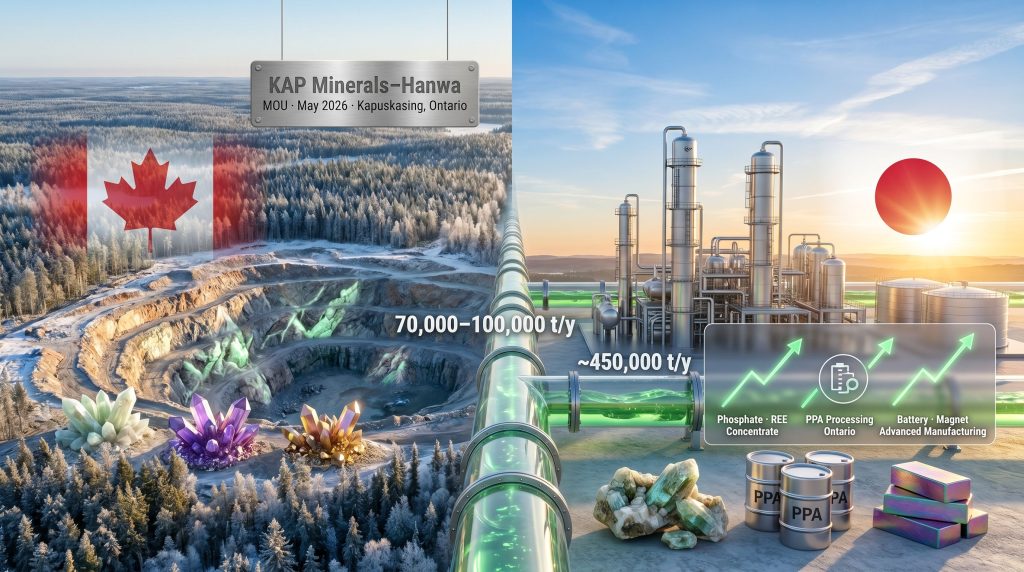
The KAP Minerals Hanwa Canada Japan critical minerals supply chain partnership, formalised through a memorandum of understanding signed in May 2026, sits squarely within this structural transformation. However, to understand why this specific agreement warrants close attention, it is worth first examining the geological and geopolitical conditions that make it strategically distinctive.
When big ASX news breaks, our subscribers know first
The Geology That Changes the Strategic Equation
Not all phosphate is equivalent, and this is a point that rarely receives sufficient attention outside specialist mining circles. The global phosphate industry is dominated by sedimentary deposits, which account for the overwhelming majority of production worldwide. These sedimentary sources, concentrated in Morocco, China, and parts of the Middle East, typically carry higher levels of impurities including cadmium, uranium, and radioactive thorium compounds that must be managed through processing. They also generally lack meaningful co-located rare earth element content.
Igneous apatite deposits represent a fundamentally different geological category. Formed through magmatic processes rather than marine sediment accumulation, these deposits typically exhibit lower impurity profiles and, critically, carry natural co-occurrence of rare earth elements within the apatite mineral structure itself. This dual-commodity characteristic transforms the economic and strategic profile of the host project entirely. Furthermore, rather than producing a single fertiliser-grade commodity, an igneous apatite operation can simultaneously generate phosphate concentrates and REE concentrates from a single ore stream, with each product feeding entirely different downstream markets.
The Kapuskasing deposit in Northern Ontario sits within this rare geological category. The project is built on the redevelopment of the former Agrium phosphate mine and tailings complex, an asset with established infrastructure and a known geological footprint. The combination of a proven deposit type, existing site infrastructure, and the dual-product potential of igneous apatite makes the Kapuskasing platform unusual among global phosphate development projects. This geological distinctiveness is foundational to the entire KAP-Hanwa partnership thesis.
Understanding Purified Phosphoric Acid and Why It Matters
One of the less-understood dimensions of this partnership involves the Phase 2 target of producing purified phosphoric acid, commonly referred to as PPA, within Ontario. To appreciate the significance, it helps to understand the phosphoric acid production hierarchy.
Standard wet-process phosphoric acid, produced by reacting phosphate rock with sulphuric acid, is the workhorse product of the fertiliser industry. It carries impurities that limit its applications in high-value sectors. Purified phosphoric acid undergoes additional processing steps to remove those impurities, achieving grades suitable for use in:
- Battery-grade lithium iron phosphate cathode material production
- Semiconductor manufacturing and electronic-grade chemical supply chains
- Food and pharmaceutical grade applications
- Specialty industrial chemicals and surface treatment processes
The price differential between standard wet-process phosphoric acid and purified phosphoric acid is substantial, reflecting both the additional processing investment and the specificity of end-market demand. By targeting PPA production within Ontario, the KAP-Hanwa partnership is not merely capturing more revenue per tonne of phosphate processed. It is inserting Canada directly into the advanced materials supply chain rather than functioning purely as a raw material exporter. This vertical integration aspiration distinguishes the deal structurally from conventional mining offtake arrangements.
The KAP Minerals-Hanwa Partnership: Structure and Strategic Logic
The MOU signed between KAP Minerals and Hanwa on May 12 and 13, 2026 establishes a framework for negotiating binding long-term commercial agreements across two distinct development phases. Understanding the architecture of each phase clarifies why this partnership represents something more sophisticated than a standard commodity offtake.
Phase Architecture at a Glance
| Phase | Production Target | Key Output | Hanwa's Role |
|---|---|---|---|
| Phase 1 | 70,000 to 100,000 t/y | Phosphate product and REE concentrates | Offtake buyer and global distributor |
| Phase 2 | Approximately 450,000 t/y | High-grade phosphate concentrate, REE concentrates, additional critical minerals | Consortium developer and processing partner |
| Downstream (Phase 2) | Volume TBD | Purified phosphoric acid (PPA) | Technical cooperation and distribution partner |
Source: Creamer Media, MiningWeekly.com, May 13, 2026
Phase 1: Market Access Through Industrial Networks
In the initial phase, Hanwa assumes the role of commercial gateway. As KAP Minerals' offtake buyer and distributor, Hanwa brings something that a junior mining company simply cannot develop independently within a viable commercial timeframe: deep, pre-existing relationships with battery manufacturers, automotive companies, magnet producers, and advanced materials firms across global markets.
This matters because phosphate and REE concentrates are not homogeneous commodities traded on open exchanges in the way that iron ore or copper are. Buyers in the battery materials and permanent magnet industries require consistent specification, reliable volumes, and bankable supply continuity. Hanwa's established position within these industrial ecosystems effectively functions as a market credibility transfer, connecting KAP's production with end-users who might otherwise require years of relationship development.
Phase 2: The Downstream Consortium Model
The second phase moves significantly beyond traditional offtake into territory that reflects the consortium-building logic increasingly characteristic of allied-nation critical minerals strategy. Hanwa's managing executive officer Shoji Shirasawa articulated the company's intention to work closely with KAP in building a downstream consortium aimed at constructing a resilient supply chain benefiting both countries. This consortium orientation means Hanwa is actively seeking to recruit additional Japanese and global industrial partners around KAP's output, creating a demand ecosystem rather than a single-buyer dependency.
This consortium model reduces offtake concentration risk and creates more durable supply chain architecture than a bilateral commodity agreement ever could.
From an investor and commercial risk perspective, this structure is meaningful. Supply chains anchored by a single buyer relationship are inherently fragile. A consortium of industrial partners, each with distinct downstream applications and procurement rationales, creates redundancy and pricing resilience across market cycles.
Why Northern Ontario and Why Now
The timing and geography of this partnership reflect broader forces reshaping how allied industrial nations source critical materials. Ontario's combination of geological endowment, established mining jurisdiction credibility, rule of law, and proximity to North American manufacturing infrastructure makes it a structurally compelling location for exactly this type of investment.
Ontario Minister of Northern Economic Development and Growth George Pirie framed the MOU as demonstrating that trusted democratic allies can construct secure supply chains together without dependence on hostile or unstable supplier nations. Ontario Energy and Mines Minister Stephen Lecce articulated the provincial government's stated commitment to reducing regulatory friction and accelerating responsible resource development, positioning Ontario as an aspirant for the title of the world's most trusted critical minerals supplier.
The Kapuskasing community itself stands to benefit materially. While precise employment figures have not been specified in announced materials, the development of a multi-product critical minerals platform of this scale, combined with midstream processing capacity in the region, represents a qualitatively different category of investment than a conventional mine operating purely as a concentrate producer shipping raw product offshore.
Hanwa's Allied-Nation Supply Chain Strategy in Context
Hanwa's participation in this partnership is not an isolated transaction. It reflects a deliberate strategic pattern of building supply relationships with geopolitically stable, resource-rich, democratic nations to reduce Japan's industrial exposure to supply chain disruptions originating in geopolitically concentrated supplier jurisdictions.
Japan's position as a global leader in battery technology, automotive manufacturing, permanent magnet production, and advanced electronics creates substantial raw material exposure. The country imports the vast majority of its critical mineral inputs, and the structural dependence on Chinese-dominated processing capacity for rare earth elements in particular has shaped Japanese industrial policy for more than a decade. Following documented periods of REE export restrictions originating from China, Japanese industrial policy has systematically prioritised long-term supply security through public-private partnerships with allied nations over spot-market procurement.
The KAP Minerals Hanwa Canada Japan critical minerals supply chain arrangement is consistent with this Japanese industrial strategy and mirrors the framework logic of allied-nation critical minerals cooperation agreements being developed across multiple bilateral relationships simultaneously. In addition, China's trade strategy around rare earth exports continues to reinforce why diversified sourcing among democratic partners has become so commercially urgent.
Comparing Allied Critical Minerals Partnership Models
| Partnership Model | Countries | Key Minerals | Processing Dimension |
|---|---|---|---|
| KAP Minerals and Hanwa MOU | Canada and Japan | Phosphate and REEs | PPA production in Ontario (Phase 2) |
| Australia-Japan Critical Minerals Frameworks | Australia and Japan | Gallium, fluorite, mineral sands, magnesium | In-country beneficiation supported |
| US-Japan Critical Minerals Framework (2025) | USA and Japan | REEs and battery metals | Processing and refining cooperation |
The pattern across these frameworks is consistent: allied-nation industrial buyers are investing in upstream supply security not merely through purchasing agreements but through active participation in developing processing and beneficiation capacity within the supplier nation. This transforms the relationship from transactional to structural.
Downstream Markets: Where KAP's Output Connects to Industrial Reality
Understanding the end-market destinations for Kapuskasing's output clarifies the commercial rationale for both parties. The products KAP Minerals is targeting serve three distinct and growing demand pools.
Lithium Iron Phosphate Battery Chemistry
Phosphate feedstocks are a fundamental input for lithium iron phosphate, or LFP, battery cathode production. LFP chemistry has emerged as one of the fastest-growing segments in energy storage globally, favoured for its thermal stability, cycle life, and lower cobalt dependency relative to competing chemistries. Demand for high-purity phosphate inputs supporting LFP production is structurally linked to the global electrification trajectory in transport and stationary storage. Consequently, the critical minerals demand tied to energy transition is driving unprecedented interest in geopolitically secure phosphate sources.
Permanent Magnet and Defense Supply Chains
REE concentrates from the Kapuskasing project feed permanent magnet production, which in turn supplies:
- Electric vehicle traction motors
- Wind turbine generators
- Defense guidance and navigation systems
- Aerospace actuators and sensors
- Industrial robotics drive systems
- Consumer electronics components
The geographic proximity of a Canadian REE source to North American defense and automotive manufacturing supply chains carries strategic value beyond pure economics. Allied-nation sourcing for defense-relevant REE inputs reduces exposure to supply disruption risk that would otherwise require costly stockpiling or chemistry substitution. Furthermore, the role of critical raw materials in supporting the green transition makes this sourcing shift structurally durable rather than cyclical.
Purified Phosphoric Acid Applications
PPA's addressable markets span semiconductor manufacturing chemicals, battery-grade cathode precursor synthesis, food and pharmaceutical processing, and specialty surface treatment industries. Each of these sectors commands meaningfully higher prices per tonne than fertiliser-grade phosphate markets, reflecting the quality specifications and processing investment required. Innovations such as direct lithium extraction technology illustrate the broader trend towards advanced processing methods that elevate the value of Canadian critical mineral output.
The next major ASX story will hit our subscribers first
What This Partnership Signals for Critical Minerals Markets
The KAP Minerals Hanwa Canada Japan critical minerals supply chain MOU is best understood not as a bilateral mining deal but as a structural building block in a broader realignment of how critical minerals supply chains are being constructed among allied industrial economies. Mining Weekly's coverage of the announcement underscores the degree to which industry observers view this as a landmark agreement in the emerging allied-nation sourcing framework.
Several market signals embedded in this agreement deserve attention:
-
Geological rarity as strategic premium: The focus on igneous apatite deposits reflects a growing recognition among sophisticated industrial buyers that deposit type, not just volume, determines supply chain suitability for advanced applications.
-
Processing location as value capture: The explicit Phase 2 commitment to Ontario-based PPA production signals Canada's ambition to move up the critical minerals value chain rather than replicate the raw-material export model that characterised earlier resource booms.
-
Consortium architecture as risk management: Hanwa's stated intention to build a downstream consortium around KAP's output represents a sophisticated approach to supply chain resilience that distributes demand risk across multiple industrial buyers and application sectors.
-
Democratic sourcing as investable thesis: The framing by both companies and Ontario government officials of this partnership in terms of allied-nation trust and stable jurisdictional sourcing reflects a structural premium that industrial buyers are increasingly willing to pay for supply chain security.
Key Milestones Investors and Industry Observers Should Watch
- Progression from MOU framework to binding long-term offtake agreement with specified volumes, pricing mechanisms, and minimum purchase commitments
- Phase 1 production ramp achieving the 70,000 to 100,000 t/y phosphate output target and first commercial shipments through Hanwa's distribution network
- Feasibility study completion and investment decision for Ontario PPA processing capacity
- Formal announcement of downstream consortium members joining the Hanwa-coordinated demand ecosystem
- Technical cooperation announcements involving Canadian and Japanese government engagement in Phase 2 development
Disclaimer: This article contains forward-looking statements and projections based on publicly announced information. Production volumes, timelines, and commercial outcomes referenced are targets and aspirations, not confirmed results. Readers should not treat this analysis as financial advice. Investment decisions in the mining and critical minerals sector carry significant risk, and independent due diligence is strongly recommended before making any investment decision.
Want to Spot the Next Major Critical Minerals Discovery Before the Market Does?
Discovery Alert's proprietary Discovery IQ model scans ASX announcements in real time, instantly identifying significant mineral discoveries — including rare earth elements and critical minerals — and translating complex data into clear, actionable investment insights for traders and investors at every level. Explore historic discoveries and their remarkable returns on Discovery Alert's dedicated discoveries page, and begin your 14-day free trial today to position yourself ahead of the market.