May 13, 2026
The Processing Gap: Why Rare Earth Projects Live or Die on Metallurgical Proof
The global rare earth sector has a structural problem that resource size alone cannot solve. Dozens of projects around the world hold substantial deposits of neodymium, praseodymium, terbium, and dysprosium, yet the vast majority will never reach production. The reason is rarely geological. It is almost always metallurgical. The ability to demonstrably separate, concentrate, and characterise rare earth minerals from host rock under continuous industrial conditions represents a technical threshold that separates credible development assets from dormant resource estimates. In a market where end-users and financiers are actively seeking non-Chinese supply, the Defense Metals Wicheeda pilot flotation test programme exemplifies the kind of processing credibility that attracts capital.
This distinction matters enormously right now. China's dominance over rare earth processing capacity creates a systemic dependency that Western industrial policy has spent several years attempting to address. The critical inputs required for electric vehicle motors, wind turbine generators, and precision defence systems flow overwhelmingly through Chinese refining infrastructure. That concentration of control creates vulnerabilities extending well beyond mining into manufacturing and national security planning.
For Canada, the United States, and Australia, accelerating the development of domestically validated rare earth supply chains has become a core industrial objective. Furthermore, the convergence of critical minerals demand from the energy transition and mounting geopolitical pressure makes the metallurgical validation of projects like Wicheeda more commercially consequential than at any previous point.
When big ASX news breaks, our subscribers know first
Understanding What Pilot-Scale Testing Actually Proves
The Gap Between Laboratory and Bankability
There is a critical distinction in rare earth metallurgy between what a laboratory can demonstrate and what a bank or offtake partner will accept. Bench-scale flotation testing confirms basic process chemistry and establishes that separation is physically possible. It does not confirm whether a process circuit will behave consistently when operating continuously over days and weeks, processing hundreds of tonnes of ore rather than kilograms.
Pilot-scale testing bridges this gap. A properly designed pilot plant programme operating under near-continuous conditions generates several categories of data that bench-scale work simply cannot produce:
- Steady-state performance data confirming that recovery rates hold across extended operations rather than spiking during brief optimised test runs
- Engineering design parameters covering material handling behaviour, reagent consumption under realistic conditions, and circuit stability
- Representative bulk product suitable for downstream processing campaigns, which cannot be generated from laboratory-scale work
- Process tailings for environmental characterisation and geotechnical planning
Without these data sets, no lender conducting due diligence on a rare earth project will advance a financing package, and no industrial offtake partner will negotiate supply agreements. The practical consequence is that resource-stage projects without pilot-validated processing credentials remain financially stranded regardless of how attractive their resource grade or tonnage may appear. The rare earth processing challenges inherent to moving from bench to bankable results are, consequently, among the most decisive factors in project viability.
Why Two-Composite Design Is More Sophisticated Than It Appears
One of the less appreciated technical choices in the Defense Metals Wicheeda pilot flotation test programme is the decision to run two distinct ore composites rather than a single blended sample. This design directly addresses a challenge that has caused problems at other rare earth operations: geological variability across the orebody producing ore that behaves differently in the processing circuit at different stages of mine life.
The programme uses approximately 30 tonnes of drill core material divided into two subsamples. The first composite represents ore characteristics expected during years one through five of the prefeasibility study mine plan, covering the initial production period that will generate early cash flows and establish operational norms. The second composite captures transitional ore types from year six onwards, which are likely to differ in mineralogical composition and liberation behaviour.
Running the pilot circuit against both ore types within the same programme generates a process flowsheet validated across the realistic range of feed material the plant will encounter. This is meaningfully different from programmes that optimise exclusively against the highest-grade or most favourable material, producing results that may not hold when ore characteristics change mid-mine life.
The Wicheeda Deposit: Resource Fundamentals and Strategic Location
What the Numbers Say
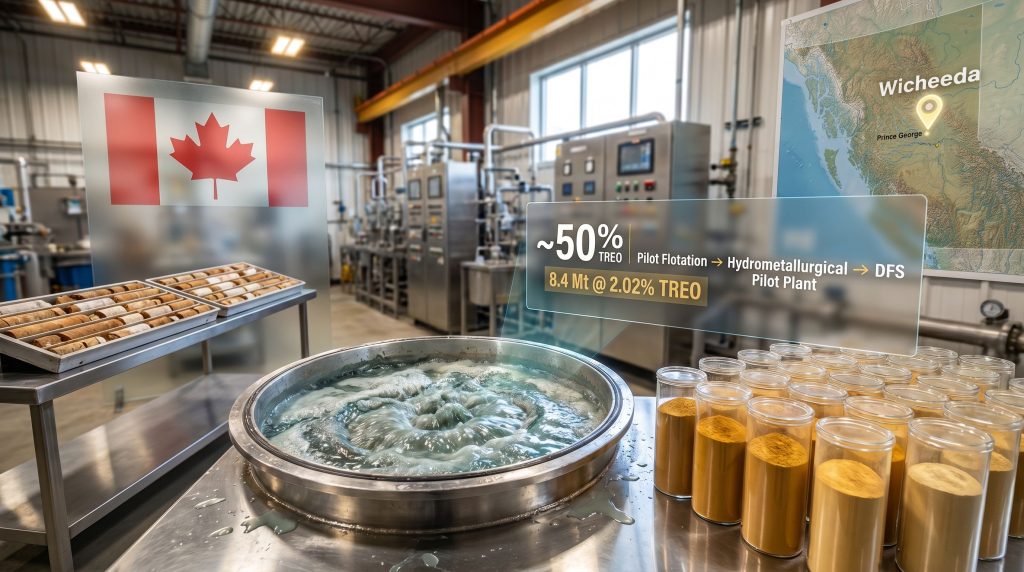
The Wicheeda rare earth project is situated near Prince George in British Columbia, Canada, and is listed on the TSX-V under ticker DEFN with an OTCQB listing under DFMTF. The project hosts an indicated resource of 8.4 million tonnes grading 2.02% Total Rare Earth Oxides (TREO), with primary target elements including neodymium, praseodymium, terbium, and dysprosium. A pre-feasibility study has been completed, positioning the project in the middle tier of the development lifecycle.
| Parameter | Detail |
|---|---|
| Location | Near Prince George, British Columbia, Canada |
| Exchange Listings | TSX-V: DEFN / OTCQB: DFMTF |
| Indicated Resource | 8.4 million tonnes at 2.02% TREO |
| Target Elements | Neodymium, Praseodymium, Terbium, Dysprosium |
| Development Stage | Post-PFS / Pilot Testing Phase |
| Testing Facility | SGS Canada, Lakefield, Ontario |
The British Columbia Advantage
Location within British Columbia carries several attributes that are genuinely relevant to project development rather than merely geographic footnotes. Access to Pacific port infrastructure at Prince Rupert and Vancouver creates viable export logistics to processing facilities in both North American and Asian markets. British Columbia's established mining regulatory framework, while rigorous, provides a degree of predictability that reduces timeline uncertainty relative to some other Canadian jurisdictions.
Critically, access to British Columbia's hydroelectric power grid supports lower-carbon processing operations. This is not a trivial consideration. ESG-aligned offtake partners and institutional investors are increasingly applying carbon intensity criteria to supply chain decisions, and rare earth processing is an energy-intensive activity. The ability to source processing power from hydroelectric generation creates a genuine competitive advantage in negotiations with potential partners in the EV and renewable energy sectors.
Where Wicheeda Sits Among North American Peers
| Project | Country | Stage | Distinguishing Feature |
|---|---|---|---|
| Wicheeda (Defense Metals) | Canada | Post-PFS / Pilot Testing | Balanced light and heavy REE profile |
| Mountain Pass (MP Materials) | USA | Operating Production | Only current US rare earth mine |
| Browns Range (Northern Minerals) | Australia | Pilot Production | Heavy rare earth specialisation |
| Nechalacho (Vital Metals) | Canada | Early Production | Remote northern logistics challenges |
| Eneabba (Iluka Resources) | Australia | Refinery Development | Integrated refinery model |
Programme Architecture: What the Wicheeda Pilot Is Designed to Deliver
Four Parallel Objectives Running Simultaneously
The Defense Metals Wicheeda pilot flotation test programme is structured to achieve four distinct outcomes within a single integrated campaign rather than addressing each sequentially. This multi-objective design is efficient from both a cost and timeline perspective, but it also requires careful planning to ensure that circuit operation optimised for one objective does not compromise data quality for another.
- Confirmatory validation of the 2021 pilot plant results under updated conditions using fresh drill core material representative of the current mine plan
- Concentrate generation targeting approximately 50% TREO grade, producing bulk product for the follow-on hydrometallurgical pilot plant campaign
- Engineering data collection providing process design criteria, material handling parameters, and operational performance benchmarks for future feasibility engineering
- Tailings characterisation generating representative process tailings samples for environmental assessment and geotechnical planning
Programme Specifications
| Metric | Value |
|---|---|
| Total drill core deployed | Approximately 30 tonnes |
| Target concentrate grade | ~50% Total Rare Earth Oxides (TREO) |
| Programme commencement | May 12, 2026 |
| Expected duration | Approximately five weeks |
| Execution facility | SGS Canada, Lakefield, Ontario |
| Programme budget | Approximately CAD $1 million |
Pre-Pilot Work Already Completed
Prior to commencing pilot plant operations, SGS Canada completed a structured programme of pre-pilot characterisation work designed to calibrate the circuit and minimise the risk of costly adjustments during pilot operations. This preparatory work included:
- Head assays confirming feed grade and elemental composition of both composite samples
- Grindability testing to establish comminution energy requirements and identify appropriate mill configurations
- Laboratory-scale flotation testing to calibrate reagent selection, dosing, and circuit parameters
- Pilot plant setup and commissioning activities to verify equipment functionality before ore feed commences
Completing this preparatory phase before pilot operations begin is standard metallurgical practice, but its completion represents genuine technical readiness rather than a scheduled milestone. Projects that skip or compress pre-pilot characterisation work frequently encounter circuit instability during pilot operations, wasting both programme time and budget.
The People and Institutions Behind the Programme
Why Third-Party Validation at SGS Canada Matters
Defense Metals selected SGS Canada's Lakefield facility to conduct the pilot programme, and the selection criteria centred on what the company described as SGS's standing as the benchmark for quality and integrity in the collaborative design and execution of pilot plants of this type. This institutional framing is deliberate and commercially significant.
For institutional investors and potential offtake partners reviewing metallurgical results, the identity and reputation of the testing laboratory is not a trivial consideration. Results generated in-house by a development company carry an inherent confirmation bias risk that third-party validation eliminates. SGS Canada's Lakefield facility carries global recognition in mining metallurgy, and its involvement establishes a quality baseline that supports the credibility of results in financing conversations and due diligence processes.
Independent metallurgical validation by a recognised third-party institution is increasingly treated by project lenders as a prerequisite rather than a preference. A result from SGS Lakefield carries weight that internal testwork simply cannot replicate in a bankable data package.
JR Goode: Over Six Decades of Rare Earth Metallurgical Expertise
The programme is managed on behalf of Defense Metals by chief metallurgical consultant JR Goode, whose career spans more than 60 years of experience in beneficiation and hydrometallurgical testwork design, monitoring, and interpretation across rare earth projects in Canada, the United States, China, Australia, Brazil, Greenland, Russia, and elsewhere.
This breadth of international project experience carries analytical value beyond individual technical tasks. A metallurgist who has worked across multiple continents and project types develops comparative insight into how ore mineralogy, reagent behaviour, and circuit design interact across different geological settings. For Wicheeda, this means programme results are being interpreted against a frame of reference that extends well beyond a single project or jurisdiction.
Jenike and Johanson: The Engineering Variable Most Projects Overlook
A detail in the programme structure that is easily overlooked is the engagement of Jenike and Johanson to conduct bulk solids handling testing on process streams generated during the pilot campaign. This specialisation addresses a consistently underestimated variable in rare earth processing plant design.
Bulk solids handling behaviour governs how materials flow through bins, hoppers, conveyors, and processing vessels. Rare earth concentrates, tailings, and intermediate products can exhibit highly variable flow properties depending on particle size distribution, moisture content, and mineralogical composition. Poor solids handling design leads directly to throughput bottlenecks, unplanned downtime, and expensive retrofitting during commissioning — problems that have affected numerous mineral processing projects.
By conducting bulk solids testing concurrently with the pilot programme using samples generated in real time, Defense Metals is incorporating engineering design rigour that feeds directly into feasibility study preparation, rather than treating it as a post-pilot afterthought.
Understanding the 50% TREO Concentrate Grade Target
Why Concentrate Grade Is a Commercial Benchmark, Not Just a Technical Metric
The programme's target of producing flotation concentrate grading approximately 50% Total Rare Earth Oxides (TREO) is not an arbitrary specification. Concentrate grade directly determines the economics of every subsequent processing step. Higher grade concentrates reduce the volume of non-rare earth material that must be processed through acid leaching circuits in hydrometallurgical operations, lowering reagent consumption, energy requirements, and waste volumes per unit of product output.
| Metric | Value |
|---|---|
| Target flotation concentrate grade | ~50% TREO |
| Maximum modelled flotation recovery | 82.4% (for feed grades above 3% TREO) |
| Praseodymium-specific recovery adjustment | x0.995 relative to TREO baseline |
| Dysprosium-specific recovery adjustment | x0.734 relative to TREO baseline |
| Hydrometallurgical recovery (praseodymium) | 93.2% |
The dysprosium recovery adjustment of x0.734 relative to the TREO baseline is a technically important figure. Dysprosium is a heavy rare earth element that commands substantially higher prices than light rare earths like cerium or lanthanum, and its recovery characteristics from flotation circuits can differ meaningfully from the overall TREO recovery metric. Understanding and characterising these element-specific recovery differences during pilot testing provides the data needed to accurately model revenue projections in feasibility studies.
What Comes After: The Hydrometallurgical Pilot Plant
The flotation concentrate generated during this programme feeds directly into the next major metallurgical milestone: a planned hydrometallurgical pilot plant campaign scheduled for later in 2026. This is where concentrate is converted into separated rare earth compounds, such as NdPr oxide and mixed heavy rare earth carbonate, that represent actual market-ready products rather than an intermediate processing output.
The progression from flotation pilot to hydrometallurgical pilot reflects a deliberate sequencing strategy. Flotation pilot results establish the quality and quantity of concentrate available for hydrometallurgical feed, while hydrometallurgical results establish the efficiency and economics of final product separation. Together, the two campaigns are expected to produce a metallurgical data package sufficient to support a definitive feasibility study — a milestone that fundamentally transforms a project's financial accessibility.
The next major ASX story will hit our subscribers first
The Development Pathway From Pilot Data to Construction Decision
A Clear Sequence With Defined Dependencies
The strategic value of the Wicheeda pilot programme is best understood within the broader development pathway it is designed to advance:
- Pilot Flotation Results (2026)
- Hydrometallurgical Pilot Plant Campaign (2026)
- Definitive Feasibility Study (DFS)
- Environmental Assessment and Permitting
- Project Financing (Debt, Equity, Offtake Structures)
- Construction Decision
Each step in this sequence has genuine dependencies on the one preceding it. Hydrometallurgical pilot plant design requires representative concentrate from the flotation pilot. DFS engineering requires process design criteria from both pilot campaigns. Project financing requires DFS-level capital and operating cost estimates. The linear dependency structure means that delays or weak results at any stage cascade forward.
What Successful Results Would Enable
If the pilot programme produces results consistent with the 2021 pilot plant and the PFS assumptions, several downstream developments become accessible:
- A confirmatory metallurgical data package accepted as bankable by project lenders and royalty/streaming financiers
- Engineering design inputs for process plant sizing and cost estimation in a DFS context
- Offtake negotiation leverage with end-users in the EV, wind energy, and defence manufacturing sectors
- A credible development narrative for continued investor engagement in a competitive critical minerals capital market
The Risks That Remain Even With Positive Results
Intellectual honesty requires acknowledging that successful pilot results, while genuinely significant, do not resolve all of the material risks facing the Wicheeda project. The CAD $1 million pilot budget represents a small fraction of the full project capital requirement. British Columbia's environmental assessment process carries timeline uncertainty. NdPr oxide prices remain subject to significant volatility driven by Chinese production policy, EV demand cycles, and macroeconomic conditions. Furthermore, as industry analysts have noted, pilot-scale performance provides a probabilistic rather than deterministic basis for full commercial-scale outcomes.
Disclaimer: This article contains forward-looking statements and projections based on currently available information. Mining project development outcomes are subject to numerous risks and uncertainties, including commodity price volatility, metallurgical variability, permitting delays, and capital market conditions. This content is informational in nature and does not constitute financial or investment advice.
What This Programme Signals to Investors and Industry Observers
Five Signals Worth Interpreting Carefully
The decision to commit CAD $1 million to a confirmatory pilot programme at this stage of development communicates several things to the market simultaneously:
- Process confidence: Management's willingness to invest in confirmatory work signals belief that results will hold under scrutiny, not that they are hoping to generate favourable data
- Institutional rigour: The combination of SGS Canada, JR Goode, and Jenike and Johanson represents a team assembled to produce results that will withstand due diligence from sophisticated counterparties
- Sequencing discipline: Pre-pilot characterisation already completed before programme commencement reflects organised execution rather than reactive management
- Engineering integration: Concurrent bulk solids testing indicates feasibility study preparation is advancing in parallel with metallurgical validation
- Strategic clarity: Concentrate generation targeted specifically for hydrometallurgical follow-on work demonstrates that the programme is designed as part of a pathway, not as a standalone milestone
The Broader North American Context
Canada's critical minerals strategy formally identifies rare earth elements as priority materials for domestic supply chain development. Federal and provincial funding mechanisms exist to support projects demonstrating credible development pathways, though access to any specific funding instrument depends on individual application processes and programme criteria that are independent of a project's technical merits.
What is clear is that the geopolitical environment has elevated the commercial and strategic value of projects capable of demonstrating processing capability rather than merely resource size. Trade tensions and export control measures affecting critical minerals supply chains have accelerated industrial policy responses in North America and allied economies, creating a market environment where technically credible rare earth development projects occupy a position of genuine strategic relevance.
The Defense Metals Wicheeda pilot flotation test programme, modest in its individual cost but significant in its developmental context, is advancing a project that sits at the intersection of these converging forces.
Want To Identify The Next Major Mineral Discovery Before The Market Does?
Discovery Alert's proprietary Discovery IQ model delivers real-time alerts on significant ASX mineral discoveries — cutting through complex data across more than 30 commodities to surface actionable opportunities the moment they are announced. Explore Discovery Alert's discoveries page to understand how historic finds have generated extraordinary returns, and begin your 14-day free trial today to position yourself ahead of the broader market.