June 15, 2026
The Hidden Cost of Shipping Opportunity Offshore
For decades, the economics of mineral extraction have followed a familiar and frustrating pattern for resource-rich nations: dig it up, ship it out, and watch the majority of value creation happen somewhere else. Countries endowed with world-class mineral deposits often capture only a fraction of the final product's worth, while processing hubs transform raw commodities into high-value industrial inputs that power everything from electric vehicles to military hardware.
Australia has lived this reality acutely. As one of the planet's most richly endowed mineral nations, it has historically shipped vast quantities of unprocessed critical minerals to offshore refiners, primarily in Asia, where the chemistry, infrastructure, and industrial expertise to convert raw ore into market-ready materials has long been concentrated. The gap between what a tonne of raw rare earth ore fetches on the open market and what that same material is worth after separation and refinement into high-purity oxides is not marginal. It is transformative.
That structural imbalance is now the explicit target of a new chapter in Australian industrial policy, one with a very specific address: Lucas Heights, Sydney. The Australia critical minerals refining facility Lucas Heights represents a decisive shift in how the nation intends to participate in the global critical minerals economy.
When big ASX news breaks, our subscribers know first
What the Australia Critical Minerals Refining Facility at Lucas Heights Actually Does
Opened on 8 May 2026, the new processing installations at the Australian Nuclear Science and Technology Organisation (ANSTO) campus in Lucas Heights represent something genuinely novel for Australian industry. Two distinct but strategically complementary facilities now operate on the site, each targeting a different class of critical material.
Clay-Hosted Rare Earth Processing
The first facility is engineered to process clay-hosted rare earth deposits, a category of mineralisation that is technically distinct from conventional hard-rock rare earth resources and has historically required specialised extraction approaches that have been largely absent from Australian soil.
Understanding the difference matters. Hard-rock rare earth deposits, such as carbonatites or alkaline igneous rocks, require energy-intensive crushing, grinding, and flotation circuits to liberate rare earth minerals from the host rock matrix. Clay-hosted deposits, by contrast, typically involve ionic adsorption clays where rare earth elements are bound to clay particles and can be leached using ammonium sulfate or similar reagents at far lower temperatures. This makes them technically different to process but also particularly sensitive to the chemistry of the leaching environment.
The rare earth elements extracted through this facility are not niche commodities. They are the feedstock for permanent magnets used in electric vehicle traction motors, direct-drive offshore wind turbine generators, and a range of defence-grade electronics where weight-to-power ratios are critical. Furthermore, without access to separated rare earth oxides such as neodymium, praseodymium, dysprosium, and terbium, the clean energy transition and advanced defence manufacturing pipelines face significant bottlenecks. The complexity of rare earth supply chains underscores just how critical this domestic capability truly is.
High-Purity Quartz via High-Temperature Chlorination
The second facility targets a material that receives considerably less public attention than rare earths but is arguably just as strategically significant: high-purity quartz (HPQ).
Standard quartz is abundant. High-purity quartz is not. Achieving semiconductor-grade purity requires reducing trace element contamination to parts-per-million or even parts-per-billion levels, a standard that demands precise thermal and chemical processing. The high-temperature chlorination process used at Lucas Heights works by exposing quartz to chlorine gas at elevated temperatures, causing metallic impurities to form volatile chloride compounds that can then be removed from the material, leaving behind an exceptionally pure silica product.
The applications that depend on this material include:
- Semiconductor manufacturing where quartz crucibles are used to grow silicon ingots and quartz components form photomask substrates
- Solar photovoltaic production where high-purity quartz glass encapsulates and protects solar cells from environmental degradation
- Advanced medical equipment including precision optical components and sensor housings where impurities would compromise performance
- Defence electronics requiring stable, thermally resistant materials in extreme operating environments
Global supply of semiconductor-grade quartz has historically been concentrated in a small number of jurisdictions, with Norway and the United States holding dominant positions. Australia's entry into this space through the ANSTO Critical Minerals Hub at Lucas Heights represents a meaningful diversification of a supply chain that has previously had very limited geographic redundancy.
Why Lucas Heights Was the Right Home for This Infrastructure
The selection of ANSTO's Lucas Heights campus as the host site reflects a deliberate strategy to leverage existing scientific infrastructure rather than building from scratch. ANSTO has operated at Lucas Heights since 1958, initially centred on the HIFAR research reactor, which ran until 2007 before being decommissioned and replaced by the current OPAL multipurpose reactor.
This decades-long legacy of materials research, isotope production, and applied nuclear science means the site already possesses the kinds of specialised infrastructure, safety frameworks, and technical expertise that underpin serious materials processing work. The transition from nuclear science host to critical minerals research and development hub represents a strategic repurposing of national scientific assets rather than a departure from the site's core competencies.
Proximity to Sydney's university research ecosystem and the administrative oversight structures of the federal government also make Lucas Heights a logical anchor for the broader collaborative hub model the facility operates under.
The Institutional Architecture Behind the Hub
The Australia critical minerals refining facility at Lucas Heights does not operate as a standalone government installation. It functions as the physical anchor of the Australian Critical Minerals Research and Development Hub, a collaborative framework bringing together three of Australia's most significant science and geoscience institutions.
| Organisation | Primary Contribution to the Hub |
|---|---|
| ANSTO | Host infrastructure, materials processing, applied nuclear science capabilities |
| CSIRO | Process chemistry research, scale-up methodology, industrial application pathways |
| Geoscience Australia | Resource characterisation, deposit mapping, geological data and mineral systems analysis |
The logic of this three-way structure is worth examining carefully. ANSTO provides the physical infrastructure and processing capability. CSIRO provides the applied research horsepower to develop and refine processing methodologies. Geoscience Australia provides the geological intelligence to identify which Australian deposits are best suited to the processing approaches being developed. Together, these three institutions compress the timeline between laboratory-scale discovery and commercially deployable process technology.
Minister for Resources and Northern Australia Madeleine King articulated the government's strategic framing at the facility's opening, stating that Australia bears a responsibility to assume a leadership position in critical minerals and rare earths globally, with the development of domestic processing capability central to strengthening the industry and reducing dependence on overseas supply chains.
Minister for Industry and Innovation Tim Ayres reinforced this framing, describing the facility as a demonstration of what onshore value-adding looks like in practice, with the explicit goal of preventing economic opportunity from being shipped offshore in the form of unprocessed raw material. This ambition aligns closely with Australia's green metals ambitions and the broader push for downstream industrial capability.
China's Refining Dominance and the Case for Supply Chain Diversification
No honest analysis of why the Lucas Heights facility matters can avoid the geopolitical dimension. China currently controls an estimated 85 to 90 percent of global rare earth refining and separation capacity, a position built over several decades of deliberate industrial policy, subsidised processing infrastructure, and strategic resource acquisition. This concentration has created a structural vulnerability in Western supply chains that governments across the United States, European Union, Japan, South Korea, and Australia have spent years trying to address.
The concern is not theoretical. China imposed rare earth export restrictions in 2010, triggering a sharp price spike and acute supply anxiety among manufacturers of electronics, clean energy equipment, and defence systems. While those restrictions were eventually wound back following World Trade Organisation rulings, the episode demonstrated precisely how dependent allied-nation manufacturing had become on a single jurisdiction's processing decisions.
Processing sovereignty is distinct from resource sovereignty. Owning a mine provides leverage over raw material supply. Controlling a refinery provides leverage over the materials that industry actually needs.
Australia holds an extraordinary position in this landscape. It possesses world-class rare earth deposits, significant quartz resources, and a stable regulatory environment that allied nations trust. What it has historically lacked is the processing infrastructure to convert that geological endowment into refined products. The rising critical minerals and energy security concerns among allied nations make this domestic capability even more strategically urgent.
The Australia-United States critical minerals partnership, which has involved commitments exceeding AU$5 billion in joint investment across Australian critical minerals projects, reflects the appetite among allied nations for reliable, non-Chinese sources of processed critical materials. Frameworks such as AUKUS and the Quad have elevated critical minerals supply chain resilience as an explicit strategic priority, creating demand signals that extend well beyond commodity markets.
Where Lucas Heights Fits in Australia's Broader Processing Ecosystem
The Lucas Heights hub is best understood not as a standalone project but as the research and development anchor of an emerging national processing network. Several significant commercial-scale refining projects are developing in parallel, each targeting different segments of the critical minerals value chain.
| Project | Location | Minerals Targeted | Development Stage |
|---|---|---|---|
| Lucas Heights R&D Hub | Sydney, NSW | Clay-hosted REEs, High-Purity Quartz | Operational (May 2026) |
| Eneabba Refinery (Iluka Resources) | Western Australia | Nd, Pr, Dy, Tb oxides | Development Phase |
| Kalgoorlie Processing (Lynas Rare Earths) | Western Australia | Mixed rare earth oxides | Expansion Phase |
The distinction between the Lucas Heights hub and the commercial operators listed above is important. ANSTO's facility is explicitly designed as a scale-up and process development platform, helping Australian firms validate and refine processing methodologies before committing to full industrial-scale capital expenditure. The commercial operators then carry those validated processes into production at scale.
This division of function between government-anchored R&D infrastructure and private-sector production capacity is a model that has proven effective in other advanced manufacturing sectors, where the risk and cost of process development can deter private investment without some form of pre-commercial institutional support. Indeed, the rising critical minerals demand across global energy transition industries makes establishing this infrastructure now particularly timely.
The next major ASX story will hit our subscribers first
The Economic Multiplier Effect of Refining Onshore
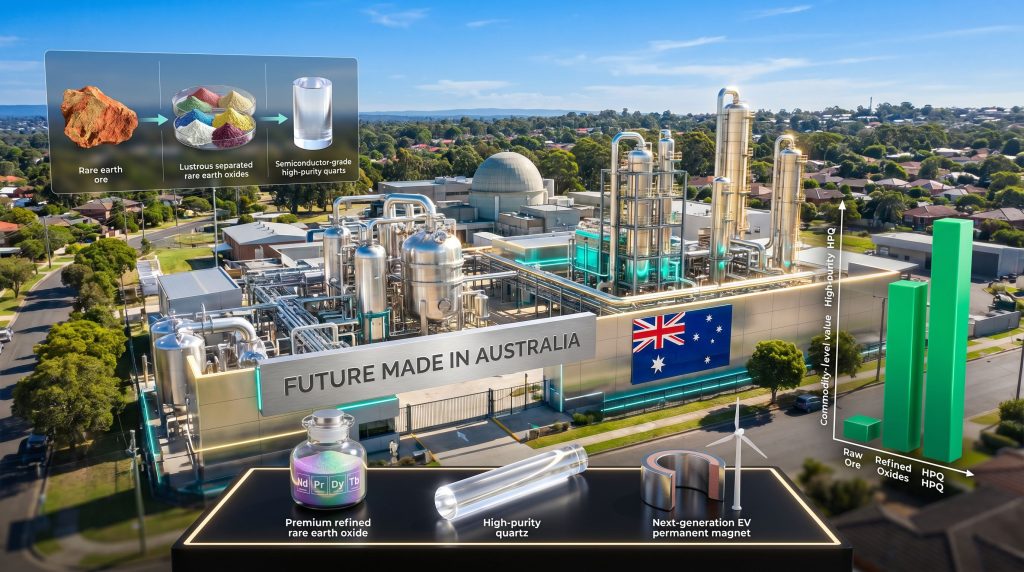
The economic argument for domestic refining is straightforward but frequently underappreciated. Raw rare earth ore, at commodity pricing, commands a fraction of the value that separated rare earth oxides achieve on international markets. A tonne of ore containing neodymium and praseodymium is worth far less than a tonne of separated NdPr oxide ready for magnet manufacturing. Add another processing step to produce rare earth metals or alloys, and the value premium expands further still.
For a nation that exports hundreds of thousands of tonnes of mineral material annually, the cumulative economic difference between raw exports and refined exports is substantial. Beyond revenue, domestic refining creates a category of employment that raw extraction does not: process chemists, materials engineers, quality assurance specialists, environmental compliance professionals, and the broader supply chain that supports industrial processing operations.
The employment multiplier effect of refining relative to mining is well established in industrial economics. A processing facility generates more highly skilled, higher-wage employment per tonne of material handled than an extraction operation of equivalent throughput. As Australia attempts to diversify its economic base beyond commodity cycling, building a domestic processing sector addresses both the revenue capture gap and the workforce diversification challenge simultaneously.
Frequently Asked Questions: Australia's Lucas Heights Critical Minerals Facility
What minerals are processed at the Lucas Heights facility?
The facility processes two categories of critical material. The first is clay-hosted rare earth elements, which are used in permanent magnets for electric vehicles, wind turbine generators, and defence electronics. The second is high-purity quartz, produced through a high-temperature chlorination process, which is a fundamental input for semiconductor manufacturing, solar panel production, and advanced medical and defence equipment.
When did the Lucas Heights facility open?
The two new processing installations were officially opened on 8 May 2026, operating under the framework of the Australian Critical Minerals Research and Development Hub.
What is ANSTO's role in this facility?
ANSTO provides the host infrastructure and materials processing capabilities at Lucas Heights. The organisation operates in a collaborative arrangement with CSIRO, which contributes applied research and scale-up expertise, and Geoscience Australia, which provides resource characterisation and geological data to inform processing development priorities. The Australian first facility at Lucas Heights marks a landmark moment for national industrial capability.
Is the Lucas Heights facility connected to nuclear operations?
The site hosts ANSTO's OPAL research reactor, which is used for scientific research, isotope production, and materials testing. However, the new critical minerals processing facilities are independent units focused on mineral refining and materials science. They are not involved in nuclear fuel processing or radioactive waste management.
How does this facility relate to Australia's Future Made in Australia policy?
The facility directly implements the policy's core objective of capturing greater economic value from Australia's mineral resources by processing them domestically rather than exporting raw commodities. By enabling onshore refining of clay-hosted rare earths and high-purity quartz, the hub generates higher-value outputs, skilled employment, and supply chain capabilities that remain within the Australian economy. Furthermore, Australia's critical minerals strategy situates this facility as a key pillar of long-term resource sovereignty.
The Competitive Window and What Comes Next
The period between now and 2030 is likely to be decisive for nations attempting to establish credible critical minerals processing capacity outside of China. Allied governments are actively seeking long-term supply agreements with trusted jurisdictions, and manufacturers of electric vehicles, clean energy infrastructure, and defence systems are under increasing pressure to demonstrate supply chain resilience to regulators and investors.
Australia's position in this window is genuinely competitive. It holds large, high-quality deposits of the minerals that matter most, operates within a trusted legal and regulatory framework, and has now demonstrated the ability to develop specialised processing infrastructure on home soil. The Australia critical minerals refining facility Lucas Heights establishes the research and development foundation, and the commercial scale-up that follows will determine whether Australia captures a meaningful share of the global refining market.
Several factors will shape the pace and scale of that transition:
- Continued concessional financing through mechanisms such as Export Finance Australia's Critical Minerals Facility to de-risk large-scale processing capital expenditure
- Offtake agreements with allied-nation manufacturers providing commercial certainty before companies commit to full industrial-scale investment
- Workforce development pipelines producing the process chemists, materials engineers, and technical specialists that refining operations require
- Regulatory frameworks that enable efficient environmental approvals for processing facilities without compromising environmental standards
- Research transfer pathways from the Lucas Heights hub to commercial operators, ensuring that process innovations developed at ANSTO scale are accessible to private sector partners
The Australia critical minerals refining facility Lucas Heights is not the culmination of Australia's processing ambitions. It is the starting point for a much larger transformation in how this country participates in the global critical minerals economy.
The infrastructure is now in place. The institutional collaboration is structured. The policy framework is aligned. What follows will depend on how effectively Australia converts scientific capability into commercial reality during a window of global demand that may not remain open indefinitely. As detailed in recent industry reporting, the downstream processing push is already attracting significant international interest, making the momentum behind this facility all the more consequential.
This article contains references to government policy frameworks, bilateral investment commitments, and broader industry developments. Readers should note that policy priorities, investment figures, and market conditions are subject to change. This article does not constitute financial or investment advice.
Want to Invest in the Companies Supplying the Critical Minerals Driving Australia's Processing Revolution?
Discovery Alert's proprietary Discovery IQ model delivers real-time alerts the moment significant ASX mineral discoveries are announced, transforming complex geological data into actionable investment insights for both short-term traders and long-term investors. Explore how historic critical minerals discoveries have generated substantial returns on Discovery Alert's dedicated discoveries page, and begin your 14-day free trial today to position yourself ahead of the market.