
May 13, 2026
The Hidden Architecture of Western Rare Earth Supply Chains
The global race to secure rare earth supply outside Chinese-controlled channels has moved well beyond policy committee discussions and ministerial rhetoric. It is now being fought in boardrooms, trading houses, and government financing desks across three continents. The Arafura rare earths offtake term sheet with Traxys North America is one such battleground — a binding commercial agreement that exemplifies how rare earth supply chains are being actively restructured outside Chinese-controlled infrastructure. The offtake agreement, not the mine itself, has quietly become the most strategically consequential document in the critical minerals sector.
When big ASX news breaks, our subscribers know first
Why NdPr Oxide Is the Functional Core of the Clean Energy Economy
Understanding why offtake agreements for neodymium-praseodymium (NdPr) oxide carry such weight requires understanding what the material actually does. NdPr oxide is the refined precursor used to manufacture neodymium-iron-boron (NdFeB) permanent magnets — the world's most powerful commercially produced magnets by energy density. These magnets are not optional components in clean energy hardware; they are load-bearing elements of the entire electrification architecture.
Where NdFeB Magnets Sit in the Supply Chain
The production pathway runs from rare earth ore, through separation and refining to produce NdPr oxide, through alloy production to create NdFeB flake or powder, and finally through magnet manufacturing to produce the finished components embedded in motors and generators. Each step involves specialised processing capability, and China dominates the majority of these stages at industrial scale.
According to the United States Geological Survey (USGS), China accounts for approximately 85–90% of global rare earth processing capacity, with its share of refined NdPr production even more concentrated than its share of mining output. This asymmetry means that even if a non-Chinese mine produces rare earth concentrate, that material frequently must pass through Chinese processing infrastructure before it can be converted into usable oxide — a structural vulnerability widely acknowledged by Western governments and manufacturers alike.
The rare earth processing challenges that underpin this vulnerability are significant. The applications dependent on this supply chain include:
- Electric vehicle traction motors, where NdFeB magnets provide the torque density required for high-performance drivetrains
- Direct-drive offshore wind turbines, which use large-format permanent magnet generators that can contain up to 600 kilograms of NdFeB magnets per megawatt of capacity
- Defence-grade guidance and propulsion systems, where magnet performance under extreme temperature and vibration conditions is non-negotiable
- Industrial robotics and servo actuators, where miniaturisation demands the highest available magnetic energy density
The growing electrification of transportation and energy systems means NdPr is not a niche industrial input — it is a volumetrically expanding, strategically irreplaceable material whose supply security has become a matter of national industrial policy for the US, EU, and Australia simultaneously.
The Arafura Rare Earths Offtake Term Sheet with Traxys North America: Core Commercial Architecture
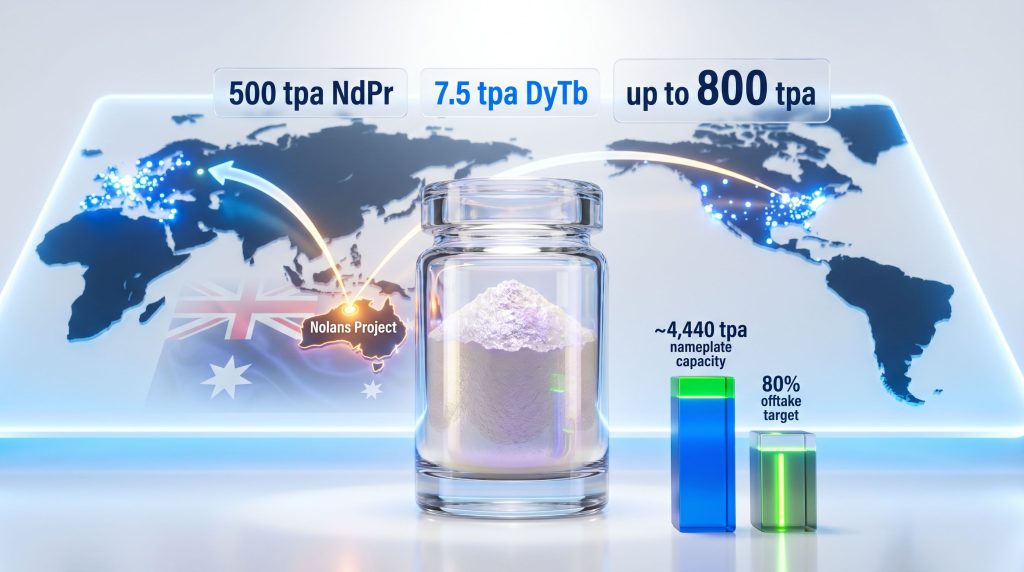
Against this backdrop, the Arafura rare earths offtake term sheet with Traxys North America carries significance that extends well beyond a single commercial transaction. The binding term sheet, executed in May 2026, commits Traxys North America to purchase up to 500 tonnes per annum (tpa) of NdPr oxide and 7.5 tpa of dysprosium-terbium (DyTb) oxide from Arafura's Nolans Rare Earths Project in the Northern Territory of Australia.
Key Terms at a Glance
| Parameter | Detail |
|---|---|
| Agreement Type | Binding offtake term sheet |
| Counterparty | Traxys North America |
| NdPr Oxide Volume | Up to 500 tpa |
| DyTb Oxide Volume | 7.5 tpa |
| Initial Term | Five years |
| Extension Option | Two years by mutual agreement |
| Long-Form Agreement Deadline | Six months from term sheet execution |
| Supply Source | Nolans Rare Earths Project, Northern Territory, Australia |
The transaction is explicitly structured to support US domestic supply chain objectives. Traxys has indicated its intention to direct the material into the US supply chain, with potential integration into the US Export-Import Bank managed project vault — a government-adjacent procurement mechanism designed to facilitate the sourcing of critical minerals for American industrial and manufacturing end users.
It is important to note that the confirmation of US EXIM Bank involvement reflects Traxys' stated commercial intentions as disclosed in Arafura's ASX announcement; this does not constitute confirmed government funding or project-specific designation for the Nolans Project itself.
A Separate and Additive Agreement to Traxys Europe
This agreement operates entirely independently from the arrangement Arafura executed with Traxys Europe SA (Luxembourg) in March 2025. The Traxys offtake agreement covers the supply of up to 300 tpa of NdPr oxide — comprising a minimum firm volume of 100 tpa with Arafura holding discretion to increase deliveries to 300 tpa annually. Furthermore, the two Traxys-entity agreements are legally distinct instruments serving different geographic supply chain mandates.
When considered in combination, total committed volume across both Traxys entities reaches up to 800 tpa of NdPr oxide — representing approximately 18% of the Nolans Project's nameplate NdPr production capacity of ~4,440 tpa.
The Nolans Project: The Asset Underpinning Multiple Commitments
Project Fundamentals and Strategic Location
The Nolans Rare Earths Project is located in the Northern Territory of Australia, positioning it within a Tier 1 mining jurisdiction with established regulatory frameworks, infrastructure access corridors, and strong sovereign alignment with Western allied nations. Australia's status as a Five Eyes partner nation and its existing critical minerals agreements with both the United States and the European Union give Nolans-sourced product a degree of geopolitical provenance that is commercially meaningful for buyers seeking to satisfy supply chain origin requirements.
The project's nameplate NdPr production capacity of approximately 4,440 tpa positions it as one of the larger planned non-Chinese NdPr producers in the global development pipeline. Beyond NdPr, Nolans produces heavy rare earth oxides including DyTb — a co-product whose commercial value has increased substantially as EV motor manufacturers seek to improve magnet thermal stability for high-performance applications.
Understanding DyTb: The Heavy Rare Earth Premium
DyTb oxide is less widely discussed than NdPr but is arguably more strategically constrained. Dysprosium and terbium are heavy rare earth elements whose primary function in NdFeB magnets is to elevate the magnet's coercivity — its resistance to demagnetisation at high operating temperatures. Without DyTb additions, NdFeB magnets lose performance rapidly above approximately 80 degrees Celsius, making them unsuitable for many EV drivetrain and industrial motor applications.
Heavy rare earth supply is geographically even more concentrated than light rare earth supply, with the majority of global production historically sourced from ionic clay deposits in southern China. Consequently, the 7.5 tpa of DyTb oxide included in the Traxys North America term sheet is a meaningful strategic component — not just an incremental revenue line.
Offtake Architecture as a Financing Instrument
Why Project Lenders Require Binding Offtake Coverage
For a pre-production mining project of Nolans' scale — which requires substantial capital expenditure before a single tonne of product is sold — project finance lenders require demonstrated revenue certainty before underwriting construction debt. Binding offtake agreements serve as the primary instrument for providing that certainty, functioning as a forward revenue guarantee that reduces the lender's exposure to market price and volume risk.
The standard threshold for achieving bankable offtake coverage in the rare earths sector is not formally codified, but industry practice — reflected in comparable projects including Lynas Rare Earths' early development phase and MP Materials' refinancing trajectory — suggests that lenders typically look for committed offtake covering 60–80% of nameplate capacity before advancing project debt on commercial terms.
Arafura has publicly stated its objective of securing binding offtake for approximately 80% of Nolans' nameplate NdPr capacity, equating to roughly 3,550 tpa of committed volume as a precondition for a Final Investment Decision (FID). The Arafura-Traxys rare earth deal moves the company meaningfully closer to this threshold.
Mapping Arafura's Cumulative Offtake Position
| Offtake Counterparty | Volume (NdPr tpa) | Geography | Status |
|---|---|---|---|
| Traxys Europe SA | Up to 300 tpa | Europe | Binding agreement (March 2025) |
| Traxys North America | Up to 500 tpa | United States | Binding term sheet (May 2026) |
| Siemens Gamesa | Undisclosed | Europe | Binding agreement (prior) |
| Additional counterparties | Undisclosed | Various | Binding (prior) |
The addition of 500 tpa through the Traxys North America binding term sheet meaningfully advances Arafura's progress toward its 80% offtake coverage threshold. Prior to this agreement, cumulative binding volume from disclosed counterparties suggested the company was tracking in the range of 66–70% of the target. The new North America commitment materially closes the remaining gap.
Each binding agreement Arafura executes serves a dual function: it validates commercial demand to project finance lenders and adds incrementally to the revenue visibility that underpins the investment case for Nolans. Offtake relationships of this kind are structural components of financing architecture, not simply forward sales contracts.
What Traxys North America's Role Reveals About US Supply Chain Strategy
The Mechanics of Physical Commodity Merchant Agreements
Traxys operates as one of the world's leading physical commodity traders and merchants across metals and natural resources, with a business model centred on originating, transporting, and distributing materials across global industrial supply chains. Unlike financial intermediaries who trade paper claims on commodities, physical merchants like Traxys take delivery of material, manage logistics, and distribute to end-use industrial buyers — making their offtake commitments operationally meaningful rather than purely financial.
The North American arm of Traxys is specifically positioned to service US-based manufacturers in automotive, defence, and advanced technology sectors. The company's existing relationships with US industrial buyers and its stated intention to integrate Nolans-sourced NdPr oxide into the US EXIM Bank managed project vault indicate that the commercial pathway from Australian mine to American manufacturer has been at least partially mapped. For further context, Australian Mining reports on how this deal fits into the broader landscape of Australian rare earth export strategy.
US Industrial Sectors That Stand to Benefit
| Sector | NdPr Application | Current Supply Vulnerability |
|---|---|---|
| Automotive (EV) | Traction motor magnets | High — Chinese magnet supply dominates |
| Defence & Aerospace | Guidance, propulsion, electronics | Critical — no substitute at scale |
| Offshore Wind | Direct-drive turbine generators | High — expansion pipeline accelerating |
| Industrial Automation | Servo motors, robotics, actuators | Growing — reshoring increasing demand |
The next major ASX story will hit our subscribers first
The Geographic Diversification Logic Behind the Dual Traxys Strategy
The deliberate use of two legally distinct Traxys entities — one European, one North American — reflects a sophisticated offtake diversification strategy. By distributing committed sales volume across separate geographic demand centres, Arafura reduces concentration risk within its offtake portfolio while simultaneously positioning Nolans as a supplier capable of satisfying both EU and US supply chain origin requirements.
This matters because the US Inflation Reduction Act (IRA), the EU Critical Raw Materials Act (CRMA), and Australia's own Critical Minerals Strategy each contain provisions that incentivise sourcing from allied or partner nations. The surge in critical minerals demand across these frameworks creates a structural preference for Australian-sourced NdPr oxide, underpinning the commercial value of long-term supply commitments from projects like Nolans.
The dual Traxys structure also creates potential operational flexibility. As a global merchant with reach across both Atlantic demand centres, Traxys retains the ability to optimise volume allocation between its European and North American books in response to evolving market conditions — a feature that may reduce the risk of volume shortfalls under either individual agreement.
The Six-Month Sunset Clause: A Near-Term Catalyst to Watch
The binding term sheet carries a sunset clause of six months from execution within which both parties must finalise and execute a comprehensive long-form offtake agreement. This timeline creates a clearly defined near-term milestone for investors and analysts monitoring Arafura's progress toward its Final Investment Decision.
Successful conversion of the term sheet to a fully executed long-form contract would represent a material de-risking event, signalling that detailed commercial, legal, and logistical negotiations have been resolved to both parties' satisfaction. However, failure to convert within the sunset window would not necessarily invalidate the commercial relationship but would remove the binding character of the current arrangement — a distinction that carries consequences for project financing discussions.
Stocks Down Under provides additional analysis on how this offtake structure compares with other ASX-listed rare earth developers and what it signals for Arafura's financing trajectory.
Investor Note: The six-month execution window is a time-sensitive catalyst that warrants close monitoring. Conversion to a long-form agreement, combined with Arafura's other existing binding commitments, could position the company's cumulative offtake coverage at or near the 80% threshold widely understood as the gateway to a Final Investment Decision.
This article is intended for informational purposes only and does not constitute financial advice. Readers should conduct their own due diligence and consult a licensed financial adviser before making any investment decisions. Forward-looking statements and scenario projections are speculative and subject to material risk and uncertainty.
Want to Stay Ahead of the Next Major Rare Earth Discovery on the ASX?
Discovery Alert's proprietary Discovery IQ model scans ASX announcements in real time, instantly identifying significant mineral discoveries across rare earths and more than 30 other commodities — turning complex data into clear, actionable opportunities for both short-term traders and long-term investors. Explore how historic discoveries have generated substantial returns on Discovery Alert's dedicated discoveries page, and begin your 14-day free trial today to position yourself ahead of the broader market.