
August 7, 2026
The Quiet Crisis That Built a $3.5 Billion Opportunity
For decades, the rare earth industry operated in near-total obscurity. Prices were low, supply seemed abundant, and the intricate chemistry required to separate these elements from ore was considered too costly and complex for most Western nations to bother with. China stepped into that vacuum with extraordinary deliberateness, building processing infrastructure, subsidising production, and systematically acquiring the technical expertise that the rest of the world had quietly abandoned.
The consequences of that strategic withdrawal are now being measured in billions of dollars, national security assessments, and emergency industrial policy. When USA Rare Earth secures $1.6bn US funding under the CHIPS Act, it is not simply a corporate financing milestone. It is the most concrete expression yet of a Western government willing to rebuild, from scratch, a supply chain it let atrophy over two generations.
When big ASX news breaks, our subscribers know first
Unpacking the Capital Architecture Behind the Deal
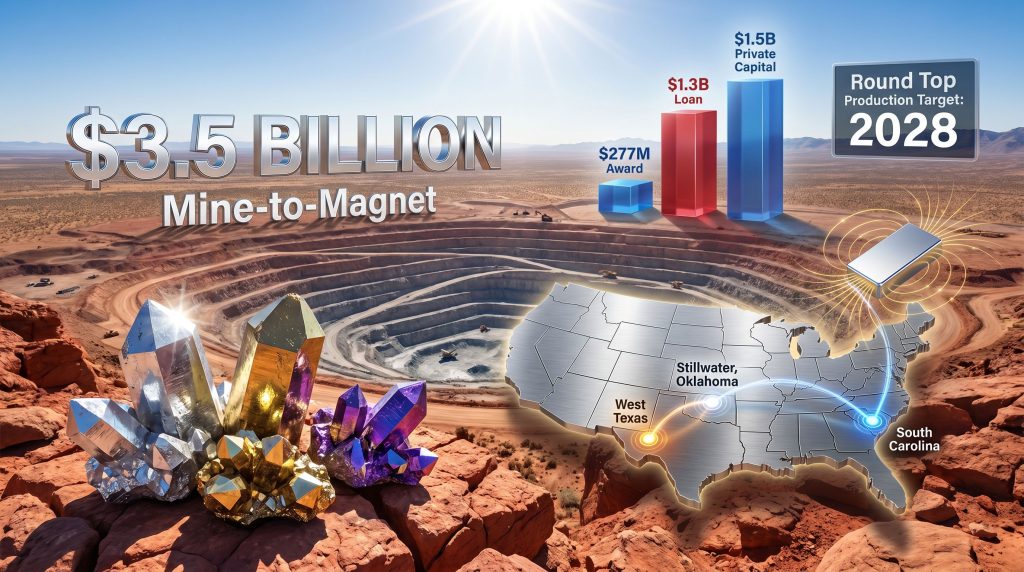
The $1.6 billion figure represents a structured federal commitment rather than a single cash transfer. It combines two distinct instruments: a $277 million direct programme award and a $1.3 billion senior secured loan, both channelled through the US Department of Commerce's CHIPS Program Office. Formal agreements activating this commitment were signed in June 2026, following a non-binding Letter of Intent issued in January 2026.
| Funding Component | Amount | Instrument |
|---|---|---|
| CHIPS Act Direct Award | $277 million | Programme Grant |
| Senior Secured Loan | $1.3 billion | Government-Backed Debt |
| Private Capital Raise | $1.5 billion | Equity / Private Markets |
| Total Committed Capital | ~$3.5 billion | Public + Private Combined |
The government's position in the company is structured through equity and warrants rather than outright shareholding, with estimates placing the stake somewhere between 8% and 16%, and a commonly cited figure of approximately 10%. This equity participation model is significant: it signals a shift away from traditional grant-and-walk-away subsidy structures toward something closer to co-investment, aligning government incentives with long-term project outcomes.
The private capital component, a $1.5 billion raise completed earlier in 2026, preceded the federal agreements and demonstrates that institutional investors had already begun pricing in the strategic logic of domestic rare earth production before Washington formalised its commitment.
Why the CHIPS Act Is Funding a Mining Company
The Legislative Logic Behind Critical Mineral Eligibility
The CHIPS and Science Act was originally designed to revitalise domestic semiconductor fabrication capacity. Its extension to rare earth supply chains reflects a recognition that advanced manufacturing cannot be disaggregated from its material inputs. Rare earth permanent magnets, specifically neodymium-iron-boron (NdFeB) types, are embedded in virtually every technology the CHIPS Act was designed to protect: advanced chips require precision manufacturing equipment that depends on these magnets, while the defence and EV sectors that consume finished semiconductors are equally dependent on them.
This is not a peripheral connection. Without domestic magnet supply, domestic semiconductor policy is incomplete. Furthermore, the legislative bridge between critical minerals and semiconductors reflects an emerging industrial policy consensus that supply chain sovereignty must be vertical, not selective.
China's Structural Advantage and Why It Took So Long to Respond
China's dominance across rare earth supply chains was not achieved overnight. It represents the cumulative effect of policy decisions stretching back to the 1980s, when Chinese industrial planners recognised that rare earths would become foundational to the electronics and defence industries of the following century. Today, China controls an estimated 60-70% of global rare earth mining output and an even higher proportion of the separation and processing capacity that transforms ore into usable materials.
What makes this dominance particularly durable is that mining is the easiest part of the supply chain to replicate. Separation chemistry, metal alloying, and magnet sintering require decades of accumulated technical knowledge, specialised equipment, and process optimisation. China controls all of it.
In 2023 and 2024, China's rare earth export restrictions on gallium, germanium, and graphite signalled to Western governments that mineral supply chains could be weaponised within the broader context of technology competition. Rare earths have not yet faced formal export bans, but the credible threat of restriction has proven sufficient to accelerate investment in alternative supply across multiple allied nations.
The Three-Node Domestic Supply Chain
Round Top, Texas: The Upstream Anchor
Located in Hudspeth County in far West Texas, the Round Top deposit is the upstream cornerstone of the entire programme. The project is distinguished not only by its scale but by its heavy rare earth element (HREE) profile. Heavy rare earths, which include dysprosium and terbium, are particularly critical for high-performance magnets used in defence applications and next-generation EV motors.
They are also the rarest and most geographically concentrated of all rare earth types, with Chinese-controlled deposits commanding the majority of global supply. Round Top's polymetallic character means it hosts a broader range of economically relevant elements beyond the rare earth suite, which may support project economics across commodity price cycles. Initial production is targeted for 2028, a timeline that demands simultaneous progress across permitting, infrastructure, and commissioning.
Stillwater, Oklahoma: The Metallurgical Bridge
Between mine and magnet lies the most technically demanding and least-understood stage of the rare earth supply chain: chemical separation and metal making. The planned Stillwater, Oklahoma facility will serve as the metallurgical bridge, converting concentrated rare earth oxides from Round Top into alloy-grade metals suitable for magnet production.
This midstream node is where most Western rare earth projects have historically stalled. Indeed, the rare earth processing challenges at this stage involve dozens of sequential solvent extraction steps, each requiring precise chemistry calibration. The United States essentially lost this industrial capability over the course of two decades of Chinese price competition, and rebuilding it at commercial scale is arguably the most technically complex component of the entire programme.
South Carolina: The Strategically Decisive Downstream Node
A $1.2 billion capital allocation has been committed to a magnet manufacturing and rare earth metals facility in South Carolina. This facility represents the programme's highest-value-added output and its most strategically important component.
Even if the US successfully mines and separates rare earth materials domestically, the absence of domestic magnet manufacturing capacity would mean those materials still flow through foreign conversion facilities before reaching defence contractors, EV manufacturers, and electronics producers. The South Carolina plant closes that gap, completing what would be the first fully domestic, end-to-end rare earth supply chain at commercial scale in the United States.
NdFeB permanent magnets, the primary product of this facility, currently sell at significant premiums to the raw materials from which they are made. That value differential, captured domestically rather than surrendered to offshore processors, is central to the programme's long-term economic rationale.
Understanding the Five Stages of Rare Earth Production
Most commentary on rare earths focuses on mining, overlooking the four downstream stages that determine whether a deposit translates into usable strategic materials. The full supply chain operates as follows:
- Mining – Extraction of rare earth-bearing ore from the deposit, typically through open-pit or heap-leach methods depending on deposit type
- Beneficiation – Physical concentration of rare earth minerals from waste rock using gravity, flotation, or magnetic separation techniques
- Chemical Separation – Isolation of individual rare earth elements through sequential solvent extraction circuits, the most technically demanding stage
- Metal Making – Conversion of separated rare earth oxides into metallic alloys suitable for magnet production
- Magnet Manufacturing – Pressing, sintering, coating, and finishing of permanent magnets to specification
China currently controls stages two through five for the overwhelming majority of global supply. A programme that achieves all five stages domestically would represent a genuinely unprecedented accomplishment in Western industrial policy terms.
How This Stacks Up Against Other Federal Mineral Investments
| Initiative | Federal Funding | Target Mineral | Status (2026) |
|---|---|---|---|
| USA Rare Earth CHIPS Package | $1.6 billion | Rare Earths / Magnets | Agreements Signed |
| MP Materials (DoD Contracts) | ~$58.5 million | Rare Earths | Operational |
| Lithium Americas (DoE Loan) | $2.26 billion | Lithium | Conditional Approval |
| Ioneer Rhyolite Ridge (DoE) | $996 million | Lithium / Boron | Loan Finalised |
The use of the CHIPS Act vehicle rather than Department of Energy or Department of Defense channels is a deliberate policy choice worth examining. It frames rare earth independence as a technology manufacturing competitiveness issue rather than purely a defence procurement matter, broadening the political coalition behind the programme. This approach also potentially opens additional funding pathways that defence-only classification would not support, as critical minerals demand continues to intensify across multiple sectors simultaneously.
The next major ASX story will hit our subscribers first
Key Risks Investors Must Weigh
The scale of committed capital does not eliminate the formidable execution challenges ahead. Investors considering exposure to this sector should monitor several distinct risk categories:
- Timeline compression risk – Achieving initial Round Top production by 2028 requires parallel progress across regulatory approvals, construction, and commissioning in multiple states simultaneously
- Financing conditionality – Formal agreement signing activates access to capital but does not guarantee full disbursement, which remains conditional on project milestones and compliance benchmarks
- Commodity price volatility – Neodymium-praseodymium (NdPr) prices have historically experienced sharp cycles driven by Chinese export policy, demand fluctuations from EV adoption rates, and speculative positioning
- Technical execution risk – Rebuilding rare earth separation and magnet manufacturing capabilities that have been largely absent from the US for over two decades involves genuine industrial complexity that cannot be resolved by capital alone
- Market sentiment divergence – Shares fell approximately 6% in morning trading on the day the agreements were announced, a counterintuitive reaction that likely reflects investor concern about the gap between committed capital and operational delivery
Disclaimer: This article contains forward-looking statements and financial analysis based on publicly available information. It does not constitute investment advice. Past performance and announced capital commitments do not guarantee future project outcomes. Investors should conduct independent due diligence before making investment decisions.
The Systemic Implications for Allied Supply Chains
A successful programme of this scale would generate consequences well beyond domestic US supply chain security. Allied nations with rare earth deposits, particularly Australia, Canada, and Japan, have been actively seeking US offtake commitments as the anchor justification for their own upstream development investments. A demonstrated US willingness to fund the entire mine-to-magnet chain domestically changes the negotiating dynamic for those partnerships considerably.
For the defence industrial base specifically, domestic magnet supply would eliminate a single-point-of-failure vulnerability that has been documented across multiple Pentagon and Congressional assessments. F-35 components, precision-guided munitions, radar systems, and naval propulsion technologies all depend on NdFeB magnets currently sourced through supply chains that pass through Chinese processing infrastructure.
If the three-node model proves deliverable on its 2028 timeline, it also establishes a replicable template for public-private critical mineral development that other nations and other minerals may follow. The combination of CHIPS Act financing mechanisms, private equity capital, and vertically integrated industrial design represents a novel institutional architecture that did not exist in this form before this programme. Consequently, USA Rare Earth secures $1.6bn US funding that may well define the standard for how allied governments approach critical mineral independence going forward.
The deeper question is whether the industrial knowledge required to operate these facilities at commercial scale can be rebuilt within the timeframe the programme demands. Capital is a necessary condition. It has never been a sufficient one. As the Financial Times reports, the broader strategic calculus behind investments of this kind reflects a fundamental reordering of how Western governments now weigh economic efficiency against supply chain resilience.
Want To Identify The Next Major Critical Mineral Discovery Before The Market Does?
Discovery Alert's proprietary Discovery IQ model delivers real-time alerts on significant ASX mineral discoveries — cutting through complex data across 30-plus commodities to surface actionable opportunities the moment they're announced. Explore historic discoveries and their extraordinary returns, then start your 14-day free trial at Discovery Alert to ensure you're positioned ahead of the broader market.