
July 21, 2026
When Industrial Policy Meets Intellectual Property: The New Battleground for Rare Earth Dominance
Strategically important industries rarely emerge without conflict. From the semiconductor wars of the 1980s to the patent battles that defined early lithium-ion battery commercialisation, the transition from nascent sector to mature industry almost always passes through a period of intense legal confrontation over who owns the foundational knowledge. The U.S. rare earth magnet sector appears to be entering exactly that phase, and the USA Rare Earth MP Materials lawsuit has become its defining flashpoint.
Understanding this dispute requires more than reading court filings. It demands an appreciation of the underlying technology, the geopolitical pressures reshaping rare earth supply chains, and the structural realities of an industry where a handful of engineers hold knowledge that entire national strategies depend upon.
When big ASX news breaks, our subscribers know first
The Technology at the Centre of the Dispute
What Grain Boundary Diffusion Actually Does
To understand why this lawsuit matters, it helps to understand what is actually being contested. Neodymium-iron-boron (NdFeB) permanent magnets are the highest-performance permanent magnets commercially available. They are essential components in the drive motors of electric vehicles, the actuators of precision-guided munitions, wind turbine generators, and a growing range of consumer and industrial electronics.
However, standard sintered NdFeB magnets have a critical vulnerability: their magnetic performance degrades significantly at elevated temperatures. This is a serious problem in EV traction motors, which routinely operate in high-heat environments. The solution, developed over decades of research, is a process called grain boundary diffusion (GBD).
In GBD processing, heavy rare earth elements, most commonly dysprosium (Dy) or terbium (Tb), are diffused into the grain boundaries of a sintered NdFeB magnet rather than being homogeneously blended throughout the bulk material. This targeted approach dramatically increases coercivity, the magnet's resistance to demagnetisation, while using far less of the costly heavy rare earths than conventional alloying methods require. The result is a high-performance magnet that is both more thermally stable and more cost-efficient to produce.
Proprietary GBD formulations, including the specific precursor compounds used, the diffusion temperatures and durations, and the post-diffusion treatment protocols, represent years of experimental development and significant capital investment. They are precisely the kind of institutional knowledge that constitutes a legally protectable trade secret, and precisely what MP Materials alleges was misappropriated.
Why Terbium and Dysprosium Make This Even More Urgent
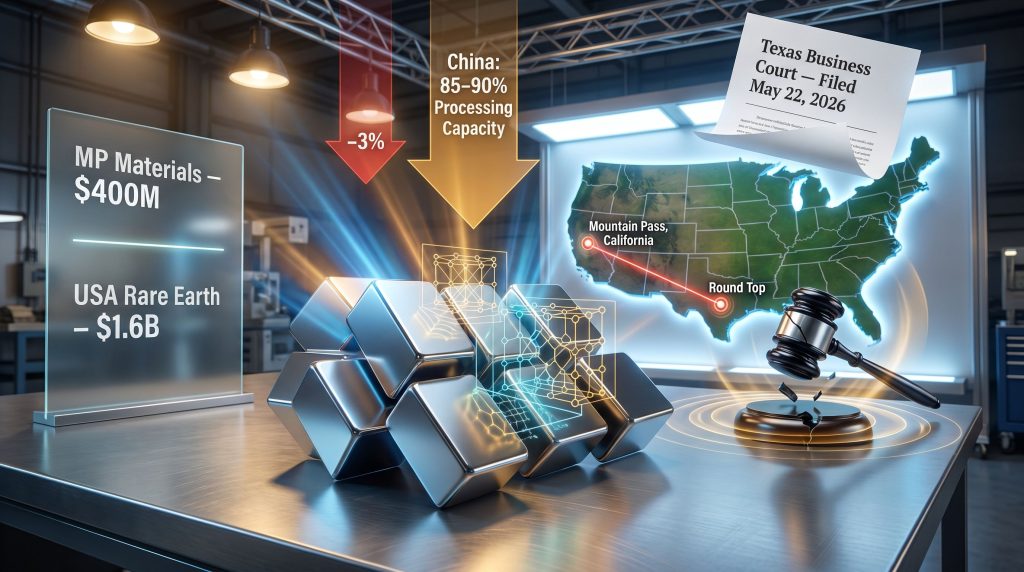
The geopolitical dimension of GBD technology cannot be overstated. Both dysprosium and terbium are classified as heavy rare earth elements (HREEs), and China controls an overwhelming share of global production and processing capacity for both. According to industry tracking data, China accounts for approximately 85 to 90% of global rare earth processing, with an even greater share of HREE refining.
Furthermore, China's rare earth export restrictions, with no shipments of terbium or dysprosium oxide recorded to Japan since November 2025, have severely stressed the global magnet supply chain. For U.S. companies racing to build domestic GBD capability, proprietary process knowledge is not merely a competitive asset. It may be the difference between operational viability and dependency on Chinese supply.
The Lawsuit in Detail: Allegations, Claims, and Counter-Arguments
What MP Materials Filed on May 22, 2026
MP Materials lodged its complaint in the Texas Business Court on May 22, 2026, naming both USA Rare Earth and a former MP employee, Kevin Elkins, as defendants. The lawsuit also implicated a third-party firm, FOM Technologies Inc., which allegedly received confidential information as part of the chain of disclosure.
The five legal claims raised by MP cover a broad range of civil liability:
- Misappropriation of trade secrets against both USA Rare Earth and Kevin Elkins
- Breach of contract against Elkins for alleged violations of confidentiality obligations
- Tortious interference with contract against USA Rare Earth
- Unjust enrichment against USA Rare Earth and FOM Technologies Inc.
- Injunctive relief both temporary and permanent, to prevent further use or disclosure
MP is seeking damages exceeding US$5 million, along with exemplary damages designed to punish intentional misconduct, attorney fees, and the return of all materials containing its alleged trade secrets. For more detail on the MP Materials allegations, independent reporting provides useful additional context.
USA Rare Earth's Response
USA Rare Earth filed its formal denial in the 8th District of the Texas Business Court in June 2026. The company rejected every allegation and framed the lawsuit as a deliberate effort to obstruct its commercial progress rather than a legitimate intellectual property grievance. The company's public position described the litigation as lacking merit and characterised it as being filed for an improper purpose.
USA Rare Earth further argued that the lawsuit represents an attempt by MP to slow its momentum as both companies work to establish domestic rare earth processing and magnet manufacturing capabilities. The company stated its intention to remain focused on its broader mission of advancing U.S. and allied rare earth supply chains.
Procedural Reality Check: As of June 2026, this case remains in its earliest stages. No court has ruled on the merits, no injunctions have been granted, and no findings of fact have been issued. Every allegation made by either party remains unproven in a court of law.
Two Companies, Two Very Different Bets on the Rare Earth Future
Comparing the Strategic Profiles
The companies at the centre of this dispute have taken fundamentally different approaches to building domestic rare earth capacity:
| Dimension | MP Materials | USA Rare Earth |
|---|---|---|
| Primary asset | Mountain Pass Mine, California (active) | Round Top deposit, Texas (development stage) |
| Processing status | Established processing operations | Sintered NdFeB magnet facility under construction in Stillwater, Oklahoma |
| Federal funding received | $400 million equity investment | $1.6 billion conditional funding deal (January 2026) |
| Headquartered | Las Vegas, Nevada | Texas |
| Key distinction | Only active rare earth mine in the U.S. | Emerging integrated magnet manufacturer |
Mountain Pass is a proven, producing asset with a long history stretching back to the mid-20th century. It was the world's dominant rare earth producer before Chinese competition drove it to bankruptcy in 2015. Under MP's stewardship since 2017, it has returned to production and expanded into downstream processing.
Round Top is a fundamentally different geological proposition. The deposit is hosted in a rhyolite formation in west Texas and contains a broad polymetallic profile including multiple rare earth elements, lithium, and other critical minerals. The USA Rare Earth MP Materials lawsuit notably saw MP cast doubt on Round Top's economic viability, characterising it as having among the lowest rare earth element concentrations of any comparable deposit globally. USA Rare Earth has not publicly accepted that characterisation.
The Deposit Quality Question: A Geological Consideration Worth Understanding
The dispute over Round Top's ore grade is worth unpacking for investors and industry observers. Rare earth deposits are evaluated not only on total rare earth oxide (TREO) grade but on the distribution of individual rare earth elements within that total. A deposit with low overall TREO grade can still be economically attractive if it is disproportionately enriched in high-value elements like terbium, dysprosium, or neodymium.
Conversely, a deposit with a high proportion of cerium and lanthanum, the lightest and most abundant rare earths with correspondingly low prices, may struggle to generate acceptable economics regardless of overall grade. Round Top's ore distribution and the economics of extracting individual elements at commercial scale remain subjects of ongoing technical study rather than settled consensus. In addition, the rare earth processing challenges involved in bringing any new deposit to commercial viability are considerable.
The Litigation Status Snapshot
| Milestone | Status as of June 2026 |
|---|---|
| Lawsuit filed by MP Materials | Confirmed, May 22, 2026 |
| USA Rare Earth formal denial filed | Confirmed, June 2026 |
| Court ruling on merits | Not yet issued |
| Injunctive relief granted | Not yet granted |
| Formal counterclaim by USA Rare Earth | Not publicly identified |
| Settlement or verdict | Not reached |
The key legal thresholds that will ultimately shape the outcome include:
- Whether MP can demonstrate that its GBD formulations qualify as legally protectable trade secrets under applicable federal and state law
- Whether Elkins was bound by enforceable confidentiality provisions at the time of the alleged disclosure
- Whether USA Rare Earth's conduct meets the legal standards for tortious interference and unjust enrichment
- Whether the court determines that injunctive relief is necessary to prevent ongoing harm during the litigation period
China's Shadow Over a Domestic Dispute
The Export Control Timing That Should Not Be Ignored
On June 22, 2026, the same day USA Rare Earth filed its rebuttal, Beijing imposed export controls targeting both companies simultaneously. This timing, whether coincidental or not, creates a striking juxtaposition: two of America's most strategically significant rare earth companies are locked in litigation with each other while facing coordinated external pressure from China.
Beijing's restrictions on terbium and dysprosium, the very elements central to GBD processing technology, have already severed supply to Japan with no shipments recorded since November 2025. Japan's rare earth vulnerability is well documented and serves as a cautionary example for what could unfold in America's rare earth supply chain if domestic production timelines slip.
Strategic Paradox: At the precise moment when Chinese export controls are compressing Western access to critical heavy rare earth elements, two of the United States' leading domestic producers are diverting management attention and legal resources toward fighting each other in court.
The Talent Scarcity Problem Underlying This Entire Dispute
One critically underappreciated dimension of this lawsuit is what it reveals about the structural fragility of the U.S. rare earth knowledge base. The country currently has an extremely limited pool of engineers and materials scientists with hands-on experience in sintered NdFeB magnet manufacturing and grain boundary diffusion processing. This is a direct consequence of decades of industrial hollowing-out as production migrated to China.
When an industry has only a small number of practitioners with relevant expertise, every employee transition carries disproportionate intellectual property risk. Unlike mature industries where talent mobility is routine and well-governed by established legal norms, the U.S. rare earth magnet sector is operating in a legal and institutional environment that has not yet caught up with the strategic importance of the knowledge being produced. This lawsuit may be the first of several such disputes as the sector scales.
The next major ASX story will hit our subscribers first
What This Means for Investors
Risk Factors Introduced by the Litigation
For investors holding positions in either company, the lawsuit introduces several distinct risk dimensions worth monitoring:
- Timeline risk: Legal proceedings and management distraction could delay USA Rare Earth's Oklahoma magnet facility construction schedule, which is central to its commercial thesis
- Technology validation risk: MP's public questioning of Round Top's deposit quality, regardless of its legal merit, introduces reputational uncertainty about USA Rare Earth's long-term production economics
- Funding conditionality risk: USA Rare Earth's $1.6 billion conditional funding deal is subject to ongoing compliance requirements, and reputational or legal complications could attract additional scrutiny
- Sector sentiment risk: Intra-industry conflict risks undermining broader investor confidence in domestic rare earth equities at a moment when capital formation is critical
Both companies saw share prices decline by approximately 3% following news of the lawsuit, a signal that markets interpreted the conflict as a net negative for the sector rather than a zero-sum outcome favouring one party. The implications extend beyond these two firms, however, as the dispute raises broader questions about critical minerals for semiconductors and other advanced technology applications.
Possible Resolution Pathways
Three broad outcomes appear possible as this litigation progresses:
- Negotiated settlement with cross-licensing: Both companies agree on terms that allow them to continue operating while compensating MP for any knowledge transfer that occurred. This would likely be the fastest path to restoring operational focus for both.
- Court ruling in MP's favour: Injunctive restrictions could limit USA Rare Earth's ability to use specific GBD processes, potentially requiring manufacturing redesign and causing significant timeline delays.
- Court ruling in USA Rare Earth's favour: A successful defence would validate the company's operational independence and remove a major source of investor uncertainty, potentially providing a catalyst for share price recovery.
The Historical Pattern This Dispute Follows
IP disputes of this nature are not anomalies. They are recurring features of the early commercialisation phase in every strategically important industry. The U.S. semiconductor industry was defined by patent litigation in its formative decades. The lithium-ion battery sector saw extensive trade secrets battles as Japanese, Korean, and later Chinese manufacturers competed for process knowledge advantages.
In each case, the resolution of those disputes helped establish which companies emerged as dominant platform players and which were permanently constrained by licensing obligations or operational restrictions. The rare earth magnet sector is following a recognisable historical arc, and the outcome of the USA Rare Earth MP Materials lawsuit may help define its competitive structure for years to come.
What is certain is that the window for building domestic rare earth capacity is narrowing. Chinese export controls are tightening, allied nations are accelerating their own supply chain investments, and the demand for high-performance permanent magnets continues to expand with the electrification of transport and defence modernisation. Whether the U.S. industry can resolve its internal conflicts fast enough to meet that external challenge remains the defining question hanging over this dispute. Comprehensive coverage of this lawsuit from industry observers offers further analysis for those wishing to track developments closely.
Readers seeking ongoing coverage of the U.S. rare earth supply chain landscape and critical minerals developments can follow related reporting at Mining.com.
This article contains forward-looking analysis and should not be construed as financial or legal advice. All litigation allegations referenced remain unproven as of the date of publication. Investors should conduct their own due diligence before making investment decisions related to any companies mentioned.
Want to Stay Ahead of the Next Major Mineral Discovery?
While the rare earth sector navigates complex legal and geopolitical pressures, Discovery Alert's proprietary Discovery IQ model cuts through the noise by delivering real-time alerts on significant ASX mineral discoveries — explore historic discoveries and the exceptional returns they generated, then begin your 14-day free trial to ensure you're positioned before the broader market moves.