July 24, 2026
The Hidden Complexity Behind North American Metal Trade Rules
Trade agreements are often misunderstood as unified frameworks that govern all cross-border commerce within their signatories. In reality, modern trade architecture is layered, with multiple legal instruments operating simultaneously on the same goods. For manufacturers, procurement teams, and investors operating across the US, Canada, and Mexico, this complexity has become a source of significant financial exposure, particularly when it comes to USMCA aluminium and steel tariffs.
Understanding why USMCA membership does not shield Canadian or Mexican metal exporters from US tariff obligations requires unpacking two distinct legal systems that coexist without cancelling each other out.
When big ASX news breaks, our subscribers know first
Why USMCA Compliance Is Only Half the Battle
Two Frameworks, One Supply Chain
The USMCA is a preferential trade agreement that determines how goods are classified, valued, and taxed when moving between the three signatory nations. Compliance with USMCA rules entitles qualifying goods to reduced or eliminated tariff rates under the agreement's framework.
Section 232 of the Trade Expansion Act of 1962 operates under an entirely different legal authority. It empowers the executive branch to impose tariffs on imports deemed to threaten national security, a classification applied to steel and aluminium across successive administrations. The critical distinction is that Section 232 is not a trade policy instrument in the conventional sense. It is a national security mechanism, and that classification means it operates independently of any bilateral or multilateral trade agreement.
A product can satisfy every USMCA rules of origin requirement and still face full Section 232 tariff exposure. These two systems do not interact by default. Exemptions must be explicitly negotiated and formally granted.
The US steel and aluminium tariffs expanded significantly in 2025, elevating aluminium tariff rates from 10% to 25% and extending coverage to include derivative goods, meaning finished products that contain aluminium or steel content rather than raw metal alone. This broadening of scope significantly increased the number of product categories exposed to tariff obligations.
What USMCA Rules of Origin Actually Determine
Rules of origin under USMCA define whether a product qualifies as North American in origin. This determination involves:
- Assessing whether the aluminium or steel content was produced within the USMCA region
- Verifying that production processes meet the agreement's transformation requirements
- Confirming that regional value content thresholds are satisfied
Achieving originating status under USMCA is the first filter in tariff determination, but it is not the final one. IEEPA tariff waivers were granted for USMCA-originating goods from Canada and Mexico, providing some relief from executive tariff orders. However, these waivers do not extend to Section 232 obligations, which continue to apply independently.
The result is a dual-track tariff system that creates variable exposure depending on a product's origin status, its classification as a primary metal or derivative good, and the specific tariff instrument that applies to it.
Tariff Exposure by Origin Status
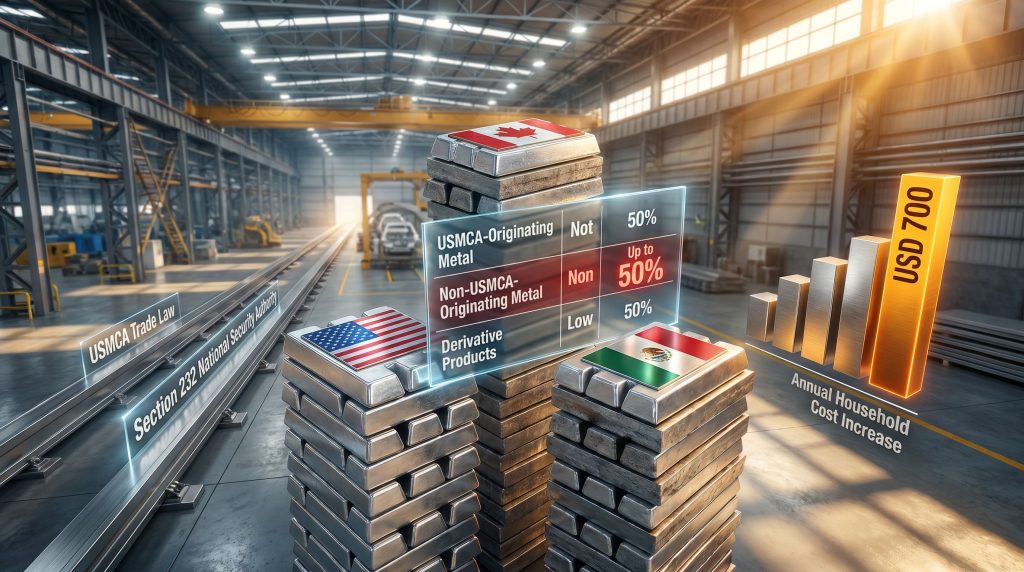
| Product Origin Status | IEEPA Waiver Applies? | Section 232 Still Applies? | Effective Tariff Exposure |
|---|---|---|---|
| USMCA-Originating Metal | Yes | Potentially Yes | Moderate to High |
| Non-USMCA-Originating Metal | No | Yes | Up to 50% |
| Derivative Products (metal content only) | Partial | Yes (on metal content) | Variable |
For non-originating Canadian and Mexican metals, the combination of no IEEPA waiver and full Section 232 exposure can generate cumulative tariff obligations of up to 50%, a level that fundamentally alters the economics of cross-border sourcing decisions. Furthermore, the impact on Canadian industries has been particularly acute given the degree of integration between Canadian and US metals production networks.
The Derivative Products Complication
One of the less understood aspects of the current tariff regime involves how Section 232 applies to derivative steel and aluminium products. Unlike raw metal imports, where tariffs are assessed against the full import value, derivative product tariffs are calculated only against the metal content within the finished good.
This creates a more complex calculation requirement for manufacturers of composite goods. A single automotive component, for example, may contain aluminium alongside polymers, adhesives, and electronic elements. Correctly isolating and valuing the aluminium content for tariff purposes requires component-level analysis that many supply chain teams were not previously equipped to perform.
Industries with the greatest exposure to derivative product tariff calculations include:
- Automotive OEMs and Tier 1 component suppliers
- Construction materials manufacturers
- Industrial machinery producers
- Aerospace component fabricators
- Packaging and container producers
For these sectors, tariff compliance has become an exercise in granular supply chain tariff disruption mapping rather than simple product-level classification.
The July 2026 USMCA Review: What Is at Stake
A Mandatory Review With Non-Routine Implications
The USMCA contains a built-in review mechanism that brings signatory governments to the table at regular intervals to assess the agreement's functioning and negotiate modifications. The review window opening in July 2026 carries heightened significance because it coincides with the scheduled expiry of existing Section 122 tariff authority, creating a concentrated moment of trade policy uncertainty.
Negotiations involving Mexico began in Mexico City in late May 2026, with the sequencing of bilateral and trilateral discussions still being determined. Three areas have emerged as primary focal points in early-stage talks:
- Tightening of rules of origin thresholds, particularly for metals and automotive content
- Closer tariff alignment against imports from countries outside US free trade agreements
- Increases to North American manufacturing content requirements in industrial supply chains
The US Negotiating Position
Washington's stated priorities in the USMCA review process centre on raising North American content requirements for industrial goods, with a particular focus on automotive components and metals. The strategic objective extends beyond bilateral trade management and reflects a broader effort to build higher tariff walls against Asian imports in steel, aluminium, and electric vehicle supply chains.
A significant near-term policy variable involves Section 301 trade powers. Once the existing Section 122 tariffs expire in July 2026, the administration may deploy Section 301 authority to introduce replacement or additional tariff measures. Section 301 is a broader trade remedy tool traditionally used to counter unfair trade practices, and its application in this context would represent a notable expansion of the tariff toolkit applied to North American trade relationships.
Canada's Counter-Tariff Position
Canada has maintained a retaliatory tariff framework covering US vehicles and approximately CAD 15.6 billion in American steel and aluminium imports. The political logic behind this posture is to preserve negotiating leverage rather than to create a permanent trade barrier.
Canadian industry groups face a compounded challenge: domestic counter-tariffs raise the cost of US-sourced inputs while simultaneously US tariffs on Canadian exports reduce the competitiveness of Canadian metal products in their largest export market. Navigating this dual exposure is reshaping sourcing decisions, contract structures, and investment priorities across Canadian aluminium and steel sectors. According to analysis of the broader trade war context, these disputes represent one of the most significant disruptions to North American trade in recent decades.
Counting the Cost: Consumer and Business Impact
The Household Burden
Tax Foundation modelling estimates that the current US tariff regime could increase average consumer costs by approximately USD 700 in 2026. Research from the Federal Reserve Bank of New York indicated that American consumers absorbed close to 90% of tariff-related costs in 2025, a finding that directly challenges the political framing of tariffs as a mechanism for extracting revenue from foreign exporters.
When domestic consumers bear the overwhelming majority of tariff-related price increases rather than foreign producers, the revenue transfer argument used to justify tariffs becomes economically difficult to sustain.
This cost absorption dynamic differs across sectors. In retail and packaging, cost pass-through to end consumers tends to be relatively direct and rapid. In automotive and construction markets, the timeline is longer, but the eventual price impact is typically larger in absolute terms given the metal intensity of finished goods.
Business Investment and Supply Chain Paralysis
Beyond consumer costs, the most structurally significant impact of the current tariff environment may be on capital allocation and supply chain architecture decisions. Industry representatives, including Matthew Holmes of the Canadian Chamber of Commerce, have highlighted that ongoing uncertainty across aluminium, steel, and automotive tariff regimes is creating decision paralysis for businesses planning investments and workforce changes.
The compounding effect of uncertain rules of origin requirements adds a further layer of complexity. A manufacturer considering a long-term supply chain redesign must factor in not only current tariff rates but also the possibility that origin thresholds will shift under a renegotiated USMCA, potentially invalidating the economics of decisions made today. Consequently, the global commodity tariff effects of this uncertainty are being felt well beyond North American borders.
Industries most acutely affected include:
- Automotive OEMs managing multi-country component sourcing
- Primary aluminium smelters evaluating capacity expansion timelines
- Construction materials suppliers pricing long-duration contracts
- Aerospace manufacturers dependent on specification-grade aluminium alloys
The Integrated Supply Chain Problem
A critical and often underappreciated dimension of USMCA aluminium and steel tariffs is that the North American metals supply chain is structurally integrated in ways that have no equivalent in other bilateral trade relationships. A Canadian aluminium smelter supplying a Michigan automotive stamping plant is not simply an exporter and an importer transacting across a border. It is part of a single production system designed around open cross-border flows.
Applying tariffs to this integrated system generates disruption disproportionate to what the same tariff rates would produce between genuinely separate trading economies. Every cross-border transaction within an integrated production network becomes a tariff event, multiplying exposure across multiple processing stages before a finished vehicle ever reaches a dealership.
How Industries Are Responding
Origin Engineering and Supply Chain Redesign
Manufacturers facing Section 232 exposure have begun exploring what practitioners are calling origin engineering, the deliberate restructuring of production processes and sourcing arrangements to maximise USMCA-originating content. The goal is to ensure that a higher proportion of metal inputs qualify for preferential treatment under rules of origin, reducing Section 232 liability.
This approach involves trade-offs. Sourcing exclusively from North American suppliers may reduce tariff exposure but can increase input costs if North American metal prices exceed global benchmarks. The optimal strategy depends on the specific tariff rates applicable to a product, the price differential between North American and non-North American inputs, and the durability of current tariff arrangements. Industry groups such as those advocating for USMCA tariff harmonisation have pushed for clearer policy frameworks to support these decisions.
Aluminium Investment Uncertainty
Prolonged tariff uncertainty is weighing on capital investment decisions in primary aluminium smelting and downstream processing. Capacity expansion projects require multi-year planning horizons and financial commitments that are difficult to justify when the tariff environment governing the resulting production could change materially within the investment period.
The risk of permanent capacity displacement is real. If tariff uncertainty persists through the USMCA review cycle without resolution, investment decisions that are deferred may eventually be redirected to jurisdictions with more predictable regulatory environments rather than simply delayed within North America.
Industry Advocacy and Exclusion Mechanisms
Trade associations representing aluminium and steel producers and downstream manufacturers are actively lobbying for product-specific tariff exclusions and broader USMCA metal exemptions within the review negotiation. The 2018–2019 Section 232 exemption process, which operated through a formal exclusion application mechanism, provides historical precedent for how such relief can be structured. A detailed overview of recent Section 232 developments outlines the latest changes to tariff stacking and calculation rules.
Whether a similar mechanism will be established in the current cycle remains uncertain. The outcome will depend significantly on the breadth of the negotiating mandate that the US trade representative carries into the USMCA review and the extent to which business coalitions can shape that mandate before formal talks intensify. In addition, the 2025 metals tariff impact continues to reverberate across downstream industries as they assess their exposure and response options.
The next major ASX story will hit our subscribers first
Frequently Asked Questions
Does USMCA Membership Exempt Canada and Mexico From US Aluminium Tariffs?
No. USMCA membership provides preferential treatment under IEEPA waiver provisions for qualifying originating goods, but Section 232 national security tariffs operate under separate legal authority and can apply to USMCA-compliant products depending on their classification and origin status.
What Is the Current US Tariff Rate on Canadian Aluminium Imports?
Canadian aluminium and steel imports, including those meeting USMCA rules of origin, face potential exposure of up to 50% under the expanded Section 232 framework as it has been applied since 2025.
What Happens After July 2026 Under the USMCA Review?
The July 2026 USMCA review is a formal renegotiation window covering the agreement's terms and thresholds. Separately, existing Section 122 tariffs are scheduled to expire around the same time, at which point Section 301 authority may be deployed to introduce new or replacement tariff measures.
How Are Derivative Aluminium and Steel Products Taxed Under Section 232?
Section 232 tariffs on derivative products are assessed only against the metal content value within the finished product, not the total product value, creating a more complex calculation requirement for manufacturers of composite goods.
What Would Stricter USMCA Rules of Origin Mean for Manufacturers?
Higher North American content requirements would oblige manufacturers to source a greater share of inputs from within the USMCA region to qualify for preferential tariff treatment. This could materially increase production costs for manufacturers currently relying on Asian-sourced steel and aluminium inputs.
Key Takeaways for 2026
- USMCA and Section 232 are parallel legal frameworks. Compliance with the trade agreement does not provide automatic protection from national security tariffs
- Non-originating Canadian and Mexican metals face combined tariff exposure of up to 50% under the current regime
- The July 2026 USMCA review is the most consequential near-term policy event for North American metals trade
- US consumers are absorbing approximately 90% of tariff-related costs, with average household expenditure estimated to rise by around USD 700 in 2026
- Origin engineering and supply chain redesign are emerging as primary corporate responses to tariff exposure
- Section 301 measures may replace Section 122 authority post-July 2026, potentially introducing new tariff instruments with broader coverage
- Investment deferral across primary aluminium smelting and downstream processing represents a structural risk that intensifies the longer tariff uncertainty persists
Disclaimer: This article contains references to economic modelling, policy forecasts, and analyst assessments. These represent estimates based on available data and are subject to change as trade negotiations evolve. Nothing in this article constitutes financial, legal, or investment advice. Readers should conduct independent research before making any commercial or investment decisions.
Want to Stay Ahead of the Next Major Minerals Discovery Driven by Shifting Trade Dynamics?
As tariff uncertainty reshapes North American metals supply chains and redirects capital flows across the global commodities landscape, Discovery Alert's proprietary Discovery IQ model delivers real-time notifications on significant ASX mineral discoveries — instantly translating complex market signals into actionable investment opportunities. Explore historic discoveries and their returns or visit the Discovery Alert home page to begin your 14-day free trial and position yourself ahead of the market.