July 17, 2026
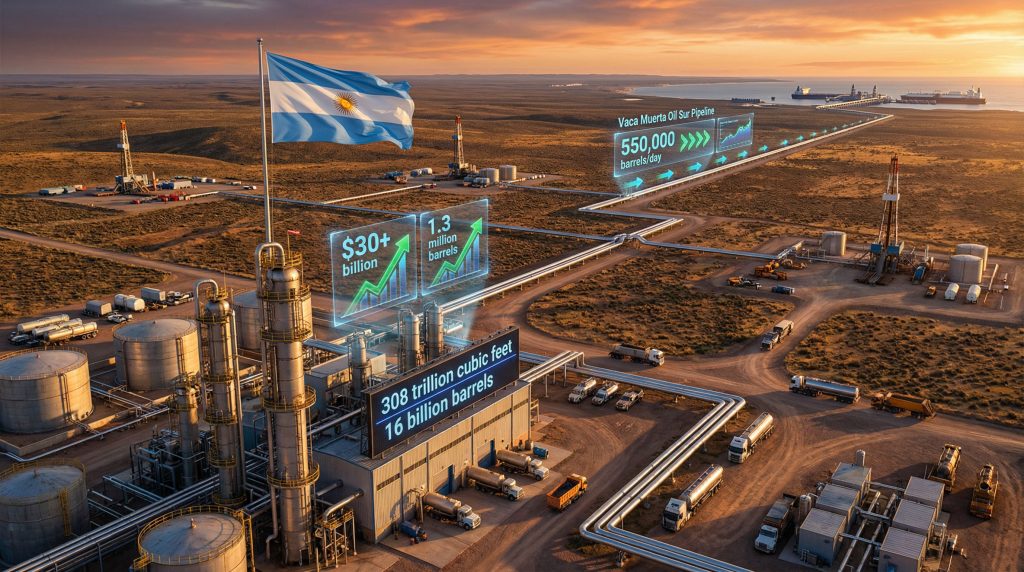
Argentina's unconventional energy sector stands at a critical juncture where geopolitical volatility meets unprecedented resource development opportunities. As Middle Eastern conflicts reshape global energy markets, South American producers find themselves positioned to capitalise on supply chain diversification demands that favour stable, accessible reserves over traditional but increasingly uncertain sources. The Vaca Muerta Argentina energy export potential represents one of the most significant opportunities for transforming the country's economic trajectory through strategic hydrocarbon development.
Understanding Argentina's Strategic Energy Position in Global Markets
The transformation of Argentina from energy importer to potential major exporter represents one of the most significant shifts in regional energy dynamics since the discovery of North Sea oil. Current production levels have reached 508,300 barrels per day for oil and 140 MMm³/day for gas, marking substantial recovery since 2017 with record levels in both production and exports.
Between 2022 and 2023, the hydrocarbon sector contributed an additional $12 billion in foreign exchange, fundamentally altering Argentina's energy trade balance from historical deficits to a positive $7.8 billion surplus in 2025. This shift occurred alongside the agroindustrial sector's $42.2 billion trade surplus, positioning energy as a potential rival to traditional agricultural export revenues.
Current Market Position Analysis:
| Metric | 2025 Baseline | Growth Trajectory | Strategic Significance |
|---|---|---|---|
| Oil Production | 508,300 bbl/d | Recovery since 2017 | Export-focused development |
| Gas Production | 140 MMm³/d | Domestic supply security | Regional integration potential |
| Energy Trade Balance | $7.8 billion surplus | Accelerating growth | Foreign exchange diversification |
| LNG Import Reduction | 27 cargos to 23 projected | Path to energy independence | Cost savings and export capacity |
The strategic positioning reflects a fundamental reorientation toward export-driven development rather than domestic consumption focus. As industry leaders emphasise, Vaca Muerta represents an export project rather than a century-long domestic supply solution, with investment capital flowing toward profitable, revenue-generating ventures rather than subsidised initiatives.
Argentina's competitive advantages extend beyond resource scale to include geographic proximity to major energy-importing economies and competitive extraction costs. Furthermore, the development window for hydrocarbon resources globally remains limited by energy transition challenges, creating urgency for current investment deployment to fully realise sector potential.
When big ASX news breaks, our subscribers know first
What Makes Vaca Muerta a Game-Changer for Regional Energy Security?
The Neuquén Basin's geological characteristics create unique opportunities for sustained production growth through superior reservoir properties that support longer-term production profiles compared to rapidly declining North American formations. Unlike conventional plays requiring continuous drilling to maintain output, Vaca Muerta Argentina energy export potential encompasses technical specifications that enable more economically sustainable development trajectories.
Three Scenario Development Framework:
Moderate Growth Scenario (Conservative Development):
- 2030 Targets: 1.0 million bbl/d oil; 213 MMm³/d gas
- 2035 Projections: 1.204 million bbl/d oil; 218 MMm³/d gas
- Investment Prerequisite: Only projects with final investment decisions already executed
- Energy trade balance: $17.7 billion (2030), $18.5 billion (2035)
Expansive Scenario (Industry Target Objective):
- 2030 Targets: 1.14 million bbl/d oil; 281 MMm³/d gas
- 2035 Projections: 1.688 million bbl/d oil; 301 MMm³/d gas
- Annual investment requirement: $18 billion average through 2030
- Energy trade balance: $24.6 billion (2030), $37.7 billion (2035)
Accelerated Scenario (Maximum Timeline Compression):
- 2030 Peak: 1.676 million bbl/d oil; 281 MMm³/d gas
- 2035 Plateau: 1.671 million bbl/d oil; 302 MMm³/d gas
- Strategic consequence: Rapid decline rates after 2030 peak due to accelerated depletion
- Front-loaded benefits: $36.8 billion energy trade balance by 2030
War-Adjusted Economic Projections
Current Middle Eastern conflicts have elevated energy prices from baseline November 2025 levels of $62 Brent crude and $9.3/MMBtu gas to current levels of $90 Brent and $16.2/MMBtu. This pricing differential creates an additional $10 billion annually in energy trade surplus potential across all development scenarios, reflecting broader oil price rally impact on global markets.
Enhanced Revenue Projections Under Conflict Pricing:
- Moderate Scenario: $18.4 billion (2030), $23.2 billion (2035)
- Expansive Scenario: $32.6 billion (2030), $48.7 billion (2035)
- Accelerated Scenario: $47.2 billion (2030), $48.2 billion (2035)
The regulatory acceleration effect through RIGI extension to upstream activities has shifted project timelines, converting evaluation-stage developments into final investment decisions earlier than originally anticipated. However, technical challenges remain in the accelerated scenario, particularly regarding associated gas treatment capacity. Insufficient treatment plant availability could create production bottlenecks despite high unconventional oil production levels, potentially impacting the general production chain through 2030-2035.
How Are Infrastructure Investments Enabling Export Capacity?
Strategic pipeline investments represent the most critical constraint-removal mechanism in Argentina's energy export development, fundamentally altering project economics by reducing transportation costs and enabling direct international market access. The progression from moderate to expansive scenarios depends entirely on infrastructure completion timelines rather than geological or operational capacity limitations.
Vaca Muerta Oil Sur (VMOS) Pipeline System Development:
- Initial Phase (December 2026): 180,000 bbl/d capacity
- Full Capacity Phase (2027): 550,000 bbl/d throughput
- Expansion Phase (Early 2028): 700,000 bbl/d capacity under expansive scenario
- Strategic Endpoint: Direct connection to Punta Colorada export terminal
- Total Investment: $3 billion consortium funding
Gas Transportation Network Sequential Expansion:
| Infrastructure Project | Capacity Addition | Operational Timeline | Scenario Dependency |
|---|---|---|---|
| TGS Network Expansion | +14 MMm³/d | July 2027 | All scenarios |
| Tratayén-La Carlota (Moderate) | +20 MMm³/d | January 2030 | Conservative timeline |
| Tratayén-La Carlota (Expansive) | +40 MMm³/d | January 2028 | Accelerated development |
| San Matías Dedicated Gasduct | 27 MMm³/d | July 2028 | LNG export enablement |
LNG Infrastructure Deployment Strategy
The floating storage and regasification unit (FSRU) deployment creates immediate export capacity without requiring permanent onshore facilities, reducing capital requirements and project development timelines. Southern Energy SESA's vessel coordination represents a critical near-term export catalyst for the Vaca Muerta Argentina energy export potential.
SESA Liquefaction Vessel Timeline:
- Hilly Eliseo: 2.45 MTPA capacity operational September 2027
- MK2: Additional 3.5 MTPA capacity operational September 2028
- Combined Capacity: 5.95 MTPA total by late 2028
- Geographic Advantage: San Matías Gulf positioning for Pacific and Atlantic market access
The infrastructure sequencing logic coordinates pipeline phasing with production ramp schedules, ensuring transportation capacity availability matches expected output increases. Moreover, the architectural separation between domestic demand systems and export-dedicated infrastructure prevents competition between heating/power needs and liquefaction requirements.
Associated supporting infrastructure requirements include new gas treatment plants for shale oil operations, NGL polyduct infrastructure via TGS, and additional export dock facilities beyond existing Punta Colorada terminal capacity. These complementary investments form essential prerequisites for production scaling beyond moderate scenario levels.
Which Market Dynamics Are Driving Argentina's Export Strategy?
Global energy supply diversification accelerated by geopolitical tensions creates premium pricing opportunities for reliable non-OPEC producers positioned outside traditional conflict zones. Argentina's strategic location enables service to both regional South American markets and transcontinental destinations through different export modalities, maximising market optionality while considering trade war market effects.
Regional Market Integration Framework:
- Brazil Partnership Development: Natural gas integration through expanded pipeline capacity targeting industrial and power generation sectors
- Chilean Export Corridor: Light sweet crude and refined product distribution leveraging geographic proximity
- Global LNG Market Access: Floating liquefaction targeting Asian premium markets while maintaining Atlantic Basin flexibility
Current international energy dynamics show petroleum demand growth projected through the 2030s before declining around 2035, consistent with International Energy Agency forecasting. However, natural gas price forecasts indicate demand increases due to global coal phase-out trends, creating specific opportunity windows for Argentine LNG development.
The war-driven pricing environment demonstrates market willingness to pay premium rates for supply security, validating export-focused development strategies over domestic-only approaches. Qatar's potential infrastructure reconstruction requirements could further tension global service and equipment demand, potentially benefiting established producers with existing capacity.
Demand Trajectory Assessment
Petroleum Market Outlook:
- Growth phase continuation through 2030s
- Decline initiation around 2035 per IEA projections
- Window optimisation requiring immediate investment deployment
Natural Gas Market Dynamics:
- Sustained demand growth through coal displacement
- LNG premium market opportunities in Asia-Pacific
- Regional integration potential with Brazil's industrial sector
Current import reduction trends show Argentina moving from 27 LNG cargo requirements in 2025 to approximately 23 vessels projected for 2026. Optimistic scenarios project single-digit import requirements or net-zero positions as domestic exports grow, reflecting advancing energy independence during peak demand periods.
What Are the Economic Multiplier Effects of Energy Export Growth?
The transformation from energy importer to major exporter generates cascading economic benefits extending far beyond direct hydrocarbon revenues. Foreign exchange earnings from energy exports create fiscal space for broader economic development while reducing Argentina's historical current account vulnerabilities that have constrained growth for decades within the global multipolar economy.
Comparative Economic Impact Analysis:
Current agroindustrial exports generated $42.2 billion in 2025 trade surplus, establishing the benchmark for Argentina's export sector leadership. Energy sector projections under expansive scenarios could exceed agricultural revenues by 2035, fundamentally rebalancing the country's export portfolio toward more capital-intensive, higher-value activities.
Scenario-Based Revenue Projections:
| Development Path | 2030 Export Revenue | 2035 Export Revenue | Annual Growth Rate |
|---|---|---|---|
| Moderate Scenario | $18.4 billion | $23.2 billion | 4.7% compound |
| Expansive Scenario | $32.6 billion | $48.7 billion | 8.3% compound |
| Accelerated Scenario | $47.2 billion | $48.2 billion | Front-loaded peak |
Investment Requirements and Economic Stimulus
The expansive scenario requires significant capital deployment averaging $18 billion annually through 2030, then $17 billion annually from 2031-2035. This investment level represents nearly doubling current sectoral investment rates, reaching $21 billion peak investment by 2027 before stabilising at $14 billion annually through the following decade.
Employment and Technical Capacity Development:
- Direct Employment: Conventional basin production sustainability for employment continuity
- Specialised Skills: Technical workforce development for unconventional operations
- Technology Transfer: Enhanced operational efficiency reducing completed well costs from $15 million to $13 million
- Regional Development: Neuquén Basin economic diversification beyond traditional agriculture
The economic multiplier extends through supply chain development, service sector growth, and infrastructure investment catalysing broader regional development. Energy export revenues provide foreign exchange stability reducing macroeconomic volatility that has historically constrained Argentine economic planning.
Furthermore, foreign exchange earnings enable reduced reliance on IMF financing arrangements and provide greater monetary policy flexibility. The sector's capital intensity creates high-value employment opportunities while generating substantial tax revenues through production-based fiscal regimes.
How Do Global Price Dynamics Affect Argentina's Export Potential?
International energy price volatility driven by Middle Eastern conflicts creates simultaneous opportunities and risks for Argentina's export strategy development. Higher global prices improve project economics and investment returns but also increase development costs and infrastructure investment requirements, creating complex optimisation challenges.
Price Sensitivity Framework:
Baseline Pricing Environment (November 2025):
- Brent crude: $62/barrel
- Natural gas (TTF): $9.3/MMBtu
- Scenario foundation: Conservative development assumptions
Conflict-Driven Pricing (April 2026 Current):
- Brent crude: $90/barrel
- Natural gas (TTF): $16.2/MMBtu
- Revenue impact: Additional $10 billion annually across scenarios
Cost Structure Implications
While elevated prices enhance revenue projections, they simultaneously increase operational and development expenses. Argentine operations face cost structure challenges compared to established producers, with extraction expenses 25-35% higher than US Permian Basin operations due to more expensive inputs including services, sand, and piping.
Competitive Cost Analysis:
- Vaca Muerta: $36-45/barrel Brent equivalent extraction costs
- Permian Basin: 25-35% lower costs with 12-13 day well completion cycles
- Efficiency Trends: Gradual improvement but persistent competitiveness gap
The cost differential reflects input pricing disparities and operational efficiency gaps rather than geological disadvantages. Completed well costs are projected to decline from $15 million to $13 million over coming years through operational improvements, but the pace remains slower than competitive regions.
Global service and equipment demand tensions could further impact Argentine development costs. Qatar's potential infrastructure reconstruction needs may strain international service capacity, potentially increasing project costs for concurrent developments including YPF-led initiatives.
Price Volatility Risk Management
Revenue Stability Mechanisms:
- Long-term contract structures for LNG exports
- Hedging strategies for price volatility management
- Diversified market exposure across regional and global buyers
- Infrastructure investment timing optimisation based on price cycles
Price volatility creates both upside potential and downside protection requirements for sustained development programmes. Investment decision frameworks must account for price cycle timing to optimise infrastructure deployment and production ramp coordination.
The next major ASX story will hit our subscribers first
What Regulatory Framework Supports Sustainable Export Growth?
Argentina's Large Investment Incentive Regime (RIGI) provides regulatory certainty necessary for long-term capital commitments in energy infrastructure development. The framework addresses historical concerns about policy continuity while maintaining competitive fiscal terms for international investors seeking stable investment environments.
RIGI Framework Core Benefits:
- Tax Stability: 30-year guarantee periods providing long-term certainty
- Accelerated Depreciation: Enhanced project economics through faster capital recovery
- Foreign Exchange Flexibility: Reduced currency conversion restrictions for international operations
- Environmental Streamlining: Coordinated permitting processes reducing development timelines
Regulatory Acceleration Effects
RIGI extension to upstream activities has fundamentally altered project development timelines by converting evaluation-stage projects into final investment decisions earlier than originally planned. The regime establishes concrete deadlines for incentive access, pushing previously delayed projects toward immediate commitment.
Timeline Acceleration Impact:
- Projects under evaluation converting to final investment decisions
- Expansive scenario probability increased through regulatory certainty
- Investment commitment timelines compressed through incentive deadlines
- International investor confidence enhanced through policy stability
The regulatory framework addresses key investor concerns including policy continuity across electoral cycles, fiscal regime stability, and foreign exchange access that have historically constrained energy sector investment in Argentina. However, successful implementation requires maintaining fiscal competitiveness at international levels while ensuring macroeconomic and regulatory stability that enables sustained investment deployment over decade-long development horizons.
Complementary Policy Requirements:
- Retention Policy Stability: Export tax certainty for investment planning
- Infrastructure Coordination: Government support for critical transportation projects
- Environmental Compliance: Clear standards for water management and emissions
- Labour Relations: Stable employment frameworks for operational continuity
Which Companies Are Leading Argentina's Energy Export Transformation?
The development of Argentina's export capacity involves diverse consortiums of domestic and international energy companies, each contributing specialised expertise and capital resources. This multi-stakeholder approach reduces individual project risks while accelerating overall development timelines through shared technical knowledge and financial capacity.
Key Industry Participants and Roles:
| Company Category | Primary Focus | Strategic Contribution |
|---|---|---|
| YPF | Domestic Integration | Argentina LNG project leadership |
| Vista Energy | Unconventional Specialist | Vaca Muerta production optimisation |
| Pan American Energy | Regional Operations | Pipeline infrastructure development |
| TGS | Transportation Infrastructure | Gas pipeline network expansion |
| Southern Energy SESA | LNG Export Pioneer | Floating liquefaction vessel deployment |
Domestic vs. International Partnership Models
Domestic Leaders:
YPF maintains strategic leadership in large-scale LNG development through the Argentina LNG project, leveraging national energy company status for regulatory coordination and domestic market integration. Vista Energy focuses on unconventional resource optimisation, bringing specialised Vaca Muerta operational expertise.
International Partnerships:
Continental Resources provides US shale expertise for technology transfer, while European companies like Eni contribute downstream integration capabilities. ADNOC participation brings Middle Eastern capital and global market access networks.
Infrastructure Specialists:
TGS leads gas transportation network expansion through its established pipeline system, while Pan American Energy coordinates multi-modal transportation solutions. These infrastructure specialists enable production-to-export connectivity essential for sustained growth.
Technology Transfer and Operational Efficiency
International partnerships facilitate technology transfer addressing cost competitiveness challenges compared to established shale regions. US operators bring drilling and completion techniques that have reduced well development timelines, though cost parity with Permian Basin operations remains elusive.
Operational Efficiency Improvements:
- Well completion timeline reduction through enhanced techniques
- Associated gas treatment technology for shale oil operations
- Enhanced recovery methods extending production curves
- Water management systems for environmental compliance
The consortium approach enables risk distribution while combining complementary capabilities necessary for complex export infrastructure development spanning upstream production, midstream transportation, and downstream export facilities.
What Challenges Could Limit Export Growth Potential?
Despite favourable resource endowments and improving infrastructure development, several critical factors could constrain Argentina's ability to fully realise its energy export potential. Understanding these limitations remains essential for realistic scenario planning and comprehensive risk assessment across development timelines.
Critical Constraint Categories:
Infrastructure Bottlenecks
Pipeline capacity limitations during peak production periods represent the most immediate constraint on export growth. The accelerated scenario specifically identifies insufficient associated gas treatment capacity as a potential production chain bottleneck, where rapid shale oil development outpaces supporting infrastructure deployment.
Capacity Constraints:
- VMOS pipeline phasing may limit oil evacuation during production ramps
- Associated gas treatment plants insufficient for accelerated oil development
- Port and terminal capacity requiring expansion beyond current Punta Colorada facilities
- Power and water infrastructure scaling for expanded operations
Capital Requirements and Financing
Sustaining development through expansive scenarios requires unprecedented capital deployment averaging $18 billion annually through 2030. This investment level represents nearly doubling current sectoral rates, creating financing challenges even with favourable global energy prices.
Financing Challenges:
- $22 billion cumulative capex requirement through 2032
- International capital market access dependent on continued policy stability
- Currency volatility affecting project economics for dollar-denominated investments
- Competition with global energy projects for limited investment capital
Technical Workforce Development
Specialised skills shortages in unconventional operations could constrain growth rates regardless of capital availability. Technical workforce development requires sustained education and training programmes coordinated across industry participants.
Skills Gap Areas:
- Horizontal drilling and completion specialists
- Associated gas processing technicians
- Pipeline and export terminal operations
- Environmental compliance and water management
Environmental and Regulatory Compliance
Water management requirements for hydraulic fracturing operations could limit development pace, particularly during extended production ramp periods. Environmental compliance frameworks require clear standards while maintaining operational flexibility for efficient development.
How Does Argentina's Energy Strategy Compare Globally?
Argentina's approach to unconventional resource development reflects lessons learned from North American shale plays while adapting to unique South American market conditions and regulatory environments. The emphasis on export-oriented development distinguishes it from purely domestic-focused strategies employed by other emerging producers.
Competitive Positioning Analysis:
Cost Structure Comparisons
Argentina vs. Global Competitors:
- Vaca Muerta: $36-45/barrel extraction costs with infrastructure challenges
- US Permian Basin: 25-35% lower costs with established service networks
- Canadian Oil Sands: Higher costs but established export infrastructure
- Brazilian Pre-Salt: Offshore complexity but closer to export facilities
Argentina's cost disadvantage reflects input pricing and operational efficiency gaps rather than geological limitations. Service availability, equipment costs, and specialised labour pricing create structural challenges requiring sustained efficiency improvements.
Resource Quality Assessment
Geological Advantages:
- Superior reservoir characteristics enabling longer production profiles
- Lower decline rates compared to many North American formations
- Substantial associated gas content supporting dual commodity development
- Geographic concentration enabling efficient infrastructure deployment
The Neuquén Basin's technical properties support extended economic production compared to rapidly declining formations, potentially offsetting some cost disadvantages through sustained output profiles.
Market Access Positioning
Strategic Geographic Benefits:
- Atlantic and Pacific market access through different export routes
- Regional integration opportunities with Brazil and Chile
- Proximity to growing Asian LNG markets via Pacific shipping
- European market access through established Atlantic trade routes
Argentina's positioning enables market diversification strategies unavailable to landlocked producers or those with limited export infrastructure options. This flexibility provides pricing optimisation opportunities across different regional markets.
What Does Success Look Like for Argentina's Energy Future?
The ultimate measure of Argentina's energy transformation centres on its ability to sustain production growth while maintaining competitive cost structures and international environmental standards. Success requires continued infrastructure investment, technological advancement, and regulatory stability across multiple electoral cycles.
Success Metrics by 2035:
Quantitative Benchmarks
Production Targets:
- Oil production: 1.2-1.7 million barrels daily depending on development scenario
- Gas production: 218-302 MMm³/daily with substantial export capacity
- Energy trade surplus: $18.5-48.7 billion annually based on scenario achievement
- LNG export capacity: 5.95-24 MTPA through floating and permanent facilities
Economic Impact Measures:
- Foreign exchange generation exceeding agricultural sector contributions
- Investment deployment averaging $14-18 billion annually through 2030
- Employment creation in specialised technical and operational roles
- Regional economic diversification beyond traditional agriculture
Qualitative Success Indicators
Regional Energy Hub Status:
Argentina achieving South American energy leadership through reliable supply and competitive pricing to neighbouring countries. This includes Brazil partnership development, Chilean market penetration, and broader regional integration through pipeline and LNG infrastructure according to regional energy analysis.
Technology Leadership Development:
Establishing technological expertise in unconventional resource development, becoming a knowledge centre for Latin American shale development. This includes training programmes, technical service capabilities, and consulting expertise exportable to other regional producers.
Environmental Standards Integration:
Implementing international best practices for water management, emissions control, and environmental protection while maintaining operational efficiency. Success includes achieving social licence through community engagement and transparent environmental monitoring as outlined by international energy authorities.
Long-Term Sustainability Framework
Diversified Export Portfolio:
- Crude oil exports to multiple regional and global destinations
- Natural gas pipeline exports to Brazil and regional markets
- LNG exports targeting Asian premium markets and Atlantic Basin opportunities
- NGL and refined product exports leveraging existing refinery infrastructure
Infrastructure Legacy Development:
Creating transportation and export infrastructure that supports sustained development beyond initial investment periods. This includes pipeline networks, port facilities, and processing plants that enable continued growth through multiple development phases.
Policy Stability Achievement:
Maintaining consistent regulatory frameworks across electoral cycles, providing long-term certainty for continued international investment. Success includes bipartisan support for energy export development and consistent implementation of investment incentive programmes.
The convergence of favourable geology, improving infrastructure, regulatory stability, and global market conditions creates unprecedented opportunities for Argentina's energy sector transformation. Realising this potential requires sustained commitment to investment, efficiency improvement, and environmental stewardship across multiple stakeholders and development timelines.
Risk Management Integration:
Successful development requires comprehensive risk management addressing price volatility, regulatory changes, environmental challenges, and technical execution risks. This includes diversified financing, hedging strategies, and operational flexibility enabling adaptation to changing market conditions.
Argentina's energy future success ultimately depends on its ability to execute complex, capital-intensive development programmes while maintaining competitiveness in evolving global energy markets. The next decade represents a critical window for establishing sustainable export capacity and regional energy leadership that could transform the country's economic trajectory for generations.
Ready to Capitalise on the Next Energy Discovery?
Argentina's unconventional energy surge demonstrates how major discoveries can transform entire market sectors, much like historic mineral discoveries that have generated exceptional returns for early investors. Discovery Alert's proprietary Discovery IQ model provides instant notifications on significant ASX mineral discoveries, empowering subscribers to identify actionable opportunities ahead of the broader market – explore Discovery Alert's dedicated discoveries page to understand how major finds can drive substantial returns, then begin your 14-day free trial today to position yourself ahead of the market.