June 4, 2026
The Midstream Bottleneck That Has Been Holding Back One of the World's Great Shale Basins
For all the geological abundance sitting beneath the Patagonian desert, the real constraint on Vaca Muerta's growth has never been the rock itself. The formation holds an estimated 308 trillion cubic feet of technically recoverable shale gas and roughly 16 billion barrels of tight oil, ranking it among the top unconventional hydrocarbon basins globally by resource scale. Yet for years, producers operating within the basin found themselves in a paradoxical position: capable of extracting more crude oil than the surrounding infrastructure could absorb or export.
That structural mismatch is now attracting serious capital. The Vaca Muerta infrastructure financing package taking shape around Transportadora de Gas del Sur's $3 billion NGL Project represents one of the clearest signals yet that international project finance markets are treating Argentina's shale sector as a mature, bankable investment destination rather than a speculative frontier play.
When big ASX news breaks, our subscribers know first
Understanding the Associated Gas Problem in Shale Oil Production
To appreciate why the TGS NGL Project matters, it helps to understand a fundamental characteristic of shale oil geology. When operators drill horizontal wells into tight formations like Vaca Muerta, they do not extract crude oil alone. Every barrel of oil produced comes accompanied by a volume of natural gas that is chemically bound to the hydrocarbon stream within the reservoir. This co-produced gas is known in the industry as associated gas.
In conventional oilfields, associated gas volumes are typically modest and manageable. In high-productivity shale plays, however, the gas-to-oil ratio can be substantial enough to become an operational constraint. Without sufficient pipeline takeaway capacity and processing infrastructure to handle the associated gas stream, producers face a difficult choice:
- Curtail oil production rates to stay within the processing system's capacity limits
- Flare the excess gas, incurring environmental penalties and wasting a valuable resource
- Accept pressure build-up in gathering systems that risks operational integrity
None of these options is commercially acceptable at scale. The result has been a persistent ceiling on how aggressively Vaca Muerta operators can ramp production, regardless of their upstream drilling capability or reservoir quality. The midstream infrastructure gap has functioned, in effect, as a governor on the entire basin's output potential.
What the TGS NGL Project Actually Does
The NGL Project is designed to dissolve that constraint by building an integrated midstream corridor connecting Vaca Muerta's core production zone to Argentina's Atlantic coast. The project's three principal components work in sequence to transform associated gas from a production liability into a suite of exportable, revenue-generating commodities.
| Project Component | Specification |
|---|---|
| Gas Processing Expansion | New NGL extraction facilities at the Tratayen plant, Neuquén Province |
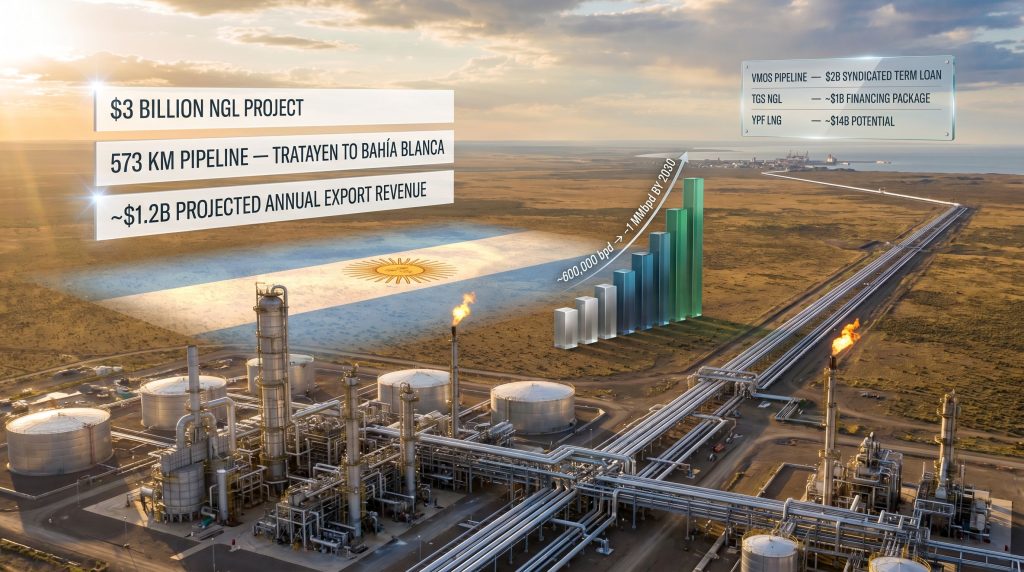
| Pipeline Corridor | 573-kilometre transmission line from Tratayen to Bahía Blanca |
| Export Terminal | Atlantic coast NGL export infrastructure at Bahía Blanca |
| Total Capital Requirement | Approximately $3 billion |
| Projected Annual Export Revenue | Approximately $1.2 billion once operational |
| Debt Financing Package | Approximately $1 billion under negotiation |
At the processing stage, raw associated gas is separated into its constituent NGL fractions: ethane, propane, butane, and natural gasoline (condensate). Each of these products commands a distinct market price and serves a different end-use sector, from petrochemical feedstock to liquefied petroleum gas for domestic and industrial consumption. Furthermore, the 573-kilometre pipeline then transports these products to Bahía Blanca, where new export terminal facilities will enable shipment to international buyers.
TGS, which operates as Argentina's largest natural gas transmission company and is partially owned by Pampa Energía SA, formally announced the project at a New York investor event in March 2026. That choice of venue was deliberate: announcing in New York signalled that TGS was engaging international capital markets from the project's inception, not as an afterthought. Shifts in global financial markets have, however, made lenders increasingly selective about the jurisdictions and structures they are willing to support.
The fundamental constraint on Vaca Muerta's growth is no longer geological or technological. The absence of sufficient midstream infrastructure has functioned as a ceiling on production upside, making pipeline and processing investment the highest-leverage capital deployment in the basin today.
How the ~$1 Billion Financing Package Is Being Structured
According to reporting by Bloomberg cited in World Oil, Citigroup, Banco Santander, and JP Morgan are among the financial institutions working on a roughly $1 billion financing package for the TGS NGL Project. Negotiations were ongoing as of early June 2026, with the precise terms and syndicate composition still being finalised.
The architecture of this deal is recognisably a project finance structure rather than a conventional corporate loan. This distinction matters enormously for how lenders assess risk:
- Project finance creates a ring-fenced special purpose vehicle whose debt is serviced from the project's own cash flows, secured against project assets and export receivables, rather than sitting on the sponsor's general balance sheet.
- Corporate finance relies on the borrower's overall creditworthiness, which in Argentina's context would expose lenders to the full weight of sovereign risk.
By structuring the debt against hard-currency export receivables, lenders effectively create a natural hedge against Argentina's residual peso volatility. The NGL project's projected $1.2 billion in annual export revenues provides a substantial coverage buffer over debt service obligations, which underpins lender comfort even amid the country's broader macroeconomic history. This approach to commodity market volatility management has become increasingly standard in emerging-market infrastructure finance.
Why Export Receivables Are Central to Lender Comfort
The use of hard-currency export receivables as primary loan security is not simply a technical preference. It reflects a deliberate attempt to insulate the debt structure from Argentina's domestic financial system. Consequently, lenders can model repayment scenarios based on international NGL prices and contracted volumes rather than relying on the stability of local banking or foreign exchange frameworks.
The VMOS Precedent and What It Unlocked
The TGS NGL financing does not exist in isolation. It is part of a rapidly developing pattern of large-scale project finance in the Vaca Muerta basin, anchored by a precedent transaction that fundamentally changed how international banks perceive Argentine energy risk.
In mid-2025, the Vaca Muerta Sur oil pipeline closed a $2 billion syndicated secured term loan, reported at the time as the largest private infrastructure financing ever completed in Argentina. The VMOS lender group included Citi, JP Morgan, Santander, Itaú, and Deutsche Bank. The borrower consortium brought together YPF alongside Chevron, Shell, Vista Energy, Pluspetrol, Pan American Energy Group, and Pampa Energía.
| Project | Financing Size | Structure | Status |
|---|---|---|---|
| Vaca Muerta Sur (VMOS) Oil Pipeline | $2 billion | Syndicated secured term loan | Closed mid-2025 |
| TGS NGL Project | ~$1 billion (debt tranche) | Project finance package | Under negotiation (2026) |
| YPF Argentina LNG Export Facility | ~$14 billion (potential) | TBD | Early-stage pursuit |
The VMOS deal did more than finance a single pipeline. It established a replicable structural template, demonstrated that international banks were willing to hold Argentine energy paper on their books, and gave subsequent project sponsors a credible precedent to present to their own lender syndicates during due diligence.
The recurring appearance of Citi, JP Morgan, and Santander across both VMOS and the TGS NGL deal is not coincidental. It reflects deepening institutional familiarity with the asset class and growing confidence in the underlying cash flow mechanics.
The VMOS pipeline financing established a structural template that subsequent Vaca Muerta deals are now replicating. The TGS NGL package follows the same debt-to-equity architecture, with debt expected to cover approximately two-thirds of total project cost.
Argentina's RIGI Investment Regime: What It Is and Why It Matters
No analysis of the current Vaca Muerta infrastructure financing package wave is complete without understanding the regulatory architecture enabling it. President Javier Milei's administration introduced the Régimen de Incentivo para Grandes Inversiones, known as RIGI, as a cornerstone of Argentina's effort to attract large-scale foreign and domestic capital into strategic infrastructure.
What RIGI offers qualifying projects:
- Significant reductions in corporate income tax rates over the investment period
- Foreign exchange repatriation rights that allow project sponsors to hold and transfer hard-currency earnings without the restrictions that have historically complicated Argentine investment returns
- Customs duty exemptions on imported capital equipment during construction phases
- Long-term legal stability provisions designed to protect qualifying projects from retroactive regulatory changes
TGS has stated its intention to seek RIGI qualification for the NGL project. The VMOS pipeline established the practical precedent for how RIGI participation integrates into a project finance lender framework, providing banks with an additional layer of confidence around cash flow predictability and foreign exchange access.
It is important to note that RIGI qualification is an application process, not an automatic entitlement. Projects must meet defined capital thresholds and sector eligibility criteria, and the regime's long-term durability across potential future administrations remains a risk factor that informed lenders price into their credit analysis.
The next major ASX story will hit our subscribers first
How a Vaca Muerta Infrastructure Deal Gets Financed: Step by Step
For investors and analysts less familiar with project finance mechanics, the following sequence describes how deals of this type typically progress from concept to financial close:
- Project scoping: The sponsor defines the infrastructure footprint, capital budget, and projected revenue streams based on offtake market analysis.
- Commercial agreements: Preliminary offtake contracts and coordination agreements are negotiated with basin operators to underpin revenue certainty. TGS has already signed such preliminary agreements with several major Vaca Muerta producers.
- RIGI application: The sponsor formally applies for RIGI status, triggering the review process for tax and foreign exchange incentive qualification.
- Syndicate formation: Lead arranging banks are mandated, due diligence processes begin, and the lender group is progressively assembled around the transaction.
- Capital structure determination: Debt and equity proportions are set, typically with debt covering approximately two-thirds of total project cost, with sponsor equity comprising the remainder.
- Security package construction: Legal teams build the loan security around project assets, export receivables, and any applicable insurance or guarantee structures.
- Financial close: All conditions precedent are satisfied, funds are committed, and initial drawdowns begin against construction milestones.
- Construction and commissioning: Capital is deployed across a multi-year build programme with regular lender monitoring of progress.
- Revenue generation: Once operational, hard-currency export receipts service debt obligations, with surplus cash flowing to the equity sponsor.
Shale Oil Growth Projections and the Capital Requirements Behind Them
The scale of midstream investment now taking shape in Vaca Muerta directly tracks the basin's upstream production growth trajectory. Shale oil output currently sits at approximately 600,000 barrels per day and is projected to approach 1 million barrels per day by the end of the decade, according to industry forecasts.
Achieving that growth ceiling is not simply a function of drilling more wells. Every incremental barrel of crude production generates a corresponding volume of associated gas that must have somewhere to go. Without the NGL processing and export corridor that TGS is building, the basin's production growth curve would flatten against its own infrastructure limits well before reaching the 1 MMbpd target.
Energy exports have also taken on macroeconomic significance well beyond the sector itself. Hard-currency inflows from hydrocarbon exports have become a meaningful support mechanism for Argentina's peso stability, making the country's energy infrastructure investment programme a matter of national balance-of-payments strategy as much as a commercial opportunity. For context, shifts in global LNG supply dynamics have further elevated the strategic value of Argentina's emerging export capacity.
Why Infrastructure Investment Is the Highest-Leverage Play in the Basin
A well-considered investment strategy focused on Vaca Muerta increasingly targets midstream assets rather than upstream exposure alone. The reason is straightforward: infrastructure bottlenecks constrain the entire value chain, meaning capital deployed to remove those bottlenecks captures leverage across multiple upstream producers simultaneously.
Risks That Sophisticated Investors Are Monitoring
The Vaca Muerta infrastructure financing package narrative carries genuine structural appeal, but informed capital does not enter these transactions without accounting for a set of real and material risks.
Execution Risks
- Large-scale pipeline construction in Patagonia involves logistical complexity, exposure to cost overruns, and multi-year timeline uncertainty
- Counterparty risk embedded in preliminary offtake agreements with basin operators, which are not yet final binding contracts
Macroeconomic and Sovereign Risks
- Argentina's history of abrupt policy reversals creates long-tenor lending risk that no single regulatory regime fully eliminates
- Global commodity price sensitivity means a sustained decline in NGL prices could compress debt service coverage ratios toward covenant thresholds. In this regard, oil price volatility remains a key variable that lenders model extensively in their downside scenarios
Regulatory Continuity Risks
- RIGI's long-term durability under potential future administrations is not guaranteed, representing the principal political risk embedded in the current financing wave
- ESG-related lending constraints are becoming increasingly relevant for major international banks with sustainability mandates, particularly around flaring practices and community impact in Patagonian regions. Indeed, analysts have highlighted that environmental and financial risks remain key considerations for international lenders evaluating Argentine energy assets
Disclaimer: This article is intended for informational purposes only and does not constitute financial advice. All forecasts, production projections, and financing figures referenced reflect available industry reporting as of the date of publication and are subject to change. Investors should conduct independent due diligence before making any investment decisions.
Want to Capitalise on the Next Major Resource Discovery Before the Market Does?
Discovery Alert's proprietary Discovery IQ model delivers real-time alerts on significant ASX mineral discoveries, transforming complex resource data into actionable investment insights for traders and long-term investors alike — explore historic examples of exceptional discovery returns to see what's possible, then begin your 14-day free trial at Discovery Alert to position yourself ahead of the broader market.