
July 7, 2026
When Pension Funds Move Against Mining Boards, Everyone Pays Attention
Corporate governance in the global mining sector has rarely been a passive affair, but a structural shift is underway that makes board composition at the world's largest resource companies more contested than at any point in recent memory. Institutional shareholders, particularly pension funds with deep connections to state-linked financial institutions, have moved decisively beyond rubber-stamping executive decisions.
They are now actively reshaping who sits at the top of boardroom tables, and in some cases, forcing the issue entirely.
The resignation of Vale chairperson Stieler on 7 July 2026 is a defining example of this dynamic. However, to understand what actually happened, and why it matters beyond the headlines, requires looking at the mechanics of pension fund influence, the particular governance pressures bearing down on Brazil's largest miner, and what the transition at the top of Vale's board signals for the company's strategic direction.
When big ASX news breaks, our subscribers know first
The Power Behind a 7% Stake: Understanding Previ's Role at Vale
Previ is not a typical minority shareholder. As the pension fund administrator for employees of Banco do Brasil, Brazil's state-controlled lender, Previ manages one of the largest pension pools in Latin America. Its 7% stake in Vale may appear modest relative to the company's overall capitalisation, but in the context of a shareholder register where no single entity commands an overwhelming majority, a concentrated 7% position carries substantial leverage at general meetings.
This matters because Vale's governance structure, established after the company's privatisation in the 1990s, was explicitly designed to distribute power across multiple institutional shareholders rather than concentrate it. That design, intended to prevent any single party from dominating strategic decisions, also means that coordinated action by a determined institutional shareholder can generate disproportionate pressure on the board.
Previ's position also reflects something less obvious: its alignment with Brazilian government interests. Because Banco do Brasil is a federal institution, Previ's investment decisions carry at least an indirect connection to the broader priorities of the Brazilian state, even though Previ operates as a legally independent pension fund. This creates a layer of political complexity that international equity investors must factor into their risk assessments when holding Vale shares — particularly given broader geopolitical mining risks reshaping investment frameworks globally.
What Triggered the Push to Remove Stieler
Daniel André Stieler joined Vale's board in 2021 and was elevated to the chairperson role in 2023. His original mandate was set to run through April 2027. By any conventional measure, a mid-term removal of a sitting chairperson is an unusual and confrontational move, requiring significant institutional motivation to pursue.
Previ's stated objective centred on strengthening governance practices at Vale. The pension fund nominated current board member Manuel Oliveira as its preferred candidate for the chairperson role, alongside a separate proposal to add José Mauricio Coelho to the board. This dual proposal structure signals that Previ was not merely reacting to a specific grievance but pursuing a broader governance reshaping agenda.
Critically, leadership changes within Previ itself appear to have been a catalyst. A shift in the pension fund's own management philosophy or strategic priorities can rapidly translate into new positions on portfolio company governance, particularly at a company as significant as Vale. Furthermore, understanding the management red flags that precede such escalations is increasingly essential for equity investors monitoring large-cap miners.
The Board's Rejection, and Why It Changed Nothing
Vale's board voted formally against Previ's removal proposal on 22 June 2026. Under most governance frameworks, a board rejection of a shareholder proposal might signal the end of the matter. Brazilian corporate law, however, operates differently.
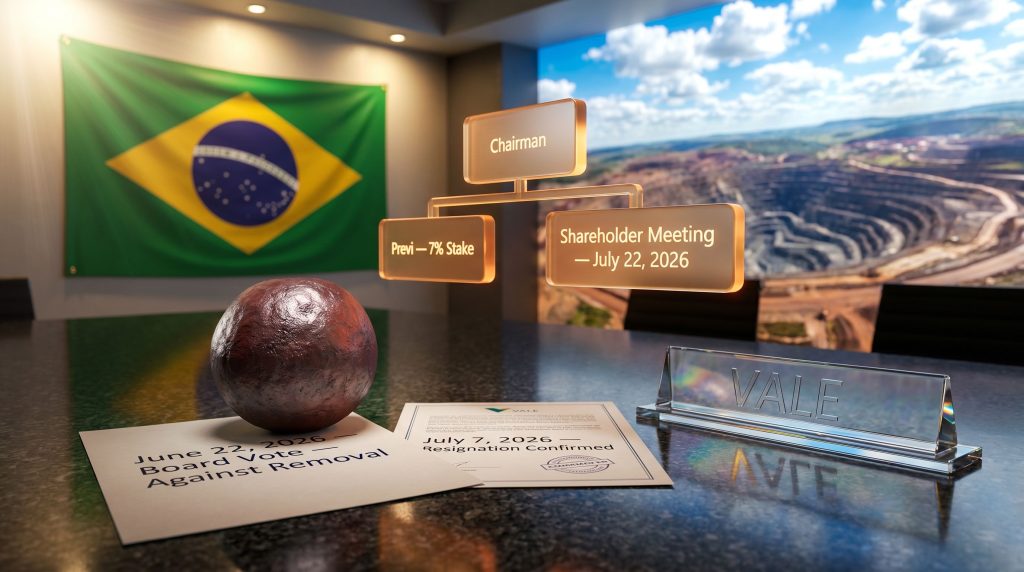
Under Brazilian corporate law, a board's internal rejection of a shareholder proposal does not prevent that proposal from being put to a full shareholder vote. Previ's removal campaign remained entirely live regardless of the board's position, with the matter scheduled for deliberation at a general meeting set for 22 July 2026.
This is a nuance that distinguishes Brazilian corporate governance from Anglo-Saxon models. The Lei das Sociedades Anônimas, Brazil's corporations law, preserves shareholder rights to call and vote on extraordinary matters even when boards formally oppose them. For investors accustomed to UK or US governance norms, this represents a meaningful structural difference in how boardroom power is distributed and contested.
The procedural distinction also explains why the story did not end with the board's June 22 vote. The shareholder meeting remained on the calendar, and with it, the possibility that a majority of voting shareholders could override the board's position entirely.
The Resignation: Sequence of Events and What It Confirms
Rather than allow the matter to reach a shareholder vote, Stieler resigned from both the chairperson position and his seat on Vale's board of directors, with immediate effect on 7 July 2026. The decision was confirmed through a formal securities filing, the standard regulatory disclosure mechanism under Brazilian capital markets rules.
Vale subsequently cancelled the agenda item relating to Stieler's removal from the 22 July shareholder meeting. The remaining agenda items, most notably the election of a new chairperson, remain scheduled for shareholder deliberation as planned.
The table below summarises the full chronology of events:
| Event | Date | Status |
|---|---|---|
| Previ pushes for shareholder meeting on removal | Prior to 7 July 2026 | Completed |
| Vale board votes against removal proposal | 22 June 2026 | Completed |
| Stieler resigns from chairperson role and board | 7 July 2026 | Confirmed |
| Shareholder meeting (revised agenda) | 22 July 2026 | Scheduled |
| Election of new chairperson | 22 July 2026 | Pending |
The resignation effectively rendered the removal vote moot whilst avoiding the optics of a sitting chairperson being formally voted out by shareholders. Whether this outcome serves Vale's institutional credibility better than a contested vote is itself a governance question worth considering.
Manuel Oliveira and What His Elevation Would Signal
Previ's preferred candidate, Manuel Oliveira, is not an external appointment. He is already a member of Vale's board, which means the transition, if it proceeds along the lines Previ envisions, would represent continuity of board composition rather than a wholesale injection of new perspectives.
This distinction matters strategically. Previ's push is not necessarily about changing Vale's operational direction or management team. It appears targeted at chairperson-level governance philosophy and, potentially, how the board positions itself relative to the company's ongoing CEO selection processes and capital allocation priorities.
Vale is navigating a complex strategic moment. Its core iron ore franchise faces long-cycle demand questions as China's steel intensity potentially plateaus, whilst the company is simultaneously pursuing diversification into base metals and battery materials, including nickel and copper assets increasingly relevant to global energy transition supply chains. A new chairperson's alignment with management on these diversification priorities could meaningfully shape how aggressively Vale pursues this pivot.
The next major ASX story will hit our subscribers first
A Pattern, Not an Isolated Incident: The March 2026 Resignation
The Vale chairperson Stieler resignation does not occur in isolation. In March 2026, board member José Luciano Duarte Penido stepped down from Vale's board, citing concerns about what he described as political influence in the company's CEO search process. Two senior board departures within a matter of months at one of the world's largest mining companies is statistically and institutionally unusual.
The two events differ in character. Penido's departure reflected a concern about external interference in executive appointment processes, whilst Stieler's resignation was driven by pension fund shareholder pressure on board composition. However, taken together, they point to a governance environment at Vale that is under meaningful stress.
This pattern is legible within a broader systemic lens. Brazil's large resource companies, given their economic and strategic importance, attract sustained attention from state-linked institutional investors. The tension between commercially independent governance and the interests of shareholders with government connections is not unique to Vale, but Vale's scale makes it the most visible testing ground for these dynamics. In addition, governance lawsuit risks elsewhere in the sector demonstrate how unresolved board-level tensions can escalate into formal legal proceedings.
Investment Implications: Short-Term Noise or Long-Term Signal?
For equity investors, the circumstances surrounding this leadership change raise a set of risk and opportunity considerations that extend well beyond the boardroom:
| Factor | Risk Scenario | Opportunity Scenario |
|---|---|---|
| New chairperson alignment with management | Friction with CEO, slower strategic decisions | Stronger board-management cohesion |
| Previ's governance agenda | Increased state-linked influence over strategy | Improved accountability and transparency frameworks |
| Investor confidence | Short-term uncertainty premium in Vale's equity | Governance reset attracting long-term institutional capital |
| Iron ore and base metals strategy | Strategic drift during leadership transition | Fresh mandate for capital discipline and diversification |
Several additional considerations are worth noting for investors monitoring this situation:
- Board-level governance uncertainty at large-cap miners can affect credit rating assessments, particularly where agencies factor management stability into their analysis.
- Vale's position as one of the world's three largest iron ore producers means its governance trajectory has downstream significance for steel producers and commodity price benchmarks globally.
- International institutional investors, including those operating through ESG frameworks that weight governance heavily, may reassess Vale's governance risk rating pending clarity on the new chairperson appointment.
- Prolonged uncertainty at board level can delay long-cycle capital investment decisions, particularly in greenfield base metals development where board mandate and risk appetite directly influence project go/no-go thresholds.
- Furthermore, mining taxes and royalties frameworks add another layer of financial complexity for large miners navigating governance transitions simultaneously.
- Broader mining consolidation trends also suggest that governance instability can accelerate acquisition interest from competitors seeking strategic entry points.
Frequently Asked Questions: Vale Chairman Stieler Resignation
Did Vale's Board Support or Oppose Stieler's Removal?
Vale's board voted formally against Previ's removal proposal on 22 June 2026. However, Stieler subsequently resigned voluntarily on 7 July 2026, prior to the scheduled shareholder vote, making the removal agenda item redundant.
What Happens to the July 22 Shareholder Meeting Now?
The meeting proceeds as scheduled. Vale confirmed via securities filing that the removal agenda item has been cancelled following the resignation, but the election of a new chairperson remains on the agenda for shareholder deliberation.
Who Is Likely to Become Vale's Next Chairperson?
Previ, which holds a 7% stake in Vale, has publicly backed current board member Manuel Oliveira for the chairperson role. The outcome will be determined by shareholder vote at the 22 July meeting.
How Long Had Stieler Served at Vale?
Stieler joined Vale's board of directors in 2021 and assumed the chairperson role in 2023, serving in that capacity until his resignation on 7 July 2026.
What Is Previ's Connection to the Brazilian Government?
Previ administers pension benefits for employees of Banco do Brasil, a state-controlled financial institution. This gives Previ a degree of alignment with Brazilian government interests, though it operates as a legally independent pension fund entity.
Is Vale's Operational Performance Affected by This Leadership Change?
Board-level transitions do not directly affect day-to-day mining operations. However, prolonged governance uncertainty can influence capital allocation decisions, strategic planning timelines, and investor sentiment toward the company's equity.
What the Mining Sector Can Learn From Vale's Governance Crisis
The events surrounding Vale chairperson Stieler's resignation carry lessons that extend across the global diversified mining industry. Pension fund activism is accelerating, not retreating, as large institutional shareholders grow more confident in using ownership rights to assert governance preferences. Mining companies operating in politically sensitive markets face particular exposure to this trend.
Several structural practices are becoming increasingly important for mining boards seeking to reduce the risk of shareholder-driven disruption:
- Transparent succession planning: Boards that have clearly articulated renewal frameworks reduce the uncertainty premium that activists exploit.
- Proactive governance communication: Regular, substantive disclosure of board composition rationale and committee structures limits the information asymmetry that motivates escalation.
- Structural independence buffers: Governance frameworks that clearly separate operational management from board oversight reduce the risk of perception that political interests are influencing executive appointments.
- Stakeholder mapping: Understanding the governance agendas of major institutional shareholders before they escalate allows boards to engage constructively rather than reactively.
Vale's experience is not a cautionary tale unique to Brazil. As pension funds globally deepen their engagement with portfolio company governance, any mining company with a complex institutional shareholder base should treat this episode as an instructive precedent. Reporting from Reuters confirms the broader market significance of this governance shift, reinforcing that institutional investors worldwide are paying close attention to how Vale navigates its board transition in the weeks ahead.
Readers seeking broader context on corporate governance dynamics in Brazil's mining sector and the role of institutional investors in shaping resource company strategy may find additional perspective in Mining Weekly's coverage of Vale and related diversified miner developments at miningweekly.com.
Want To Stay Ahead of High-Impact ASX Mineral Discoveries Before the Market Moves?
Discovery Alert's proprietary Discovery IQ model delivers real-time alerts on significant ASX mineral discoveries, cutting through complex mineral data to surface actionable opportunities for both short-term traders and long-term investors — explore historic discovery returns to see what early positioning has meant for investors, and begin your 14-day free trial today to secure a market-leading edge.