July 31, 2026
The Structural Case for Commodity Focus: Why Junior Miners Are Separating Assets Rather Than Stacking Them
In the junior mining sector, the instinct to diversify across commodities often collides with a fundamental market reality: the investors who fund exploration companies are rarely generalists. Uranium-focused funds screen for uranium. PGM-focused funds screen for palladium, platinum, and rhodium exposure. When a single exploration company holds assets spanning both commodity families, neither investor pool finds a clean thesis match, and the result is a pricing penalty that erodes value on both sides of the ledger.
This dynamic, sometimes called the conglomerate discount, has intensified as commodity cycles have pulled further apart. Uranium has attracted renewed institutional attention driven by utility contracting cycles and geopolitical supply security concerns, while platinum and palladium dynamics have followed a structurally different trajectory shaped by automotive catalyst demand, electric vehicle adoption rates, and industrial substitution trends. A junior holding both assets is effectively asking two separate investor audiences to share a single balance sheet, rarely a winning proposition at the exploration stage.
The completed ValOre uranium project sale to Future Fuels, finalised on May 29, 2026, is a practical illustration of how one junior resolved this problem, and the mechanics of how it did so carry lessons that extend well beyond the two companies involved.
When big ASX news breaks, our subscribers know first
How the Conglomerate Discount Penalises Multi-Commodity Juniors
The structural disadvantage of holding unrelated assets inside a single junior exploration company is not simply theoretical. Commodity-specific fund mandates mean that investors in uranium vehicles are typically screened out of PGM opportunities by their own investment policies, and vice versa. When both asset types sit under one ticker, neither pool of capital sees a compelling reason to allocate.
"At the exploration stage, where revenue does not yet exist to justify diversification, investor conviction in a single commodity thesis is often the primary determinant of capital access. Multi-commodity juniors frequently find themselves starved of attention on their secondary asset, regardless of its technical merit."
The divergence in uranium and PGM market drivers makes this structural problem particularly acute. Furthermore, uranium supply-demand volatility adds another layer of complexity for multi-commodity juniors attempting to maintain investor confidence across two distinct asset classes simultaneously.
| Commodity | Primary Demand Driver | Investor Mandate Type | Price Cycle Alignment |
|---|---|---|---|
| Uranium | Nuclear energy contracting, geopolitical supply security | Energy transition and nuclear-focused funds | Driven by utility contracting cycles |
| Platinum Group Metals | Automotive catalysts, industrial applications | Precious and industrial metals funds | Shaped by EV adoption and substitution rates |
These two commodity families attract different analyst coverage, different institutional fund categories, and different risk frameworks. Simultaneous ownership by a single junior company creates a blended narrative that satisfies neither audience fully, suppressing the valuation of each asset below what a focused vehicle could achieve independently.
Why Exploration-Stage Companies Face Greater Exposure to This Problem
At the producer level, revenue diversification across commodities can provide genuine cash flow stability. At the exploration stage, however, that logic inverts. There is no revenue to diversify. There is only investor capital, and that capital flows most readily toward companies where the commodity thesis is unambiguous. Multi-commodity juniors therefore face a structural disadvantage not because diversification is inherently bad, but because the exploration-stage capital markets are not built to reward it.
Transaction Overview: The ValOre Uranium Project Sale to Future Fuels Explained
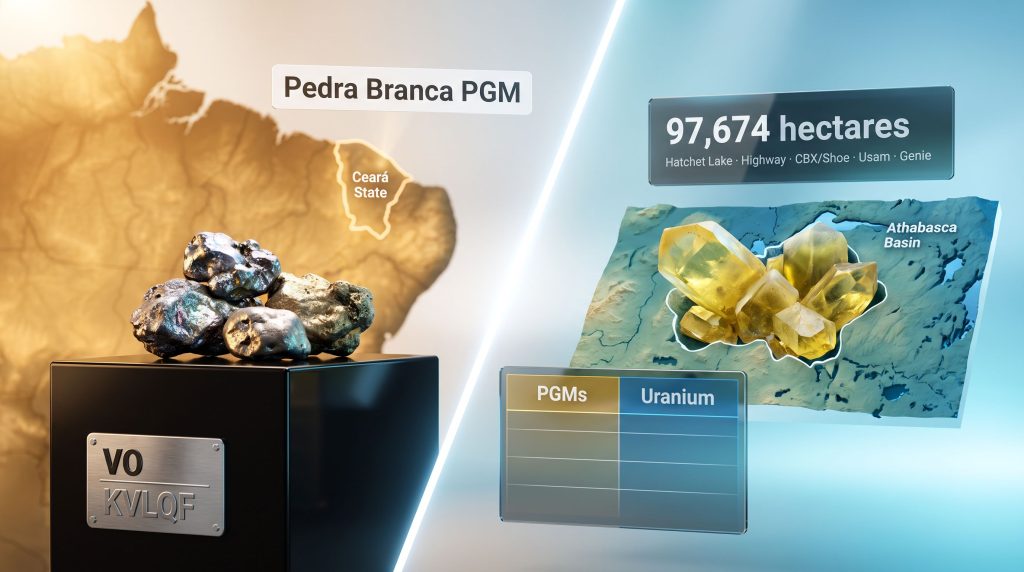
ValOre Metals Corp. (TSXV: VO | OTCQB: KVLQF | Frankfurt: KEQ0) held a 51% interest in Hatchet Uranium Corp. (HUC), the vehicle through which its Saskatchewan uranium assets were held. Rather than selling those assets for cash and walking away, ValOre chose a structure that preserved its exposure to the uranium exploration upside while freeing its management and capital to concentrate entirely on its Brazilian PGM project.
The vehicle for doing so was a three-cornered amalgamation under British Columbia's Business Corporations Act. HUC merged with a wholly owned subsidiary of Future Fuels Inc., with the surviving entity continuing operations as Future Fuels Athabasca Inc. (Amalco). HUC shareholders received Future Fuels securities at a fixed exchange ratio of 0.760836 Future Fuels shares per HUC share held, with warrantholders receiving corresponding Future Fuels warrants on the same proportional basis.
ValOre converted its 51% HUC interest into a significant equity position in Future Fuels rather than receiving cash. The company's chairman, James R. Paterson, had articulated the strategic rationale for this approach in 2024, when ValOre first formed its plan to realise value from its Saskatchewan assets in order to concentrate fully on its wholly held Pedra Branca PGM property in Brazil.
Comparing Asset Separation Structures Available to Junior Miners
The three-cornered amalgamation sits in a middle ground between several alternatives that junior miners have used to separate non-core assets. In addition, considering mining asset sales alongside amalgamation structures provides a fuller picture of the options available to exploration companies.
| Structure Type | Cash Received | Retained Upside | Complexity | Common Use Case |
|---|---|---|---|---|
| Direct asset sale | Yes | None | Low | Full exit from non-core asset |
| Three-cornered amalgamation | No | Yes, via equity | Medium | Strategic separation with retained exposure |
| Joint venture spin-off | Partial | Partial | High | Shared development of a retained asset |
| Royalty conversion | Partial | Yes, via NSR | Medium | Monetisation without full exit |
"A three-cornered amalgamation allows an asset separation to occur without a direct cash transaction. The selling party retains ongoing exposure to the asset's upside through equity in the acquiring entity, rather than taking a clean exit. This is particularly relevant when the separated asset has long-term upside that the seller does not want to forfeit entirely."
What Future Fuels Acquired: The Athabasca Basin Portfolio
The core asset package transferred through the ValOre uranium project sale to Future Fuels is a 97,674-hectare land position across five distinct project areas in northern Saskatchewan's Athabasca Basin. This is one of the world's most significant uranium-producing jurisdictions by grade, hosting several major operating mines and a track record of high-grade discoveries that has made it a focus for exploration capital globally.
The five Athabasca Basin project areas acquired through Amalco are:
- Hatchet Lake – carries an NSR royalty held by Rio Tinto Exploration Canada Inc., with a partial buydown right retained by International Gold Corporation
- Highway – held under option from Skyharbour Resources Ltd., requiring ongoing cash payments, share issuances, and minimum exploration expenditures to earn a majority interest
- CBX/Shoe – carries an NSR royalty in favour of Skyharbour Resources
- Usam – carries an NSR royalty in favour of Skyharbour Resources
- Genie – carries an NSR royalty in favour of Skyharbour Resources
One detail that warrants close attention from investors is that a portion of the acquired claims were not in good standing at the closing date. The disclosure attributed this to administrative processing delays with the Government of Saskatchewan rather than any lapse in HUC's obligations. Consequently, Amalco is responsible for restoring the affected claims to good standing as the administrative process completes.
Future Fuels' Full Multi-Jurisdiction Portfolio Post-Transaction
The Athabasca Basin acquisition expands Future Fuels from a two-project company into a multi-jurisdiction uranium exploration vehicle:
| Project | Location | Key Characteristics |
|---|---|---|
| Hornby Project | Hornby Basin, NW Nunavut | Historic Mountain Lake System; multiple underexplored uranium showings; shorter annual operating season |
| Covette Project | James Bay region, Quebec | Pre-discovery stage exploration |
| Hatchet Lake | Athabasca Basin, Saskatchewan | NSR royalty held by Rio Tinto Exploration Canada Inc. |
| Highway | Athabasca Basin, Saskatchewan | Under option from Skyharbour Resources; earn-in obligations apply |
| CBX/Shoe | Athabasca Basin, Saskatchewan | NSR royalty held by Skyharbour Resources |
| Usam | Athabasca Basin, Saskatchewan | NSR royalty held by Skyharbour Resources |
| Genie | Athabasca Basin, Saskatchewan | NSR royalty held by Skyharbour Resources |
The Athabasca Basin's extended annual operating season relative to Nunavut is a practical advantage that should not be understated. In remote Canadian uranium exploration, fieldwork windows are constrained by weather and ground conditions. A longer season translates directly into more exploration news flow per year, which is meaningful for maintaining investor engagement in an exploration-stage vehicle.
The Highway Property Earn-In: An Ongoing Obligation Investors Must Track
One of the most material post-closing obligations attached to the Athabasca Basin package is the Highway property's earn-in structure. Future Fuels Athabasca Inc. does not yet hold a majority interest in Highway. To earn that interest, Amalco must meet a schedule of cash payments, share issuances, and minimum exploration expenditures to Skyharbour Resources over the coming years.
This is a common structure in Canadian junior mining, where project generators like Skyharbour use option agreements to maintain royalty streams and share issuance income while allowing exploration partners to fund and advance the work. However, for investors evaluating Future Fuels' post-transaction portfolio, it is important to distinguish between assets that are already owned and those that remain contingent on meeting earn-in milestones.
"The Highway property's earn-in structure means Future Fuels does not currently hold a majority interest in one of its newly acquired Athabasca Basin assets. Investors should monitor whether Amalco meets its payment and expenditure schedule to Skyharbour Resources. Failure to do so could result in the loss or renegotiation of the Highway option."
What ValOre Retains: Pedra Branca and Passive Uranium Exposure
Following the close of the ValOre uranium project sale to Future Fuels, ValOre's asset base consolidates into a single primary development focus: the 100%-owned Pedra Branca PGM property in Ceará State, northeastern Brazil. The company is targeting a Preliminary Economic Assessment (PEA) for Pedra Branca later in 2026, which represents a significant step among mining study milestones for the project's exploration history.
A PEA is a meaningful inflection point for any junior exploration asset. It produces an initial assessment of technical and economic viability, typically including preliminary mine design concepts, processing assumptions, capital cost estimates, and early-stage economic outputs such as net present value and internal rate of return. For a company like ValOre, which is now a single-asset, single-commodity vehicle, the PEA result becomes the central driver of investor sentiment and capital access.
The Passive Uranium Exposure Model: Retained Upside Without Direct Ownership
One of the more strategically nuanced aspects of the ValOre uranium project sale to Future Fuels is that ValOre did not execute a clean exit. Instead, by receiving Future Fuels shares as consideration rather than cash, ValOre retains indirect exposure to Athabasca Basin uranium exploration outcomes through its equity position in the acquirer.
This model has distinct advantages for a company in ValOre's position:
- Management bandwidth and exploration capital are fully directed at Pedra Branca, without the distraction of funding or overseeing uranium fieldwork in Saskatchewan.
- If Future Fuels advances its Athabasca Basin portfolio toward a meaningful discovery or resource delineation, ValOre shareholders benefit through appreciation in their company's Future Fuels shareholding.
- The structure avoids the finality of a cash exit, which would have permanently severed any connection to the uranium upside that originally motivated the formation of HUC.
From an investor psychology perspective, this is a meaningful distinction. A clean cash sale signals a complete strategic pivot. An equity-for-equity exchange signals strategic refinement, retaining optionality on the separated asset's future without continuing to manage it directly. Investors seeking broader context around uranium investment strategies will find this passive exposure model increasingly relevant as commodity cycles diverge.
Governance Dimensions: Non-Arm's Length Disclosure Requirements
The transaction triggered formal non-arm's length disclosure obligations under TSX Venture Exchange rules. The disclosure requirement arose from IsoEnergy Inc.'s position as a major shareholder of Future Fuels, combined with connections that certain HUC securityholders and Mega Uranium Ltd. hold to IsoEnergy. These related parties received a portion of the Future Fuels shares issued through the amalgamation, generating a governance disclosure that persists beyond the closing date.
This dimension of the transaction illustrates a frequently underappreciated aspect of junior mining deals: related-party networks in the Canadian junior resource sector are dense. Companies sharing major shareholders, directors, or advisory relationships are common, particularly in focused commodity verticals like uranium, where the pool of active capital allocators is relatively concentrated. TSXV rules require transparency around these connections to protect minority shareholders and ensure deal pricing was conducted at arm's length.
Investors evaluating similar transactions should review the full announcement carefully, not because non-arm's length disclosures indicate impropriety, but because they map the full network of parties receiving consideration and can illuminate alignment of interests between the acquiring and selling entities.
The next major ASX story will hit our subscribers first
When Does the ValOre Model Work? Scenario Analysis for Asset Separation
The ValOre uranium project sale to Future Fuels offers a template, but not a universal one. Furthermore, several conditions must be present for a three-cornered amalgamation with equity consideration to create value rather than simply shift risk:
- The receiving company must have a credible and experienced management team capable of advancing the separated asset independently. Equity in a poorly managed acquirer is not a strategic asset.
- The receiving company must have a financeable corporate structure. Equity received is only valuable if the acquirer can raise capital to advance its portfolio and the shares trade in a liquid market.
- The non-core asset must have genuine strategic fit with the acquirer's existing portfolio, not just geographic proximity. Future Fuels' existing focus on uranium exploration made the Athabasca Basin package a logical extension of its mandate.
- The seller must be comfortable accepting illiquid or thinly traded equity rather than cash proceeds, which requires confidence in the acquirer's long-term trajectory and the seller's own balance sheet position.
- The separated asset's ongoing obligations must be manageable by the acquirer. Royalties, option payments, and earn-in schedules that strain the acquirer's capital resources can undermine the value of the transferred equity.
Where these conditions are met, asset separation through an equity exchange can deliver a structurally superior outcome compared to a straight cash sale, preserving upside while eliminating the management and capital drag of running a non-core asset alongside a primary development focus.
Key Takeaways for Investors Evaluating Similar Junior Mining Restructurings
The completed ValOre uranium project sale to Future Fuels delivers several actionable insights for investors monitoring the junior mining sector. Understanding uranium supply-demand volatility remains equally important when assessing the long-term viability of the uranium assets transferred through this transaction:
- Commodity focus is increasingly rewarded at the exploration stage, where investor mandates are commodity-specific and management bandwidth is finite
- Three-cornered amalgamations provide a middle path between a clean cash exit and continued direct ownership, allowing sellers to retain upside through equity while concentrating on a primary asset
- Ongoing obligations transfer with assets: royalties, option payments, and earn-in schedules do not disappear at closing and must be tracked by the acquiring entity and its investors
- Governance complexity persists even in structurally clean transactions when related-party shareholding relationships exist among the parties involved
- The Pedra Branca PEA in 2026 is the next material catalyst for ValOre's equity story as a single-asset, single-commodity PGM company
- Future Fuels' expanded Athabasca Basin portfolio positions it as a multi-project uranium exploration vehicle, subject to meeting earn-in and royalty obligations on the Highway property and other contingent assets
- Claims administration risk, while attributed to processing delays rather than obligation failures in this case, is a category of risk that investors in junior uranium explorers should include in their due diligence frameworks
This article is provided for informational and educational purposes only and does not constitute financial or investment advice. All forward-looking statements, projections, and scenario analyses involve uncertainty and should not be relied upon as predictions of future outcomes. Investors should conduct their own due diligence and consult a licensed financial adviser before making any investment decisions. All financial details referenced are drawn from publicly available company disclosures.
Want To Be First When The Next Major ASX Mineral Discovery Hits The Market?
Discovery Alert's proprietary Discovery IQ model scans ASX announcements in real time, instantly converting complex mineral data across 30+ commodities into clear, actionable insights — so subscribers can identify significant discoveries before the broader market reacts. Explore historic discoveries and their returns to understand what's possible, then begin your 14-day free trial at Discovery Alert to position yourself ahead of the next major find.