June 23, 2026
The Long-Duration Storage Gap That One Chemistry Cannot Fill
Spend enough time studying how modern electricity grids actually function, and a structural problem becomes impossible to ignore. Wind turbines generate their peak output overnight or during storms. Solar panels flood the grid with surplus power at midday, precisely when residential and commercial demand is still building toward its evening peak. The mismatch between when clean energy is produced and when it is consumed is not a minor inconvenience. It is the central engineering challenge of the global energy transition, and it demands storage solutions capable of holding large volumes of energy for extended periods rather than simply discharging quickly and recharging.
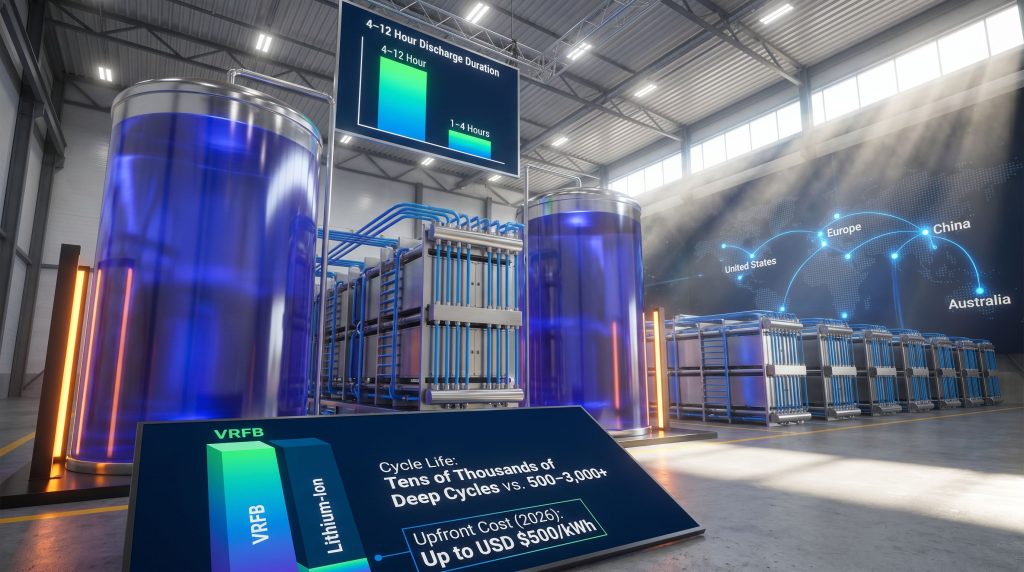
This is where the dominant battery chemistry of the last two decades begins to reveal its limitations. Lithium-ion technology has achieved extraordinary cost reductions and performance improvements, but its architectural strengths are best expressed in short discharge cycles of one to four hours. At the utility scale, grids increasingly need storage that can dispatch power across eight, ten, or twelve-hour windows, covering the gap between afternoon solar generation and the following morning's demand. That is a fundamentally different performance envelope, and it is driving serious institutional attention toward vanadium redox flow batteries in energy storage applications where duration matters more than compactness.
Furthermore, the intersection of critical minerals and energy security is making long-duration storage technologies a strategic priority for governments and grid planners alike.
When big ASX news breaks, our subscribers know first
What Actually Happens Inside a Vanadium Redox Flow Battery
The Electrochemical Mechanism Behind VRFB Technology
Understanding why vanadium redox flow batteries behave so differently from conventional battery designs requires understanding what vanadium does at the chemical level that no other element replicates. Vanadium is unusual in that it can exist stably in four distinct oxidation states within an aqueous solution. This means a single element can serve as both the positive and negative charge carrier simultaneously, with one oxidation pair on each side of the electrochemical cell.
During charging, an external electrical current drives vanadium ions on each side of the cell into their respective higher or lower oxidation states, storing potential energy in the electrolyte solution. During discharge, those ions return to their equilibrium states and release that stored energy as electrical current. The reaction is entirely reversible and, critically, the two electrolyte solutions never physically mix in a way that creates contamination. Because both sides of the cell contain vanadium, any minor cross-contamination through the membrane simply results in slightly mixed vanadium concentrations that can be rebalanced, rather than permanent capacity loss. This is a property unique to single-element flow battery chemistry and represents a genuine structural advantage over competing flow battery designs that use different chemical species on each side.
The physical architecture reflects this chemistry. Two large external tanks store the positive and negative electrolyte solutions separately. A central cell stack, containing the membrane and electrodes where the electrochemical reactions occur, sits between them. Pumps continuously circulate electrolyte from the tanks through the cell stack during operation. The amount of energy the system can store is governed entirely by how much electrolyte is held in the tanks, while the rate at which power can be delivered is determined by the size and number of cell stacks. For a deeper technical overview, vanadium redox battery documentation provides a useful reference on the underlying electrochemistry.
How the Physical Separation of Power and Energy Creates Strategic Flexibility
This decoupled architecture is not merely a technical curiosity. It has direct and significant implications for project economics and deployment flexibility. In a lithium-ion system, power capacity and energy capacity are inseparable. Adding more energy means adding more cells, which also adds more power capacity, whether the project needs it or not. In a VRFB installation, a developer can independently size each component to match exactly what the project requires, adding electrolyte volume to extend storage duration without modifying the power-generating stack.
As noted in technical coverage from AZO Materials, this separation also enables spatial flexibility that conventional battery installations cannot match. Electrolyte tanks can be installed underground or in areas with ample space, while the cell stacks that generate heat during operation can be positioned where thermal management infrastructure is most efficient. The practical result is a potentially significant reduction in cooling system complexity and associated capital cost at large-scale industrial deployments.
VRFB Performance Metrics: Reading the Data Honestly
The performance characteristics of vanadium redox flow batteries are frequently misrepresented in both directions. Advocates overstate their efficiency while critics dismiss their cost without accounting for lifecycle economics. A balanced comparison requires looking at the full picture.
| Performance Metric | Vanadium Redox Flow Battery | Lithium-Ion Battery |
|---|---|---|
| Round-Trip Efficiency | 70-80% (practical) / up to 90% (lab) | 90-95% |
| Cycle Life | Tens of thousands of deep cycles | 500-3,000+ cycles (chemistry-dependent) |
| Energy Density | Lower (bulkier per kWh stored) | Higher (compact per kWh stored) |
| Fire / Explosion Risk | Very low (non-flammable electrolyte) | Moderate to high (thermal runaway risk) |
| Optimal Discharge Duration | 4-12 hours | 1-4 hours |
| Upfront Cost (2026) | Up to USD $500/kWh | USD $150-$300/kWh (utility scale) |
| Capacity Fade Over Time | Minimal | Moderate to significant |
| Temperature Sensitivity | Sensitive to extremes | Performs across wider temperature range |
A 2019 review published in the Journal of Energy Storage documented that vanadium redox flow batteries produce lower levels of gas evolution during rapid charge cycles compared with other flow battery chemistries. This matters because gas evolution accelerates degradation of membrane materials, so lower gas production at high charge rates directly extends operational lifespan. The practical round-trip efficiency of 70-80% is lower than lithium-ion's 90-95%, and this is a genuine cost that must be priced into any system comparison. However, when amortised across tens of thousands of deep discharge cycles over a 20-plus year operational lifespan, the efficiency disadvantage becomes far less decisive than the upfront cost figures suggest.
The total cost of ownership calculation over a 25-year VRFB installation can look very different from a simple dollar-per-kilowatt-hour comparison at the point of procurement. The question is not just what the system costs to build, but what it costs to operate, maintain, and eventually replace across its full service life.
Where VRFBs Outperform Every Alternative
Renewable Energy Time-Shifting at Scale
The most direct application for vanadium redox flow batteries in energy storage is absorbing surplus solar and wind generation during peak production periods and dispatching it during high-demand evening hours. A four-hour lithium-ion system installed alongside a solar farm can capture afternoon surplus and release it into the early evening peak. However, it cannot bridge the overnight gap that a grid with very high solar penetration requires. An eight to twelve-hour VRFB installation can cover that extended window, reducing renewable curtailment and allowing grid operators to commit to higher renewable generation shares without compromising reliability.
Grid Ancillary Services and Frequency Regulation
Beyond energy time-shifting, VRFBs are well-positioned to provide frequency regulation services, which require the rapid injection or absorption of power to maintain grid stability within tight frequency bands. The low self-discharge rate of vanadium electrolyte, which retains its charge state far more effectively than most battery chemistries when the system is not actively cycling, makes VRFBs particularly well-suited to applications that require sustained charge retention between dispatch events. Consequently, utility-scale vanadium battery storage projects are beginning to emerge as credible grid infrastructure investments.
Microgrids, Remote Installations, and Critical Infrastructure
For remote communities, mining operations, and off-grid industrial facilities, the combination of long discharge duration, minimal degradation over time, and non-flammable chemistry creates a compelling case for VRFB deployment. Data centres and other critical infrastructure operators are increasingly evaluating VRFBs precisely because the aqueous electrolyte eliminates the thermal runaway and fire risk that makes lithium-ion systems a liability in densely occupied facilities.
The Limitations That Are Holding VRFBs Back
Energy Density and Physical Footprint
Vanadium electrolyte stores significantly less energy per unit volume than lithium-ion cells. A grid-scale VRFB installation delivering 100 MWh of storage will occupy substantially more land area than an equivalent lithium-ion installation. This is not a solvable problem through engineering optimisation alone. It reflects fundamental chemistry: the energy density ceiling of aqueous vanadium electrolyte is constrained by solubility limits and electrochemical potential, both of which are physical rather than engineering barriers. For applications where space is genuinely constrained, this remains a disqualifying factor.
The Capital Cost Barrier in 2026
As of 2026, upfront capital costs for VRFB installations can reach USD $500 per kilowatt-hour, compared to USD $150-$300 per kilowatt-hour for utility-scale lithium-ion systems. This cost gap reflects lower manufacturing volumes, the relatively early stage of commercial scale-up, and the commodity cost of vanadium itself. Vanadium pentoxide prices are notoriously volatile, creating project-level cost uncertainty that makes financing VRFB installations more complex than equivalent lithium-ion projects.
The cost trajectory is moving in the right direction. Manufacturing scale-up, standardised electrolyte production processes, and improved cell stack manufacturing techniques are all contributing to gradual cost reductions. However, the gap between current VRFB costs and the levelised cost of storage levels needed to compete with lithium-ion on a per-project basis without lifecycle adjustment remains significant.
Temperature Sensitivity as a Deployment Constraint
Vanadium electrolyte viscosity changes meaningfully with temperature. At low temperatures, the electrolyte becomes more viscous, increasing pumping energy requirements and reducing system efficiency. At high temperatures, vanadium precipitation from solution can occur, damaging the electrolyte and requiring restoration procedures. Lithium-ion systems operate across a broader temperature range without equivalent performance degradation, giving them a genuine advantage in harsh climate deployments.
The Geopolitical Dimension: Supply Chain Risk and Strategic Diversification
Why Lithium's Supply Chain Concentration Is a Structural Vulnerability
The global battery industry's reliance on lithium has created a supply chain architecture that concentrates both raw material processing and cell manufacturing within Chinese-controlled entities. China controls a dominant share of global lithium refining capacity and an even larger proportion of battery cell manufacturing output. Shifts in the global lithium market and the ongoing lithium market downturn are, in addition, reinforcing the case for diversifying into alternative battery chemistries. For governments pursuing grid decarbonisation, this concentration is not an abstract geopolitical concern. It is a practical infrastructure risk, where the ability to build and maintain a clean energy grid depends on maintaining access to supply chains largely outside domestic control.
Vanadium's Geographic Distribution as a Strategic Asset
Global vanadium resources are more geographically dispersed than lithium deposits. Significant vanadium reserves exist in Russia, South Africa, China, Brazil, and Australia, among other jurisdictions. This distribution does not eliminate supply concentration risk entirely, but it provides a credible pathway for nations seeking to develop domestic or allied-nation supply chains for a strategic battery chemistry. Australia in particular has both significant vanadium resources and an established framework for developing critical minerals projects targeting export markets in the United States, Europe, and Japan. For instance, the Speewah vanadium project represents one of the more significant domestic resource developments in this space.
Furthermore, growing critical minerals demand from clean energy sectors is adding additional momentum to vanadium exploration and project development globally.
It is worth noting that vanadium is not a complete substitute for lithium across all applications. Electric vehicles, consumer electronics, and portable devices will continue to require high-energy-density chemistries that flow batteries cannot provide. The realistic outcome is a multi-chemistry storage ecosystem in which each technology is deployed in the applications where its specific properties are most advantageous.
The next major ASX story will hit our subscribers first
VRFB vs. Lithium-Ion: Choosing the Right Tool for the Application
| Application | Best-Fit Technology | Key Deciding Factor |
|---|---|---|
| Utility-Scale Grid Storage (4-12h) | VRFB | Cycle life, scalability, safety |
| Residential Energy Storage | Lithium-Ion | Energy density, upfront cost |
| Electric Vehicles | Lithium-Ion | Energy density, weight |
| Renewable Smoothing (Solar/Wind) | VRFB | Long discharge, low degradation |
| Frequency Regulation | Both | Response speed, cost |
| Remote Microgrid / Off-Grid | VRFB | Safety, longevity, scalability |
| Data Centre Backup | VRFB | Non-flammable, long duration |
The framing of VRFBs as lithium-ion competitors misunderstands the market structure that is actually emerging. Grid planners and storage developers increasingly treat these technologies as occupying different segments of a layered storage architecture rather than competing for the same contracts.
Frequently Asked Questions: Vanadium Redox Flow Batteries in Energy Storage
What is the typical lifespan of a vanadium redox flow battery?
VRFBs are engineered for tens of thousands of deep discharge cycles, with operational lifespans commonly cited in the range of 20-25 years or longer, significantly exceeding many lithium-ion systems under equivalent cycling conditions.
Are vanadium redox flow batteries safe?
The aqueous, non-flammable nature of vanadium electrolyte eliminates the thermal runaway and fire risk associated with lithium-ion battery chemistries, making VRFBs particularly well-suited to densely populated or space-constrained industrial environments.
Why are VRFBs more expensive than lithium-ion batteries?
As of 2026, VRFB upfront costs reach up to USD $500/kWh, reflecting lower manufacturing volumes, vanadium commodity costs, and the earlier stage of commercial scale-up relative to lithium-ion. However, total lifecycle cost analysis over 20-plus years can narrow this gap considerably.
Can VRFBs replace lithium-ion batteries entirely?
No. VRFBs are optimised for stationary, long-duration storage applications and cannot replicate the energy density required for electric vehicles or portable electronics. The two technologies are complementary rather than competitive across all use cases.
What is the round-trip efficiency of a VRFB?
Practical round-trip efficiency typically falls in the 70-80% range, with laboratory conditions demonstrating up to 90%. This is lower than lithium-ion systems, which commonly achieve 90-95% efficiency.
How scalable are VRFBs for large grid projects?
Highly scalable. Energy capacity can be expanded by increasing electrolyte tank volume, while power capacity is scaled by adding cell stacks. This independent scaling makes VRFBs particularly cost-effective for projects requiring large energy-to-power ratios.
The Strategic Outlook: Critical Milestones and Market Trajectory
What Needs to Happen for VRFBs to Reach Mainstream Adoption
The path from a technically validated technology to a mainstream grid infrastructure component requires progress on several fronts simultaneously:
-
Capital cost reduction toward the USD $200-$250/kWh range to compete with lithium-ion on a project-level basis without requiring a full lifecycle analysis to justify the economics.
-
Vanadium electrolyte recycling at scale, which could fundamentally change the cost structure by allowing electrolyte to be recovered and reused at the end of a system's life, reducing both waste and raw material cost.
-
Supply chain development outside China-dominated processing networks, particularly in Australia, Canada, and Brazil, where vanadium resources exist alongside established mining and minerals processing industries.
-
Procurement frameworks that explicitly value long-duration discharge capability, giving VRFB installations a clear competitive pathway in tender processes rather than competing against short-duration lithium-ion systems on a cost-per-kilowatt-hour basis that does not capture duration value.
The Multi-Chemistry Storage Ecosystem
The most credible long-term scenario for grid storage is not a single-technology outcome. Iron-air batteries, compressed air energy storage, gravity-based systems, and hydrogen are all being developed alongside VRFBs to address different segments of the long-duration storage market. VRFBs occupy the four-to-twelve-hour window with a combination of safety, scalability, and cycle life durability that competing technologies have not yet matched at equivalent commercial maturity.
The next decade of grid investment decisions will determine whether vanadium redox flow batteries in energy storage achieve the deployment scale needed to drive the manufacturing cost reductions that would make them self-evidently competitive. That outcome is not guaranteed, but the structural demand for exactly what VRFBs do well is growing with every additional gigawatt of solar and wind capacity connected to grids that were not designed to manage variable generation at this scale.
Disclaimer: This article is intended for informational and educational purposes only and does not constitute financial, investment, or professional advice. Forecasts, cost projections, and market trajectory statements involve inherent uncertainty and should not be relied upon as the basis for investment decisions. Readers should conduct independent research and consult qualified advisers before making any investment or procurement decisions related to energy storage technologies.
Want to Track the Next Major Vanadium Discovery Before the Market Does?
As long-duration storage demand accelerates and vanadium's strategic importance grows, Discovery Alert's proprietary Discovery IQ model instantly notifies subscribers of significant ASX mineral discoveries — including vanadium — turning complex exploration data into actionable insights. Explore historic discovery returns on Discovery Alert's discoveries page and begin your 14-day free trial to position yourself ahead of the broader market.