June 23, 2026
Why India's Industrial Metal Gap Is One of the Most Consequential Supply Chain Stories of the Decade
The global race to secure industrial metals has entered a phase that few analysts predicted even five years ago. Critical minerals demand for aluminium, copper, zinc, nickel, and rare earth elements is accelerating simultaneously, driven by electrification, defence modernisation, and the wholesale restructuring of energy infrastructure. Yet supply growth has struggled to keep pace, constrained by capital discipline, permitting delays, and the geographic concentration of key resources. Within this landscape, India occupies a paradoxical position: a nation with enormous mineral endowments and even larger industrial ambitions, yet one that still imports a significant share of the critical materials its economy requires.
Closing that gap is increasingly the defining industrial challenge of India's next development phase. And few corporate strategies illustrate the scale of that ambition more vividly than the trajectory being charted by Vedanta through its post-demerger transformation, anchored by a sweeping Vedanta aluminium expansion and critical minerals strategy that redefines what an integrated resource company can look like in an emerging market context.
When big ASX news breaks, our subscribers know first
The Demerger Logic: Unlocking Value Through Structural Clarity
Why Diversified Mining Conglomerates Trade at a Discount
For decades, diversified natural resource companies faced a structural valuation penalty. When aluminium, zinc, copper, oil and gas, and critical minerals all sit beneath a single corporate umbrella, investors struggle to price each business accurately. Capital allocation becomes politicised internally, high-growth assets subsidise underperforming ones, and sector-specialist investors who might pay a premium for pure-play exposure simply stay away.
Vedanta's post-demerger structure is a direct response to this dynamic. By separating its operating businesses into distinct entities, the company is making a calculated bet that each unit, valued on its own merits by investors who understand that specific sector, will attract a valuation multiple significantly above what the conglomerate commanded as a whole. Individual entity valuations are projected to reach as high as USD 100 billion, a figure that reflects not just current earnings but the trajectory of India's resource demand curve over the coming decade.
Aligning Corporate Structure With India's Strategic Priorities
The demerger is not purely a financial engineering exercise. India's industrial policy has shifted decisively toward domestic resource self-sufficiency, particularly for materials underpinning clean energy, defence, and advanced manufacturing. A corporate structure that allows each business unit to pursue its own capital strategy, form its own partnerships, and access sector-specific funding is better positioned to respond to that policy environment than a monolithic conglomerate.
With 70% of its portfolio being realigned toward energy transition metals, Vedanta is effectively restructuring itself to mirror the commodity requirements of India's next industrial phase rather than its last one.
Vedanta's Aluminium Expansion: The Numbers Behind the Ambition
From 2.88 MTPA to 6 MTPA: What Doubling Capacity Actually Involves
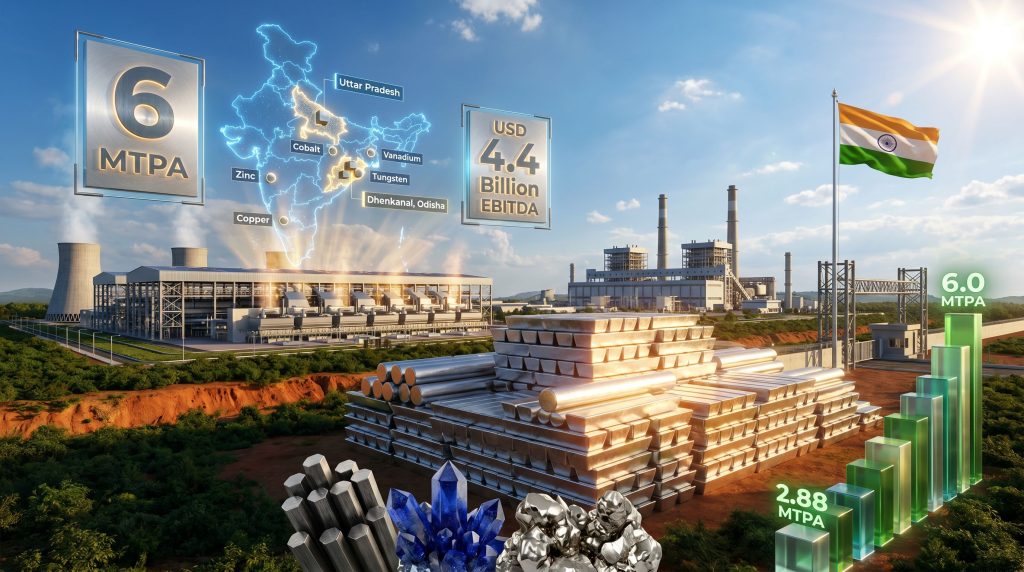
Scaling aluminium production capacity from approximately 2.88 million tonnes per annum (MTPA) to 6 MTPA within 3.5 years is not a routine brownfield expansion. It is, in practical terms, the construction of an entirely new industrial system running in parallel with an existing one. The capital commitment reflects this complexity, with approximately ₹30,000 crore already deployed and a separate ₹1.3 trillion greenfield commitment allocated to the flagship Dhenkanal project in Odisha.
The near-term milestone is achieving 90% utilisation of existing capacity by FY2026-27, which disciplines the operational base before the greenfield additions come online. Vedanta's broader expansion plans underscore just how transformative this programme is at a national level.
| Facility | Current Capacity | Target Capacity | Key Feature |
|---|---|---|---|
| Total Aluminium Smelting | ~2.88 MTPA | 6.0 MTPA | 3.5-year build timeline |
| Dhenkanal Greenfield Smelter | New Build | 3.0 MTPA | 4,900 MW captive power plant |
| BALCO Smelter | ~565 KT | ~1.0 MTPA | India's first 525 kA pot technology |
| Lanjigarh Alumina Refinery | 3.5 MTPA (current) | 5.0 MTPA | Upstream integration anchor |
The Dhenkanal Mega-Smelter: Engineering at Industrial Scale
The Dhenkanal facility in Odisha is the centrepiece of the expansion. With 1,447 acres of land already allotted, the project combines a 3 MTPA smelter with a dedicated 4,900 MW captive power plant, a pairing that is as strategically important as the smelter capacity itself.
Aluminium smelting is one of the most electricity-intensive industrial processes in existence. Power typically accounts for 30 to 40% of total production costs, which means that a producer dependent on grid electricity is, in effect, exposed to energy market volatility on a continuous basis. Co-locating captive generation eliminates that exposure and creates a structural cost floor that grid-dependent competitors simply cannot match.
BALCO and the 525 kA Technology Threshold
The BALCO smelter expansion adds 435,000 tonnes of capacity, bringing the facility to 1 million tonnes total. More technically significant than the volume addition is the amperage specification: BALCO will become India's first facility to operate 525 kA pot technology.
In aluminium smelting, amperage directly governs production efficiency. Higher amperage means more metal produced per cell per unit of energy consumed. The 525 kA threshold places BALCO among the most technically advanced smelting operations globally, reducing energy intensity per tonne and improving the economics of each cell line. This matters not just for cost competitiveness today but for the facility's position on the global cost curve over a multi-decade operational life.
Lanjigarh Refinery: The Upstream Foundation That Makes Everything Else Possible
Aluminium production begins with bauxite, which is refined into alumina before being smelted into metal. A smelter that outpaces its alumina supply is forced to buy feedstock on the spot market, erasing the cost advantages of integration. Vedanta's Lanjigarh refinery has recently commissioned an additional 1.5 MTPA of capacity, moving from 2 MTPA toward its interim 3.5 MTPA level, with a further target of 5 MTPA to fully backstop the 6 MTPA smelting programme.
The critical variable in this equation is bauxite security. Achieving 100% captive bauxite supply alongside 100% captive coal is the mechanism through which Vedanta targets a production cost of USD 1,550 to 1,600 per tonne, down from the current range of approximately USD 1,700 to 1,750 per tonne. That USD 150 to 200 per tonne reduction, applied across a 6 MTPA production base, generates several hundred million dollars of additional annual margin at steady state. Furthermore, shifts in global bauxite supply dynamics make this upstream integration even more strategically valuable over time.
The transition from a cost-exposed, partially integrated smelter to a fully captive-resourced operation represents a structural shift in risk profile, not merely a volume growth story. The cost curve trajectory is arguably more significant for long-term investors than the headline capacity number.
Medium-Term EBITDA Projection
Vedanta's aluminium segment EBITDA is projected to reach USD 4.4 billion over the medium term. This figure assumes both the volume ramp to 6 MTPA and the realisation of integration-driven cost reductions. The leverage is considerable: each USD 100 per tonne of cost reduction across a fully scaled 6 MTPA operation translates into approximately USD 600 million of incremental annual EBITDA.
The Critical Minerals Portfolio: Beyond Aluminium
Hindustan Zinc: The World's Largest Integrated Producer
Zinc rarely attracts the attention that lithium or rare earths command in energy transition narratives, but its industrial indispensability is beyond question. Galvanising steel against corrosion remains zinc's dominant application, but the metal is gaining profile in emerging battery chemistries. Zinc-air and zinc-ion battery formats offer specific advantages in grid storage applications, particularly around safety and recyclability, where lithium-ion chemistries face structural limitations.
Hindustan Zinc's designation as the world's largest integrated zinc producer is not a marketing description. It reflects genuine scale in mining, smelting, and refining within a single operational system, along with substantial silver production as a co-product, which provides additional revenue diversification.
The Zinnovation 2026 initiative, developed in partnership with V-Spark DeepTech Ventures, represents Hindustan Zinc's commitment to AI-driven operational transformation. The programme targets accelerated automation and process intelligence across mining and refining operations. If AI-driven optimisation delivers even a 2 to 3% reduction in energy or reagent consumption, the absolute dollar impact across Hindustan Zinc's scale is material.
Zinc International: A 3x Capacity Ambition by 2030
Zinc International's target of scaling from 300,000 tonnes per annum to 1 million tonnes by the end of the decade represents a tripling of capacity within roughly a decade. This level of organic capacity growth in a single commodity is relatively rare and reflects both the quality of underlying assets and the capital commitment required to develop them.
Sterlite Copper: Serving India's Electrification Backbone
Copper's role in energy transition is well understood in broad terms, but its specific demand intensity is often underappreciated. A single electric vehicle contains roughly three to four times the copper of a conventional internal combustion vehicle. Charging infrastructure, grid reinforcement for renewable integration, and solar installation all carry substantial copper intensity. Sterlite Copper's approximately 35% share of India's domestic copper market positions it as the primary domestic beneficiary of India's electrification agenda.
India's copper import dependency represents a strategic vulnerability, and the broader copper supply crunch playing out globally only intensifies the case for domestic production capacity. Domestic production through Sterlite is a partial structural response to that vulnerability, though the degree to which it closes the gap depends on future capacity decisions that remain subject to regulatory and environmental considerations.
Nicomet: The Strategic Irreplaceability of Sole Domestic Production
Nicomet's status as India's only domestic nickel producer carries a significance that extends well beyond its current production volumes. In critical mineral strategy, the absence of domestic production in a key battery metal is a supply chain vulnerability of the highest order. Nickel is a primary component of the cathode chemistry in high-energy-density lithium-ion batteries, specifically NMC (nickel-manganese-cobalt) and NCA (nickel-cobalt-aluminium) formulations used in long-range EVs and grid storage applications.
A nation building a domestic EV industry without domestic nickel production is, by definition, importing a strategic input. Nicomet's existence within the Vedanta aluminium expansion and critical minerals strategy provides a foundation on which that vulnerability can be addressed.
FACOR: Ferrochrome and the Specialty Steel Connection
FACOR provides Vedanta with exposure to ferrochrome, the essential alloying agent in stainless steel production. Stainless steel's applications span construction, medical devices, food processing, and industrial equipment, making ferrochrome demand broadly correlated with economic activity rather than a single end-market. Within India's growing manufacturing ambitions, including aspirations to build domestic aerospace and defence supply chains, specialty steel demand is structurally supported.
The Critical Minerals Expansion: 10 Blocks and Three Priority Targets
What Vedanta Has Already Secured
Vedanta's critical minerals portfolio now encompasses 10 mineral blocks covering copper, graphite, vanadium, cobalt, tungsten, nickel, manganese, and potash. Each of these minerals occupies a specific position within the clean energy and advanced manufacturing supply chain.
- Graphite is the dominant anode material in lithium-ion batteries, a market currently dominated by Chinese supply chains.
- Vanadium serves dual purposes as a steel strengthening agent and, increasingly, as the active material in vanadium redox flow batteries, which are gaining traction for large-scale, long-duration grid storage.
- Cobalt remains a key cathode component in high-performance battery formulations, though chemistry evolution is gradually reducing per-unit cobalt intensity.
- Tungsten is a defence and precision manufacturing critical, used in armour-piercing components, cutting tools, and high-temperature electronics.
Three Priority Additions: The Strategic Rationale
| Target Mineral | Primary Application | Strategic Rationale |
|---|---|---|
| Potash | Fertiliser production | Reduce India's approximately 95% import dependency on potash fertilisers |
| Vanadium | Steel alloys and redox flow batteries | Dual-use industrial and grid storage applications |
| Tungsten | Defence components, cutting tools, electronics | Critical for domestic defence manufacturing capability |
Rare Earth Elements: The Highest-Stakes Addition
A rare earth block has been awarded to Hindustan Zinc in Uttar Pradesh, with a mining licence expected in the near term. This development deserves careful contextualisation because rare earth elements occupy a genuinely singular position in the critical minerals hierarchy. Indeed, the broader challenges surrounding rare earth supply chains globally make any domestic REE development of outsized strategic importance.
REEs, particularly the magnet metals neodymium, praseodymium, dysprosium, and terbium, are the foundation of permanent magnet manufacturing. Neodymium-iron-boron (NdFeB) magnets are the highest-performance permanent magnets available and are irreplaceable in the traction motors of electric vehicles, the generators of wind turbines, and the guidance systems of precision defence munitions.
A tonne of finished NdFeB magnets commands a value multiple of ten to twenty times the equivalent weight of raw rare earth oxide. The value-add opportunity in moving from extraction through processing to magnet manufacturing is one of the most dramatic in the entire critical minerals supply chain.
China currently controls approximately 85 to 90% of global rare earth processing capacity and an even larger share of magnet manufacturing. Vedanta is actively evaluating downstream neodymium permanent magnet manufacturing as a logical extension of the REE block development. If pursued, this would represent one of the most strategically significant steps any Indian industrial company has taken in the critical minerals space.
India's Energy Transition as a Structural Demand Engine
The Five Demand Pillars Supporting Metal Consumption Growth
Understanding the demand side of Vedanta's expansion case requires mapping the specific commodity requirements of India's stated economic and energy goals.
- Infrastructure spending on roads, railways, ports, and urban housing drives aluminium (structural applications, transportation) and copper (electrical systems) consumption at scale.
- Transport electrification, particularly in the high-volume two- and three-wheeler segments, generates demand for copper wiring, aluminium structural components, nickel-based battery chemistry, and rare earth traction motors.
- Renewable energy buildout toward India's 500 GW target by 2030 requires aluminium (solar panel frames and transmission cables), copper (grid connections and inverter wiring), rare earths (wind generator magnets), and vanadium (grid storage).
- Advanced and lightweight manufacturing in aerospace, defence, and consumer electronics creates premium-margin demand for aluminium alloys and specialty metals where quality specifications, not just commodity pricing, drive purchasing decisions.
- Agricultural self-sufficiency through domestic potash production addresses a fertiliser import dependency that currently sits at approximately 95%, making potash arguably India's most acute single-mineral vulnerability.
The next major ASX story will hit our subscribers first
Vedanta in Global Context: Where India's Aluminium Industry Stands
The Global Supply Landscape
| Region | Production Trend | Key Dynamic |
|---|---|---|
| China | Regulated capacity ceiling near 45 MTPA | Environmental restrictions limiting new build |
| Middle East | Moderate expansion | Low energy cost advantage offset by logistics exposure |
| India | Rapid capacity growth (Vedanta, Hindalco) | Domestic demand growth and export opportunity |
| Western Europe | Constrained or declining | High energy prices structurally eroding competitiveness |
China's regulatory ceiling on aluminium capacity creates a structural opportunity for export-oriented producers elsewhere. India's combination of captive bauxite, captive coal power, relatively low labour costs, and domestic demand growth positions integrated producers like Vedanta to compete on the global cost curve in a way that European or North American producers cannot.
If Vedanta achieves its 6 MTPA target, it would place the company among the top five global aluminium producers by volume, a standing that would significantly alter its negotiating position with international customers and its visibility to global capital markets. In parallel, India's lithium supply strategy continues to evolve as another layer of the broader resource security picture. The Vedanta aluminium expansion and critical minerals strategy sits squarely within this national context, reinforcing why the company's trajectory is being watched so closely both domestically and internationally.
Key Risks That Investors and Observers Should Understand
Execution Complexity at This Scale
Greenfield industrial projects of the Dhenkanal smelter's scale carry inherent execution risk. In India's regulatory environment, environmental clearances, forest land diversion approvals, and local community engagement have historically added time to large project timelines. Managing ₹1.3 trillion in greenfield commitments alongside post-demerger capital structure requirements will demand disciplined prioritisation.
Input Cost Exposure During the Integration Journey
The path from current partial integration to full captive resource security is not instantaneous. During the transition period, alumina purchases and coal procurement at spot market rates remain necessary, exposing margins to commodity price cycles. The Lanjigarh refinery's ramp to 5 MTPA is the critical upstream milestone that determines how long this exposure persists.
Environmental and Social Licence Considerations
Large-scale bauxite mining and alumina refining in Odisha has a documented history of tension with forest clearance requirements and tribal land rights frameworks. Red mud management at the scale of a 5 MTPA refinery represents a significant environmental compliance challenge. These are not insurmountable obstacles, but they are genuine risk factors that affect project timelines and regulatory relationships.
LME Price Cycles and the Timing of Capital Deployment
A 3.5-year construction programme means capital is at maximum deployment risk precisely when the market cannot guarantee a favourable pricing environment at completion. Aluminium price cycles have historically operated on a 7 to 10 year pattern. The intersection of that cyclicality with a fixed construction timeline is a risk that investors in large mining capital projects must always account for, regardless of the underlying strategic logic. However, the fundamental case underpinning the Vedanta aluminium expansion and critical minerals strategy — that India's structural demand for these materials is durable and growing — remains compelling even when short-term price volatility is factored in. Vedanta's strategic positioning across multiple commodity segments provides additional resilience against single-market downturns.
This article is for informational purposes only and does not constitute financial or investment advice. Forward-looking projections, capacity targets, and financial estimates discussed herein are based on publicly available company materials and independent research. Actual outcomes may differ materially from projected figures due to market conditions, regulatory developments, execution risks, and other factors outside any company's control.
Want To Catch The Next Major ASX Mineral Discovery Before The Market Does?
Discovery Alert's proprietary Discovery IQ model scans ASX announcements in real time, instantly identifying high-potential mineral discoveries across critical commodities — from copper and nickel to rare earths — and translating complex data into actionable investment insights for both traders and long-term investors. Explore historic discoveries and the returns they generated, then begin your 14-day free trial at Discovery Alert to position yourself ahead of the next major find.