August 6, 2026
When Conglomerates Break Apart: The Corporate Logic That Reshapes Industries
There is a well-documented phenomenon in capital markets where the whole is worth less than the sum of its parts. Diversified conglomerates, despite the apparent stability of their broad revenue bases, routinely trade at a discount to the combined standalone valuations of their individual business units. This is the conglomerate discount effect, and it has driven some of the most consequential corporate restructurings in modern industrial history. Understanding this dynamic is the essential starting point for making sense of the Vedanta demerger in India, an event that has redefined the boundaries of corporate restructuring in one of the world's fastest-growing economies.
When institutional investors evaluate a diversified miner that simultaneously operates aluminium smelters, upstream oil fields, iron ore mines, thermal power stations, and zinc refineries, they face an analytical challenge. No single sector-specific fund can cleanly position itself in a business that crosses so many commodity boundaries. The result is a structural undervaluation that persists regardless of the underlying operational quality of individual business units. The solution, as global mining majors from BHP to Anglo American have demonstrated, is separation. This trend towards mining industry consolidation and restructuring has become increasingly common across global resource markets.
When big ASX news breaks, our subscribers know first
The Architecture of India's Most Complex Corporate Separation
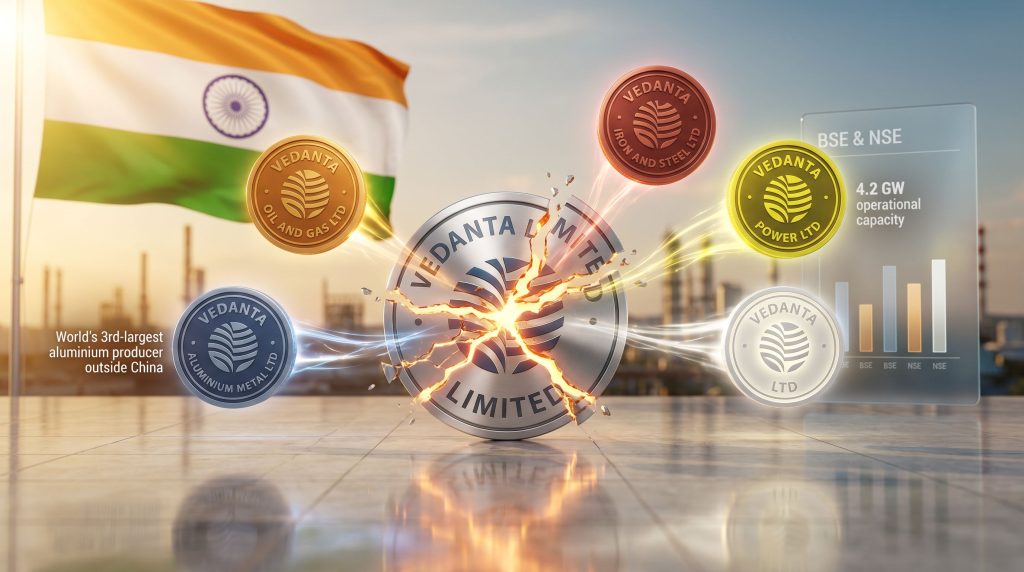
The Vedanta demerger in India, completed in June 2026 with the listing of four newly independent companies on both the Bombay Stock Exchange and the National Stock Exchange, represents the most complex simultaneous multi-entity listing in Indian corporate history. Five distinct businesses now exist where one sprawling conglomerate previously operated, each carrying its own balance sheet, management mandate, investor relations function, and growth trajectory.
The structural logic is straightforward, even if the execution was anything but. By separating operations into focused entities, each company can now attract capital from investors whose mandates align specifically with that sector. A global aluminium-focused fund, an energy transition investor, or a steel sector analyst can now engage directly with the relevant Vedanta entity without navigating the complexity of a blended conglomerate structure.
The five entities created through the demerger are outlined below:
| New Listed Entity | Core Business Focus | Key Scale Metric |
|---|---|---|
| Vedanta Aluminium Metal Ltd | Aluminium smelting and refining | World's 3rd-largest aluminium producer outside China |
| Vedanta Oil and Gas Ltd | Upstream oil and gas production | Long-term production target: 500,000 bbl/d |
| Vedanta Iron and Steel Ltd | Iron ore mining and steel production | ~4 billion tonnes of iron ore resources |
| Vedanta Power Ltd | Thermal power generation | 4.2 GW operational capacity |
| Vedanta Ltd (Residual) | Zinc, copper, and critical minerals | Anchored by Hindustan Zinc, world's largest integrated zinc producer |
Shareholder Eligibility and Share Allocation
The mechanics of participation were relatively straightforward for existing investors. Shareholders who held Vedanta Limited shares on or before April 29, 2026 (the ex-date, with the official record date falling on May 1, 2026, a market holiday) were entitled to receive one share in each of the four newly created entities for every Vedanta share held. The original Vedanta Limited shares were retained alongside the four new allocations. New shares were expected to be credited and listed within 30 to 45 days of the record date, placing the expected listing window between mid-June and early July 2026 on the BSE and NSE. For further details on the official demerger scheme, Vedanta's investor relations page provides comprehensive documentation.
A Detailed Look at Each of the Five New Businesses
Vedanta Aluminium: Chasing Global Leadership From Odisha
India's largest aluminium producer already holds an extraordinary position in global rankings, sitting as the third-largest aluminium producer outside of China globally. Its flagship asset is the world's largest single-location aluminium smelter, located in Jharsuguda, Odisha. The expansion roadmap targets a capacity doubling to 6 million tonnes per annum, with the stated ambition of becoming the world's largest integrated aluminium producer.
The strategic relevance of this entity extends well beyond the aluminium market in isolation. Aluminium sits at the intersection of India's electric vehicle supply chain, aerospace manufacturing ambitions, and packaging industry growth. As India pushes to indigenise more of its manufacturing base, a focused domestic aluminium giant capable of competing on global scale becomes a genuinely strategic asset. Furthermore, its direct commodity price exposure to global aluminium cycles will now be transparently visible to sector-specific investors.
Vedanta Oil and Gas: The Domestic Energy Security Play
With a long-term production ambition of 500,000 barrels per day, Vedanta Oil and Gas is positioned as one of India's most strategically important upstream energy producers. India imports approximately 85% of its crude oil requirements, making domestic production expansion a persistent policy priority. A focused, independently listed oil and gas entity is better positioned to access international energy capital, pursue upstream joint ventures, and respond to energy market dynamics than a sub-division buried inside a diversified miner. Consequently, this separation may prove particularly significant for India's broader goals around critical minerals and energy security.
Vedanta Iron and Steel: Resource Base and High-Value Ambition
Few industrial assets on the Indian subcontinent carry the raw resource depth of Vedanta Iron and Steel. Backed by approximately 4 billion tonnes of iron ore resources and around 800,000 tonnes per annum of metallurgical coal capacity, the entity has a production scale-up target of 15 million tonnes per annum. Crucially, the growth strategy is not focused on commodity-grade steel alone. The company is targeting high-value product segments including electrical steel, specialty steel, and green steel pricing opportunities, positioning itself at the premium end of India's infrastructure and manufacturing supply chain.
Electrical steel in particular deserves attention. This specialised flat-rolled product is essential for transformer cores and electric motor laminations, making it a direct beneficiary of India's accelerating grid modernisation and EV motor manufacturing growth. Furthermore, the dynamics of global steel and iron ore markets will play a central role in shaping this entity's revenue profile in the years ahead.
Vedanta Power: From Thermal Base to a 20 GW Vision
Currently ranked as India's fifth-largest thermal power producer, with 4.2 GW of operational capacity, Vedanta Power has articulated a long-term vision of scaling toward 20 GW. This trajectory is designed to serve India's industrial and digital infrastructure growth, including the rapidly expanding data centre sector that is drawing enormous electricity loads across Tier 1 and Tier 2 cities. Perhaps most intriguingly, Vedanta Power is evaluating opportunities in nuclear energy, a signal that this entity is thinking well beyond its current thermal base when considering its long-term generation mix.
Vedanta Limited (Residual): The Critical Minerals Powerhouse
The residual Vedanta Limited entity is far from a leftover. Anchored by Hindustan Zinc, which holds the distinction of being the world's largest integrated zinc producer and a leading global silver producer, this entity controls a genuinely world-class critical minerals portfolio. Beyond zinc and silver, the portfolio spans copper, nickel, ferroalloys, and other strategic minerals.
Several less-discussed components of this entity deserve closer attention:
- Fujairah Gold, based in the UAE, is recognised as one of the Middle East's leading precious metals refineries, giving the residual entity a meaningful presence in global gold and silver refining markets.
- FACOR (Ferro Alloys Corporation) is on track to become India's largest producer of special-grade ferrochrome and is positioned to become the country's only private-sector producer in certain manganese product segments, a near-monopoly position in niche but strategically important materials.
Ferrochrome is a critical input in stainless steel production, and manganese plays an essential role in both conventional steelmaking and emerging battery chemistries, particularly lithium-manganese-oxide battery variants. The residual entity's exposure to these materials adds a critical minerals dimension that is easily overlooked when the narrative focuses on the more prominent zinc and copper businesses.
Understanding the Share Price Reset: A Critical Investor Distinction
One of the most misunderstood aspects of any major demerger is the post-separation share price movement of the parent entity. When Vedanta Limited's share price fell sharply following the demerger, many retail investors interpreted this as a destruction of value. This interpretation is technically incorrect.
The adjusted Vedanta Ltd price following the demerger reflects only the residual zinc, copper, and critical minerals portfolio. The market value attributed to the aluminium, oil and gas, iron and steel, and power businesses has been redistributed into four independent entities, each now carrying its own standalone market capitalisation.
The post-demerger reference valuation for the residual Vedanta Ltd entity was reported at approximately ₹298.50 per share. Investors must assess the total value of their portfolio across all five holdings, not the Vedanta Ltd price in isolation. This is a fundamental principle of demerger accounting that frequently escapes retail investor awareness in the weeks immediately following a separation. Indeed, analysis of which demerged stock to buy after market debut has been a key focus for analysts in the immediate post-listing period.
Tax Treatment for Indian Shareholders
The tax implications of receiving demerger-allocated shares are more favourable than many investors assume:
- Receiving shares through a court-approved demerger scheme is not treated as a taxable event under Indian income tax law.
- Tax liability arises only at the point of sale.
- The holding period for capital gains classification begins from the original Vedanta Limited purchase date, not the demerger date.
- Long-term capital gains (LTCG) tax at 12.5% applies if shares are held for more than one year from the original purchase date.
- Investors who purchased Vedanta shares significantly before April 2026 may immediately qualify for LTCG treatment on all five holdings upon sale.
This holding period treatment is a structural advantage of demerger participation that is often underappreciated, particularly among investors who fear an immediate tax liability upon receiving new shares.
Comparing the Vedanta Demerger to Global Precedents
The Vedanta demerger in India does not exist in isolation. Global mining and resources history offers instructive parallels, though none match the simultaneous five-way complexity of this particular restructuring.
| Comparable Demerger | Company | Year | Outcome |
|---|---|---|---|
| BHP Billiton / South32 | BHP Group | 2015 | South32 became an independent diversified miner; re-rated upward post-listing |
| Anglo American / Amplats | Anglo American | 2024 to 2026 | Platinum assets separated for independent listing amid portfolio review |
| Tata Group restructurings | Tata Group | Various | Sector-specific entities created across geographies over multiple cycles |
A pattern that emerges consistently from these global precedents is that pure-play entities tend to re-rate upward within 12 to 24 months of listing, as sector-specific institutional investors establish positions and dedicated analyst coverage deepens. The Vedanta demerger creates five opportunities for this re-rating dynamic to play out simultaneously, which is a scenario without direct precedent in Indian capital markets history.
Key Risks Every Investor Should Evaluate
Debt Distribution and Credit Profile Risk
Vedanta Group carried approximately ₹48,000 crore in debt at the group level. How this debt burden is allocated across the five independent entities will materially influence each company's credit rating, cost of capital, and capacity to fund growth. Entities carrying heavier debt loads will face constraints on capital expenditure and may struggle to access international bond markets on competitive terms during the critical early years of independent operation.
Commodity Price Concentration Risk
The demerger trades diversification for focus. While focus improves valuation transparency and capital allocation discipline, it also means each entity now carries concentrated commodity price exposure to its primary commodity cycle. Aluminium price downturns, oil price volatility, zinc demand fluctuations, and power tariff regulation each become existential considerations for the respective pure-play entities in a way they never were when averaged across a diversified portfolio.
Liquidity and Index Inclusion Timeline
Newly listed entities face a bootstrapping challenge. Inclusion in major indices such as the Nifty 50 or BSE Sensex depends on meeting market capitalisation thresholds, free-float requirements, and liquidity benchmarks. Until index inclusion occurs, many large passive funds and index-tracking institutional investors cannot hold these stocks, which may suppress valuations in the near term.
There is also a meaningful retail investor education gap. Many smaller shareholders who held Vedanta as a single diversified position may not fully understand that their total portfolio value must now be assessed across five separate holdings, potentially leading to premature or poorly informed selling decisions in the initial months after listing.
The next major ASX story will hit our subscribers first
What This Restructuring Signals for Indian Capital Markets
Vedanta's history as the first Indian company to list on the London Stock Exchange and subsequently achieve FTSE 100 membership speaks to a group that has consistently pursued international capital market ambitions. The demerger extends this trajectory by creating five entities each independently capable of pursuing international listings, cross-border joint ventures, and sector-specific strategic partnerships.
For Indian capital markets more broadly, the demerger may establish a new template. India's industrial conglomerates have historically maintained diversified structures partly for historical reasons, partly for political economy considerations, and partly because domestic capital markets lacked the depth to support multiple large pure-play listings simultaneously. The fact that this Vedanta demerger in India has now been executed at this scale signals a maturation of Indian equity markets and a growing alignment between corporate structure and global capital market norms.
The five new Vedanta entities collectively cover some of the most strategically significant materials in India's industrial future: aluminium for transportation and packaging, oil and gas for energy security, speciality steel for infrastructure and manufacturing, power for industrial and digital growth, and zinc, copper, and critical minerals for the broader energy transition. Each business is now independently positioned to attract the capital, partnerships, and management focus necessary to grow into its full potential.
This article is intended for informational purposes only and does not constitute financial advice. Past performance and stated corporate targets are not guarantees of future outcomes. Investors should conduct independent research and consult qualified financial advisers before making investment decisions based on corporate restructuring events.
For additional context on global mining and resources sector developments relevant to topics discussed in this article, readers may find value in exploring coverage published by Mining Weekly at miningweekly.com.
Want to Catch the Next Major Mineral Discovery Before the Broader Market Does?
Discovery Alert's proprietary Discovery IQ model scans ASX announcements in real time, instantly identifying significant mineral discoveries across more than 30 commodities and translating complex data into clear, actionable investment insights — ideal for investors tracking the kinds of resource sector shifts this article explores. Start your 14-day free trial at Discovery Alert today, or visit the discoveries page to see how historic ASX mineral finds have generated exceptional returns for well-positioned investors.